The Lenormand: the history and meaning of the 36 cards

The Lenormand — the Petit Lenormand, as it is known around the world, and the ‘Baralho Cigano’ in Portuguese — has thirty-six cards, each with a simple, recognisable picture: a rider, a clover, a ship, a house, a tree. Unlike the Tarot, it does not speak of inner forces: it speaks of things, people and events, and it answers directly.
This page tells where the deck comes from and how it is read. Further down you will find the thirty-six cards, with a summary of each and a link to its full page.
The Game of Hope
The Lenormand began life as a family game. Around 1799, in Nuremberg, the merchant and games author Johann Kaspar Hechtel published ‘Das Spiel der Hoffnung’, the Game of Hope: thirty-six illustrated cards laid out in six rows of six, like a board, and moved across with two dice. Some cards sent you forward, some sent you back and some made you pay — and the Anchor, hope, was the goal.
The instructions already said that the same cards could be used to tell fortunes. That is why each one bore, in a corner, a miniature playing card — the Rider, the nine of hearts; the Clover, the six of diamonds — taken from a thirty-six-card pack, from the sixes to the aces. Anyone who already told fortunes with ordinary playing cards could use the same rules.
Mademoiselle Lenormand
Marie Anne Adélaïde Lenormand (1772–1843) was the most famous fortune-teller in Europe in her day. In Paris she read the cards for common folk and courtiers alike, and it was said that she had foretold the fortunes of Josephine and Napoleon. She wrote books, was imprisoned, grew rich — and died before any deck bore her name.
Soon after her death, German publishers began selling the thirty-six cards of the Game of Hope as ‘Lenormand’, to cash in on her fame. There is no evidence that she ever used them: the decks she used were different ones. But the name stuck, and the thirty-six-card deck became for ever the ‘Petit Lenormand’ — the little Lenormand, to set it apart from another, larger deck also named after her.
The Lenormand in Portugal and Brazil
In Portuguese, the Lenormand came to be called the ‘Baralho Cigano’, the Gypsy Deck. The name is a popular one and links the deck to the Romani fortune-tellers who read people’s fortunes at fairs and in the streets; it does not reflect a Romani origin, which the deck does not have. In Brazil, above all from the twentieth century onwards, it became the most widely used fortune-telling deck, with reading traditions of its own, and it is also very well known in Portugal.
The cards are the same as those of the European Lenormand, in the same order and with the same names — with small regional variations: the nine, the Bouquet, is called ‘Buquê’ in Brazil, and cards 28 and 29 are the Man and the Woman, which in other traditions are called the Gypsy Man and the Gypsy Woman.
How the Lenormand is read
In the Lenormand each card works almost like a word: the Rider is news, the Ship a journey, the House the home, the Scythe a cut, the Heart affection. And the words come together into sentences. Meaning is born from proximity: the same card changes its tone according to the cards beside it, which is why the page for each card gives so much importance to combinations.
The cards are never read reversed — the Lenormand has no upside-down. Good or bad always comes from the neighbouring cards. There are cards for people (the Man, the Woman, the Child), for places (the House, the Tower, the Garden), for things and for events, and there are fast cards, such as the Rider, and slow ones, such as the Tree or the Anchor.
The fullest spread is the Grand Tableau, in which all thirty-six cards are laid out at once and each position corresponds to a ‘house’. For everyday questions shorter spreads are used: Three Cards, Five Cards, the Lenormand Cross, the Square of Nine.
The 36 Lenormand cards
1Rider
Card 1: what arrives from outside, and arrives quickly — a piece of news, a visit, a matter that starts to move. It does not say whether it is good or bad; it says that it is on its way, and that it is coming now.
Read about the card →2Clover
Card 2: small, short-lived luck — the happy chance, the relief that comes without being asked for, the opportunity that passes by and is best seized. It promises neither much nor for long; beside heavy cards, it is the breath of air among them.
Read about the card →3Ship
Card 3: distance — the journey, what comes from far away, foreign lands, trade that crosses borders. Also estrangement and the urge to leave. It moves slowly, but it goes a long way.
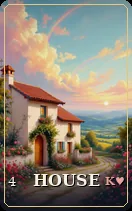
Read about the card →4House
Card 4: everything that is your own and settled — home, family, security, property, the place you come back to. It is the card of stability, and it says that the matter belongs indoors, not out in the street.
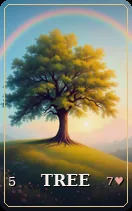
Read about the card →5Tree
Card 5: health and roots — the body, vitality, what grows slowly and lasts, what comes from further back in time: family, lineage, old habits. Where the Tree falls, nothing is quick, but everything runs deep.
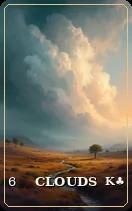
Read about the card →6Clouds
Card 6: confusion — what cannot be seen clearly, doubt, missing information, misunderstanding. The Clouds are passing: clouds do not stay. The dark side shows which way the matter is weighing.
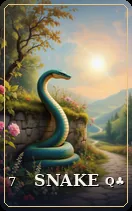
Read about the card →7Snake
Card 7: the detour — the path that does not run straight, the complication, the person who twists things, whatever calls for care. It is not always bad faith; often it is simply the long way round that has to be taken. But it is never the shortest route.
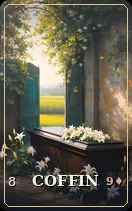
Read about the card →8Coffin
Card 8: the ending — what finishes, what closes, what cannot be undone and is best laid to rest. A cycle that closes, a farewell, a time of grief. It is a heavy card, but a clean one: after it, the ground is clear.
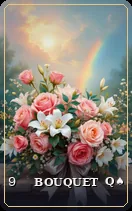
Read about the card →9Bouquet
Card 9: the gift, the invitation, courtesy, the lovely gesture that brightens the day. It is one of the kindest cards in the deck — it brings recognition and pleasure, and it softens everything beside it.
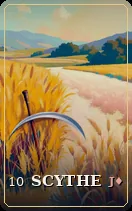
Read about the card →10Scythe
Card 10: the sudden cut, the decision that is not up for negotiation, separation — and also the harvest, because harvesting means cutting. It arrives quickly and changes things at a stroke; the neighbouring cards say whether it cuts away what was harmful or what was needed.
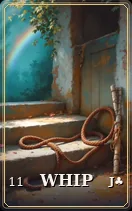
Read about the card →11Whip
Card 11: what repeats itself and takes its toll — the argument that always comes back, friction, criticism, physical effort. Not one blow, but many. And it is also the repetition that builds: training, practice, persistence.
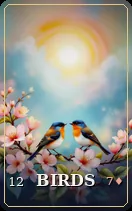
Read about the card →12Birds
Card 12: conversation, the spoken word, the phone call, the exchange between two people — and also small-scale nerves, restlessness, idle talk. There are always two: a pair, a dialogue, two sides trying to understand each other.
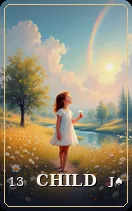
Read about the card →13Child
Card 13: beginnings and small things — what has just been born, innocence, inexperience, the trust of someone seeing the world for the first time. It is also an actual child. It makes whatever lies beside it new and small.
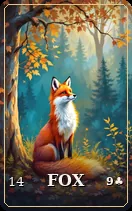
Read about the card →14Fox
Card 14: caution and cunning — what is not what it seems, calculation, the cleverness of those who deceive and of those who protect themselves. It is also the card of employment and trade, of the work that puts food on the table.
Read about the card →15Bear
Card 15: strength and whoever is in charge — the boss, the elder, the one who protects and the one who imposes. It is also money in bulk: not the money that flows, but the money that is stored away. It is heavy, and it does not shift easily.
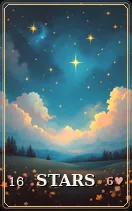
Read about the card →16Stars
Card 16: guidance and clarity — a direction you can see from far off, hope with solid grounds, whatever spreads and reaches many people. One of the most favourable cards in the deck, it lights up everything near it.
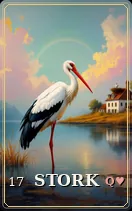
Read about the card →17Stork
Card 17: change — of home, of job, of phase, of mind. It is not a rupture but a move: something passes from one place to another and, almost always, for the better. It brings new things and returns.
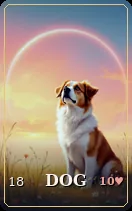
Read about the card →18Dog
Card 18: loyalty — the friend, the one on your side, the companionship that stays. It is the card of the people you can count on and of trust that lasts. Next to a difficult card, it says you are not facing it alone.
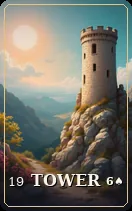
Read about the card →19Tower
Card 19: what is big and official — the institution, the company, the state, authority. And also isolation, the distance of those who stand high up or shut themselves away. A cold card, but a solid one, which gives structure and protection.
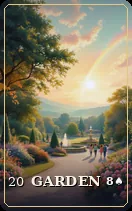
Read about the card →20Garden
Card 20: the public and the social — the meeting, the party, the group, the network, everything that happens in full view of others. Wherever the Garden falls, the matter leaves the house and becomes shared, for better and for worse.
Read about the card →21Mountain
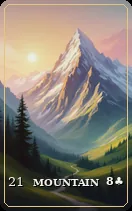
Card 21: the obstacle — what blocks, what delays, what is too big to push aside. You do not knock a mountain down: you go round it or you climb it. It is the card of enforced patience and of effort that, in the end, rewards you with a wide view.
Read about the card →22Crossroads
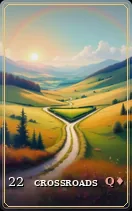
Card 22: choice — two options, the fork in the road, the decision that cannot be put off. It says there really is something to choose between, and that the choice belongs to the person asking. It also stands for the short trips of everyday life.
Read about the card →23Mice
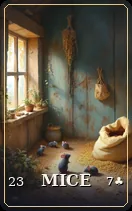
Card 23: wear and tear — what is lost little by little, tiredness, the worry that gnaws, petty theft. It does not destroy in one go; day by day it diminishes whatever lies beside it.
Read about the card →24Heart
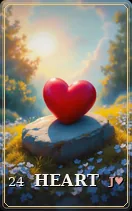
Card 24: affection — love, fondness, generosity, the things we care about. It says the matter is one of the heart, not of the head or the wallet. It is one of the most favourable cards in the deck.
Read about the card →25Ring
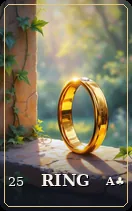
Card 25: commitment — the contract, the marriage, the partnership, the word given — and the cycle that comes back to its beginning. It says the matter is bound; if what lies beside it is bad, the bad is bound in too.
Read about the card →26Book
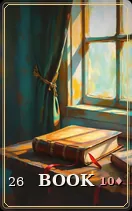
Card 26: what is closed — the secret, what is not yet known, study, knowledge that is hard won. Until the Book opens, there is something still to be revealed.
Read about the card →27Letter
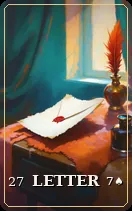
Card 27: the written word — the document, the note, the message, the official paper, the invoice. Unlike the Birds, which talk, the Letter writes, and what is written stays. It is communication that leaves a trace.
Read about the card →28Man
Card 28: the man in the question — the querent, if he is a man, or the man being asked about. It has no meaning of its own: it is a person. What describes him is the cards around him and the direction in which he is looking.
Read about the card →29Woman
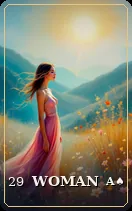
Card 29: the woman in the question — the querent, if she is a woman, or the woman being asked about. Like the Man, it has no meaning of its own: it is a person. The cards around her and the direction she faces are what describe her.
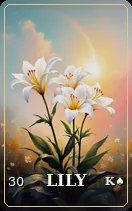
Read about the card →30Lily
Card 30: serenity, maturity, the peace that comes with time — what is serious, long-standing and dignified, and in no hurry any more. It calms everything it touches, and sometimes cools it.
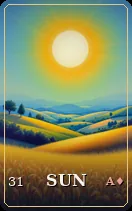
Read about the card →31Sun
Card 31: success, energy, clarity — what goes well, in full view of everyone. It is the most favourable card in the deck: it lights up whatever it touches and takes the weight out of the heavy cards beside it.
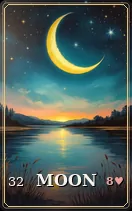
Read about the card →32Moon
Card 32: recognition, honour, the esteem of others — and also sensitivity, imagination, what is felt at night. If the Sun is the achievement, the Moon is the echo it leaves in others.
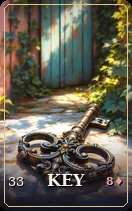
Read about the card →33Key
Card 33: the solution, certainty, the door that opens. It is the card of confirmation — whatever it touches comes to pass. Wherever there is doubt in a spread, it is the Key that resolves it.
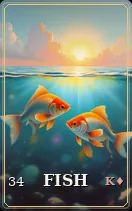
Read about the card →34Fish
Card 34: money on the move — business, income, abundance, what comes in and goes out. Unlike the Bear, which is money put away, the Fish is flow. It is also the card of the trader and the self-employed.
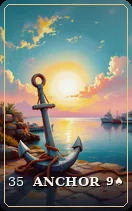
Read about the card →35Anchor
Card 35: steadiness, stable work, what holds fast and endures — the goal reached, the harbour at journey’s end. It is the card of staying: wherever it falls, things become fixed, for the better if what lies beside it is good.
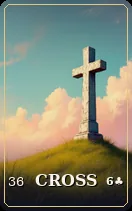
Read about the card →36Cross
Card 36: weight, trial, duty, the burden you carry. It is also what is sacred and what is final — faith, destiny. It is rarely for ever, but while it lasts, it weighs heavy.
Read about the card →


No sign-up · Reading written on the spot · Free