
The Letter: meaning of Lenormand card 27
The Letter is card 27 of the Lenormand, and the card of everything that is written and sent. For centuries it was the way to get news to someone far away; today it is also the email, the text message on your phone, the document that arrives in the post, the invoice, the invitation, the form that needs signing. What sets it apart is writing: what is put on record and can be read again.
Like the Rider, the Letter announces news — but while the Rider brings movement and haste, the Letter brings the paper itself. And, like all Lenormand cards, it does not say on its own what the message contains: the neighbouring cards say that. Next to the Heart it is a love letter; next to the Ring, a contract; next to the Fish, an invoice or a payment.
The card at a glance
| Number | 27 |
|---|---|
| Playing card | Seven of Spades (7♠) |
| Lenormand names | Der Brief (German); The Letter (English); La Lettre (French) |
| Type | Event — written communication |
| Keywords | letter, document, note, written message, email, paperwork, invoice, invitation, news |
| Timing | Fairly quick: days or a few weeks, the time it takes for a message to arrive |
| Yes or no | Neutral — it depends on what the message says; the neighbouring cards give the answer |
The image on the card
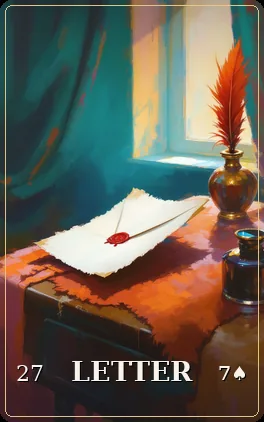
In the Sol da Alma Lenormand, the Letter is a sheet of thick, rough-edged paper, folded like an envelope and closed with a red wax seal. It lies on a table covered with an orange and red cloth with worn fringes. On the right, in an amber glass vase, stands a red and orange quill, and in front of it a dark glass inkwell with a brass lid. In the background there is a blue-green curtain and a window through which a clear light falls. It is the scene of someone who has just finished writing — or who is about to read.
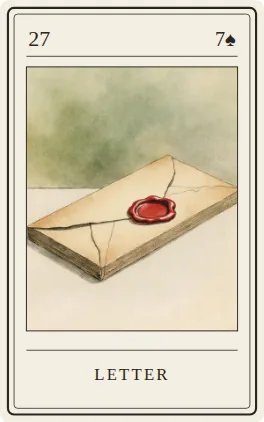
In the Engraved Lenormand, the picture is simpler: a cream-coloured envelope, thick as a bundle of papers, closed with a large red wax seal, lying at an angle on a pale surface against a mottled green background. There is no quill and no inkwell — just the letter, sealed, waiting to be opened.
The symbolism, detail by detail
- The envelope
- The message that travels from one person to another. It is communication with a sender and a recipient.
- The wax seal
- Closure and authenticity: the letter has not yet been opened, and the seal guarantees that it comes from whom it claims to. It also speaks of official and confidential documents.
- The paper
- What is written down, and can therefore be read again, kept, used as proof. The Letter is the word the wind cannot carry away.
- The quill and the inkwell
- In the Sol da Alma card, the act of writing: replying, signing, drafting. The letter may yet be written by the person asking.
- The thickness of the envelope
- In the Engraved Lenormand, it looks like a sheaf of pages: papers, files, documentation — much more than a note.
- The window
- In the Sol da Alma card, the world outside, where the letter is going or where it came from. The message connects two places.
- The seven of spades
- Spades, the suit of Swords in the tarot, is the suit of Air — of thought, of the word, of decision; the Seven is what is done alone. The Letter is the word thought out in solitude and put in writing, which then goes on its way without the person who wrote it.
The history of the Letter
The Letter is one of the thirty-six cards of ‘Das Spiel der Hoffnung’, the Game of Hope, which Johann Kaspar Hechtel published in Nuremberg around 1799: a board game made of illustrated cards, each with a miniature playing card in one corner. In the Lenormand, it holds place 27, with the seven of spades.
The deck only acquired the name ‘Lenormand’ after 1843, the year of the death of Marie Anne Lenormand, a famous Parisian fortune-teller, on the initiative of publishers who wanted to cash in on her fame; there is no evidence that she ever used it. In Portugal and Brazil it became known as the ‘Baralho Cigano’, the Gypsy Deck, a popular name with no historical Romani origin.
When the game was created, the written letter was the main way of communicating at a distance, and sealing wax was the usual means of closing and authenticating it. The letter has changed its form — today it arrives faster and rarely on paper — but the meaning has stayed the same: the written message that is sent and received.
The meaning of the Letter
The Letter is written communication: letters, emails, messages, notes, invitations, documents, official papers, certificates, invoices, results, forms. It announces that something is going to arrive in writing — or that something needs to be written. In a spread, it is often the reply you are waiting for, the missing paper, the news you receive.
In meaning, it stands apart from two related cards. From the Birds, which are conversation, the spoken word, the phone call: the Letter writes, and what is written stays. From the Rider, which is arrival and movement: the Letter is the content that arrives. That is why it also speaks of evidence, records and formalities — everything that can be shown on paper.
It is a neutral card, with a light side: it speaks of small pieces of news, messages, brief matters. A letter is a single sheet, not a book. The content, good or bad, is for the neighbouring cards to say — the Letter says only that it will be put in writing.
The Letter in love
In love, the Letter is the message: a declaration in writing, a note from the person you are waiting for, a conversation picked up again by message. For someone who is single, it may announce a contact — often at a distance or in writing, like an acquaintance that begins on an app or through an exchange of messages.
In a relationship, it speaks of communication: what is said in writing, what people prefer to write rather than say face to face. Next to the Heart, it is a love letter; next to the Ring, a wedding invitation or a paper that makes the relationship official; next to the Scythe, a message that cuts; next to the Clouds, an ambiguous message open to misunderstanding.
The Letter in work and money
At work, the Letter is one of the most concrete cards in the deck: the reply to an application, an offer in writing, an important email, a contract to read, paperwork to deal with. It favours professions connected with writing, correspondence, administration and communication. In a question about a job, it says the answer will come in writing.
With money, it speaks of invoices, receipts, statements, letters from the tax office or the bank — the paperwork that goes with money. With the Fish, it may be a payment or a transfer; with the Mice, a bill to pay or a mislaid paper. The advice is to keep your paperwork in order.
The Letter in health and wellbeing
In questions about wellbeing, the Letter speaks of paperwork and information: appointments, results, documents arriving. It calls for attention to correspondence and deadlines. As always with the Lenormand, the reading shows tendencies and attitudes, and it is no substitute for any consultation or any kind of health care.
The Letter as a person
As a person, the Letter is someone who expresses themselves better in writing than out loud; a writer, a journalist, a postman, a secretary, someone who deals with paperwork. Next to a person card, it says that you will hear from that person — or that you need to write to them.
The Letter as advice
As advice, the Letter says: write. Send the message, answer the email, put in writing what was agreed. And also: keep the receipts. What is written protects you — and what is not can be lost.
The timing of the Letter
The Letter is a fairly fast card: it speaks of the time it takes for a message to arrive — days, or a few weeks. Next to the Rider or the Birds, the message arrives very quickly; next to the Mountain or the Anchor, it is paperwork that takes its time, a bureaucratic process that drags on.
In the Grand Tableau: house 27
In the Grand Tableau, house 27 is the house of the Letter. The card that falls there shows the content of the message on its way, or the matter that will be dealt with in writing. And the Letter itself, wherever it falls, brings paperwork and news to the subject of that house: in the house of the House, correspondence about the home; in the house of the Tower, an official document.
Combinations with other cards
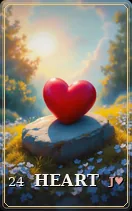 Heart — A love letter, a declaration in writing, an affectionate message.
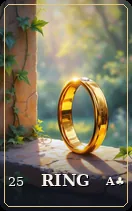 Ring — A written contract, a document to sign, a wedding invitation.
 Rider — A message that arrives quickly, an email or a parcel on its way.
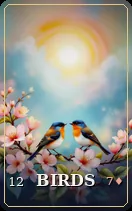 Birds — An exchange of messages, conversations in writing, lots of contacts.
 Fish — An invoice, a payment, a transfer, money paperwork.
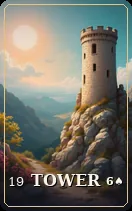 Tower — An official document, a letter from the tax office, a court or an institution.
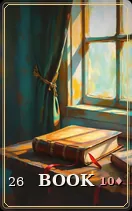 Book — A confidential document, a letter not yet read, a diploma.
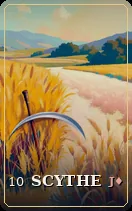 Scythe — A message that cuts: a refusal, a dismissal, an ending communicated in writing.
 Clouds — An ambiguous or misunderstood message; confusing paperwork.
 Sun — Excellent news in writing, an approval, a positive result.
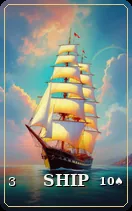 Ship — Correspondence from abroad, news from far away.
 Fox — A misleading message, a forged document; beware of scams in writing.
Frequently asked questions
What does the Letter mean in the Lenormand?
Written communication: a document, a message, a note, an email, an official paper. The content is for the neighbouring cards to say.
What is the difference between the Letter and the Birds?
The Birds are the spoken word — conversations, phone calls. The Letter is the written word, which stays on record.
What does the Letter mean in love?
A message from the person you are waiting for, a declaration in writing, or a relationship that lives largely through exchanging messages. With the Heart, it is a love letter.
Is the Letter a yes or a no?
It is neutral. It says the answer will come in writing; whether it is yes or no is for the cards beside it to say.
Which playing card corresponds to the Letter?
The seven of spades. Spades is the suit of the word and of thought; the Seven, what is done alone — the written word that goes on its way.
No sign-up · Reading written on the spot · Free