
The Scythe: meaning of Lenormand card 10
The Scythe is the card of the cut. A curved, sharp blade that in a single sweep separates the ear from the stalk: what was standing no longer stands. In a reading, the Scythe announces a quick decision, a sudden change, an ending that comes without warning — or a choice that has to be made once and for all, with no more hesitation.
It has a reputation as a dangerous card, and it is one of those that most alarm people learning the Lenormand. But the scythe is, first and foremost, the tool of the harvest. Wheat is cut when it is ripe, so that it can be used; undergrowth is cut to clear a path. The Scythe says that something is going to be separated; the neighbouring cards say whether it is a blow, a relief or the fruit of a piece of work that has come to its end.
The card at a glance
| Number | 10 |
|---|---|
| Playing card | Jack of Diamonds (J♦) |
| Lenormand names | Die Sense (German); The Scythe (English); La Faux (French) |
| Type | Event — cut, decision |
| Keywords | sudden cut, decision, separation, harvest, speed, danger, surprise, abrupt ending |
| Timing | Sudden: from one moment to the next |
| Yes or no | Yes, if the question is about cutting or deciding; no, if it is about keeping — and either way, quickly |
The image on the card
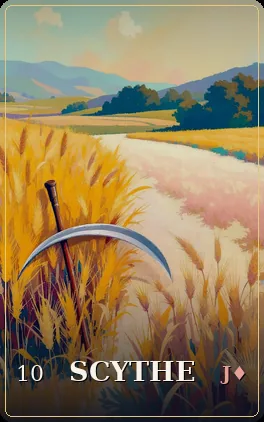
In the Sol da Alma Lenormand, the Scythe leans in the middle of a wheatfield: a silver crescent blade fixed to a reddish-brown wooden handle, half hidden among the golden ears of wheat. A pale path with pink glints crosses the field and disappears into the distance, between bluish hills and clumps of dark green trees, beneath a clear sky with rosy clouds. The painting, in broad brushstrokes, is serene: it is harvest time, and no one has started reaping yet. In the corner, the number 10 and the jack of diamonds.
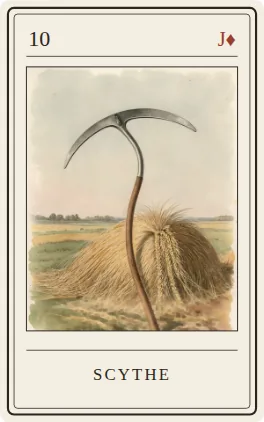
In the Engraved Lenormand, the scene is sparer and more direct. An iron scythe, with a broad arched blade and a fine point, mounted at the top of a long, curved wooden handle, stands upright in front of a stook of wheat already cut, in a flat field with a line of trees on the horizon. Here the work is done: the cut wheat lies beside the tool that cut it. In the Sol da Alma, the harvest is still to come; in the engraving, it has already been gathered.
The symbolism, detail by detail
- The curved blade
- The clean, quick cut. A scythe neither saws nor tears: it separates in a single stroke. That is why this is the card of irreversible decisions and sudden events.
- The long handle
- The reach of the gesture: a scythe cuts at a distance and in a wide sweep, many ears at once. The change it announces is rarely a small one.
- The ripe wheat
- The harvest. The cut comes at the right moment, when what was sown is ready. This is the positive side of the card: gathering in what you have worked for.
- The reaped stook
- In the engraving, the wheat already bound shows the result: after the cut, there is something to store away. The end of a phase can also be its fruit.
- The open path
- In the Sol da Alma painting, the road across the wheatfield is a reminder that cutting also means clearing a space to pass through.
- The jack of diamonds
- A jack, the card of young people and of messages; of diamonds, the suit of practical things. It gives the Scythe its character as a concrete, rapid event that affects material life.
The history of the Scythe
The Scythe was already card 10 in ‘Das Spiel der Hoffnung’, the Game of Hope published by Johann Kaspar Hechtel in Nuremberg around 1799, with the jack of diamonds in the corner. It was a board game of thirty-six cards, played with dice, and the miniature playing cards meant it could also be used to tell fortunes.
After the death of Marie Anne Lenormand in 1843, publishers began selling the deck under her name, although there is no evidence that the Parisian fortune-teller ever used it. In Portugal and Brazil it became known as the ‘Baralho Cigano’ (‘Gypsy deck’), a popular name that does not reflect any historical Romani origin.
The tool in the picture deserves a note. In German, ‘Sense’ is the scythe, with a long handle and wielded with both hands, and it is the scythe that many decks show; in Portuguese the card kept the name ‘Foice’, which strictly speaking is the smaller hand tool, the sickle. In a reading, the difference does not matter: both cut what is ripe, and both carry the old European image of reaping as the end of a cycle.
The meaning of the Scythe
The Scythe is the card of decisions and ruptures: cutting off a relationship, leaving a job, saying no, putting an end to a situation. It may be a decision taken by the person asking or one that others take; either way, it is quick and leaves little room for negotiation. Where the Scythe falls, something is separated.
It is also the card of the unexpected — the sudden event, the surprise that changes plans, the fright. That is why traditional readers treat it as a warning of danger: it calls for attention to hasty movements, to rushing, to tools, to the road. It is not a sentence; it is a sign to take care.
And finally, it is the card of the harvest: the moment to gather in the results, to finish a piece of work and make the most of what it has yielded. This reading appears above all when the Scythe sits beside cards of gain or completion. In a question about a situation that is dragging on, the Scythe can be the best possible news: the deadlock is going to be cut through.
The Scythe in love
In love, the Scythe speaks of a cut: a separation, a sudden distancing, a decision to end things — or, on the contrary, the decision to cut through indecision and move forward. In a relationship that was no longer good for you, it can be liberating. In a solid relationship, it warns of a cutting argument, of words that wound and are best weighed carefully.
For someone who is single, it can announce a sudden encounter, an attraction that springs up out of nowhere, love at first sight. Next to the Heart, the meaning depends on the order: the Scythe before the Heart can be a cut that makes room for a new affection; after it, an affection that is cut off.
The Scythe in work and money
At work, it announces quick decisions — a dismissal, a resignation, a restructuring, the end of a project — and also cost-cutting and hard choices that can no longer wait. In a positive reading, it is the harvest: the reward for an effort, the delivery of a piece of work, an opportunity seized at the right moment. It favours professions involving cutting and precision.
In money matters, it calls for attention: cuts, sudden losses, unexpected expenses. With the Fish, it can be a quick gain or the profit from a harvest; with the Mice, a loss that appears out of nowhere; with the Anchor, a cut in an income that seemed stable.
The Scythe in health and wellbeing
In questions about wellbeing, the Scythe calls for care with sudden movements, minor accidents and haste, and it is traditionally associated with procedures and incisions. It can also be the decision to cut out a bad habit once and for all. As always in the Lenormand, the reading shows tendencies and attitudes, and it does not replace any medical consultation or care.
The Scythe as a person
As a person, the Scythe is someone decisive, direct and quick, who cuts straight to the point and does not like beating about the bush — sometimes abrupt or aggressive in speech. It can also be someone who works with blades and precision: a surgeon, a hairdresser, a cook, a farmer. Because of the jack it carries, some read it as a young person.
The Scythe as advice
As advice, the Scythe says: decide. Cut away what no longer serves you, stop dragging out what has to end, make the choice you have been putting off. But it also says: beware of haste — a good cut is a considered cut. And if the harvest is ripe, do not leave it in the field.
The timing of the Scythe
The Scythe is sudden: what it announces happens all at once, often without prior warning. It does not indicate a length of time but an instant — the blow, the decision, the news. In seasonal readings, it is linked to harvest time, the end of summer and the beginning of autumn.
In the Grand Tableau: house 10
In the Grand Tableau — the thirty-six cards laid out in rows — the tenth position is the house of the Scythe. The card that falls there shows what is going to be cut, decided or harvested in the life of the person asking. And the Scythe itself, wherever it falls, brings speed and cutting to the theme of that house. Many readers also look at the direction of the blade: whatever lies on the side it cuts towards is what is struck.
Combinations with other cards
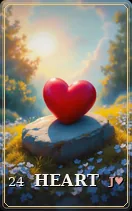 Heart — A cut in affection, a disappointment in love; or a sudden passion.
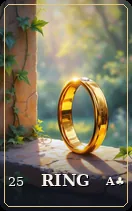 Ring — The breaking of a commitment or a contract; an agreement terminated.
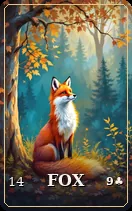 Fox — A cut at work: dismissal, resignation, an abrupt change of role.
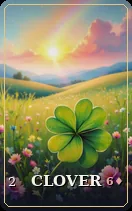 Clover — A sudden stroke of luck, an opportunity seized on the spur of the moment.
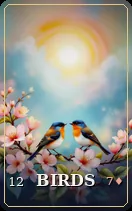 Birds — A cutting argument, hurtful words; a decisive conversation.
 Rider — Sudden news that arrives quickly and changes plans.
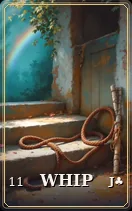 Whip — Conflicts that keep recurring and hurt; hard decisions taken under tension.
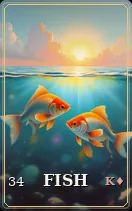 Fish — A quick gain, the harvest of an investment; or a cut in finances.
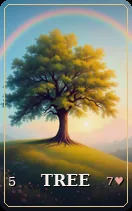 Tree — A drop in energy that calls for a pause; nipping an old habit in the bud.
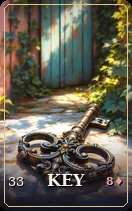 Key — The right decision, the cut that settles things; the solution comes all of a sudden.
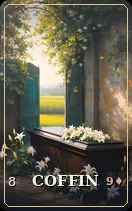 Coffin — An abrupt and final ending; a matter closed once and for all.
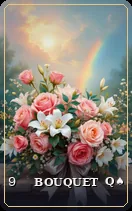 Bouquet — A pleasant surprise; or a separation handled with elegance.
Frequently asked questions
What does the Scythe mean in the Lenormand?
A sudden cut: a quick decision, a separation, something unexpected. It is also the harvest — the moment to gather in what you have worked for. The neighbouring cards say which of the two.
Is the Scythe a bad card?
Not necessarily. It is a strong, fast card that warns of cuts and surprises, but it can also cut away what was harmful or bring the harvest of an effort.
What does the Scythe mean in love?
A separation, a distancing or a cutting argument — or, on the contrary, a sudden passion. In a relationship that was no longer good for you, it can be the cut that sets you free.
Is the Scythe a yes or a no?
It depends on the question: it is a quick yes when you ask whether it is time to decide or to cut, and a no when you ask whether a situation will stay as it is.
Does the Scythe announce a death?
No. No card in the Lenormand should be read as a prediction of death. The Scythe speaks of cuts, decisions and the end of phases, and it calls for care with haste.
No sign-up · Reading written on the spot · Free