
The Tree: meaning of Lenormand card 5
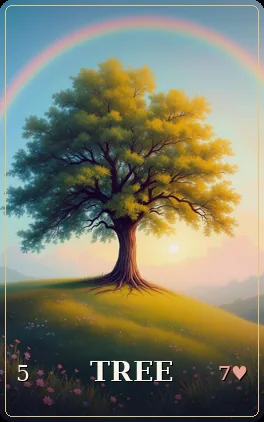
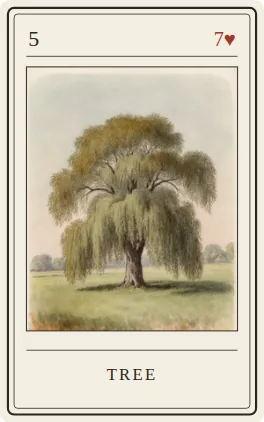
The Tree is the fifth card of the Lenormand and one of the slowest in the whole deck. A great, solitary tree rises in a meadow: roots in the earth, a sturdy trunk, a crown open to the sky. It does not move, it is in no hurry, and it has stood there for many years. That is its lesson: some things only grow with time, and for that very reason they last.
In the Lenormand, the Tree is traditionally the card of health — in the broad sense of vitality, energy, the general state of the body and of the person. It is also the card of roots: family, lineage, what comes from the past, old habits and old ties. And it is the card of slow growth, whether of a relationship, a career or a person. In a spread, it lends depth and duration to the matter it touches, but it asks for patience. The neighbouring cards say what ground it is planted in.
The card at a glance
| Number | 5 |
|---|---|
| Playing card | Seven of Hearts (7♥) |
| Lenormand names | Der Baum (German); The Tree (English); L’Arbre (French) |
| Type | State — health, roots, growth |
| Keywords | health, vitality, roots, slow growth, family, lineage, stability, inner life |
| Timing | Very slow: months, sometimes years |
| Yes or no | Yes, but with time — what you are asking about grows slowly |
The image on the card
In the Sol da Alma Lenormand, the Tree is a great broadleaf tree standing alone on top of a green hill. Its round, dense crown shades from dark green to golden yellow where the light strikes it; the reddish-brown trunk opens into thick roots that spread out in plain sight over the grass. Behind it, the low sun warms the horizon, and a rainbow arches above the crown in a blue and rosy sky. In the distance there are hazy mountains; in the foreground, small pink flowers in the grass. In the corner, the number 5 and the seven of hearts.
In the Engraved Lenormand, the tree is a weeping willow, painted in the manner of the illustrations of the 1800s: a thick, short trunk and a wide crown of long branches that hang down almost to the ground, in a flat meadow with other trees in the distance. The two images differ in the species and the setting — the Engraved willow is more withdrawn, the Sol da Alma tree more luminous —, but they agree on the essentials: a single tree, large and old, firmly rooted in the ground.
The symbolism, detail by detail
- The solitary tree
- The whole person, with their body and their history. A tree standing alone in a meadow is also an image of strength of one’s own: it does not need to lean on anything.
- The roots
- What holds everything up and cannot be seen: family, origins, old habits, underlying health. In the Sol da Alma painting they are on show — a reminder that everything that grows comes from a foundation.
- The trunk
- Endurance, structure, the backbone of a life or a project. It is what withstands the storms.
- The crown
- Visible growth, the fruit, the shade it gives to others. A broad crown is the sign of a well-nourished life.
- The willow
- In the Engraved Lenormand, the weeping willow adds a note of inwardness and flexibility to the tree: it bends, but it does not break.
- The hill and the meadow
- The ground in which the tree grows. A tree depends on its soil: the card always asks what ground you are planted in.
- The seven of hearts
- A card from the suit of hearts, the suit of affections and bonds, which links the Tree to family and to long-standing relationships as much as to the body.
The history of the Tree
The Tree already held fifth place in ‘Das Spiel der Hoffnung’, the Game of Hope published by Johann Kaspar Hechtel in Nuremberg around 1799, with the seven of hearts in the corner. It was a board game of thirty-six cards moved across with dice, which could also be used for reading the cards thanks to the miniature playing cards.
The name ‘Lenormand’ was given to it after the death in 1843 of Marie Anne Lenormand, the most famous fortune-teller in Paris — a selling name, since there is no evidence that she ever used this deck. In Portugal and Brazil it became known as the ‘Baralho Cigano’, the Gypsy Deck, a popular name with no historical Romani origin.
The tree is one of the oldest images there is for speaking of life and of family — just think of the expression ‘family tree’. In the Lenormand, the card inherited this double meaning: the life of the body and the life of the lineage. The association of the Tree with health is one of the most widespread in Lenormand reading.
The meaning of the Tree
The Tree is the card of vitality and of your general state: energy, endurance, the balance of the body and of the person. In a spread, it draws attention to the foundation — how the person asking is, inside and out — and it reminds us that nothing flourishes if the roots are not tended.
It is also the card of roots and of what comes from the past: the extended family, ancestors, traditions, old habits, ties that go back a long way. It may speak of matters of inheritance, of links to a homeland, of patterns handed down from generation to generation. And it is the card of slow, steady growth: a relationship that matures, a project that consolidates, a person who develops over time.
The Tree is essentially positive, but never quick. What it announces takes time, and in return it lasts. Its shadow is immobility: a tree cannot move to another place, and sometimes the card speaks of someone stuck in their roots, or of a situation that does not move forward because it is too deeply rooted. The neighbouring cards say whether the tree is growing or standing still.
The Tree in love
In love, the Tree speaks of relationships with roots: a long-standing love, a bond that grows slowly but firmly, a relationship in which time is on your side. For anyone who is single, it says that love will not come suddenly, but that what does come may be solid — often an old friendship that turns into something more.
It may also point to the importance of family in the relationship — the in-laws, traditions, the weight of the past — or to a bond that feels very old. The risk is stagnation: a relationship that has stopped growing and carries on out of habit. Next to the Heart, it is a deep and lasting love; next to the Anchor, stable to the point of routine.
The Tree at work and with money
At work, the Tree indicates slow but steady progress: a career built over the years, a stable job, a company with a history. It favours professions connected with care, health, nature, agriculture, education and everything that requires patience. It is not the card of rapid promotion; it is the card of accumulated experience.
With money, it speaks of long-term investments, of savings that grow slowly, of family assets. With the Fish, it is money that multiplies over time; with the Mice, a slow loss, a drain that is best stopped early.
The Tree in health and wellbeing
This is the question in which the Tree stands out most: in the Lenormand, it is the card that represents the general state of the person asking. The cards around it say whether vitality is high or whether there is tiredness, and the Tree itself invites you to look after the basics — sleep, food, movement, rest — patiently and without hurrying. As always with the Lenormand, a reading shows tendencies and attitudes, and it is no substitute for any consultation or any medical care.
The Tree as a person
When it describes someone, the Tree is a calm, patient, stable person with both feet firmly on the ground. It may be a relative, especially an older one, a long-standing friend, someone connected with health, care or nature. It is the person you can lean on. The flip side is slowness and stubbornness: someone who finds it hard to change and will not be hurried.
The Tree as advice
As advice, the Tree says: give it time. Look after your roots — your body, your family, your foundations — and the rest will grow. Do not force quick results; build slowly. And go back to your origins when you feel lost: that is where your strength lies.
The timing of the Tree
The Tree is one of the slowest cards in the deck. What it announces takes months, sometimes years, to happen — but then it stays. Next to the Rider or the Birds, the growth speeds up a little; next to the Mountain or the Anchor, the time stretches out even further. To a question about timing, the Tree answers: not now, but certainly.
In the Grand Tableau: house 5
In the Grand Tableau — the thirty-six cards laid out in four rows —, the fifth position is the house of the Tree. The card that falls there tells how the vitality of the person asking is faring, or what is going on in their roots and their family. And the Tree itself, wherever it falls, brings duration, depth and slow growth to the theme of that house.
Combinations with other cards
 Rider — Energy returning, physical activity, a boost of vitality.
 Clover — An improvement, relief in wellbeing.
 House — The family, the family home, strong roots.
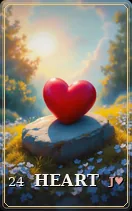 Heart — A deep and lasting love, with roots.
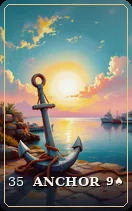 Anchor — Long-term stability; something that lasts many years.
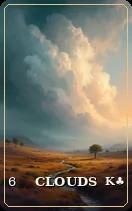 Clouds — A phase of tiredness, or of little clarity about one’s own state.
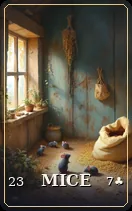 Mice — A slow wearing down, energy draining away little by little.
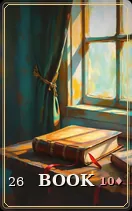 Book — Family history, genealogy, what can be learnt from the past.
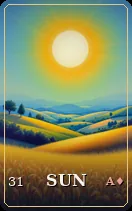 Sun — Vitality at its height, recovery, full growth.
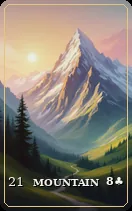 Mountain — Growth held back; something that takes even longer.
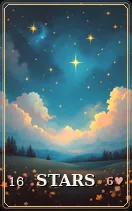 Stars — Spiritual growth, long-term personal development.
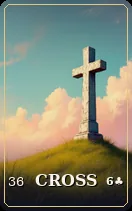 Cross — An old burden, a family pattern that is hard to carry.
Frequently asked questions
What does the Tree mean in the Lenormand?
Health, in the sense of vitality and general state, roots and family, and slow, lasting growth.
Is the Tree a good card?
Yes, it is positive, but slow. What it announces takes time and, in return, it lasts.
What does the Tree mean in love?
A relationship with roots, one that grows slowly and lasts; often an old love or a friendship that turns into something more.
Does the Tree speak about health?
It is the traditional card of the general state of the person asking. It shows tendencies and invites you to look after yourself, but it is no substitute for any consultation or any diagnosis.
Is the Tree a yes or a no?
Yes, but with time. The answer is favourable, although the matter will take a while to come about.
No sign-up · Reading written on the spot · Free