
The Lily: meaning of Lenormand card 30
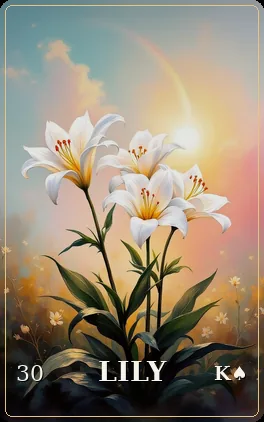
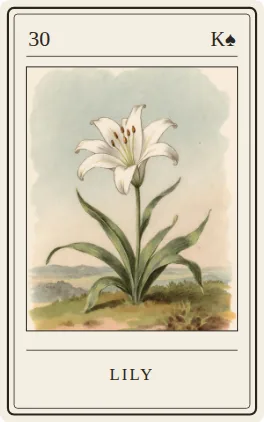
The Lily is the thirtieth card of the Lenormand and one of the calmest: a white flower, tall and upright, that opens without a sound. It does not announce events or arrivals. It speaks of a state — the peace of someone who no longer needs to prove anything, the maturity that only time can give, the dignity of someone who knows how to wait.
In a spread, the Lily soothes. Where there is conflict, it brings harmony; where there is haste, it asks for calm; where there is doubt, it reminds you that experience counts too. But serenity has its other side: beside lively cards, or in a question about passion, the Lily can speak of a certain coolness, of enthusiasm that has faded, of a relationship more tranquil than ardent. As always in the Lenormand, it is the neighbouring cards that decide which way it leans.
The card at a glance
| Number | 30 |
|---|---|
| Playing card | King of Spades (K♠) |
| Lenormand names | Die Lilie (German); The Lily (English); Le Lys (French) |
| Type | State — peace, maturity, dignity |
| Keywords | serenity, maturity, peace, harmony, dignity, experience, family, an older man |
| Timing | Slow: months, a season; whatever the Lily touches moves calmly |
| Yes or no | Yes — but without hurry |
The picture on the card
In the Sol da Alma Lenormand, the Lily is not a single flower: there are four white lilies with broad, curling petals, orange stamens and yellow hearts, rising on long stems from a clump of long, pointed, dark green leaves. Behind them the sky shades from blue to pink and gold; a bright sun shines behind the flowers, a rainbow arcs overhead and there are light clouds on the left. Below, in a field in shades of gold, small white and yellow flowers are scattered through the grass. In the corner, the number 30 and the king of spades.
In the Engraved Lenormand, in the manner of old botanical prints, the scene is simpler: a single white lily, open at the top of a straight stem, its petals turned back and its brown stamens showing, and half a dozen long leaves springing from the base. The plant stands on a small mound of grass and earth, with bluish hills in the distance and a pale sky. This is the classic Lenormand image: the flower alone, plain and upright.
The two versions say the same thing by different routes. The Engraved one dwells on the dignified solitude of the flower, upright and unadorned; the Sol da Alma one adds the light, the rainbow and the other flowers — peace that is shared, and the calm after the storm.
The symbolism, detail by detail
- The white flower
- Purity, clean intentions, peace. White is the colour of someone who has nothing to hide and is no longer fighting anything.
- The tall, straight stem
- Dignity, rectitude, the bearing of someone who stands tall with composure. The Lily does not bend, but neither does it impose itself.
- The open flower
- Maturity: what has reached its moment, without hurry and without forcing. Nothing in the Lily is a bud; it is the flower fully formed.
- The long leaves
- A solid base, and the time it took to get there. A lily takes months to flower; the card speaks of things that ripen slowly.
- The sun and the rainbow
- In the Sol da Alma painting, the light that comes after bad weather: the Lily is the peace that comes once the conflict has passed.
- The several flowers
- Also in the Sol da Alma painting: the harmony of a group, the family, people living together in peace.
- The king of spades
- A mature male figure of authority. It reinforces the reading of the Lily as the card of older people, of experience and of seriousness.
The history of the Lily
The Lily was already card 30 of ‘Das Spiel der Hoffnung’, the Game of Hope published by Johann Kaspar Hechtel in Nuremberg around 1799, with the king of spades in the corner. It was a board game of thirty-six cards, played with dice, and the miniature playing cards meant it could also be used to tell fortunes.
After the death in 1843 of Marie Anne Lenormand — the most famous fortune-teller in Paris — publishers began selling the deck under her name, though there is no evidence that she ever used it. In Portugal and Brazil it became known as the ‘Baralho Cigano’, the Gypsy Deck, a popular name that does not reflect any historical Romani origin.
In the Europe of that time the white lily was a very familiar image: in religious painting it is the flower of purity, appearing again and again in scenes of the Annunciation. That is how the Lenormand Lily came to be read as peace, virtue and dignity. Some modern schools also read it as a card of sensuality, especially beside the Heart; it is a common reading, but a more recent one, and Sol da Alma gives priority to the sense of serenity and maturity.
The meaning of the Lily
The Lily is the card of serenity. It says that a matter is, or will be, at peace: without hurry, without conflict, without upheaval. It is the calm after a difficult phase, harmony in a home, the tranquillity of someone who has been through a great deal and has learned not to be shaken by small things.
It is also the card of maturity and experience. It speaks of what is serious and long-standing, of what has been built over time, of older people and the wisdom they bring. In a spread about a decision, it asks you to listen to the voice of experience — your own, or that of someone who has been through the same thing. And it speaks of virtue in the simple sense: honesty, decency, a good reputation, a clear conscience.
The Lily does, however, have a cooler side. Serenity can turn into distance; calm into a lack of enthusiasm; maturity into rigidity. Beside heavy cards such as the Clouds, the Coffin or the Cross, it can speak of loneliness, of isolation or of a matter that has come to a standstill. That is why it is said that the Lily calms whatever lies near it, and sometimes cools it. It is a good card, but a slow one — and what it promises comes with time, not all at once.
The Lily in love
In love, the Lily speaks of a mature, calm and stable relationship: a couple who know each other well, who have weathered the storms and live in peace. It is a card of quiet faithfulness and serene affection rather than passion. For those going through a time of conflict it announces reconciliation; for those who are looking, it may point to an older person, or someone who brings stability and maturity.
The other side is a lack of fire. In a question about passion, the Lily may say that the relationship has cooled, that it has become more habit than desire. Beside the Heart or the Ring the meaning is good: a serious love that lasts. Beside the Clouds or the Mice, it asks you to watch for the distance that creeps in without anyone noticing.
In the readings that link it to sensuality, the Lily next to the Heart speaks of intimacy and shared pleasure. It is a nuance each reader applies, or not, depending on the question.
The Lily at work and with money
At work, the Lily points to a calm environment, an established position, retirement, or experience recognised over the years. It may speak of an older boss or mentor, of an old and respected company, of roles in which seriousness and ethics count. It is not a card of rapid growth; it belongs to those who build patiently and earn the respect of others.
With money, it asks for prudence and a long-term view: savings that grow slowly, conservative investments, the peace of mind of having your finances in order. With the Fish, it is money coming in steadily; with the Bear, wealth built up over many years.
The Lily in health and wellbeing
In questions about wellbeing, the Lily speaks of rest, of a calmer pace, of recovery that takes its time, and of the need for inner peace. It asks for sleep, breaks and less hurry. As always in the Lenormand, the reading shows tendencies and attitudes, and does not replace any consultation or any form of health care.
The Lily as a person
When it represents someone, the Lily is traditionally an older man, or a mature person of any age: calm, dignified, experienced, with firm principles. It may be a father, a grandfather, an adviser, a respected superior. This is someone you can trust, who gives good advice and does not get carried away by the moment — but who may also seem distant, reserved, not given to showing their feelings.
The Lily as advice
As advice, the Lily says: calm down. Do not force things, do not rush, do not answer in the heat of the moment. Let the matter ripen, seek peace rather than victory, and act with the dignity of someone who does not need to shout to be heard. If there is someone more experienced nearby, listen to them.
The Lily and timing
The Lily is one of the slow cards of the deck. What it announces comes with time — weeks, months, sometimes a whole season. Many readers associate it with winter, the quietest season of the year. Beside fast cards such as the Rider or the Birds, the news arrives quickly, but the matter it brings is resolved calmly.
In the Grand Tableau: house 30
In the Grand Tableau — the spread in which all thirty-six cards are laid out in four rows — the thirtieth position is the house of the Lily. The card that falls there tells where the person’s peace lies, or what needs to mature; it also speaks of the family and the older people around them. And the Lily itself, wherever it falls, brings calm, and sometimes slowness, to the theme of that house.
Combinations with other cards
 Heart — A mature and serene love; quiet, lasting affection.
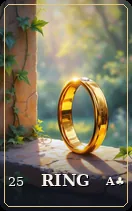 Ring — A serious, stable commitment; a long marriage.
 House — Peace at home, a family in harmony; the home of parents or grandparents.
 Man — An older man, calm and experienced; the father or a mentor.
 Woman — A mature and serene woman of great dignity.
 Clouds — An apparent peace with some disturbance underneath; an older person who is confused or worried.
 Anchor — Lasting stability; an established career, a peaceful retirement.
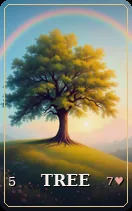 Tree — Longevity, a calm life, the roots of an old family.
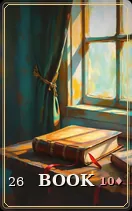 Book — Wisdom, serious study, knowledge gathered over the years.
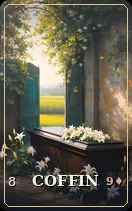 Coffin — A period of withdrawal; a relationship that has cooled to a standstill.
 Sun — Peace and success together: a happy, tranquil phase.
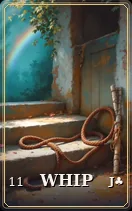 Whip — An argument that calms down; or, with love cards, quiet passion and intimacy.
Frequently asked questions
What does the Lily mean in the Lenormand?
Serenity, maturity and peace: a matter that settles down, experience, dignity, older people. It is a good card, but a slow one.
What does the Lily mean in love?
A mature, stable and tranquil relationship. Beside cards of passion, it speaks of serene affection and intimacy; in a question about enthusiasm, it may warn that the relationship has cooled.
Is the Lily a yes or a no?
Yes, but slowly. The answer is positive, as long as the matter is given time and nothing is forced.
Which playing card corresponds to the Lily?
The king of spades, ever since the first deck of c. 1799. It is a mature male figure, which reinforces the reading of the Lily as the card of experience and of older people.
Does the Lily represent a person?
It can: traditionally an older man, or someone mature, calm and of firm principles — a father, a grandfather, an adviser.
No sign-up · Reading written on the spot · Free