The Ring: meaning of Lenormand card 25
The Ring is card 25 of the Lenormand, and the card of bonds: the commitment you take on, the contract you sign, the word you give. A ring is a circle with no beginning and no end, and so it also speaks of what repeats itself, of what comes full circle and returns to its starting point.
In a spread, the Ring binds. It links two things together, or ties a person to a matter. It is a favourable card in questions of love and business, because it says there is agreement — but by nature it is neutral: it binds whatever lies beside it, good or bad. Next to the Heart it is a marriage; next to the Cross, a heavy obligation; next to the Mice, a contract that loses money.
The card at a glance
| Number | 25 |
|---|---|
| Playing card | Ace of Clubs (A♣) |
| Lenormand names | Der Ring (German); The Ring (English); La Bague (French) |
| Type | Event — commitment, bond |
| Keywords | commitment, contract, marriage, wedding ring, promise, partnership, cycle, repetition |
| Timing | Cyclical: what repeats or comes back; with dates, it speaks of anniversaries and complete cycles |
| Yes or no | Yes — the matter is sealed |
The image on the card
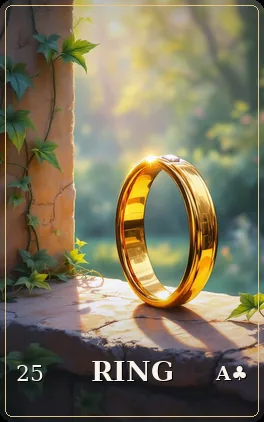
In the Sol da Alma Lenormand, the Ring is a broad, polished gold band standing upright on a worn, cracked stone slab. At the top it has a small pale setting, where the light strikes and flares into a star. On the left, a sand-coloured stone column is covered in green ivy; behind, a blurred garden full of golden and green light, with patches of pink flowers. The sun shines from behind the ring and casts a long shadow from it across the stone.
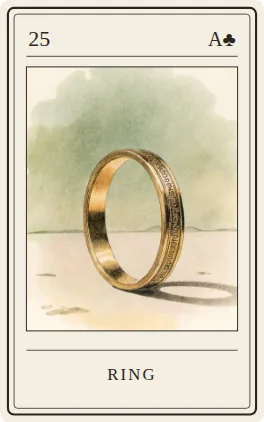
In the Engraved Lenormand, the band is gold as well, but older in style: a hoop that is plain on the inside and engraved on the outside with an inscription that runs all the way round, standing upright on pale ground, against a grey-green sky and a line of low hills. Here too the ring casts a circular shadow. It is the classic Lenormand image: the ring on its own, seen from the side, so that the whole hoop can be seen.
The symbolism, detail by detail
- The circle
- What has no beginning and no end: continuity, faithfulness, the cycle that closes and begins again.
- The gold
- The value of the commitment, and its durability: gold does not tarnish. A bond of gold is a bond meant to last.
- The engraved inscription
- In the Engraved Lenormand, the word given — the names, the date, the promise. It is the commitment that is put in writing, like a contract.
- The setting
- In the Sol da Alma card, the point where the light gathers: the moment of saying yes, the instant when the agreement becomes real.
- The circular shadow
- Every commitment has its other side: obligation, whatever ties you down. The shadow is a reminder that a ring also binds.
- The stone and the ivy
- In the Sol da Alma card, solidity and attachment. The ivy clings to the column and climbs with it — an age-old image of faithfulness and of a bond that lasts.
- The ace of clubs
- Clubs, the suit of Wands in the tarot, is the suit of Fire, of will; the Ace is its seed, its full strength. The Ring is commitment as an act of will: the yes you decide to give.
The history of the Ring
The Ring is already among the thirty-six cards of ‘Das Spiel der Hoffnung’, the Game of Hope, which Johann Kaspar Hechtel published in Nuremberg around 1799 — a board game made of illustrated cards, each with a miniature playing card in one corner. In the Lenormand, the Ring holds place 25, with the ace of clubs.
The name ‘Lenormand’ was given to the deck after the death of Marie Anne Lenormand in 1843, by publishers who wanted to cash in on the fame of the Parisian fortune-teller; there is no evidence that she ever used it. ‘Baralho Cigano’, the Gypsy Deck, is the popular name the deck has in Portugal and Brazil, with no historical Romani origin.
The wedding ring as a sign of marriage is a very old custom in Europe, and the signet ring was used for centuries to seal documents and contracts. The two ideas — the personal bond and the formal agreement — still live side by side in the card today.
The meaning of the Ring
The Ring is commitment: everything that binds two parties by their own free will. On a personal level, it is the relationship taken seriously, the engagement, the marriage, the promise. On a practical level, it is the contract, the agreement, the partnership, the signature, the collaboration. It says there is a bond, and that the bond carries weight.
It is also the card of the cycle. A ring goes round and comes back to the start: it can speak of something that repeats itself, a pattern that returns, a matter that comes full circle. Next to cards of endings, it says a cycle is being completed; next to cards of repetition, it warns of a pattern the person keeps falling back into.
The Ring does not judge what it binds. It is favourable when what lies beside it is good — a happy commitment, a deal sealed. When the neighbouring cards are heavy, it can speak of a tie that is hard to get out of, an obligation no longer wanted, an unfavourable contract. Either way, the thing is fastened: it will not come undone overnight.
The Ring in love
In love, the Ring is the card of commitment: a relationship made official, an engagement, a marriage, a life together. In a question about the future of a relationship, it is one of the best cards that can come up — it says there is a bond, and that it is a serious one. For someone who is single, it announces a relationship with a future, or a reunion with someone from the past.
The Ring also shows the state of a commitment that already exists. Next to the Heart, it is love and faithfulness; next to the Mice or the Clouds, a marriage that is worn out or confused; next to the Scythe or the Coffin, a break-up or a divorce; next to the Anchor, a stable and lasting relationship. With the Man or the Woman, it says that this person is committed to someone.
The Ring in work and money
At work, the Ring is the contract: a job made official, a partnership, an agreement with a client, a business partnership. It is excellent for anyone waiting for a signature. Next to the Letter, it is the signed document; next to the Tower, a tie with an institution; next to the Anchor, a long-term contract.
With money, it speaks of financial agreements, regular income, recurring payments — rent, an instalment, a steady salary. With the Fish, it is a profitable deal; with the Mice, a contract that loses money or a debt that ties you down. Before signing, it is worth looking at the neighbouring cards: the Ring says you are going to be bound.
The Ring in health and wellbeing
In questions about wellbeing, the Ring speaks of cycles and habits: routines that repeat themselves, for better or worse, and of the commitment to yourself involved in keeping them or changing them. The cards are no substitute for any consultation or any kind of health care; here, as always, the reading speaks of attitude, not diagnosis.
The Ring as a person
As a person, the Ring is the partner — the spouse, the fiancé or fiancée, the business partner. It also describes someone faithful, who keeps their word and takes commitments seriously. Next to person cards, it says that the person is bound to someone, or to a contract.
The Ring as advice
As advice, the Ring says: commit. Stand by what you want, give your word, sign, seal the deal. But it also says: read before you sign. A commitment is a bond, and you should only give your word to what you intend to keep.
The timing of the Ring
The Ring measures time in cycles. It can point to something that happens again, a deadline that coincides with an anniversary or the end of a cycle, a matter that closes when the wheel comes full circle. Next to fast cards, the agreement comes quickly; next to slow cards, it is a commitment for a long time.
In the Grand Tableau: house 25
In the Grand Tableau, house 25 is the house of the Ring. The card that falls there shows what the person asking is bound to — the relationship, the contract, the obligation. And the Ring itself, wherever it falls, brings commitment to the subject of that house: in the house of the Clover, luck that you hold on to; in the house of the Cross, a duty you cannot escape.
Combinations with other cards
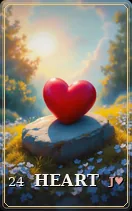 Heart — Love with commitment: an engagement, a wedding, a relationship made official.
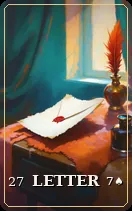 Letter — A written contract, a signed document, a formal agreement.
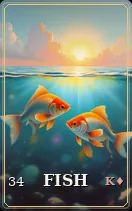 Fish — A profitable deal, a favourable financial agreement.
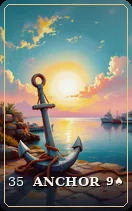 Anchor — A stable and lasting commitment; a secure employment contract.
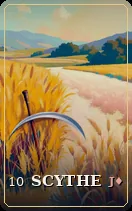 Scythe — A break-up, a contract that is broken, a divorce.
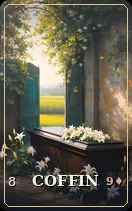 Coffin — The end of a commitment, or a cycle that closes for good.
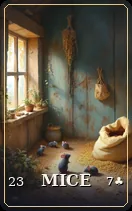 Mice — A commitment wearing thin, or a contract that loses money.
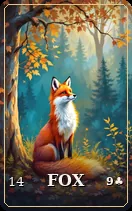 Fox — An agreement with a catch, a misleading clause; read the small print.
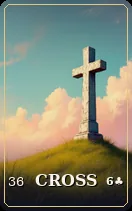 Cross — A heavy obligation, a commitment lived as a duty.
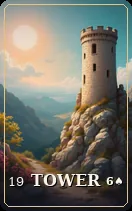 Tower — A tie with an institution, an official or legal agreement.
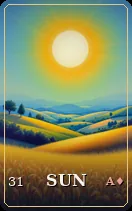 Sun — A happy and successful commitment; an agreement that goes well.
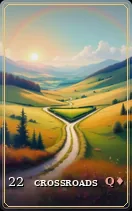 Crossroads — A choice between commitments; or an agreement not yet decided.
Frequently asked questions
What does the Ring mean in the Lenormand?
Commitment: a contract, a relationship made official, a marriage, a partnership, a promise. It is also the cycle — what comes full circle and returns to the beginning.
Does the Ring mean marriage?
It can, especially next to the Heart or the person cards. But the Ring is any commitment: in a work context, it is a contract.
Is the Ring a good card?
It is favourable, because it points to agreement and connection. But it binds whatever lies beside it: next to heavy cards, it can be an obligation that is hard to undo.
Is the Ring a yes or a no?
It is a yes: it says the matter is being sealed, that there is agreement. The neighbouring cards say whether it is a happy yes or a yes that ties you down.
Which playing card corresponds to the Ring?
The ace of clubs. Clubs is the suit of will, and the Ace its seed — commitment as an act of will.
No sign-up · Reading written on the spot · Free