The Coffin: meaning of Lenormand card 8
The Coffin is the eighth card of the Lenormand and, at first sight, the most frightening. The picture leaves no room for doubt: a closed coffin. But in the Lenormand this card rarely speaks of physical death, and it should never be read as that kind of prediction. It speaks of endings: of things, phases, situations, relationships and ways of living that have run their course and need to be brought to a close.
It is a heavy card, because endings hurt — there is farewell, there is grief, and sometimes weariness and exhaustion. But it is also a clean card: what the Coffin closes stays closed, and that leaves the ground free for what comes next. In a reading, it says that something has ended or is ending, and it asks whether the person asking is ready to let it go. The neighbouring cards say what is ending and what may be born afterwards.
The card at a glance
| Number | 8 |
|---|---|
| Playing card | Nine of Diamonds (9♦) |
| Lenormand names | Der Sarg (German); The Coffin (English); Le Cercueil (French) |
| Type | Event — ending, closure |
| Keywords | ending, closure, farewell, grief, loss, exhaustion, pause, transformation |
| Timing | A closing: what ends does not come back; the pause that follows can be a long one |
| Yes or no | No — the matter, as it stands, has come to an end |
The image on the card
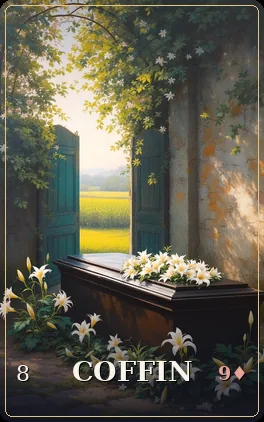
In the Sol da Alma Lenormand, the Coffin is a box of dark, polished wood with its lid shut, resting on the flagstones of a courtyard. On the lid lies a spray of white lilies, and more white lilies grow around it in the foreground. Behind it stands an old wall of worn plaster, stained with ochre, and a double door of blue-green wood thrown wide open onto a bright field of green and yellow, with trees in the distance. Above the door, a climbing plant with small white flowers lets the light through. The scene is serene: the coffin lies in the shade, but the open door looks out onto the sun. In the corner, the number 8 and the nine of diamonds.
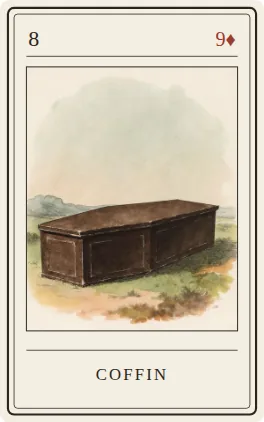
In the Engraved Lenormand, in the manner of the decks of the 1800s, the Coffin is a dark brown wooden coffin with plain panels and a closed lid, seen from the side and standing alone on the grass of a field, with bluish hills in the distance and a pale, misty sky. There are no flowers and no door: it is the sober, direct image of the card’s traditional description. The Sol da Alma painting keeps the coffin closed but adds two elements that change the tone — the lilies and the open door — and with them the idea that after the ending there is a way through.
The symbolism, detail by detail
- The coffin
- The ending, the closure. What is shut away and put aside, never to be opened again.
- The closed lid
- What is over is over. The card does not speak of a temporary ending, but of a full stop.
- The dark wood
- Weight, seriousness, mourning. The Coffin is a card that is felt.
- The white lilies
- In the Sol da Alma painting, the traditional flowers of farewell. They are a reminder that endings deserve respect and care, and that they can also be lived through in peace.
- The open door
- The way out into a field full of light: after the ending comes open space. It is the most important lesson of this version of the card — the Coffin closes one thing to make room for another.
- The worn wall
- The wear of time, what has been used until the very end. Some things end simply because they are spent.
- The nine of diamonds
- A card from the suit of diamonds, the suit of material things. It helps us remember that the Coffin often speaks of very concrete endings: a job, a business, a financial situation, an object that is no longer any use.
The history of the Coffin
The Coffin was already card 8 in ‘Das Spiel der Hoffnung’, the Game of Hope published by Johann Kaspar Hechtel in Nuremberg around 1799, with the nine of diamonds in the corner. It was a board game of thirty-six cards, played with dice, and the miniature playing cards meant it could also be used to tell fortunes.
After the death in 1843 of Marie Anne Lenormand — the most famous fortune-teller in Paris — publishers began selling the deck under her name, although there is no evidence that she ever used it. In Portugal and Brazil it became known as the ‘Baralho Cigano’ (the ‘Gypsy deck’), a popular name that does not reflect any historical Romani origin.
In the old readings, the Coffin was one of the most feared cards, and the traditional books also linked it to illness and mourning. The modern reading, which is the one used on Sol da Alma, is broader and calmer: the Coffin is above all the card of cycles coming to an end, and not a prediction about anyone’s life or health.
The meaning of the Coffin
The Coffin is the card of endings: a cycle that closes, a phase that finishes, a situation that has reached its limit. It may be the end of a relationship, a job, a project, a habit or a way of thinking. It says there is no turning back, and that the best thing is to accept it and close the chapter.
It is also the card of grief in the broad sense — the sadness that comes with losses and farewells, and the need for time to take in what has ended. And it can speak of exhaustion: of a person or a situation that has run out of strength, of something that has dragged on until it could go on no longer. In that case, the Coffin asks for rest, not more effort.
But the Coffin has a liberating side. What closes leaves space. The card often appears precisely when something has to be let go before you can move forward: a relationship that no longer works, a job that drains you, an old guilt. Next to positive cards, it is the end of a problem; next to the Child, the Clover or the Stork, it is an ending that gives way to a fresh start.
The Coffin in love
In love, the Coffin often speaks of the end of a relationship, or of a phase within it: a separation, a final parting, a relationship that carries on but in which something has died — passion, trust, desire. For someone who is single, it may show that they are still carrying the grief of an old relationship, and that it needs to be closed before another can begin.
It is not always bad news. Next to positive cards, it can be the end of a crisis, of jealousy, of a pattern that was harming the relationship. Next to the Ring, it is the end of a commitment; next to the Heart, a feeling that fades — or a pain that finally passes.
The Coffin in work and money
At work, the Coffin points to the end of a job, a contract, a project or a stage in your career. It may be a dismissal, a resignation, a business that closes — or simply the burnout of someone who has lost all motivation. It invites you to close things with dignity and to prepare the next step.
In money matters, it speaks of losses, of sources of income that come to an end, of a period of restraint. With the Fish, a source of money that dries up; with the Key, the end of a debt or of a financial problem. It calls for prudence and restraint until the situation settles again.
The Coffin in health and wellbeing
In questions about wellbeing, the Coffin speaks of tiredness, of the need for rest, of a low phase that calls for a pause, and sometimes of the end of a harmful habit. It is not a prediction about anyone’s health or life, and it should never be read that way. As always in the Lenormand, the reading shows tendencies and attitudes, and it does not replace any medical consultation or care.
The Coffin as a person
When it describes someone, the Coffin is a person going through a time of loss or farewell, someone tired and withdrawn, who needs time and silence. It can also be a person who lives clinging to the past. It rarely describes a character; above all, it describes a moment.
The Coffin as advice
As advice, the Coffin says: let go. Accept that certain things are over, close them with respect and do not waste energy trying to bring them back to life. Give yourself time to grieve and to rest. And prepare the space that is left free: after the ending, there is ground to build on.
The timing of the Coffin
The Coffin does not measure a length of time; it marks a full stop. What it announces ends and does not come back. What follows is often a pause, a time of silence before the new beginning, and it can be a long one. Next to the Scythe, the ending is sudden; next to the Anchor, it is a prolonged standstill; next to the Stork or the Child, the new beginning is not far off.
In the Grand Tableau: house 8
In the Grand Tableau — the spread in which all thirty-six cards are laid out in four rows — the eighth position is the house of the Coffin. The card that falls there shows what is ending in the life of the person asking, or what needs to be brought to a close. And the Coffin itself, wherever it falls, brings ending, pause or farewell to the theme of that house.
Combinations with other cards
 Child — A fresh start after an ending; a new life born from what has finished.
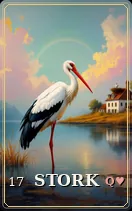 Stork — A change that comes after an ending; renewal.
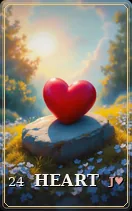 Heart — The end of a feeling; or a heartache that finally passes.
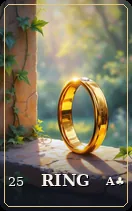 Ring — The end of a commitment, a contract or an official relationship.
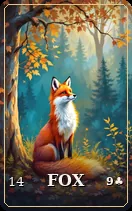 Fox — The end of a job; work that wears itself out.
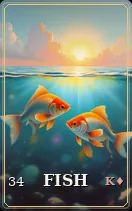 Fish — A source of money that comes to an end; financial losses.
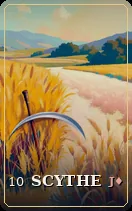 Scythe — A sudden ending, a final cut.
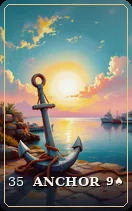 Anchor — A long standstill; something that stays at a halt for a long time.
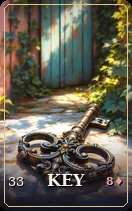 Key — The end of a problem; the solution that closes a difficult situation.
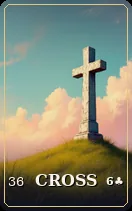 Cross — A burden that finally comes to an end; or a very heavy phase.
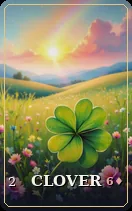 Clover — An ending that brings relief; a small stroke of luck after a loss.
 Sun — The end of a dark phase; the light returning.
Frequently asked questions
What does the Coffin mean in the Lenormand?
Ending, closure, farewell: a cycle that closes, a situation that finishes, a time of grief. It is heavy, but it leaves the ground free for what comes next.
Does the Coffin mean death?
It should not be read that way. In the Lenormand, it speaks of the end of cycles, relationships, jobs or phases, and it is never a prediction about anyone’s life.
What does the Coffin mean in love?
The end of a relationship or of a phase within it; also the end of a crisis, or the need to close the past before starting again.
Is the Coffin always negative?
No. It can be the end of a problem, a debt or a situation that was doing harm. With positive cards beside it, it is liberating.
Is the Coffin a yes or a no?
No: the matter, as it stands, has come to an end. Something else may follow, but not that.
No sign-up · Reading written on the spot · Free