The Garden: meaning of Lenormand card 20
The Garden is card 20 of the Lenormand and the card of the public. It is not the back garden or the vegetable patch: it is the public garden, the park, the place where people meet, stroll, talk and see one another. Everything that happens there happens in full view of everyone. That is its message — the matter leaves the private sphere and enters social life.
In the Lenormand, the Garden is paired with the House. The House is what is intimate, familial, behind closed doors; the Garden is what is open, shared, visible. It speaks of meetings, parties, events, groups of friends, associations, professional networks, the public and reputation. It is a cheerful, outgoing card, but not a naive one: whoever puts themselves on show is also being watched.
The card at a glance
| Number | 20 |
|---|---|
| Playing card | Eight of Spades (8♠) |
| Lenormand names | Der Park (German); The Garden (English); Le Jardin (French) |
| Type | Place — the public, the social |
| Keywords | public, meeting, society, party, event, group, network, exposure, reputation, leisure |
| Timing | That of an appointed gathering: an event, a meeting, a date not far off |
| Yes or no | It leans towards yes, especially when the matter involves other people |
The image on the card
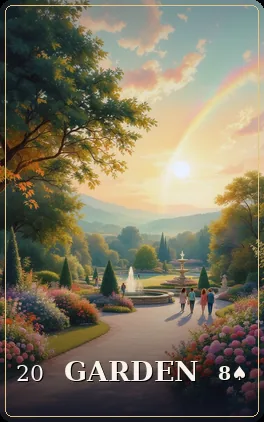
In the Sol da Alma Lenormand, the Garden is a large public park in the late afternoon. A leafy tree, its leaves green and some already turning orange, frames the scene on the left. A wide, pale path curves between beds full of flowers — pink, red, purple, orange — and cypresses clipped into cones. In the middle, a jet of water in a round pool; further back, a tiered fountain with a small statue on top and, on the right, an urn on a pedestal. Four people walk together along the path, seen from behind; another stands near the jet of water. In the background, bluish hills, a low sun and a rainbow arching across the sky. In the corner, the number 20 and the eight of spades.
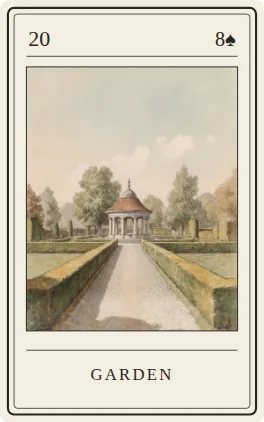
In the Engraved Lenormand, the Garden is a formal garden in the style of old European parks: a straight gravel path between tall clipped box hedges, leading to a small round pavilion with white columns, a red-tiled dome and a finial on top. Around it, lawns, more hedges and broad-crowned trees, under a clear sky. There are no people. The two pictures agree on the essentials — the designed garden, with paths and hedges, made for strolling; the engraving emphasises order and the meeting place, the pavilion; the Sol da Alma puts people there, along with the fountains and the flowers, and shows the Garden already full of social life.
The symbolism, detail by detail
- The public garden
- Shared space. It belongs to no one in particular, and so it belongs to everyone: it is society, the public, the community.
- The people strolling
- In the Sol da Alma, the group walking together: friends, socialising, meeting. The Garden is always a card of more than two people.
- The wide path
- The place everyone passes through. Whatever is in the Garden sees and is seen: it is exposure, reputation, public image.
- The clipped hedges
- The order and rules of social life. A formal garden is nature tamed: the Garden also speaks of etiquette, conventions, what is expected in public.
- The pavilion
- In the Engraved Lenormand, the meeting point at the end of the path: the place where people gather, the event, the function room.
- The fountains
- In the Sol da Alma painting, water that flows and is shared. They recall the squares and places where people have always met.
- The flowerbeds
- Leisure, beauty, the pleasure of being with others. The Garden is also the card of parties and free time.
- The eight of spades
- Spades is the sternest suit in cartomancy with ordinary playing cards. It is a reminder that public life has its price: judgements, comments, exposure to other people’s eyes.
The history of the Garden
The Garden was already card 20 of ‘Das Spiel der Hoffnung’, the Game of Hope published by Johann Kaspar Hechtel in Nuremberg around 1799, with the eight of spades in the corner. It was a board game of thirty-six cards, played with dice, and the miniature playing card on each one meant the deck could also be used to tell fortunes.
After the death of Marie Anne Lenormand in 1843, publishers began selling the deck under the name of the most famous fortune-teller in Paris, with no proof that she ever used it. In Portugal and Brazil it is the ‘Baralho Cigano’, the Gypsy Deck, a popular name that has no historical Romani origin.
The image the deck chose says a great deal about its time: in the late eighteenth and the nineteenth centuries, gardens and parks open for strolling were the great stage of social life in European cities — a place to see and be seen. The card’s usual German name, ‘Der Park’, makes it clear what kind of garden is meant: public space, not a private garden.
The meaning of the Garden
The Garden is the card of social life and the public. It speaks of meetings, gatherings, parties, weddings and celebrations, events, conferences, exhibitions — everything that brings people together. In a reading, it often says that the matter will have witnesses, that it will be dealt with in public, or that the solution lies in going out and talking to others.
It is also the card of groups and networks: associations, clubs, communities, teams, circles of friends, professional networks and, in modern readings, social media. And it is the card of public image — reputation, the way others see the querent, the visibility of a piece of work.
Its tone is generally positive: the Garden opens things up, airs them and brings people together. But it has its flip side. What is in the Garden is exposed — it can be commented on, judged, copied. Next to cards such as the Snake or the Birds, it is a reminder that people talk; next to the Book, that a secret may stop being one. And, as a card of many people, it is sometimes impersonal: lots of contacts, little intimacy.
The Garden in love
In love, the Garden speaks of the relationship in public: introducing your partner to friends and family, going out together, making the relationship known to others. It can also announce a party, a celebration, a wedding as a social occasion. In a discreet relationship, it says the time has come to make it visible — or that people are already talking about it.
For those who are single, it is one of the most helpful cards: the meeting happens outside the home, at an event, a party, in a group, through friends. It asks you to go out and accept invitations. The thing to watch is superficiality: the Garden holds many people, and not every encounter goes far. Next to the Heart, it is a love born at a social gathering; next to the Ring, a ceremony; next to the Tower, someone who has to come out of their isolation.
The Garden in work and money
At work, the Garden speaks of contacts, networking, trade fairs and professional events, meetings, presentations and working with the public. It favours those who work in communications, events, hospitality, tourism, retail, teaching or entertainment — and anyone who depends on their reputation. In a question about a project, it says it is time to show it; in a question about a job, that the way forward is through your contacts.
In money matters, it links income to clientele and visibility: more public, more business. It can also indicate social spending — parties, events, nights out. Next to the Fish, it is a business open to the public or an event that makes money; next to the Mice, spending on social occasions that adds up.
The Garden in health and wellbeing
In questions about wellbeing, the Garden speaks of the outdoors, of socialising, of group activity and of the importance of not isolating yourself — walking in a park, doing sport with others, taking part in a community. It can also represent public care facilities. As always with the Lenormand, the reading is no substitute for any medical consultation or health care.
The Garden as a person
As a person, the Garden describes someone sociable, outgoing, well known, surrounded by people — the host, the organiser, the one who knows everybody. It can also be a public figure, someone who works with the public or who lives by their image. In many cases, however, the Garden is not one person but a group: friends, colleagues, the community, ‘other people’ in general.
The Garden as advice
As advice, the Garden says: go out. Accept the invitation, show up, show what you do, talk to people, look for the right group. The solution may lie in a contact you have not yet made. At the same time, it reminds you that everything said in the Garden is overheard — it is wise to look after your image and choose what you put on show.
The timing of the Garden
The Garden is not a card with a fixed time: its time is that of an appointed gathering — a party, a meeting, an event, a date when people come together. In general, it speaks of weeks. Next to the Rider, the meeting is brief or close at hand; next to the Anchor or the Tower, it speaks of a public presence that lasts a long time.
In the Grand Tableau: house 20
In the Grand Tableau — the spread of all thirty-six cards laid out in four rows — the twentieth position is the house of the Garden. The card that falls there shows how the querent’s social life is going, what is happening in public or how others see them. And the Garden itself, wherever it falls, brings people and exposure to the theme of that house: the matter is no longer purely private.
Combinations with other cards
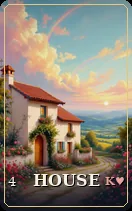 House — A party at home, a family gathering; the private opening up to others.
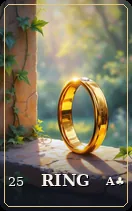 Ring — A ceremony, a wedding, an event marking a public commitment.
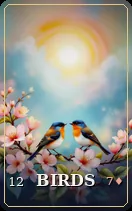 Birds — Group conversations, comments, gossip; a conference or a debate.
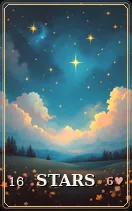 Stars — Popularity, fame, social media; a large audience.
 Dog — A group of friends, an association, a network of trust.
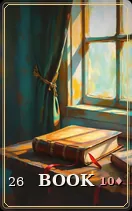 Book — A secret that becomes public; or training, a group course.
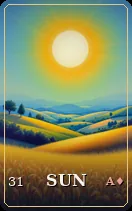 Sun — Public success, recognition, an event that goes very well.
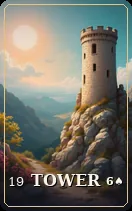 Tower — An official event, an institution open to the public.
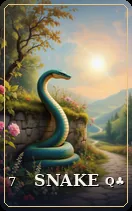 Snake — Rivalry or intrigue in a group; someone speaking ill of you in public.
 Clouds — A reputation called into question, rumours, confusion within a group.
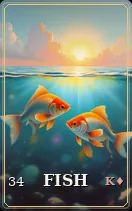 Fish — A business open to the public; an event that turns a profit.
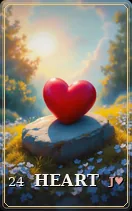 Heart — A love born at a social gathering; a relationship made public.
Frequently asked questions
What does the Garden mean in the Lenormand?
The public and social life: meetings, parties, events, groups, networks, reputation. Everything that happens in full view of others.
Is the Garden a good card?
Generally, yes: it opens things up, brings people together and gives visibility. Its less favourable side is exposure — comments, judgements, a lack of intimacy.
What does the Garden mean in love?
A relationship made public, a celebration, or, for those who are single, a meeting at an event or through friends.
What is the difference between the Garden and the House?
The House is the private and the familial; the Garden is the public and the social. Together, they speak of a party at home or of a family matter that becomes known.
Is the Garden a yes or a no?
It leans towards yes, especially if the matter depends on other people, on contacts or on an event.
No sign-up · Reading written on the spot · Free