
The Fish: meaning of Lenormand card 34
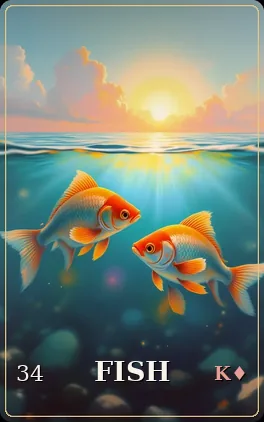
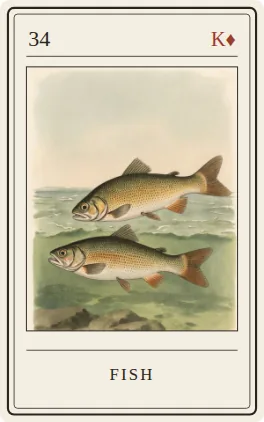
The Fish is card 34 of the Lenormand and the card of money in motion. Two fish swim in the water: they are not still, they are not stored away, they come and go. That is how the card speaks of material life — of business, income, buying and selling, of everything that comes in and goes out.
The Fish is the main money card in the Lenormand, but it is not the only one, and it is worth telling it apart from the others. The Bear is accumulated money, assets, reserves; the Clover is luck; the Fish is flow. In a spread, it shows that things are circulating — and, with the right cards beside it, that they are circulating in abundance.
The card at a glance
| Number | 34 |
|---|---|
| Playing card | King of Diamonds (K♦) |
| Lenormand names | Die Fische (German); The Fish (English); Les Poissons (French) |
| Type | Area — money, business |
| Keywords | money, business, income, abundance, trade, self-employment, flow, freedom |
| Timing | Ongoing: whatever flows; neither very fast nor very slow |
| Yes or no | Yes — especially in questions about money and business |
The picture on the card
In the Sol da Alma Lenormand, the card shows two fish with silvery scales and orange heads and fins, swimming face to face just below the surface in clear blue-green water. Above, you can see the line of the sea and, over it, a sunset sky, with the disc of the sun on the horizon and pink and golden clouds. The light enters the water in rays that reach down to the bottom, where rounded pebbles and small points of light can just be made out. In the corner, the number 34 and the king of diamonds.
In the Engraved Lenormand, in the manner of natural history prints, there are two river fish with greenish backs and golden flanks speckled with dark spots, and reddish fins, swimming side by side, one above the other, facing left. The water is green, with its rippled surface in view and dark stones on the bottom; the sky is pale. This is the classic Lenormand image: fish seen from the side, in motion.
The two images show the same thing — two live fish in running water — but with different emphases. In the Engraved one, the fish head in the same direction, like a business moving forward; in the Sol da Alma one, they meet face to face, as in an exchange, and the golden light falling on them speaks of prosperity.
The symbolism, detail by detail
- The fish
- Money, wealth, multiplication. Fish live in shoals and breed in great numbers: they are an age-old image of abundance.
- Two fish
- Exchange, trade: giving and receiving. A deal always needs two parties.
- The movement
- Flow: the Fish’s money does not stand still. It comes in, goes out, circulates — it is income, not savings.
- The water
- The medium in which everything flows, and also emotions and freedom. Fish swim wherever they like: the card also speaks of independence.
- The light shining down
- In the Sol da Alma painting, the prosperity that comes to those who keep moving. The gold on the water is wealth in the making.
- The spots and scales
- In the Engraved Lenormand, the many details of a living fish: coins, quantity, a variety of business.
- The king of diamonds
- Diamonds are the suit of money in fortune-telling with ordinary playing cards, and the king is the one who rules it: a businessman, a trader, someone who knows how to make money grow.
The history of the Fish
The Fish was already card 34 of ‘Das Spiel der Hoffnung’, the Game of Hope published by Johann Kaspar Hechtel in Nuremberg around 1799, with the king of diamonds in the corner. It was a board game of thirty-six cards, played with dice, and the miniature playing cards meant it could also be used to tell fortunes.
After the death in 1843 of Marie Anne Lenormand — the most famous fortune-teller in Paris — publishers began selling the deck under her name, though there is no evidence that she ever used it. In Portugal and Brazil it became known as the ‘Baralho Cigano’, the Gypsy Deck, a popular name that does not reflect any historical Romani origin.
The meaning of the Fish has hardly changed over time: it is the card of money and business, which its playing card — the king of diamonds — reinforces. Some modern schools add drinks to it, and alcohol in particular; it is a common reading, but a secondary one, which applies only when the question or the neighbouring cards call for it.
The meaning of the Fish
The Fish is the card of money. It speaks of income, business, sales, wages, payments — of everything that comes in and goes out. In a spread about finances, it is the card you hope to see: it says that there is movement, that money is circulating and, with good cards nearby, that it is circulating well.
It is also the card of trade and independence. It speaks of those who work for themselves, who do deals, who know how to make the most of what they have. And it speaks of abundance in a broad sense: having more than you need, being able to share, a life with resources. There is an idea of freedom in it — the fish that swims wherever it likes — and that is why many readers also associate it with autonomy and the ability to decide for yourself.
The difficult side of the Fish is the flow itself. Money that flows can also slip away: beside the Mice, it is loss; beside the Fox, a dubious deal; beside the Clouds, murky finances. The Fish does not say that money stays — it says that money moves. For it to stay, you need the Anchor or the Bear.
The Fish in love
In love, the Fish is not a sentimental card, and that in itself says something. It may show that money carries weight in the relationship — a comfortable life together, shared material plans or, in difficult spreads, a relationship in which interests count for more than affection. It may also speak of someone independent who values their freedom.
Beside the Heart, it is a generous love, with plenty and wellbeing; beside the Ring, a commitment that also has a practical side, such as a shared home or business; beside the Fox, it asks you to watch out for hidden interests.
The Fish at work and with money
At work, the Fish is the card of running your own business, of trade, sales and self-employment. It favours entrepreneurs, negotiators, anyone with clients. In a question about a project, it says that it can make money; in a question about a job, it points to a good salary or to a role connected with finance and commerce.
With money, it is the central card: income coming in, good deals, prosperity. With the Sun, it is a business that flourishes; with the Anchor, steady income; with the Clover, an unexpected gain; with the Bear, money that turns into lasting wealth.
The Fish in health and wellbeing
In questions about wellbeing, the Fish speaks of flow, hydration and balance, and it is a reminder to be moderate in what you drink. As always in the Lenormand, the reading shows tendencies and attitudes, and does not replace any consultation or any form of health care.
The Fish as a person
The Fish is not one of the deck’s person cards, but when it describes someone, it describes a businessman, a trader, someone independent with a knack for money — the king of diamonds in the corner. This is a practical, enterprising person who loves freedom and knows how to make the most of what they have, and who may be generous or calculating depending on the cards beside them.
The Fish as advice
As advice, the Fish says: get things moving. Do deals, invest, offer what you know how to do, trust your ability to generate income. But know where what comes in is going — money that flows can also slip away, if no one gives it direction.
The Fish and timing
The Fish is not a card with a fixed time frame: it speaks of something ongoing, something that flows. The income it announces is not a stroke of luck; it is a stream. Beside fast cards, money comes in quickly; beside slow cards such as the Mountain, business takes longer to pay off.
In the Grand Tableau: house 34
In the Grand Tableau — the spread in which all thirty-six cards are laid out in four rows — the thirty-fourth position is the house of the Fish. The card that falls there tells how the money of the person asking is doing, or where their income comes from. And the Fish itself, wherever it falls, brings movement and money to the theme of that house.
Combinations with other cards
 Sun — Prosperity, a flourishing business, large gains.
 Bear — Money that turns into assets; solid wealth.
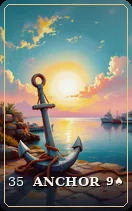 Anchor — Steady, secure income; a job that pays well.
 Clover — An unexpected gain; luck in business.
 Mice — Losing money, spending that drains your finances.
 Fox — A dubious deal; beware of scams and faulty accounts.
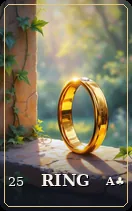 Ring — A business contract, a partnership, a financial agreement.
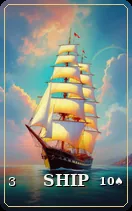 Ship — Foreign trade, import and export; money from far away.
 House — A family or property business; money coming into the home.
 Clouds — Murky finances, uncertain income.
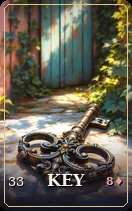 Key — The right business; the solution to a money problem.
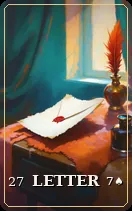 Letter — An invoice, a payment, a financial document.
Frequently asked questions
What does the Fish mean in the Lenormand?
Money in motion: business, income, trade, abundance, self-employment. It is the main money card in the deck.
What is the difference between the Fish and the Bear?
The Fish is money that flows — income, sales, cash flow; the Bear is money that is kept — assets, reserves, financial power.
Is the Fish a yes or a no?
Yes, especially in questions about money and business. Beside cards of loss, such as the Mice, the yes comes with conditions.
What does the Fish mean in love?
It is not a sentimental card: it can speak of the weight of money in the relationship, of shared material comfort or of someone independent.
Which playing card corresponds to the Fish?
The king of diamonds, ever since the first deck of c. 1799: the figure who rules the suit of money.
No sign-up · Reading written on the spot · Free