
The Bear: meaning of Lenormand card 15

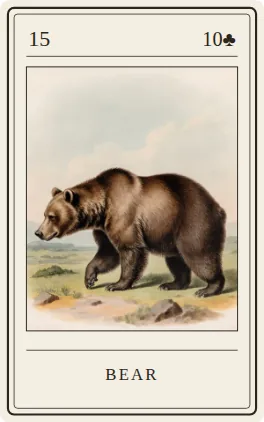
The Bear is the card of strength. A huge animal, calm as long as nobody provokes it, able to protect its own and to knock down whoever gets in its way. In a reading, the Bear speaks of power and authority: the boss, the elder, the one in charge, the one who protects — and also of everything that is big, heavy and hard to move.
It has a second meaning that is widely used in the Lenormand: money in bulk, reserves, what has been put away. Like the bear that stocks up before winter, the card speaks of savings, assets and resources — and, by extension, of appetite, the body and food. It is a strong card and therefore a double-edged one: the strength that protects can become the strength that oppresses. The neighbouring cards show which way it leans.
The card at a glance
| Number | 15 |
|---|---|
| Playing card | Ten of Clubs (10♣) |
| Lenormand names | Der Bär (German); The Bear (English); L’Ours (French) |
| Type | Person and circumstance — strength, authority |
| Keywords | strength, power, authority, boss, protection, reserves, savings, weight, appetite, jealousy |
| Timing | Slow and drawn out: whatever the Bear touches takes its time |
| Yes or no | Yes, if there is strength or backing from whoever is in charge; a heavy yes, and a costly one |
The image on the card
In the Sol da Alma Lenormand, a brown bear with a thick coat, gilded by the light, stands on all fours on top of a great grey rock, gazing into the distance to the left. Around it opens a mountain valley: a tall cliff on the left, slopes covered in pines, a river far below, and in the background, among bluish mists, mountains that stretch out of sight. The sun, round and bright, shines between orange clouds. The bear commands the landscape from above, like a guardian. In the corner, the number 15 and the ten of clubs.
In the Engraved Lenormand, the bear is on the ground, on open land of grass and stones, with low hills in the distance and a clear sky with clouds. It is a big brown bear, drawn in profile, walking to the left with one front paw raised and its head lowered, heavy and sure of itself. The engraving shows the bear on the move, strength that advances without hurrying; the Sol da Alma shows it standing still up high, strength that keeps watch and guards its territory. In both pictures the bear faces the same way — to the left.
The symbolism, detail by detail
- The bear
- Physical strength and power: the strongest animal in the forests of Europe, which nobody attacks head-on. On the card, it is authority — whoever carries weight in a situation.
- The heavy body
- Volume and mass: what is big, what takes up space, what does not move easily. The Bear enlarges the cards around it and makes them heavier.
- The rock
- In the Sol da Alma, the bear is up high, on solid stone: a position of command, the security of someone standing on their own ground.
- The gaze into the distance
- The bear keeps watch. This is protection — someone who looks after their own and pays attention to whatever approaches their territory.
- The slow walk
- In the engraving, the bear moves slowly, head lowered: strength that has no need to hurry and always reaches its destination.
- The reserves
- The bear stocks up for winter and hibernates on what it has stored. Hence the meaning of money put by, of savings and accumulated resources — and of appetite.
- The ten of clubs
- A ten, the end of the suit’s cycle, with the abundance and the weight that brings; clubs, the suit of energy. It gives the Bear its stored-up strength, and also the load of someone carrying a great deal of responsibility.
The history of the Bear
The Bear was already card 15 of ‘Das Spiel der Hoffnung’, the Game of Hope published by Johann Kaspar Hechtel in Nuremberg around 1799, with the ten of clubs in the corner. It was a board game of thirty-six cards, played with dice, and the miniature playing cards meant it could also be used to tell fortunes.
After the death in 1843 of Marie Anne Lenormand — the most famous fortune-teller in Paris — publishers began selling the deck under her name, though there is no proof that she ever used it. In Portugal and Brazil it became known as the ‘Baralho Cigano’, the Gypsy Deck, a popular name that does not reflect any historical Romani origin.
For centuries the bear was a symbol of strength and power in Europe: it appears on coats of arms — the Swiss city of Bern has one on its own — and fables gave it the role of the powerful, somewhat rough animal. Reading the Bear as money in reserve and as a protective figure is one of the most common interpretations among today’s Lenormand readers.
The meaning of the Bear
The Bear is the card of power: authority, leadership, influence, strength. It represents whoever is in charge in a situation — the boss, the employer, the director, the father or mother, an older or stronger figure — and the querent’s relationship with that power. It can be a powerful protector, a solid source of support; it can be someone who imposes, who controls, who smothers.
The second meaning is that of resources: money in quantity, savings, assets, investments, reserves. Not the money that comes and goes — that belongs to the Fish — but the money that has been built up and is kept. Next to cards of gain, the Bear is one of the best financial cards in the deck.
And there is the meaning of the body and appetite: physical strength, weight, food, a taste for good eating and comfort — and, in excess, greed, laziness, possessiveness. The Bear protects what is its own, so it also speaks of jealousy and a sense of ownership. It is a strong card, but a slow one: everything it touches gains weight and is slow to move.
The Bear in love
In love, the Bear is the protective, strong partner who gives security — the person you can count on. In a relationship, it speaks of stability, support and someone who takes care. The flip side is possessiveness: jealousy, control, a person who wants to run the relationship or who smothers with too much protection.
It can also point to a difference in power or age between the two, or to interference from an authority figure — very often a father or mother. Next to the Heart, protective love; next to the Whip, a relationship with power struggles; next to the Ring, a solid commitment with material foundations.
The Bear in work and money
At work, the Bear is the boss, the management, whoever makes the decisions. With positive cards, a supportive superior, a promotion, a position of responsibility; with difficult cards, authoritarian management or a power that blocks the way. It favours those who lead, those who manage resources and those who work with finance, with food or with physical strength.
In money matters it is one of the strongest cards: reserves, savings, investments, assets that grow slowly. With the Fish, wealth and abundance; with the Mice, reserves being eaten away; with the Fox, be careful with whoever manages other people’s money.
The Bear in health and wellbeing
In questions about wellbeing, the Bear speaks of physical strength, stamina, food and weight — and of the balance between the pleasure of eating and taking care of the body. It also calls for rest: even the bear hibernates. As always with the Lenormand, the reading shows tendencies and attitudes, and it is no substitute for any medical consultation or health care.
The Bear as a person
As a person, the Bear is someone strong, with authority, protective, generous to their own and formidable to anyone who crosses them. Very often it is an older person or someone in a position of power: a boss, a father, a mother, a mentor, someone influential. Their difficult side is control, a bad temper, possessiveness; their good side, loyalty and protection.
The Bear as advice
As advice, the Bear says: own your strength. Be firm, protect what is yours, take the reins, and ask for support from those who can help. Put resources aside for the future. But it also says: beware of excess — the strength that protects must not become the strength that controls.
The timing of the Bear
The Bear is slow. What it announces takes time, because it is big: assets that are built up, authority that is earned, a process that depends on whoever is in charge. In a question about timing, it speaks of months, and of a pace that cannot be forced.
In the Grand Tableau: house 15
In the Grand Tableau — all thirty-six cards laid out in rows — the fifteenth position is the house of the Bear. The card that falls there shows where strength, power or money lie in the querent’s life, and who has authority over it. And the Bear itself, wherever it falls, lends strength and weight to the theme of that house: in the house of the Heart, a protective or possessive love; in that of the Tower, a powerful institution.
Combinations with other cards
 Fish — Wealth, large reserves of money, solid assets.
 Fox — A strategic boss; or a power that does not play fair.
 Heart — A protective love — or a possessive, jealous one.
 House — A strong figure in the family; the home as an asset.
 Tower — A large institution, a powerful company, the civil service.
 Whip — Conflict with an authority; power struggles.
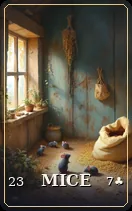 Mice — Reserves being spent; loss of assets.
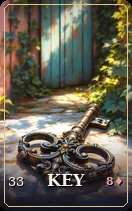 Key — A powerful person who opens doors; strength that gets things done.
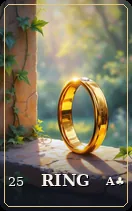 Ring — An important contract; a commitment on solid material foundations.
 Child — Protection of the young; a strong parental figure.
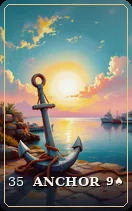 Anchor — Lasting financial stability; a secure position of power.
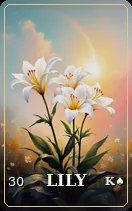 Lily — An older, respected person; calm and wise authority.
Frequently asked questions
What does the Bear mean in the Lenormand?
Strength, power and authority: the boss, the one in charge, the one who protects. It is also money put away — savings, reserves, assets.
Is the Bear a good card?
It is a strong card. It can be very positive — protection, support, wealth — or heavy, if it speaks of control, possessiveness or a power that oppresses. The neighbouring cards decide.
What does the Bear mean in love?
A protective partner who gives security; or, on the difficult side, jealousy and control. It can also point to the influence of an authority figure, such as a father or mother.
Does the Bear have to do with money?
Yes. It is one of the money cards in the Lenormand: not the money that flows, but the money that is stored up and accumulated.
Is the Bear a yes or a no?
Yes, especially if the question depends on strength or on backing from whoever is in charge. But it is a slow yes, one that costs effort and takes its time.
No sign-up · Reading written on the spot · Free