
The Child: meaning of Lenormand card 13
The Child is the card of beginnings. A small being standing on the path, eyes wide open to the world: everything in it is still to come, and that is precisely what makes it precious. In a reading, the Child speaks of what is new — a project that is starting, a relationship still in its early days, a phase that has just opened up — and it also speaks of what is small, of what needs time and care to grow.
It is one of the person cards of the Lenormand, and it can represent an actual child — a son or daughter, a nephew or niece, a pupil — or a young person. But it is used above all as a quality: next to another card, it makes it small and new. A House with the Child is a small house or a new house; a Tree with the Child, renewed energy. The card has the lightness and trust of childhood — and its inexperience too.
The card at a glance
| Number | 13 |
|---|---|
| Playing card | Jack of Spades (J♠) |
| Lenormand names | Das Kind (German); The Child (English); L’Enfant (French) |
| Type | Person and quality — beginning, smallness |
| Keywords | beginning, novelty, something small, innocence, inexperience, trust, play, a child |
| Timing | At the start: what has just begun and is still growing |
| Yes or no | Yes — but it is a beginning, small and still to be built |
The image on the card
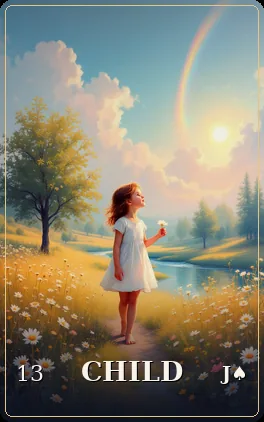
In the Sol da Alma Lenormand, the Child is a girl with wavy red hair, in a short white dress, barefoot, on a dirt path that crosses a meadow of white daisies and yellow flowers. She holds a daisy in her raised hand and looks up at the sky, where a bright sun shines among rosy clouds and a rainbow comes down from above. Beside her runs a calm river; on the left stands a leafy tree with yellowish-green foliage, and on the right, in the distance, pine trees and softly blurred woods. It is a scene of spring or early summer, full of light. In the corner, the number 13 and the jack of spades.
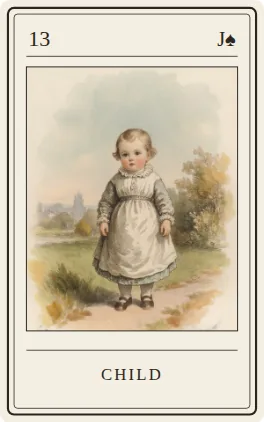
In the Engraved Lenormand, the Child stands full length, facing the viewer: a small child with fair, curly hair, in a grey dress with ruffled collar and cuffs, a long white pinafore, white stockings and black shoes, in the fashion of the nineteenth century. The arms hang by the sides and the serious gaze is fixed straight ahead. The child stands on a dirt path, between grass and shrubs in autumn tones, and in the background a church tower and houses can be seen in the distance. The engraving shows the child as it is — small, still, looking at us; the Sol da Alma shows her discovering the world, with her eyes on the sky.
The symbolism, detail by detail
- The child
- Beginning and smallness: what has not yet grown but has everything it needs to grow. It is also the trust and openness of someone who has not yet learnt to be suspicious.
- The upward gaze
- In the Sol da Alma, the girl looks up in wonder: curiosity, the capacity to marvel, openness to the new. It is also the naivety of someone who does not yet watch where they are stepping.
- The daisy in her hand
- A simple wild flower that children pick: joy without calculation, the small things that are enough to make a happy day.
- The bare feet
- Direct contact with the world, without protection. Lightness, and vulnerability too: the Child needs someone to look after it.
- The path
- In both images, the Child stands on a path: there is a journey ahead, and it has only just begun. The card speaks of first steps.
- The straight gaze
- In the engraving, the child faces the viewer, serious and defenceless: frankness, sincerity — the child who says what they think.
- The jack of spades
- A jack, the youngest figure among the playing cards, and therefore the natural card for the Child. The spades are a reminder that inexperience can also get hurt, or hurt others without meaning to.
The history of the Child
The Child was already card 13 in ‘Das Spiel der Hoffnung’, the Game of Hope published by Johann Kaspar Hechtel in Nuremberg around 1799, with the jack of spades in the corner. It was a board game of thirty-six cards, played with dice, and the miniature playing cards meant it could also be used to tell fortunes.
After the death in 1843 of Marie Anne Lenormand — the most famous fortune-teller in Paris — publishers began selling the deck under her name, although there is no evidence that she ever used it. In Portugal and Brazil it became known as the ‘Baralho Cigano’ (‘Gypsy deck’), a popular name that does not reflect any historical Romani origin.
The picture varies from deck to deck — a child standing, playing, with a toy or with flowers — but the meaning is always the same. And the number 13, which has a bad name in other traditions, carries no weight here at all: the Child is one of the lightest cards in the deck.
The meaning of the Child
The Child is the card of beginnings: what has just been born, just opened, just got under way. A new project, a job in its early days, a recent friendship, an idea still in outline. It says that the matter is at an early stage and needs to be looked after and nurtured in order to grow.
It is also the card of smallness: a small amount, a short time, little importance — or simply a young age. Many readers use it as a diminutive: a little money, a short trip, a small animal, a small house. And it is the card of innocence and trust, of spontaneity, of play, of joy for no particular reason.
Its more fragile side is inexperience: naivety, immaturity, lack of preparation, trust given too quickly. Next to cards of deception, it warns that someone is being naive. And it can, of course, speak of a real child and the matters that concern them — school, education, the care of the young.
The Child in love
In love, the Child is a beginning: a new relationship, a romance taking its first steps, the phase when everything is discovery. It brings freshness, tenderness and lightness — and, in a long relationship, a fresh start, a new way of being together. For someone who is single, it announces an encounter that is still small, but promising.
The warning is about immaturity: a relationship that cannot yet bear great weight, someone who is not ready for commitment, or a younger person. In a question about family, it can speak of the children and the place they hold in the relationship. Next to the Ring, a recent commitment; next to the Snake, a naivety that someone else may take advantage of.
The Child in work and money
At work, the Child announces beginnings: a new job, an internship, the first phase of a project, a newly opened business, learning a new field. It calls for humility and a willingness to learn. It favours professions connected with childhood — teaching, education, paediatrics, children’s entertainment, toys.
In money matters, it speaks of small sums and modest investments, or of starting to save. With the Fish, a small business that could grow; with the Mice, small expenses that need watching.
The Child in health and wellbeing
In questions about wellbeing, the Child speaks of new vitality, of a fresh start, of habits that are just beginning, and of the importance of playing and resting without guilt. It can also concern the wellbeing of the young. As always in the Lenormand, the reading shows tendencies and attitudes, and it does not replace any medical consultation or care.
The Child as a person
As a person, the Child is a real child or a young person — young in years or in spirit. It describes someone spontaneous, cheerful, curious, sincere and trusting — and also naive, dependent or a little immature. In the Grand Tableau, when the person asking has children, the Child is often read as one of them, and the cards around it show how they are doing.
The Child as advice
As advice, the Child says: start small. Take the first step without demanding the end result straight away; learn, experiment, let yourself be surprised. Look at the matter with fresh eyes, without the usual preconceptions. And it also says: do not be naive — trust is a virtue, but it needs good judgement alongside it.
The timing of the Child
The Child does not speak of speed or slowness, but of a phase: the beginning. What it announces is starting now, or will start soon, and it will need time to grow. In a question about timing, it says it is still too early to harvest; it is the time to sow and to tend.
In the Grand Tableau: house 13
In the Grand Tableau — the thirty-six cards laid out in rows — the thirteenth position is the house of the Child. The card that falls there shows what is beginning in the life of the person asking, or what is happening with the children around them. And the Child itself, wherever it falls, makes the theme of that house new and small: in the house of the Fox, a recent job; in that of the Ship, a short trip.
Combinations with other cards
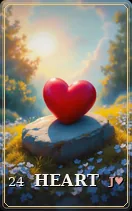 Heart — A love that is beginning; tenderness, sincere affection without calculation.
 House — A small house or a new house; the children at home.
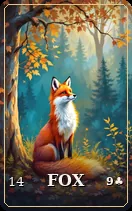 Fox — A new job, an internship; or someone naive faced with a shrewd person.
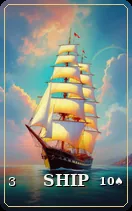 Ship — A short trip; a first step towards something far away.
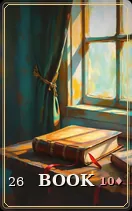 Book — Studies, school, learning; knowledge that is still at the beginning.
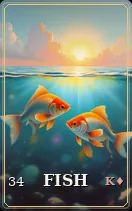 Fish — Little money, a small business; starting to save.
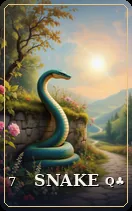 Snake — Naivety exploited; beware of those who take advantage of trust.
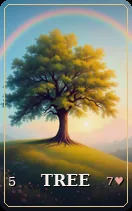 Tree — Energy that renews itself; a fresh start with roots.
 Dog — A new friendship; or a small pet.
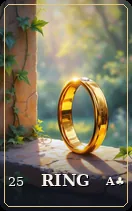 Ring — A recent commitment, an agreement still taking shape.
 Sun — A new joy, a beginning with plenty of light and plenty of future.
 Mountain — A difficult beginning, obstacles right from the first step.
Frequently asked questions
What does the Child mean in the Lenormand?
Beginnings and small things: what has just been born, innocence, inexperience. It can also represent a real child or a young person.
What does the Child mean in love?
A new relationship or a fresh start, with tenderness and lightness. The warning is about immaturity: it may be a love that is still fragile, or someone who is not ready for commitment.
Does the Child always represent a child?
No. It can represent a real child, but it is used above all as a quality: it makes the card beside it small and new.
Is the Child a yes or a no?
Yes, but a yes of beginnings: the thing is starting, and it will need time and care to grow.
Which playing card corresponds to the Child?
The jack of spades, ever since the first deck of c. 1799. The jack is the youngest figure among the playing cards.
No sign-up · Reading written on the spot · Free