The Mountain: meaning of Lenormand card 21
The Mountain is card 21 of the Lenormand and the card of obstacles. A high, steep peak rises in the middle of the road. You cannot leap over it or push it aside: either you climb it, slowly, or you go round it. That is the meaning of the card — something is blocking the way, holding things up, demanding more time and effort than expected.
The Mountain is not a card of catastrophe. It does not destroy like the Scythe, it does not close like the Coffin, it does not confuse like the Clouds: it simply holds things back. That is why it is, above all, the card of delay and patience. But it also has the other face of every mountain: whoever reaches the top can see far. The obstacle is real, and it is also a challenge that, once overcome, leaves the querent stronger and with a broader view.
The card at a glance
| Number | 21 |
|---|---|
| Playing card | Eight of Clubs (8♣) |
| Lenormand names | Der Berg (German); The Mountain (English); La Montagne (French) |
| Type | Circumstance — obstacle, delay |
| Keywords | obstacle, blockage, delay, difficulty, resistance, challenge, distance, effort, patience |
| Timing | Slow: delays, waiting, matters that stand still |
| Yes or no | No, not for now — or not without a great deal of effort |
The image on the card
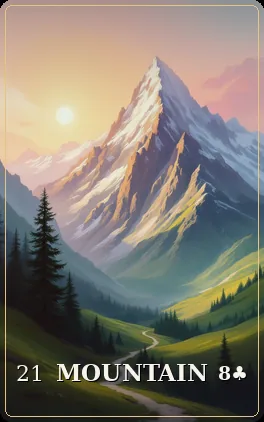
In the Sol da Alma Lenormand, the Mountain is a tall, sharp alpine peak, snow-covered on its summit and ridges, painted gold and pink by the low sun. The sun is on the left, pale, in a peach-coloured sky with pinkish clouds. At the foot of the mountain stretches a green valley, with grassy slopes and patches of dark pines; in the foreground, a large pine on the left and a dirt path winding through the valley towards the peak. In the corner, the number 21 and the eight of clubs.
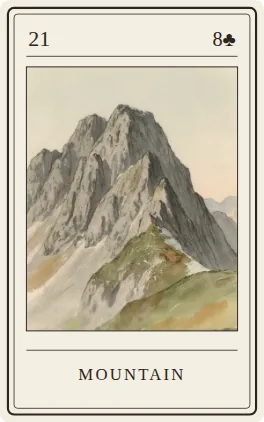
In the Engraved Lenormand, the Mountain is a massif of grey rock, with several jagged, craggy summits, small patches of snow and slopes of loose stone. In front, a ridge of green and yellowish grass rises up to the rock. The sky is clear, beige and pinkish, and in the background on the right other, paler mountains can be seen. There is no path and there are no trees. The two pictures show the same thing — the bulk of the mountain filling the whole horizon; the engraving stresses the hardness of the stone and the lack of a way through; the Sol da Alma adds the light on the summit and the path in the valley, and with them the idea that the obstacle, however large, can be crossed.
The symbolism, detail by detail
- The mountain
- The large, fixed obstacle that does not depend on the querent’s will. It is not a problem that can be solved with a conversation: it is a reality that has to be dealt with.
- The height
- The scale of the effort. The higher the mountain, the longer it takes to climb. The card asks you to measure the difficulty before tackling it.
- The bare rock
- Hardness, coldness, resistance. Sometimes the obstacle is a person, an institution or a circumstance that simply will not give way.
- The snow on the summit
- What is at a standstill, frozen. It is the exact image of a matter that is not moving. But snow also melts: the blockage has an end date.
- The light on the peak
- In the Sol da Alma painting, the sun touches the summit first. It is the reward for whoever climbs: the wide view, perspective, success achieved through effort.
- The path in the valley
- In the Sol da Alma, the trail winding towards the mountain: there is always a way forward, even if it is long and full of bends.
- The eight of clubs
- Many Lenormand readers see clubs as the suit of difficulties and hard work. It reinforces the laborious side of the card: what the Mountain asks for is effort.
The history of the Mountain
The Mountain was already card 21 of ‘Das Spiel der Hoffnung’, the Game of Hope published by Johann Kaspar Hechtel in Nuremberg around 1799, with the eight of clubs in the corner. It was a board game — thirty-six cards laid out on the table and moved across with dice — and the miniature playing cards meant it could also be used to tell fortunes.
Only after the death of Marie Anne Lenormand in 1843 did publishers give it the name of the Parisian fortune-teller, to cash in on her fame; nobody knows whether she ever used it. In Portugal and Brazil the deck is the ‘Baralho Cigano’, the Gypsy Deck, a popular name with no historical connection to the Romani people.
In many traditional Lenormand readings, the Mountain is also an adversary: a person or a force that stands in opposition and blocks the way. This meaning applies above all when the card falls next to a person card.
The meaning of the Mountain
The Mountain is the card of the obstacle. It says there is something between the querent and what they want: a delay, a difficulty, resistance, a person who stands in the way, a circumstance that will not change. The matter is not moving at the expected pace, and forcing it will not help.
It is also the card of delay. Often the Mountain does not say ‘no’ — it says ‘not yet’. Processes that drag on, answers that do not come, plans put on hold. It can also speak of distance: a mountain separates, and there are situations in which it represents people or places that are far away and hard to reach.
But the Mountain is also challenge and achievement. Whoever climbs it grows stronger, gains perspective and learns patience. That is why, next to positive cards, it can announce a success that is hard-won but solid — earned step by step. What it asks for is realism: recognising the size of the obstacle, choosing the route and accepting the time it will take.
The Mountain in love
In love, the Mountain speaks of obstacles: physical distance, differences that are hard to overcome, families who object, a person who does not open up, a relationship that is going nowhere. It can describe a phase of coldness or emotional blockage, in which each person seems to be on their own side of the mountain.
For those who are single, it usually indicates that love is slow in coming or that something is holding back a meeting — sometimes external, sometimes internal: fears, wounds, excessive demands. It is not a sentence: the Mountain says the road is longer, not that it does not exist. Next to the Heart, it is a love facing obstacles; next to the Ship, a long-distance relationship; next to the Key, the blockage finally resolved.
The Mountain in work and money
At work, the Mountain announces difficulties and delays: projects that get stuck, bureaucracy, stiff competition, a boss or colleague who blocks the way, an answer that does not come. It is a card of hard work and persistence. In a question about a new job, it says the process will take time or there are obstacles to overcome; in a question about a project, that it will demand more effort than planned, but can reach the top.
In money matters, it indicates blockages: late payments, money that does not come in, investments that are not paying off for now, difficulty getting credit. It is not a card of loss like the Mice, but of standstill. Next to the Fish, money held up or a stalled deal; next to the Anchor, a difficult but stable situation; next to the Key, the solution to a financial problem that had been dragging on.
The Mountain in health and wellbeing
In questions about wellbeing, the Mountain speaks of accumulated tiredness, of a recovery that calls for patience and of effort that must be carefully measured. It invites you to respect your own limits and move forward step by step. As always with the Lenormand, the reading shows tendencies and attitudes, and it is no substitute for any medical consultation or health care.
The Mountain as a person
As a person, the Mountain describes someone hard to reach: cold, stubborn, inflexible, who will not give way or be persuaded. It may be an adversary, someone who opposes or obstructs — a rival, an uncooperative superior, a relative who will not accept a decision. In other contexts, it is simply a distant person, physically or emotionally. In the best sense, it is someone solid, resilient and persevering, who is not easily shaken.
The Mountain as advice
As advice, the Mountain says: be patient and do not force things. Accept that some things take their time, measure the obstacle, choose between climbing and going round. Break the journey into stages, save your strength, persevere. And if the obstacle is a person, do not waste energy trying to push them aside — look for another way through.
The timing of the Mountain
The Mountain is one of the slowest cards in the deck. It announces delays, waiting, matters that stand still for weeks or months. Next to a fast card, such as the Rider, the news arrives, but the matter is slow to be resolved; next to the Key or the Sun, the blockage lifts sooner than feared; next to the Anchor, it is here to stay.
In the Grand Tableau: house 21
In the Grand Tableau — the spread of all thirty-six cards laid out in four rows — the twenty-first position is the house of the Mountain. The card that falls there shows where the obstacle lies in the querent’s life, or what is being delayed. And the Mountain itself, wherever it falls, brings delay and resistance to the theme of that house: that matter is going to call for patience.
Combinations with other cards
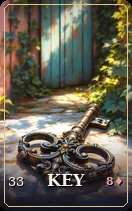 Key — The obstacle overcome; the solution to a problem that seemed to have no way out.
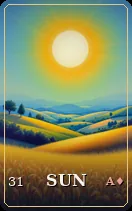 Sun — Success after a great deal of effort; the difficulty conquered.
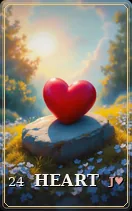 Heart — A love facing obstacles; blocked feelings.
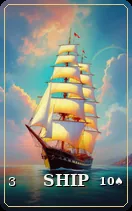 Ship — A great distance; a difficult or postponed journey.
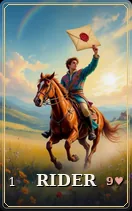 Rider — News that is slow to come; a delayed arrival.
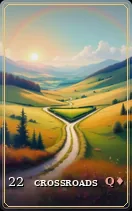 Crossroads — A difficult choice; or a detour to get round the obstacle.
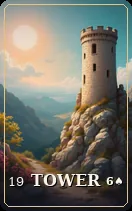 Tower — Bureaucracy, an official process at a standstill; an institution that blocks the way.
 Fish — Money held up, late payments, a stalled deal.
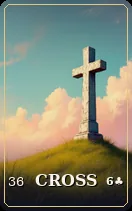 Cross — A hard period, a trial that demands great strength.
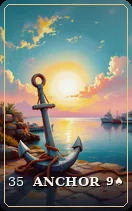 Anchor — A difficulty that settles in; a long-lasting blockage.
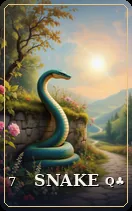 Snake — An adversary, a rivalry that blocks the road.
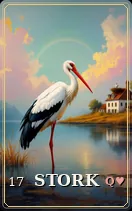 Stork — A change held up or postponed, meeting resistance.
Frequently asked questions
What does the Mountain mean in the Lenormand?
Obstacle and delay: something blocking or holding up the matter. It calls for patience and effort, but it is not an ending.
Is the Mountain a bad card?
It is a difficult card, not a disaster card. It holds things back but does not destroy; and next to positive cards it can announce a success won through effort.
What does the Mountain mean in love?
Obstacles in the relationship — distance, coldness, opposition from others — or a love that is slow to arrive. The road is longer, but it exists.
How long a time does the Mountain indicate?
A long time: it is one of the slowest cards in the deck. It speaks of delays of weeks or months, depending on the cards alongside.
Is the Mountain a yes or a no?
For now, no. If the question is about a short timeframe, it is a no; if it is about a long-term goal, it is a ‘yes, but with effort and time’.
No sign-up · Reading written on the spot · Free