
The Bouquet: meaning of Lenormand card 9
The Bouquet is the card of what is given. A bunch of flowers tied with a ribbon, ready to be handed over: it is not a necessity, it solves no practical problem, and yet it changes the day of whoever receives it. That is exactly what the card brings to a reading — a lovely gesture, a moment of joy, a recognition that arrives without being asked for.
It is one of the kindest cards in the Lenormand. Wherever it falls, it softens: a difficult conversation becomes more cordial, a meeting gains charm, a piece of work is finally recognised. Like every Lenormand card, it needs its neighbours to say what kind of gift it is — an invitation, a compliment, a job offer, real flowers — but the tone it gives the sentence is almost always the same: pleasant, light and welcome.
The card at a glance
| Number | 9 |
|---|---|
| Playing card | Queen of Spades (Q♠) |
| Lenormand names | Der Blumenstrauß (German); The Bouquet (English); Le Bouquet (French) |
| Type | Circumstance — gift, joy |
| Keywords | gift, courtesy, joy, invitation, recognition, beauty, kindness, gratitude |
| Timing | Brief and pleasant: days or weeks; sometimes a festive date |
| Yes or no | Yes — and gladly |
The image on the card
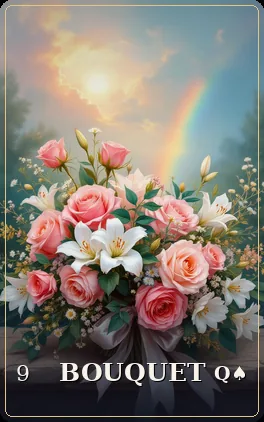
In the Sol da Alma Lenormand, the Bouquet is a lavish bunch of pink and salmon roses, interspersed with white lilies with golden stamens, small white and yellow wild flowers and buds that have not yet opened. It is tied with a wide silvery-grey satin ribbon whose ends fall over a stone wall. Behind it, the sky opens onto a golden sun among the clouds, and a rainbow comes down on the right, against a background of softly blurred trees. In the corner, the number 9 and the queen of spades.
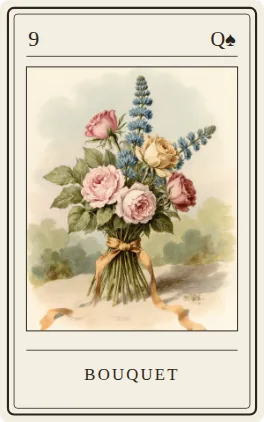
In the Engraved Lenormand, in the manner of the old prints, the bunch is smaller and simpler: half a dozen roses — pink, one pale yellow, one crimson — with spikes of blue flowers and green leaves on long stems, tied with a bow of orange ribbon whose ends trail along the ground. The bouquet stands upright on pale ground, with green shrubs behind and a faded sky. Both images say the same thing — flowers cut and tied to be given — but the Sol da Alma paints the celebration, and the engraving paints the gesture.
The symbolism, detail by detail
- The cut flowers
- Something of no practical use, and valuable precisely for that reason: beauty, pleasure, the luxury we cannot do without. Cut flowers do not last long — the card speaks of real joys, but joys of the moment.
- The tied bunch
- Flowers chosen and gathered by someone. This is not a garden that grows by itself: it is a deliberate gesture, made with another person in mind.
- The ribbon
- The wrapping, the way of giving. The Bouquet is also the card of good manners: how things are said and offered counts as much as what is offered.
- The roses
- In the Sol da Alma painting, pink roses dominate — tender affection, admiration and warmth rather than passion.
- The white lilies
- They appear in the Sol da Alma bouquet and recall the purity of intentions: the gift is given with no ulterior motive. The Lily, however, has its own card, number 30, which speaks of something else.
- The rainbow and the sun
- In the Sol da Alma, the sky opening behind the bouquet shows the card’s effect: after a grey spell, something brings cheer and reconciliation.
- The queen of spades
- It is one of the four Queens in the deck. Those who read the court cards of the playing cards as people see a woman here — usually someone who brings the gift or the joy the card speaks of.
The history of the Bouquet
The Bouquet was already card 9 in ‘Das Spiel der Hoffnung’, the Game of Hope published by Johann Kaspar Hechtel in Nuremberg around 1799, with the queen of spades in the corner. It was a board game of thirty-six cards, played with dice, and the miniature playing cards meant it could also be used to tell fortunes.
The deck began to be sold under the name of Marie Anne Lenormand after her death in 1843 — she was the most famous fortune-teller in Paris — although there is no evidence that she ever used it. In Portugal and Brazil it became known as the ‘Baralho Cigano’ (‘Gypsy deck’), a popular name that does not reflect any historical Romani origin. In Brazil card 9 is often called ‘Buquê’; in Portugal, ‘Ramalhete’ or ‘Flores’.
In the nineteenth century a bunch of flowers was one of the most common and most codified of gifts: it was offered on visits, on birthdays and in courtship, and there were even whole books on what each flower meant. The card inherits that world of courtesy — the world of a society in which a well-made gesture could say more than an entire letter.
The meaning of the Bouquet
The Bouquet is the card of gifts, in every sense: a material present, an invitation, a compliment, a thank-you, a favour, a pleasant surprise. It speaks of what is given and received with pleasure, and also of the ability to receive — to accept the kindness of others without suspicion.
It also concerns beauty and good manners: aesthetics, elegance, the art of pleasing, care for one’s appearance, tact in dealing with people. In a reading about a conflict, it is one of the best cards that can come up — it says there is room for cordiality, for an apology, for a gesture that eases the tension.
It is a thoroughly positive card, and it has the peculiarity of rubbing off on its neighbours. Next to a heavy card, it does not cancel it out, but it makes it lighter: a separation handled with respect, difficult news broken gently. The only warning it carries is about surfaces — a bouquet is beautiful, but it wilts. Sometimes the card speaks of a friendliness that is just that, courtesy, with nothing deeper behind it.
The Bouquet in love
In love, the Bouquet is the card of courtship: flowers, dinner invitations, attentions, compliments, the lovely phase in which two people make an effort to please each other. For someone who is single, it announces admiration, an invitation, someone who notices. In a relationship, it speaks of affection openly shown, of a gesture that rekindles tenderness, of an anniversary celebrated.
It is also the card of gentle reconciliation: after a quarrel, the Bouquet is the step one of the two takes to make peace. Next to the Heart or the Ring, the reading is a very happy one; next to the Fox, it is worth asking whether so much attention is sincere; next to the Clouds, the gesture is there, but the intention is not yet clear.
The Bouquet in work and money
At work, the Bouquet is recognition: praise from your boss, a favourable appraisal, an award, an invitation to join a project, an attractive offer. It favours a good atmosphere — friendly colleagues, satisfied clients — and professions connected with beauty, aesthetics, flowers, decoration, hospitality and events.
In money matters, it can point to a gift, a bonus, help that arrives unasked, or money spent on beautiful things. With the Fish, it is a pleasant gain; with the Mice, a present that costs more than it should, or spending on luxuries.
The Bouquet in health and wellbeing
In questions about wellbeing, the Bouquet speaks of joy, of good spirits, of taking care of yourself with pleasure — a beauty treatment, an outing, a well-spent moment of rest. It is a card of lifting moods. As always in the Lenormand, the reading shows tendencies and attitudes, and it does not replace any medical consultation or care.
The Bouquet as a person
When it describes someone, the Bouquet is a pleasant, well-mannered, thoughtful person, with taste and charm — someone who is a good host, who remembers dates and who puts others at ease. Because of the queen of spades, it is often a woman. The less attractive side is vanity, or a kindness that serves to please everyone and commits to no one.
The Bouquet as advice
As advice, it says: be kind. Say thank you, pay a compliment, give something, accept the invitation. A gesture of courtesy can settle what an argument could not. And it also says: accept what you are offered — there are times when the hardest thing is to receive.
The timing of the Bouquet
The Bouquet is neither one of the fastest cards nor one of the slowest. It speaks of days or a few weeks, and it tends to be linked to occasions — a birthday, a party, a special date, the spring. What it brings is pleasant but, like flowers, it does not last for ever: it is worth making the most of it.
In the Grand Tableau: house 9
In the Grand Tableau — the thirty-six cards laid out in rows — the ninth position is the house of the Bouquet. The card that falls there shows where joy, gifts or recognition come from in the life of the person asking. And the Bouquet itself, wherever it falls, brings courtesy and pleasure to the theme of that house: in the house of the Book, the pleasure of learning; in that of the Tower, an institution that gives recognition.
Combinations with other cards
 Heart — A declaration of love, flowers from someone who cares, affection openly shown.
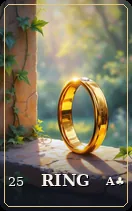 Ring — A marriage proposal or a commitment celebrated; a contract on good terms.
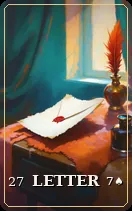 Letter — A written invitation, a card, a thank-you message.
 Rider — A pleasant visit; someone who arrives with a present.
 Fox — Kindness with an agenda; a gift with ulterior motives.
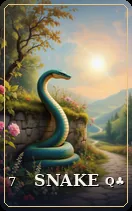 Snake — Calculated charm, seduction with a purpose; beware of flattery.
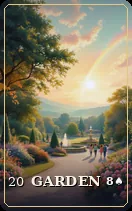 Garden — A party, a celebration, an invitation to a public event.
 Fish — A bonus, an unexpected gain, money given as a gift.
 Sun — Great joy, public recognition, a success celebrated.
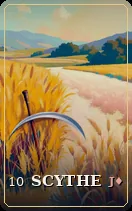 Scythe — A sudden, pleasant surprise; or a gift that cuts a situation short — a farewell made with elegance.
 House — A party at home, a beautiful house, a visitor warmly welcomed.
 Cross — A gesture that lightens a burden; comfort in a difficult period.
Frequently asked questions
What does the Bouquet mean in the Lenormand?
Gifts, invitations, courtesy and joy: a lovely gesture, recognition, a pleasant surprise. The neighbouring cards say what kind of gift it is.
What does the Bouquet mean in love?
Courtship, attentions, flowers, compliments — the phase in which two people make an effort to please. In a relationship, it speaks of affection openly shown or of a gentle reconciliation.
Is the Bouquet a yes or a no?
Yes, and one of the most pleasant in the deck. Next to heavy cards, it is still a yes, but a more modest one.
Which playing card corresponds to the Bouquet?
The queen of spades, ever since the first deck of c. 1799. Because it is a queen, some readers also read the Bouquet as a woman.
Are the ‘Ramalhete’ and the ‘Buquê’ the same card?
Yes. ‘Buquê’ is the name most used in Brazil; in Portugal it is called ‘Ramalhete’. In English it is the Bouquet, and it is always card 9 of the Lenormand.
No sign-up · Reading written on the spot · Free