
The Clover: meaning of Lenormand card 2
The Clover is the second card of the Lenormand and one of the most pleasant to draw. It is the card of small luck: the coincidence that solves a problem, the money that turns up just when it was needed, someone’s smile on the right day, the relief that comes without having been asked for. Nothing grand — but it is precisely because it is small that the Clover is so reliable.
There is, however, one condition that always comes with this card: its luck is short-lived. The Clover does not speak of fortunes or of lasting change; it speaks of windows that open for a little while. Whoever draws it in a spread is invited to stay alert, because the opportunity is there, but it will pass. And, like every Lenormand card, the Clover is read with its neighbours: it lends a touch of luck to the matter beside it and, next to a difficult card, makes it lighter.
The card at a glance
| Number | 2 |
|---|---|
| Playing card | Six of Diamonds (6♦) |
| Lenormand names | Der Klee (German); The Clover (English); Le Trèfle (French) |
| Type | Circumstance — luck, opportunity |
| Keywords | small luck, passing relief, happy chance, opportunity, lightness, gambling |
| Timing | Quick and brief: days, rarely more than two weeks |
| Yes or no | Yes — but a small yes, and a yes for now |
The image on the card
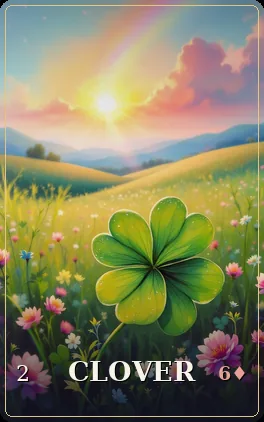
In the Sol da Alma Lenormand, the Clover fills almost the whole card: a large clover, with broad heart-shaped leaves of a vivid green sprinkled with drops of dew, rises on a slender stem in the middle of a meadow full of pink, white, yellow and blue flowers. Behind it are gentle hills, a few trees, bluish mountains and a low sun, with rosy clouds and a rainbow arching across the sky. It is an image of morning, of freshness and of promise. In the corner, the number 2 and the six of diamonds.
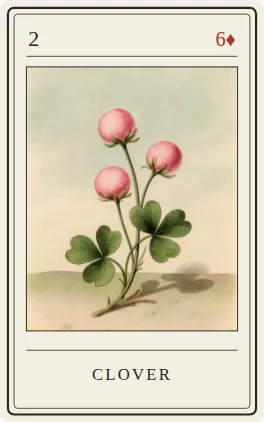
In the Engraved Lenormand, in the manner of the botanical illustrations of the 1800s, the scene is more modest: a common clover plant, with three-part leaves and three round pink flowers, grows alone on bare earth beneath a clear sky, casting a short shadow. It is clover as you find it by the side of any path — a low-growing, ordinary plant. This difference between the two paintings sums the card up well: the Clover’s luck is a common thing, found on the ground, and not a rare prize.
The symbolism, detail by detail
- The clover
- A small, low-growing plant that springs up in any meadow. It is the image of a luck within everyone’s reach, which does not come from above but from the ground we walk on every day.
- The heart-shaped leaves
- In the Sol da Alma painting, the leaves recall open hearts: the Clover’s luck is above all a luck that is felt — relief, joy, good spirits.
- The four-leaf clover
- The four-leaf clover is the popular good-luck charm precisely because it is rare: you come across it by chance, when you are not looking for it. It is the happy accident, the unexpected stroke of luck.
- The dew
- The freshness of the morning, which vanishes as the sun warms up. It is the best image of the Clover’s timing: what it brings is good, but it evaporates if it is not made use of.
- The flowers and the meadow
- The Clover is not alone: it is part of a field full of life. Small luck turns up in the midst of ordinary life, not outside it.
- The rainbow
- The sign that appears after the rain. It says that the Clover is often the relief that follows a difficult phase.
- The six of diamonds
- In the ordinary pack, the suit of diamonds is the suit of material things and money, which gives the Clover a practical leaning: luck in concrete things, small gains, tangible help.
The history of the Clover
The Lenormand was born from a board game: ‘Das Spiel der Hoffnung’, the Game of Hope, published by Johann Kaspar Hechtel in Nuremberg around 1799. It consisted of thirty-six illustrated cards that were laid out on the table and moved across with dice, and each one bore a miniature playing card in the corner, so that the deck could also be used for fortune-telling. The Clover already held second place, right after the Rider, with the six of diamonds.
The name ‘Lenormand’ only came after the death in 1843 of Marie Anne Lenormand, the most famous Parisian fortune-teller of her time: publishers used her fame to sell the deck, although it has never been proved that she used it. In Portugal and Brazil, the same deck acquired the popular name of ‘Baralho Cigano’, the Gypsy Deck — a name that links it to fortune-tellers, not to a Romani origin, which it does not have.
The clover is a natural choice for a card of luck. In European folk tradition, finding a four-leaf clover has always been a sign of good fortune, precisely because it is so rare. The card inherits that idea, but with the restraint typical of the Lenormand: it does not speak of treasure, it speaks of the clover — a luck that fits in the palm of your hand.
The meaning of the Clover
The Clover is the card of small strokes of luck: a favourable chance, an unexpected opportunity, help that turns up at the right moment, a pleasant surprise. It brings lightness and good spirits, and usually indicates that the situation is easier than it looks. In many spreads, it is the sign that you can breathe again.
Its strength lies in its speed and its measure. The Clover does not build anything lasting; it opens a window. If the opportunity is not taken, the window closes. That is why the card asks for attention to the present: what it announces is to be seized now, without elaborate plans. It also has its gambling side — bets, raffles, small risks —, but it is worth remembering that this is a short-lived luck, and not an invitation to risk everything.
Where the Clover shows most is beside the heavy cards. Next to the Cross, the Clouds or the Mountain, it does not erase them, but it softens them: it is the break, the breathing space, the small victory in the midst of difficulty. It is a card of concrete hope, without illusions.
The Clover in love
In love, the Clover speaks of happy encounters and light-hearted moments: a romance that begins in a relaxed way, a flirtation, a chance reunion, a conversation that goes well. For anyone who is single, it says that an opportunity may come along when least expected, and that it is worth being open to it.
In a relationship, it brings a good, uncomplicated phase of laughter and closeness, or relief after an argument. What it does not bring, on its own, is commitment: the Clover is more the happy beginning than the guaranteed future. Next to the Ring or the Anchor, the luck may settle; next to the Ship or the Crossroads, it is a passing encounter.
The Clover at work and with money
At work, the Clover announces an opportunity that arises suddenly: a vacancy that comes up, a chance contact who helps, a task that goes better than expected, a problem that more or less solves itself. It favours those who stay alert and respond quickly. It is not the card of a long-term career, but it is the card of the door that opens.
With money, it speaks of modest gains and one-off help: a refund, a discount, a small prize, some extra work. It may indicate luck in games of chance, but only in a small way. Next to the Fish, it is money that comes in unexpectedly; next to the Mice, the luck does not make up for the losses — it is a small breathing space in a period of attrition.
The Clover in health and wellbeing
In questions of wellbeing, the Clover speaks of improvement, relief, good spirits and a lighter phase after a tiring period. It suggests that laughter, fresh air and small pleasures do you good. As always with the Lenormand, a reading shows tendencies and attitudes, and it is no substitute for any consultation or any medical care.
The Clover as a person
When it describes someone, the Clover is a cheerful, easy-going and optimistic person, who always seems to have a bit of luck and who makes things lighter around them. It may be someone who turns up by chance and helps, or fun company. The flip side is lightness: they are not always the person you can count on in the long run, and sometimes they like the game more than the commitment.
The Clover as advice
As advice, the Clover says: make the most of it. Keep an eye out for small opportunities and do not let them slip by while you wait for a bigger one. Take a small risk, light-heartedly, and do not take everything so seriously. But do not bet what you cannot afford to lose — the Clover’s luck is good, and it is short.
The timing of the Clover
The Clover is a fast card of short duration. What it announces usually happens within days, and rarely lasts more than a week or two. It is the luck of the moment. Next to slow cards, such as the Tree or the Anchor, the opportunity arrives quickly, but its fruits may last; next to the Rider or the Scythe, everything happens in the blink of an eye.
In the Grand Tableau: house 2
In the Grand Tableau — the thirty-six cards laid out in four rows —, the second position is the house of the Clover. The card that falls there shows where the small luck of the moment lies, what is going well without effort, or where there is an opportunity that should not be missed. And the Clover itself, wherever it falls, gives the theme of that house a touch of relief and luck.
Combinations with other cards
 Rider — Unexpected good news; an opportunity that arrives quickly.
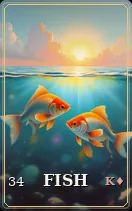 Fish — A small gain, money that turns up by chance.
 Heart — A happy encounter, a light romance, luck in love.
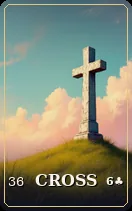 Cross — Relief in the midst of a difficult phase; the burden becomes lighter.
 Clouds — Luck that is hard to make out, or an opportunity clouded by doubts.
 Sun — Great luck and success: a phase in which everything goes well.
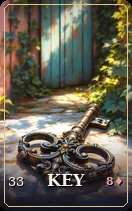 Key — The right opportunity, the solution that appears at exactly the right moment.
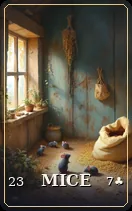 Mice — Luck lost through carelessness; a wasted opportunity.
 Mountain — An obstacle that gives way by chance; a let-up in a deadlock.
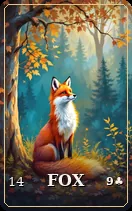 Fox — Apparent luck that hides a trick; beware of what seems too easy.
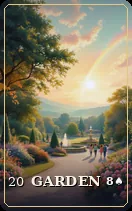 Garden — Luck at social events, a happy contact at a party or in a group.
Frequently asked questions
What does the Clover mean in the Lenormand?
Small luck: a happy chance, an unexpected opportunity, relief that comes without being asked for. It is short-lived luck, best made use of straight away.
Is the Clover a good card?
Yes, it is one of the positive cards in the deck. But its luck is modest and fleeting, and it does not settle the big matters on its own.
What does the Clover mean in love?
Happy encounters, flirtation, a light and fun phase in a relationship. It speaks more of pleasant beginnings than of lasting commitments.
Is the Clover a yes or a no?
Yes — a small, quick yes. It says the answer is favourable, especially if the question is about something immediate.
Which playing card corresponds to the Clover?
The six of diamonds, ever since the first deck, the Game of Hope of c. 1799.
No sign-up · Reading written on the spot · Free