
The Snake: meaning of Lenormand card 7
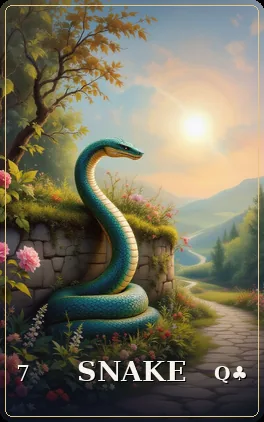
The Snake is the seventh card of the Lenormand and one of those that most demand attention. A coiled serpent raises its head and watches. It is not striking, but it is alert, and its body traces exactly what the card means: a path that does not run straight. Where the Snake appears, things get complicated, go round in circles, call for care.
It has a reputation as a bad card, and understandably so: in many readings it speaks of betrayal, of envy, of a person who cannot be trusted. But the Snake is not only that. It is also intelligence, prudence, the ability to get round an obstacle rather than crash into it head-on. Often what it describes is not bad faith but simply a necessary detour — the long way round that has to be taken to get where you want to go. The neighbouring cards say whether the serpent is the danger or the cunning.
The card at a glance
| Number | 7 |
|---|---|
| Playing card | Queen of Clubs (Q♣) |
| Lenormand names | Die Schlange (German); The Snake (English); Le Serpent (French) |
| Type | Circumstance and person — detour, complication |
| Keywords | detour, complication, roundabout way, caution, cunning, temptation, rivalry, an experienced woman |
| Timing | Slow and winding: the matter goes round in loops before it arrives |
| Yes or no | Not directly — perhaps, but by an indirect route |
The image on the card
In the Sol da Alma Lenormand, the Snake is a large serpent with gleaming blue-green scales and a creamy yellow belly, coiled in several loops on the ground beside a low stone wall covered in moss and flowers. It holds its neck up high and looks to the right, its mouth closed. All around are pink, white and red flowers; behind it, a tree with golden autumn leaves. On the right, a flagstone path winds into the distance, through a green valley with pine trees, up to the sunlit hills. The path, like the snake, twists and turns. In the corner, the number 7 and the queen of clubs.
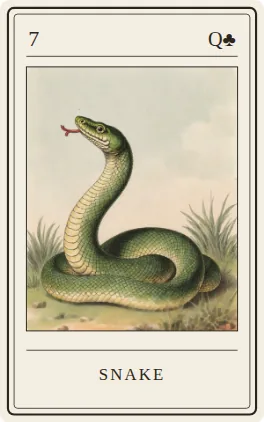
In the Engraved Lenormand, in the manner of the natural history illustrations of the 1800s, the Snake is a green serpent with a cream belly and finely drawn scales, coiled up on itself on bare earth among tufts of grass. It raises its head, with a watchful yellow eye, and flicks out its forked red tongue. This is the image closest to the card’s traditional description — the serpent with its head raised and its tongue out —, while the Sol da Alma picture adds the garden, the wall and the winding path.
The symbolism, detail by detail
- The serpent
- An animal that does not move in a straight line. On the card, it is the image of everything that comes by indirect routes: complications, detours, manoeuvres.
- The coils
- Complication, entanglement, the situation that keeps turning back on itself. Also contained strength: a coiled snake is ready to move.
- The raised head
- Attention, vigilance, intelligence. The Snake watches before it acts.
- The flicking tongue
- In the Engraved Lenormand, the forked tongue recalls double-dealing words: what is said one way and meant another, flattery, intrigue.
- The winding path
- In the Sol da Alma painting, the flagstone path repeats the shape of the serpent: there is a way to get there, but it is not the shortest.
- The wall and the garden
- The snake is in a garden full of flowers. It is a reminder that a complication may be hidden in a pleasant place — or that temptation often comes well disguised.
- The queen of clubs
- A female figure. This is the source of one of the most common readings of the Snake: a woman — often older or more experienced —, and, in questions of love, a possible rival.
The history of the Snake
The Snake was already card 7 in ‘Das Spiel der Hoffnung’, the Game of Hope published by Johann Kaspar Hechtel in Nuremberg around 1799, with the queen of clubs in the corner. The game was a board of thirty-six cards moved across with dice, and the miniature playing cards meant the same deck could be used for cartomancy.
The name ‘Lenormand’ came after the death in 1843 of Marie Anne Lenormand, the most famous fortune-teller in Paris, although there is no evidence that she used this deck. In Portugal and Brazil it became known as the ‘Baralho Cigano’, the Gypsy Deck, a popular name that does not correspond to any historical Romani origin.
The serpent carries a long history in European culture — from the serpent of Genesis, associated with temptation, to the serpent coiled around the staff of Asclepius, the symbol of medicine. The Snake card keeps above all the first meaning, that of cunning and danger, but modern reading also recovers the second: wisdom, prudence, the capacity for renewal.
The meaning of the Snake
The Snake is the card of detours and complications: a matter that does not follow a straight line, a process that goes round in loops, an obstacle that forces you to go around it. It may indicate delays, red tape, tangled situations, conversations with ulterior motives. It calls for care and attention to detail and to the small print.
It also has its side as a person and as an intention: envy, jealousy, intrigue, manipulation, someone who cannot be trusted. But it is best not to read the Snake as betrayal every time. Often it describes strategic intelligence, diplomacy, the ability to negotiate and to reach the goal by a longer but safer route. The serpent does not attack head-on — it goes around.
There is also the sense of temptation and desire: something that attracts and may not be good for you. The Snake is a seductive card, and what seduces is not always what it seems. With positive cards beside it, the complication is resolved with intelligence; with negative cards, it is a clear warning to protect yourself.
The Snake in love
In love, the Snake is traditionally the card of the rival: a third person, often a woman, who complicates the relationship. It may also speak of jealousy, mistrust, games of seduction, a relationship that has become complicated or someone who is not entirely sincere.
But it may simply be desire, strong attraction, seduction — an intense and far from simple relationship. For anyone who is single, it calls for care with anyone who seems too good to be true, and attention to hidden intentions. Next to the Ring, it is a relationship with complications; next to the Fox, there is deceit; next to the Heart, a passion that ensnares.
The Snake at work and with money
At work, the Snake indicates a complicated environment: intrigue, competition, disloyal colleagues, bureaucratic procedures, projects delayed by detours. But it can also favour those who know how to negotiate, get round obstacles and think strategically — diplomats, lawyers, negotiators, strategists.
With money, it calls for prudence: contracts with hidden clauses, deals that lack transparency, payments that drag on. With the Fish, money that arrives by indirect routes; with the Mice, losses through deception or bad faith. Read everything carefully before you sign.
The Snake in health and wellbeing
In questions of wellbeing, the Snake calls for attention to detail and patience with processes that take a winding course: the road to feeling better may not be the most direct. It invites you to listen to your body and to seek qualified opinions. As always with the Lenormand, a reading shows tendencies and attitudes, and it is no substitute for any consultation or any medical care.
The Snake as a person
When it describes someone, the Snake is, in the most common reading, a woman — often older, experienced, intelligent and seductive. She may be a rival, an envious or manipulative person, but also a shrewd adviser, a skilful negotiator, someone who knows what she wants and how to get it. She is a person who never reveals herself entirely. The neighbouring cards say whether she is an ally or an adversary.
The Snake as advice
As advice, the Snake says: be prudent and be clever. Do not charge straight at the obstacle — go around it. Watch before you act, read the small print, do not trust at first sight. And it also says: do not be seduced by what is too easy. Sometimes the longest way is the safest.
The timing of the Snake
The Snake is not a fast card: the matter goes round in loops before it arrives. It indicates delays, detours and complications that stretch out the time, without fixing it precisely. Next to the Rider, the complication arises quickly; next to the Mountain or the Anchor, the process drags on.
In the Grand Tableau: house 7
In the Grand Tableau — the spread in which all thirty-six cards are laid out in four rows —, the seventh position is the house of the Snake. The card that falls there tells where the complication, the detour or the person worth keeping an eye on is to be found. And the Snake itself, wherever it falls, brings detours, a need for caution and, at times, a third person to the theme of that house.
Combinations with other cards
 Heart — A complicated passion; jealousy or rivalry in love.
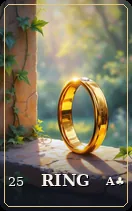 Ring — A commitment with complications; a contract with hidden clauses.
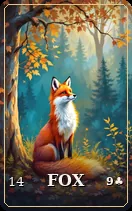 Fox — Deceit, manipulation, two people playing games behind each other’s backs.
 Clouds — A tangled, confusing situation; someone who muddles things on purpose.
 Woman — A cunning woman, a rival, or the woman asking herself acting strategically.
 Man — A man caught up in a complicated situation, or a third person in his life.
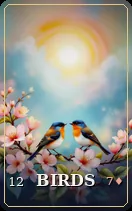 Birds — Intrigue, gossip, spiteful talk.
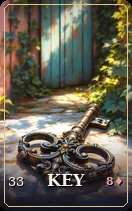 Key — The solution found by an indirect route; the way out of the maze.
 Crossroads — A change of route; a choice that forces a detour.
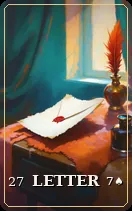 Letter — A message with ulterior motives; a complicated document.
 Sun — The complication is resolved; intelligence leads to success.
 Coffin — A complication that comes to an end; a toxic relationship that ends.
Frequently asked questions
What does the Snake mean in the Lenormand?
Detour, complication, caution: a matter that does not run straight, a person who is not transparent, or the long way round needed to reach the goal.
Does the Snake always mean betrayal?
No. It may indicate bad faith, but also cunning, diplomacy and prudence. It depends on the neighbouring cards.
What does the Snake mean in love?
Traditionally, a rival or a third person; also jealousy, mistrust or a complicated passion.
Does the Snake represent a woman?
Often, yes: because of the queen of clubs, it is read as an experienced, shrewd woman — an ally or a rival, depending on the cards around it.
Is the Snake a yes or a no?
Not directly. It may be a ‘maybe’, but by a long route and with complications.
No sign-up · Reading written on the spot · Free