
The Ship: meaning of Lenormand card 3
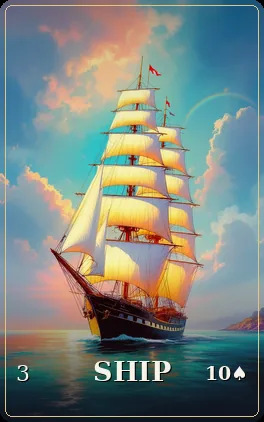
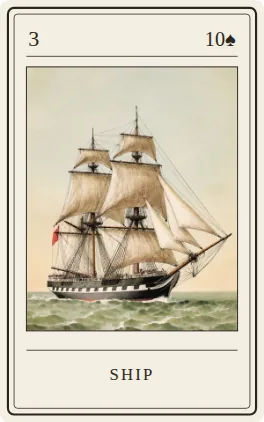
The Ship is the third card of the Lenormand and the great card of distance. A three-masted sailing ship, under full canvas, is moving away from the coast towards the open sea. It carries people, goods, hopes — and leaves behind the harbour it set out from. Everything to do with going far, coming from far or being far away passes through this card.
In a spread, the Ship may be a real journey, but it is not always one. It also speaks of changes in life, of business with other countries, of people who are far away, and of the wish — sometimes the need — to put some distance between yourself and a matter. It is a card of movement, like the Rider, but with a different rhythm: where the Rider gallops, the Ship sails. It goes slowly, and it goes far. The neighbouring cards say where to and why.
The card at a glance
| Number | 3 |
|---|---|
| Playing card | Ten of Spades (10♠) |
| Lenormand names | Das Schiff (German); The Ship (English); Le Navire (French) |
| Type | Event — journey, distance, change |
| Keywords | travel, distance, abroad, what comes from afar, trade, estrangement, longing |
| Timing | Slow but sure: weeks or months |
| Yes or no | Yes, but not yet — the matter still has some way to go |
The image on the card
In the Sol da Alma Lenormand, the Ship is a large three-masted sailing ship with a dark hull and a gold trim, heading straight towards the viewer, all its sails billowing, a warm white gilded by the light. Small red pennants fly at the tops of the masts. The sea is calm and blue-green, with a little foam at the bow; the sky, blue and turquoise, is filling with rosy and orange clouds, and on the right there is a rainbow and, in the distance, a mountainous coast. It is a departure in fair weather. In the corner, the number 3 and the ten of spades.
In the Engraved Lenormand, in the manner of the maritime prints of the early nineteenth century, the Ship is seen side-on: a three-master with cream sails, a black hull with a band of gunports painted in black and white and a red flag at the stern cuts through a green, choppy sea. It is the ship of the age in which the Game of Hope was published — the way to reach other continents and to bring their goods back. In both paintings the ship is sailing with its sails set: it is under way, not at anchor.
The symbolism, detail by detail
- The ship
- The means of transport for great distances. In the days of the first cards, it was the only way to reach distant lands, and it took weeks or months to do so.
- The open sails
- The ship depends on the wind: it moves forward when conditions allow. It is the image of a journey that has to be prepared and needs the right moment.
- The open sea
- The unknown, what lies beyond the horizon. Also the feeling of setting out — adventure and uncertainty.
- The coast in the distance
- The point of departure left behind, or the destination not yet reached. The Ship is always between two places.
- The flags
- Nationality, origin. They are a reminder that the Ship is also the card of foreign lands and of trade between countries.
- The cargo
- You cannot see it, but it is there: a merchant ship carries goods. That is why the card also speaks of trade, of import and export, of far-reaching business.
- The ten of spades
- The playing card the Ship has carried in its corner since the first deck. A ten is the highest of the number cards, and it fits the idea of the card well: a long course, followed through to the end.
The history of the Ship
The Ship was already card 3 in ‘Das Spiel der Hoffnung’, the Game of Hope, which Johann Kaspar Hechtel published in Nuremberg around 1799: thirty-six illustrated cards, with a miniature playing card in the corner, laid out on the table like the board of a dice game. In the Ship’s corner was the ten of spades.
After the death in 1843 of the famous Parisian fortune-teller Marie Anne Lenormand, the deck began to be sold under her name, although there is no evidence that she ever used it. In Portugal and Brazil it became known as the ‘Baralho Cigano’, the Gypsy Deck, a popular name that does not correspond to any historical Romani origin.
For anyone living around 1800, the sailing ship was the most powerful image there was of a great distance. A sea voyage could take months; a letter sent to another continent took a long time to be answered. That experience remained in the card: the Ship is not the card of haste, but of distance overcome with patience — and, often, with longing.
The meaning of the Ship
The Ship is the card of journeys, above all long ones: trips abroad, holidays, emigration, a move to another town or another country. It also speaks of everything that comes from far away — people, news, goods, opportunities — and of what is far away: a relative who has emigrated, a long-distance love, a business in another country.
But the Ship is not only about geography. It is also the card of a change of life, of the wish to get out of a situation, to see the world, to start again somewhere else. It may indicate estrangement — someone distancing themselves from a matter or a person — and the longing that leaves behind. And it has a practical, commercial side: trade, transport, import and export, dealings with the outside world.
The Ship is a neutral to positive card. The journey may be a dream come true just as easily as a separation; the meaning depends on the neighbouring cards. What is constant is the idea of a course to be run: the matter will not be settled here and now, it has some way to go.
The Ship in love
In love, the Ship often speaks of distance: a long-distance relationship, a love who lives in another country, someone who leaves or someone who arrives from far away. For anyone who is single, it may announce a meeting while travelling or with someone from abroad.
In a relationship, it may indicate a drifting apart — emotional or physical —, a phase in which each goes their own way, or the need to take a trip together to renew the bond. Next to the Heart and the Ring, it is a love that crosses the distance; next to the Scythe or the Cross, a painful separation. Longing is the constant note of the Ship in love.
The Ship at work and with money
At work, the Ship favours everything that involves distance and exchange: international trade, tourism, transport, logistics, working abroad, clients from elsewhere. It may indicate a business trip, a transfer, an offer that comes from far away or a change of field that takes time to come about.
With money, it speaks of business that is slow to bring returns but may be profitable — the goods arrive, but not straight away. With the Fish, it is trade that goes well; with the Mice, a loss connected with travel or transport. It calls for patience and a long-term view.
The Ship in health and wellbeing
In questions of wellbeing, the Ship suggests a change of scene, rest away from routine, journeys that do you good. It may also be a reminder of how important it is not to be carried along by the tides — to keep your balance when everything is changing. As always with the Lenormand, a reading shows tendencies and attitudes, and it is no substitute for any consultation or any medical care.
The Ship as a person
When it stands for someone, the Ship is a person who comes from far away or who is far away: a foreigner, an emigrant, a traveller, a trader, someone who works in transport or with other countries. It also describes a temperament: a curious, adventurous person who needs a horizon and rarely stays in the same place for long.
The Ship as advice
As advice, the Ship says: broaden your horizons. Think further ahead, look beyond your usual haunts, risk a change of scene. Sometimes it also says: step back — put some distance between yourself and a problem so as to see it better. And it reminds you that long journeys are prepared with care and made with patience.
The timing of the Ship
The Ship is a card of medium to long timing: weeks or months. What it announces does happen, but not immediately — it has a journey to make. Next to the Rider or the Birds, the departure may come sooner; next to the Anchor, the ship reaches port and the matter settles; next to the Mountain, the journey is delayed.
In the Grand Tableau: house 3
In the Grand Tableau — the spread in which all thirty-six cards are laid out in four rows —, the third position is the house of the Ship. The card that falls there tells what is in transit, what is coming from far away or what change is being prepared in the life of the person asking. And the Ship itself, wherever it falls, brings distance, slow movement or a link with abroad to the theme of that house.
Combinations with other cards
 Rider — News from afar; a journey decided on quickly.
 House — A house move, especially a long way away; a home abroad.
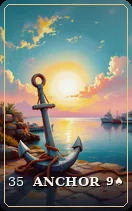 Anchor — Reaching a safe harbour: a journey that ends, settling in another place.
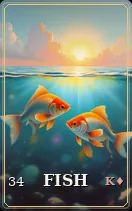 Fish — Profitable trade, business with other countries, money from abroad.
 Heart — A long-distance love, or a love found while travelling.
 Scythe — A sudden departure, a separation, a cancelled journey.
 Crossroads — Several possible destinations; a decision about where to go.
 Mountain — A journey postponed or made difficult; obstacles at a distance.
 Clouds — Muddled travel plans; uncertainty about whether to go or stay.
 Letter — Correspondence from abroad; travel documents.
 Fox — Work abroad, or work connected with travel and transport.
 Moon — A dream journey; recognition that comes from elsewhere.
Frequently asked questions
What does the Ship mean in the Lenormand?
Distance: journeys, foreign lands, what comes from far away, trade and changes of life. Also estrangement and longing.
Does the Ship always mean a journey?
No. It may be a real journey, but also a move, a drifting apart, business with other countries or someone who is far away. The neighbouring cards make it clear.
What does the Ship mean in love?
Often a long-distance relationship or a drifting apart; also a meeting while travelling or with someone from abroad.
Is the Ship a yes or a no?
It leans towards yes, but with time: the matter moves forward, though not immediately.
How much time does the Ship indicate?
Weeks or months. It is a card of slow but sure movement, one that goes a long way.
No sign-up · Reading written on the spot · Free