The House: meaning of Lenormand card 4
The House is the fourth card of the Lenormand and one of the most reassuring in the whole deck. A country house with pale walls and a tiled roof, surrounded by a low wall, awaits whoever arrives. It is one’s own place, the shelter, the place you return to at the end of the day — and everything that represents: family, security, intimacy, what has been built and what you want to keep.
In a spread, the House may literally be the dwelling — a move, a purchase, building work, domestic life —, but it is often more than that. It says that the matter is private, something that happens behind closed doors; that there is a solid foundation; that what is at stake is stability. Beside another card, it usually settles it: it gives it roots, takes away its haste, makes it safer. It is a positive card without being spectacular, and it is always read with its neighbours, which tell what is going on inside that house.
The card at a glance
| Number | 4 |
|---|---|
| Playing card | King of Hearts (K♥) |
| Lenormand names | Das Haus (German); The House (English); La Maison (French) |
| Type | Place and state — home, family, stability |
| Keywords | home, family, security, stability, property, real estate, intimacy, tradition |
| Timing | Stable: what the House brings stays; it takes the time a building takes |
| Yes or no | Yes — a solid yes, especially in matters of family and home |
The image on the card
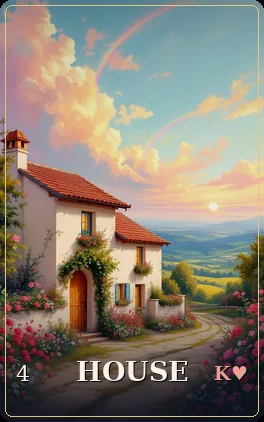
In the Sol da Alma Lenormand, the House is a whitewashed two-storey country house with a red-tiled roof and a chimney topped by a small cowl. The arched wooden door is framed by a flowering climber; the windows have blue shutters and window boxes with pink flowers. A low wall, also white and full of flowers, runs alongside an earth path that curves in front of the house, lined with red and pink rose bushes. In the background there are green and yellow fields, trees, hills, the setting sun and a rainbow in a sky of rosy clouds. It is the hour of coming home. In the corner, the number 4 and the king of hearts.
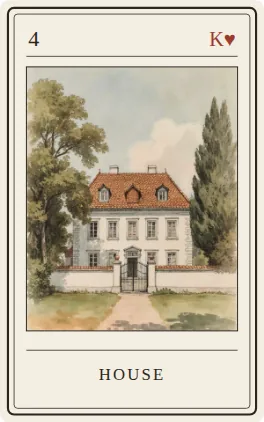
In the Engraved Lenormand, the House is a two-storey manor house seen from the front, with a pale façade and symmetrical windows, an orange-tiled roof with three dormer windows and two chimneys. In front of it there is a low white wall with a wrought-iron gate between two pillars, and an earth path leading up to it. On one side stands a leafy tree; on the other, a tall cypress. The two paintings agree on the essentials — the house seen from the front, the wall, the path that leads to the door —, but the Sol da Alma one is more intimate and more full of flowers, and the Engraved one more solid and formal: one speaks of home, the other of property.
The symbolism, detail by detail
- The house
- One’s own place: the home, the shelter, the property. Also the person on the inside — what is private, what is not shown to the street.
- The roof
- Protection. The family lives under the same roof; the House is what shelters from the weather and from other people.
- The chimney
- The fire in the hearth, a sign that the house is lived in and kept warm. It is domestic life, food on the table, comfort.
- The wall and the gate
- The boundary between inside and outside. The House protects, but it also shuts in: it has its own rules and chooses who comes in.
- The door
- Entrance and hospitality. In the Sol da Alma painting it is surrounded by flowers: this is a house that welcomes.
- The path to the door
- The return. The House is the place you come back to, and the path says that you will get there.
- The king of hearts
- A king, the figure who rules, in the suit of hearts, the suit of the affections. It fits the idea of the card: the house as a place of both authority and affection, the head of the family, the well-run home.
The history of the House
The House was already card 4 in ‘Das Spiel der Hoffnung’, the Game of Hope published by Johann Kaspar Hechtel in Nuremberg around 1799, with the king of hearts in the corner. The game was a board of thirty-six cards moved across with dice, and the miniature playing cards meant the same deck could be used to tell fortunes.
It was only after the death of Marie Anne Lenormand in 1843 that publishers began to give it the name of the celebrated Paris fortune-teller — with no evidence that she used it. In Portugal and Brazil, the deck acquired the popular name of ‘Baralho Cigano’, the Gypsy Deck, which does not correspond to any historical Romani origin, but it kept the same pictures and the same order.
The house is one of the simplest and most universal images in the deck, and perhaps for that reason one of the most stable in reading: from one deck to another the architecture changes — village house, manor house, town house —, but the meaning remains that of home and security.
The meaning of the House
The House is the card of home and family: the dwelling, domestic life, the people you live with, the close family. It speaks of security, stability, roots, everything that gives the person asking a solid foundation. It is also the card of property — real estate, possessions, assets that last.
It has a concrete, practical sense: moving house, buying or selling property, renting, building work, questions with the neighbours. And it has a broader sense: what is one’s own, private, trustworthy. A family business, a business run from home, the inner circle. Beside another card, it says that the matter takes place behind closed doors.
The House is positive, but it has its shadow: what protects can also shut in. In some spreads it speaks of conservatism, of routine, of someone who will not leave their comfort zone, or of family matters that remain unresolved precisely because no one takes them outside. The neighbouring cards say whether the house is at peace or needs airing.
The House in love
In love, the House is one of the most favourable cards for anyone looking for stability: it speaks of living together, of making a home, of a secure relationship with a solid foundation. In an existing relationship, it indicates solidity, shared routine, family as the centre. Next to the Ring or the Heart, it is the plan for a life together.
For anyone who is single, it may say that love will come from close by — from the circle of friends, the family, the neighbourhood — or that there is a need to feel good at home before opening the door to someone. The risk of the House in love is complacency: a comfortable relationship that has stopped growing. Next to the Clouds or the Snake, there is tension behind closed doors.
The House at work and with money
At work, the House indicates stability: a secure job, a sound company, a familiar environment. It favours working from home, family businesses, and professions connected with property, building, interior design and hospitality. It may also indicate a phase in which security is preferred to adventure.
With money, it is the card of property and household expenses: rent, mortgage payments, building work, buying property. It says that the financial base is solid or that it is wise to invest in what lasts. With the Fish, it is a good property deal or a prosperous household; with the Mice, expenses that eat away at the household budget.
The House in health and wellbeing
In questions of wellbeing, the House speaks of rest, of routine, of looking after yourself in a safe environment, of getting your strength back at home. It is a reminder that wellbeing begins with the space you live in and the people you live with. As always with the Lenormand, a reading shows tendencies and attitudes, and it is no substitute for any consultation or any medical care.
The House as a person
When it describes someone, the House is a reliable, home-loving person, close to their family, who values security and tradition. It may be a relative, a neighbour, a landlord, someone who works from home or with houses. Because of the king of hearts, some readers also see in it a family man or a protector. The flip side is rigidity: someone not much given to change, who prefers the familiar to the new.
The House as advice
As advice, the House says: go back to base. Look after what is yours — your home, your family, your health, your finances —, consolidate before taking risks, look for support from the people close to you. It also says: settle at home what belongs at home, discreetly. And sometimes it reminds you that it is good to open the windows.
The timing of the House
The House is not a card of haste: it is a card of permanence. What it announces tends to stay, and its timing is that of a building — weeks or months to settle, and then duration. Next to the Rider or the Crossroads, there is change at home; next to the Anchor or the Tree, the stability is long-term.
In the Grand Tableau: house 4
In the Grand Tableau — the spread in which all thirty-six cards are laid out in four rows —, the fourth position is the house of the House. The card that falls there tells how the home, the family and the foundations of the person asking are faring: what is going on behind closed doors. And the House itself, wherever it falls, brings security, stability and a private character to the theme of that house.
Combinations with other cards
 Ship — A house move, especially a long way away; a home abroad.
 Rider — A visitor at home; family news.
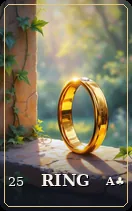 Ring — Living together, commitment to a shared home; a tenancy agreement or a purchase contract.
 Heart — A happy home, love within the family, a relationship that settles.
 Fish — Property, investment in real estate, a prosperous household.
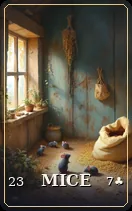 Mice — Household expenses, a house in need of repairs, domestic wear and tear.
 Clouds — Tension or confusion at home; an unclear family atmosphere.
 Snake — Complications behind closed doors; someone who unsettles the family.
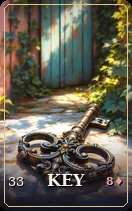 Key — The keys to a new home; a solution to the housing question.
 Child — A family with children; a new beginning at home.
 Anchor — Lasting stability, settling down for good, a home of your own.
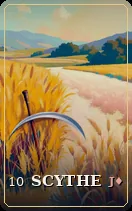 Scythe — A sudden change at home; a decision that cuts ties with the family.
Frequently asked questions
What does the House mean in the Lenormand?
Home, family, security and stability: what is one’s own, private and settled. It may be the actual house or the inner circle of the person asking.
Is the House a good card?
Yes, it is one of the most stable and positive cards in the deck. It only weighs heavy when stability turns into routine or into shutting oneself away.
What does the House mean in love?
A stable relationship with a solid foundation, and often the plan to live together or to start a family.
Does the House indicate moving house?
On its own, it speaks more of stability. Next to the Ship, the Rider or the Crossroads, yes, it can indicate a move.
Is the House a yes or a no?
Yes — a solid yes, especially in questions about home, family and security.
No sign-up · Reading written on the spot · Free