The Woman: meaning of Lenormand card 29
The Woman is card 29 of the Lenormand and, together with the Man, one of the deck’s two person cards. She is not an event or a quality: she is someone. She stands for the querent, when the person asking is a woman, or for the woman at the heart of the question — the partner, the wife, the girlfriend, the love interest, the mother, the colleague, the friend you want to know about.
On her own, the Woman says only that there is a woman involved in the matter. Everything else — what she feels, what she is living through, what worries her, where she is heading — is read in the cards that fall around her and in the direction she is facing. In a large spread she is often the card the reading starts from; in a love question, her position in relation to the Man is, in itself, an important part of the answer.
The card at a glance
| Number | 29 |
|---|---|
| Playing card | Ace of Spades (A♠) |
| Lenormand names | Die Dame (German); The Lady or The Woman (English) |
| Type | Person card — the female significator |
| Keywords | the querent, the woman in the question, the partner, the wife, the love interest, a woman close to you |
| Timing | None: she is a person, not an event |
| Yes or no | Neutral — the answer lies in the cards around her |
The picture on the card
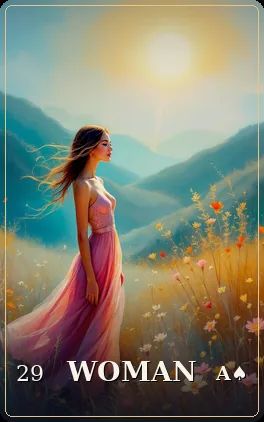
In the Sol da Alma Lenormand, the Woman is a young woman with long brown hair, loose and lifted by the wind, standing in a meadow of tall golden grass dotted with wild flowers — daisies and flowers in orange, pink and yellow. She wears a long pink dress with a strapless lace bodice and a light, sheer skirt that the wind also catches. She is shown in profile, facing to the viewer’s right, her arms hanging by her sides and her face serene. Behind her rise layers of blue-green mountains and, high above, a great pale sun that fills the sky with yellow light.
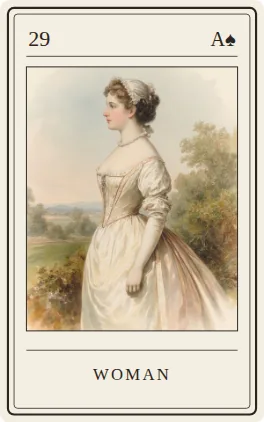
In the Engraved Lenormand, the Woman is a lady from another age, painted in watercolour, in profile and facing left. Her brown hair is gathered in curls beneath a white lace cap; she wears a string of pearls close to her neck and an ivory silk gown with a wide neckline, a fitted buttoned bodice and a full skirt with rosy highlights; her arm is covered by a long glove. Behind her are shrubs and trees with green and golden foliage; to the left, her gaze opens onto a meadow, a valley and bluish hills in the distance. This is the classic Lenormand image: a lady standing, seen from the side, so that you can tell which way she is looking.
The symbolism, detail by detail
- The standing figure
- The whole person, present. The Woman, like the Man, does nothing on the card — she simply is. What she does and what she is living through is told by the neighbouring cards.
- The profile
- The direction of her gaze, which is the key to the reading. In the Engraved deck the Woman looks to the left; in the Sol da Alma deck, to the right. What lies ahead of her is read on that side.
- The windswept hair
- In the Sol da Alma deck, freedom and inner movement: a woman who feels what is happening around her and lets herself be touched by it.
- The open landscape
- In both paintings, the wide horizon in front of the figure: the life that stretches ahead, with room to choose.
- The sun
- In the Sol da Alma deck, the light on the side she is looking towards: the direction in which she places her hope.
- The cap, the pearls and the gloves
- In the Engraved deck, a woman composed and presented to the world in the manner of her time — the outward signs of the person and of her place.
- The ace of spades
- Spades is the suit of Air — of thought, of the word, of decision; the Ace is its seed. It places clarity of mind and the ability to decide at the centre of the Woman, just as the ace of hearts gives the Man the capacity to feel.
The history of the Woman
The Woman is one of the thirty-six cards of ‘Das Spiel der Hoffnung’, the Game of Hope, published around 1799 in Nuremberg by Johann Kaspar Hechtel — a board game made of illustrated cards, each bearing a miniature playing card. In German decks, card 29 is called ‘Die Dame’, the lady, and forms a pair with ‘Der Herr’, the gentleman, card 28. Ever since, it has kept its place as number 29 and the ace of spades.
The name ‘Lenormand’ was given to the deck after the death in 1843 of Marie Anne Lenormand, the most famous fortune-teller in Paris, by publishers who wanted to cash in on her fame; there is no evidence that she ever used it. In Portugal and Brazil it is the ‘Baralho Cigano’, the Gypsy Deck, a popular name with no historical Romani origin. In Brazil the Woman is often called ‘a Cigana’, the Gypsy Woman, and the Man ‘o Cigano’, the Gypsy Man.
Having a card to represent the person asking — the ‘significator’ — was already customary in fortune-telling with playing cards. The Lenormand builds it into its thirty-six cards: one female and one male figure, full length and in profile.
The meaning of the Woman
The Woman has no meaning of her own beyond being a person. When she appears in a spread, she says that a woman is involved in the matter; when the person asking is a woman, she represents her. It is from this card that the querent’s life is read: what surrounds her, what occupies her, what is coming her way.
When the querent is a man, the Woman is usually the most important woman in the question: the partner, the wife, the girlfriend, the love interest, the ex. In a work question she may be a boss, a colleague or a client; in a family question, the mother, the sister, a grown-up daughter.
When the question involves two women — a woman asking about another, or a couple of two women — it is common to agree, before shuffling, which card will stand for each: the Woman for one and another card (often the Lily, the Stork, the Child or a card that means something to the querent) for the other. What matters is that the choice is made before the cards are drawn and kept throughout the reading.
The direction of her gaze
The Woman is drawn in profile, and the direction she faces is one of the keys to reading her. Here the two versions of this card differ: in the Engraved Lenormand the Woman looks to the viewer’s left; in the Sol da Alma Lenormand she looks to the right. Before reading, it is worth checking which of the two is on the table — what lies ahead of her is read on the side she is looking towards.
The most common reading is this: the cards in front of her gaze show where the person is heading, what occupies her, what she wants or faces — often the near future. The cards behind her, at her back, speak of what she is leaving behind, of the past or of what she is not paying attention to. If the Woman falls at the edge of the table looking outwards, many readers take it that her interest lies outside the situation, or that she does not yet see a way forward in the matter.
Some readers also read the vertical axis: the cards above her speak of what occupies her thoughts or weighs on her; those below, of what she has under control or what gives her solid ground. There is no single rule; what matters is to choose a method and stick to it in every reading.
The cards around the Woman
The cards that say most about the Woman are the ones touching her: left and right, above, below and on the diagonals. They describe her state, what she feels, what she has in her life. A card right beside her weighs more than several cards further away; the further off a card is, the less directly it concerns her.
They are read as adjectives and as situations. The Woman beside the Heart is a woman in love or an affectionate one; beside the Lily, a mature, serene woman, or an older family figure; beside the Snake, a complicated woman, or a rival; beside the Stork, a woman going through change; beside the House, a family woman, or one tied to her home; beside the Anchor, a woman with a secure job; beside the Clouds, a confused or undecided woman; beside the Stars, a woman with hope and a plan.
The same card changes its meaning depending on the side it falls on. The Rider in front of her gaze is someone or something coming towards her; behind her, news or a person that has already passed. That is why, before reading the cards around her, you look at where she is looking.
The Woman and the Man in the same spread
In a love question, the relationship between the Woman and the Man on the table is part of the answer. The distance between the two cards shows how close the two people are: side by side, they are together or close; at opposite ends, there is distance, physical or emotional.
Where they are looking also counts. In the Engraved Lenormand, the Woman looks left and the Man looks right: if the Woman is to the right of the Man, they are facing each other — interest, attention, a wish to meet. If they have their backs to each other, each is looking their own way. In the Sol da Alma Lenormand, both figures look to the right: there you can see whether the Woman has the Man in front of her gaze, whether he is the one looking at her, or whether both are looking in the same direction, towards the same horizon.
The cards between the two say what unites or divides them: the Ring and the Heart bring them closer; the Mountain blocks; the Scythe cuts; the Clouds confuse; the Fox or the Snake may point to a third person or to an unclear intention.
The Woman in love
In love, the Woman is almost always the partner or the love interest, when the person asking is a man — and the querent herself, when she is a woman. The cards around her tell her state: beside the Ring, she is committed; the Heart, in love; the Crossroads, facing a choice; the Book, keeping her feelings to herself; the Cross, going through a heavy time; the Sun, happy and secure.
For a single man asking about love, the Woman in a small spread announces a woman coming onto the scene; the neighbouring cards say who and how. For a woman asking, the cards in front of her gaze show what she is looking for or what is coming her way; those behind, what she has already left.
The Woman at work and with money
At work, the Woman is the querent or a woman who carries weight in the situation: a boss, a colleague, a client, a business partner. Beside the Tower, someone connected to an institution; the Anchor, someone in steady employment; the Bear, a woman with authority or decision-making power; the Fox, a competitor or a colleague best treated with caution.
With money, the cards around her show that woman’s financial situation: the Fish, money and business; the Mice, expenses or losses; the Clover, a small stroke of luck; the House, investment in the home.
The Woman in health and wellbeing
In questions about wellbeing, the Woman shows who is being talked about, and the neighbouring cards show her spirits and her energy — the Sun gives strength, the Garden speaks of socialising, the Mice of tiredness. The cards do not replace any consultation or any form of health care: they show tendencies and attitudes, and nothing more.
Who is this woman?
If the Woman is not the querent, the cards around her help to identify her. The House points to someone from the family or the household; the Dog, a friend; the Tower, someone from an institution or more distant; the Ship, someone who lives far away or comes from elsewhere; the Child, a young woman or a daughter; the Lily, an older woman, sometimes the mother or the grandmother. Some readers also use the Woman’s playing card — the ace of spades — to link her to cards of the same suit lying nearby.
When the Woman is the querent herself, the spread is a portrait of her: what she is living through, what surrounds her, where she is looking.
The Woman as advice
As advice, the Woman says little by herself — what counts is the advice of the cards around her. But in an advice position it is common to read her as an invitation to take the matter into your own hands: to put yourself at the centre of the question, to trust your own reading of things, or, in a man’s question, to speak directly to the woman concerned.
The Woman and timing
The Woman does not measure time: she is a person, not an event. In a ‘when’ question, the timing is read in the neighbouring cards — fast beside the Rider or the Scythe, slow beside the Mountain, the Tree or the Anchor.
In the Grand Tableau: house 29
In the Grand Tableau — all thirty-six cards laid out on the table — the Woman is one of the cards the reading starts from, when the querent is a woman. The house she falls in sets the tone of her life: in the house of the House, family is at the centre; in the house of the Anchor, work; in the house of the Heart, affection; in the house of the Clouds, a period of doubt.
House 29, in turn, is the house of the Woman. The card that falls there describes the woman in the question, or the querent herself — what she has in mind, her state of mind, what is shaping her at that moment.
Combinations with other cards
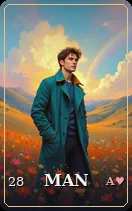 Man — A couple, a meeting, a relationship — the distance and the gaze between the two cards show how things stand.
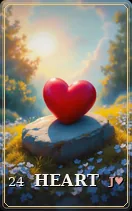 Heart — A woman in love, affectionate and generous.
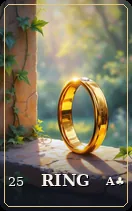 Ring — A committed woman: married, engaged, or bound by a contract.
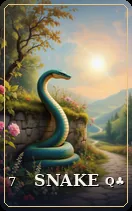 Snake — A complicated or jealous woman; sometimes a rival.
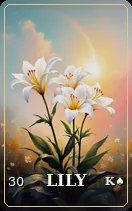 Lily — A mature, serene woman, or an older female figure in the family.
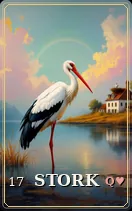 Stork — A woman going through change, moving house or changing her life.
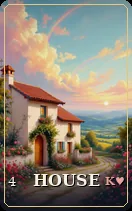 House — A family woman, devoted to her home, or a homebody.
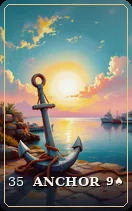 Anchor — A woman with a stable job, with her feet firmly on the ground.
 Clouds — A confused, undecided woman who cannot yet see clearly.
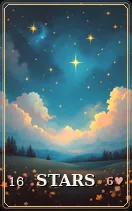 Stars — A woman with hope, with plans and a sense of direction.
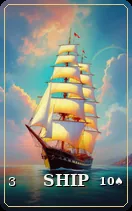 Ship — A woman who travels, who lives far away or who comes from elsewhere.
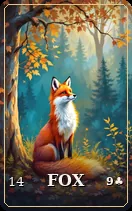 Fox — A calculating or insincere woman; also someone very skilled at her work.
Frequently asked questions
What does the Woman mean in the Lenormand?
She is a person card: she represents the querent, if she is a woman, or the woman being asked about. Her meaning is read in the cards around her and in the direction of her gaze.
If I am a man, who is the Woman in the spread?
Usually the most important woman in the question: the partner, the love interest or the ex, in a love question; a boss or a colleague, in a work question.
Which way does the Woman look?
It depends on the deck: in the Engraved Lenormand she looks to the left; in the Sol da Alma Lenormand, to the right. The cards in front of her gaze show what lies ahead of her; those behind, what she is leaving behind.
What does the Woman next to the Man mean?
A relationship or a meeting. Side by side and facing each other, there is closeness and interest; far apart or back to back, there is distance.
Is the Woman a yes or a no?
She is neutral: she is a person, not an answer. The answer lies in the cards around her.
In Brazil, is the Woman called the Gypsy Woman?
Yes, in Brazil card 29 is often called ‘a Cigana’, the Gypsy Woman, and card 28 ‘o Cigano’, the Gypsy Man. It is the same card.
No sign-up · Reading written on the spot · Free