
The Mice: meaning of Lenormand card 23
The Mice is card 23 of the Lenormand, and one of the easiest to recognise in a spread: it is the card of what slips away without anyone noticing. There is no blow here, no catastrophe — just a few small creatures that nibble, every day, at a little of whatever is within their reach. By the time you notice, half the sack is gone.
That is why the Mice are always read with the neighbouring cards. On their own, they say there is wear and tear; alongside other cards, they say of what. Near the Fish, it is money draining away; near the Heart, it is affection wearing thin or anxiety tightening the chest; near the House, it is a home in need of repairs or a tired family atmosphere. The card is not a sentence: it is a warning to go and find where the hole is before it grows.
The card at a glance
| Number | 23 |
|---|---|
| Playing card | Seven of Clubs (7♣) |
| Lenormand names | Die Mäuse (German); The Mice (English); Les Souris (French) |
| Type | Event — wear and tear, dwindling |
| Keywords | wear and tear, gradual loss, tiredness, worry, theft, stress, lack |
| Timing | Sets no deadline: it is a process that drags on and keeps diminishing whatever it touches |
| Yes or no | No — or ‘yes, but with losses along the way’ |
The image on the card
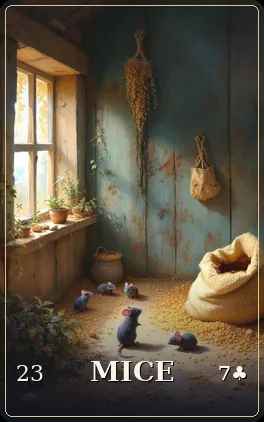
In the Sol da Alma Lenormand, the Mice are inside an old pantry, with walls of bluish, peeling boards. Through the window on the left comes a golden light that falls on a sill lined with potted plants; from the wall hang a bunch of dried ears of wheat and a hessian pouch. On the floor, to the right, an open sack of grain has toppled over and spilled its contents across the floorboards, and beside an earthenware pot there is spilt grain too. Five grey mice with pink ears move about among the grains: one of them, in the foreground, is standing up on its hind legs, looking around. The scene is calm, almost pretty — and that is what makes it so accurate: the damage happens silently, in broad daylight, in a place no one suspects.
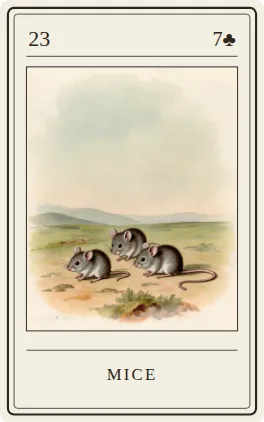
In the Engraved Lenormand, the picture is simpler and older in style: three grey mice, painted like a natural-history watercolour, crouch on a patch of sparse grass and bare earth, with low hills in the distance and a cloudy sky. There is no sack and no pantry — just the animals, their noses pointing left, ready to scurry off. It is the classic Lenormand image: the mice and nothing else, because what they gnaw at is always the card that falls beside them.
The symbolism, detail by detail
- The mice
- Small, constant wear and tear. One mouse on its own eats little; many, given time, empty a pantry. The card speaks of the cumulative effect of small losses.
- The number of mice
- Three in the Engraved Lenormand, five in the Sol da Alma painting: never just one. The trouble with the Mice is that it multiplies when nothing is done to stop it.
- The toppled sack and the spilt grain
- What had been put away and is now being lost — money, energy, time, trust. The sack is still half full: the loss is real, but the rest can still be saved.
- The pantry
- In the Sol da Alma painting, the place where supplies are kept. The Mice go for whatever has been set aside for later, and they do it out of sight.
- The light from the window
- Everything in plain view, and no one looking. It is the wear and tear that happens in the middle of the daily routine, with nothing dramatic to draw attention to it.
- The mouse standing up
- Alert and restless. It is also the image of worry, of the mind that keeps gnawing at the same thing.
- The seven of clubs
- Clubs, the suit of Wands in the tarot, is the suit of Fire, of will and of the energy spent in doing; the Seven is what is done alone, without support. Together they describe the Mice well: energy being used up, day after day, with no one to replenish it.
The history of the Mice
The Lenormand was born from a board game published around 1799 in Nuremberg by Johann Kaspar Hechtel, ‘Das Spiel der Hoffnung’ — the Game of Hope. It consisted of thirty-six illustrated cards, each with a miniature playing card in one corner, which were laid out on the table like a board. The Mice were already there, and they have kept place 23 and the seven of clubs ever since.
The name ‘Lenormand’ only appeared after 1843, when German publishers made use of the fame of Marie Anne Lenormand, the most celebrated Parisian fortune-teller of her day, to sell these cards — though there is no evidence that she ever used them. In Portugal and Brazil the deck kept the popular name of ‘Baralho Cigano’, the Gypsy Deck, which does not correspond to any historical Romani origin.
In a Europe of granaries and larders, mice were a very real enemy: they ate the grain, spoiled the flour and chewed through stored clothes. No wonder the card came to stand, in readings, for every slow loss and every petty theft.
The meaning of the Mice
The Mice are wear and tear: what dwindles, what spoils, what disappears bit by bit. It may be material things — money draining away, objects that go missing or are taken, a house falling into disrepair — or inner things: tiredness, stress, anxiety, the worry that gives no rest. Either way, the idea is the same: something is being used up faster than it is being replaced.
Traditionally, the card also speaks of theft and loss: a robbery, something mislaid, someone taking advantage without anyone noticing. It is not necessarily a crime; very often it is simply a habit, an expense, a relationship or a job that takes more than it gives.
The good news about the Mice is that the damage is gradual. Something that is lost little by little can also be stopped little by little. The card is an invitation to identify what is gnawing away, and to shut the pantry door. And since the Mice diminish everything they touch, they diminish heavy cards too: next to the Cross or the Clouds, they may say that a burden or a confusion is wearing away and losing its strength.
The Mice in love
In love, the Mice speak of a relationship wearing thin: small irritations piling up, routine eating away at the enthusiasm, jealousy or distrust gnawing from within, conversations that never happen. They do not announce a sudden break-up — they announce the weariness that, if no one does anything, may pave the way for one.
For someone who is single, they can point to the anxiety of waiting, hopes slowly fading, or an interest that dwindles before it ever becomes anything. Next to the Heart, it is affection wearing thin or a heart tight with worry; next to the Fox, someone who is not being sincere; next to the Ring, a commitment slowly coming apart. The card asks for attention to whatever has been left for later.
The Mice in work and money
At work, the Mice speak of stress, too many tasks, a draining environment, projects that lose momentum or funding. They can also point to small leaks: information getting out, materials going missing, someone profiting from other people’s work. In questions about a business, they warn of shrinking margins and costs that nobody is keeping an eye on.
With money, it is one of the clearest cards in the deck: the money is slipping away. Not through one big expense, but through lots of small ones — forgotten subscriptions, little purchases, debts that grow slowly. With the Fish, it is financial loss; with the House, spending on the home; with the Fox, beware of scams and of anyone who overcharges. The advice is to do the sums and close off the leaks.
The Mice in health and wellbeing
In questions about wellbeing, the Mice speak of tiredness, frayed nerves, poor nights’ sleep and energy running out. They call for rest, a slower pace and attention to small signs before they pile up. Like any Lenormand card, they show tendencies and attitudes, and they are no substitute for any consultation or any kind of health care.
The Mice as a person
When they describe someone, the Mice are an anxious, restless person who worries about everything — or someone who wears others out, who asks a lot and gives little. In harsher readings, they may point to someone who takes advantage on the quiet. Next to the Man or the Woman, they mainly say that this person is tired, under pressure or losing something.
The Mice as advice
As advice, the Mice say: go and find where the hole is. Go over your accounts, your habits, the relationships that take more than they give. Rest before you are exhausted. And do not leave today’s small problem for tomorrow — that is how it stops being small.
The timing of the Mice
The Mice do not mark a date: they mark a process. What they announce happens slowly and builds up, sometimes over weeks or months, until it becomes visible. Next to fast cards, such as the Rider or the Scythe, the loss may happen suddenly; next to the Mountain or the Anchor, it is a wearing-down that drags on and is best stopped early.
In the Grand Tableau: house 23
In the Grand Tableau — all thirty-six cards laid out on the table — house 23 is the house of the Mice. The card that falls there shows what is being worn down or lost, or what is causing the person asking to worry. And the Mice themselves, wherever they fall, bring wear and tear to the subject of that house: in the house of the House, domestic life; in the house of the Heart, affection.
Combinations with other cards
 Fish — Loss of money, expenses draining the savings, a budget that does not stretch to the end of the month.
 Heart — Affection wearing thin, or a heart tight with worry and anxiety.
 House — A house in need of repairs, household expenses, a tired family atmosphere.
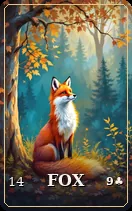 Fox — Theft, a scam, someone taking advantage on the quiet.
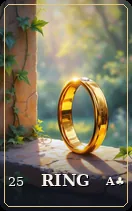 Ring — A commitment slowly coming apart, or a contract that loses money.
 Anchor — Wear and tear at work, weariness from a heavy work routine.
 Clouds — Muddled worries, anxiety with no clear cause, nights with a head too full to sleep.
 Cross — A burden wearing away and losing its strength — or a suffering that gnaws from within, depending on the question.
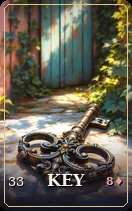 Key — A lost key, a solution that slips away; or the solution for stopping the loss.
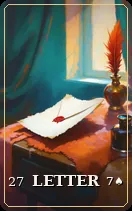 Letter — A mislaid document, missing papers, a message that never arrives.
 Birds — Anxious conversations, draining gossip, nerves on edge.
 Sun — The wear and tear loses its strength: the problem shrinks and energy returns.
Frequently asked questions
What do the Mice mean in the Lenormand?
Wear and tear, slow loss, tiredness and worry: whatever dwindles little by little without anyone noticing. The neighbouring cards say what is being lost.
Is the Mice a bad card?
It is a warning card. It points to loss or wear and tear, but gradual — which means there is still time to stop it. Next to heavy cards, it can even lessen their weight.
What do the Mice mean in love?
A relationship worn down by routine, jealousy or small irritations piling up; or the anxiety of waiting. They call for talking and care before weariness sets in.
Are the Mice a yes or a no?
They lean towards no, or towards a yes with losses along the way. They say the matter is losing strength.
Which playing card corresponds to the Mice?
The seven of clubs. Clubs is the suit of will and energy; the Seven, what is done alone — energy spent and not replaced.
No sign-up · Reading written on the spot · Free