
The Fox: meaning of Lenormand card 14
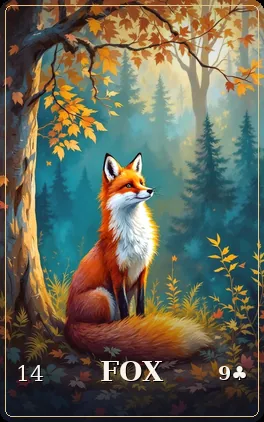
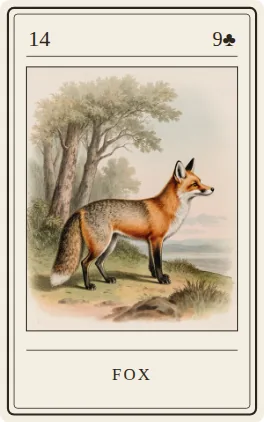
The Fox is the card of caution. An alert animal, ears pricked, that survives by being cleverer than the rest. In a reading, the Fox says that not everything is what it seems: something is hidden, there is an intention behind the words, a calculation — and you need to keep your eyes open.
It is a two-sided card, and both sides are cunning. It may be the cleverness of someone who deceives — the lie, the trickery, the person who plays with hidden cards — or the cleverness of someone who defends themselves, who grows suspicious in time and uses their head to get by. And it has a third meaning, widely used in the Lenormand: employment, one’s trade, the everyday work by which one earns a living. The neighbouring cards and the question say which fox has turned up.
The card at a glance
| Number | 14 |
|---|---|
| Playing card | Nine of Clubs (9♣) |
| Lenormand names | Der Fuchs (German); The Fox (English); Le Renard (French) |
| Type | Circumstance and person — caution, work |
| Keywords | caution, cunning, cleverness, mistrust, deception, strategy, employment, trade, survival |
| Timing | Uncertain: the matter has not yet shown its true face |
| Yes or no | No for now — or yes, with great caution |
The image on the card
In the Sol da Alma Lenormand, the Fox sits on the floor of an autumn wood, with bright orange fur, a white chest and muzzle, black legs and a bushy tail stretched out in front of it. Its head is turned to the right and its eyes are half closed, intent on something we cannot see. Above it, a pale-trunked tree spreads branches of orange and yellow leaves; in the background, bluish pine trees fade into a green and golden mist, and fallen leaves lie on the ground. In the corner, the number 14 and the nine of clubs.
In the Engraved Lenormand, the Fox stands in profile, facing right, head raised and ears pricked — the classic figure of the card, an animal on the alert. Its fur is orange on the back and greyish on the flanks, its legs are dark and its tail ends in a white tip. Behind it are trees with pale crowns; in front, a stretch of water and hills in the distance, with a stone in the foreground. In the engraving, the Fox is ready to set off; in the Sol da Alma it is sitting, waiting — but in both images it looks in the same direction, and the gaze is the same: watchful.
The symbolism, detail by detail
- The fox
- In the tradition of European fables, it is the clever animal par excellence: the one that tricks the crow, the one that slips out of traps, the one that lives by its wits rather than by strength.
- The pricked ears
- Attention, listening, vigilance. The Fox hears what goes unsaid and senses intentions before they show themselves.
- The sidelong gaze
- In both images, the Fox does not look at the viewer: it looks elsewhere, at something only it can see. It is the card of what is happening outside our field of vision.
- The russet colour
- The colour of autumn and of a low fire. In the Sol da Alma wood, the Fox almost merges with the leaves — camouflage, the knack of passing unnoticed.
- The wood
- Hidden ground, full of shadows and of paths that only a few know. The Fox moves easily where others get lost.
- The nine of clubs
- A nine, the far end of the suit; clubs, the suit of energy and action. Together, they give the Fox its liveliness: an intelligence that is always switched on, that never rests and is never caught off guard.
The history of the Fox
The Fox was already card 14 in ‘Das Spiel der Hoffnung’, the Game of Hope published by Johann Kaspar Hechtel in Nuremberg around 1799, with the nine of clubs in the corner. It was a board game of thirty-six cards, played with dice, and the miniature playing cards meant it could also be used to tell fortunes.
After the death of Marie Anne Lenormand in 1843, publishers began selling the deck under her name, although there is no evidence that the Parisian fortune-teller ever used it. In Portugal and Brazil it became known as the ‘Baralho Cigano’ (‘Gypsy deck’), a popular name that does not reflect any historical Romani origin.
The figure of the fox goes back a very long way: it is the wily character of the fables of Aesop and La Fontaine and, in the Middle Ages, the hero of the ‘Roman de Renart’, from which French took the word ‘renard’. The Lenormand inherits that image, and over time it added a more practical meaning, now common among many readers: the Fox as employment, the work by which each of us gets by in life.
The meaning of the Fox
The Fox is the card of mistrust and strategy. It warns that someone may not be sincere, that there are hidden interests, that an offer is too good to be true. It asks you to read the small print carefully, to check before you trust, and not to tell everyone everything.
But it is also the cleverness of the person asking: flexibility, practical intelligence, the ability to solve problems with limited means, to read people and to protect yourself. In a difficult situation, the Fox can be the best card to come up — it says there is a way out, as long as you use your head.
The third meaning is that of work: employment, one’s trade, the tasks by which one earns a living, above all working for someone else. In a question about work, the Fox is often simply the job of the person asking, and the cards around it show how it is going.
The Fox in love
In love, the Fox calls for caution. It may speak of someone who is not entirely sincere, who plays games, who hides part of their life or whose intentions differ from the ones they show. It may also be the mistrust that has settled into a relationship — with or without reason. Next to the Heart, a feeling with calculation behind it; next to the Snake, a third party or a more serious deception.
Sometimes, however, it is just strategy: the art of winning someone over, of not showing everything at once, of being prudent before giving yourself. For someone who is single, it says this is not the time to trust at first sight — get to know the other person well first, and then open your heart.
The Fox in work and money
At work, the Fox is the job itself — which is why it is one of the most important cards in questions about careers. With positive cards, a good job or an opportunity; with difficult cards, a job that is not what it seems, disloyal colleagues, backstage manoeuvring. It favours strategy, negotiation, self-employment and professions in research, analysis, auditing and security.
In money matters, it warns against dubious deals, schemes and promises of easy money. With the Fish, money earned through intelligence — or ill-gotten, depending on the other cards; with the Mice, fraud or embezzlement.
The Fox in health and wellbeing
In questions about wellbeing, the Fox asks you to pay attention to small signs and not to dismiss what your body is telling you, and also to seek a second opinion when something does not convince you. As always in the Lenormand, the reading shows tendencies and attitudes, and it does not replace any medical consultation or care.
The Fox as a person
As a person, the Fox is someone intelligent, clever, resourceful and independent, who observes a lot and says little — and who can be wily, calculating or insincere. It may represent a colleague, a competitor, a negotiator or someone it is wise to be wary of. In the Grand Tableau, the card that sits next to the Fox often shows where the deception lies — or where the job is.
The Fox as advice
As advice, the Fox says: be prudent. Check before you trust, do not show all your cards, think about strategy before you act. Use your intelligence to your own advantage. But it also says: do not become what you mistrust — being clever is not the same as being dishonest.
The timing of the Fox
The Fox gives no clear timeframe. What it touches is still hidden, and will only be revealed when someone lets their guard down. In a question about timing, it says that information is still missing — or that the date that was promised may not be the real one.
In the Grand Tableau: house 14
In the Grand Tableau — the thirty-six cards laid out in rows — the fourteenth position is the house of the Fox. The card that falls there shows where caution is needed, or what is happening in the job of the person asking. And the Fox itself, wherever it falls, brings mistrust and strategy to the theme of that house: in the house of the Ring, a contract to be checked; in that of the Dog, a friend who may not be one.
Combinations with other cards
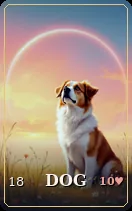 Dog — A false friend; or a loyal colleague.
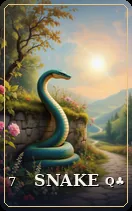 Snake — Deception, betrayal, a wily person; take great care.
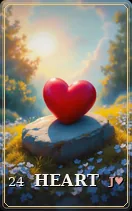 Heart — Calculated feelings; someone who is not sincere in love.
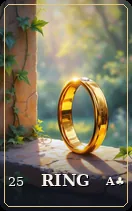 Ring — A contract with small print; a commitment to check carefully.
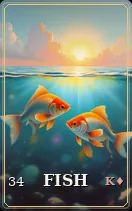 Fish — Dubious deals, easy money that hides a risk; or money earned through cleverness.
 Bear — A strategic boss; or someone powerful who does not play fair.
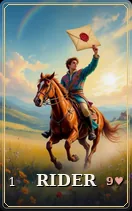 Rider — A job offer; or news that should not be trusted at first.
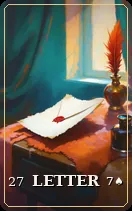 Letter — A false or misleading document; or a letter about a job.
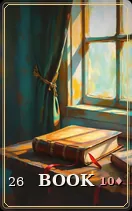 Book — Secrets, hidden information; investigation.
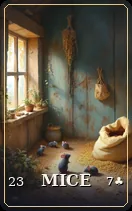 Mice — Theft, fraud, losses through dishonesty.
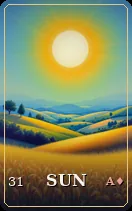 Sun — The truth comes to light; success at work.
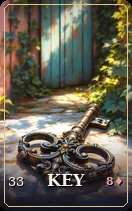 Key — The right strategy, the solution found through intelligence.
Frequently asked questions
What does the Fox mean in the Lenormand?
Caution and cunning: what is not what it seems, deception, strategy. It is also the card of employment and of everyday work.
Is the Fox a bad card?
Not necessarily. It warns of deception and calls for prudence, but it also represents the practical intelligence of the person asking and, very often, their job itself.
What does the Fox mean in love?
It calls for caution: someone may not be sincere, or there may be mistrust in the relationship. Sometimes it is just strategy — not showing everything at once.
Why does the Fox represent work?
It is a common reading in the Lenormand: the fox lives by its wits, and the card came to represent the job and the trade by which each of us earns a living.
Is the Fox a yes or a no?
It leans towards no, or towards ‘not everything is known yet’. If it is a yes, it is a yes to be checked carefully.
No sign-up · Reading written on the spot · Free