
Two of Pentacles: meaning and symbolism of the tarot card
The Two of Pentacles is the juggler’s card. A young man tosses two gold coins into the air and catches them, one at a time, while behind him the sea churns and the boats go by. There is neither disaster nor victory here: there is someone keeping things going, nimbly, in the midst of movement. It is a very familiar image for anyone living between two jobs, two homes, two responsibilities — or simply between the month’s bills.
In a spread, the Two of Pentacles speaks of balance in motion: managing, adapting, deciding what comes first and what can wait. It is a light card, almost playful, but with a hidden warning: juggling works as long as the number of coins fits in your hands. When it no longer fits, the card changes its tone.
The card at a glance
| Card | Two |
|---|---|
| Suit | Pentacles |
| Element | Earth |
| Astrology | Jupiter in Capricorn (Golden Dawn) |
| Keywords | balance, management, adaptation, two jobs, flexibility, rhythm, resourcefulness |
| Reversed | imbalance, unsustainable juggling, overload, disorganisation, accounts that do not add up |
| Yes or no | ‘Yes, but with good management’: it is possible, if you know how to balance everything else |
The image on the card
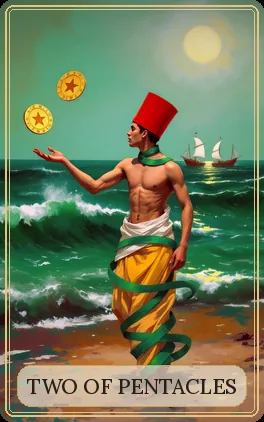
In the Sol da Alma Tarot, a bare-chested young man stands on a beach of dark, wet sand. He wears a tall, red, cylindrical hat, and from the waist down a saffron-yellow cloth, fastened with a white sash. A long green ribbon loops once around his neck and winds down in a spiral around his legs, all the way to the ground. With his right hand open and outstretched, he follows with his eyes two gold coins in the air to his left, each with a red star at its centre. Behind him the sea is green and strong, with high waves breaking in white foam; in the background, on the horizon, two sailing boats with white sails and red hulls glide across calmer waters, beneath a pale sun in a greenish sky.
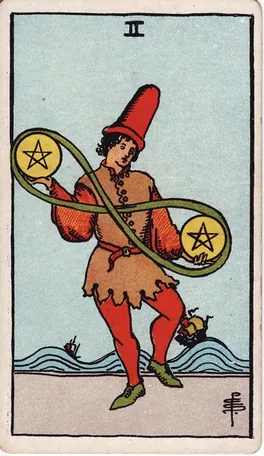
In the 1909 Rider-Waite-Smith, the idea is the same, and it was from it that the Sol da Alma painting set out: a young man in a tall red hat dances with a coin in each hand, and the two coins are joined by a green ribbon that forms a figure of eight on its side, the sign of infinity; behind him, two ships rise and fall on high waves. The Sol da Alma changes the heart of the gesture: the coins are no longer held in the hands but loose in the air, as in true juggling; the green ribbon no longer joins them and now winds around the young man’s body; and the boats, instead of battling the waves, sail far off on a calm sea, while the turmoil is close at hand, in the waves breaking behind him.
In the Marseille Tarot there is no figure and no sea: the Two of Pentacles shows only two coins, one above and one below, linked by a ribbon that snakes between them. In many old decks, it was on this ribbon that the card-maker wrote his name or the date. The ribbon, curiously, was already there — the Rider-Waite-Smith gave it the shape of infinity and placed it in someone’s hands.
The symbolism, detail by detail
Everything in this card is in motion: the coins, the sea, the boats, the young man’s own body. What it has to say lies in the art of keeping your balance without stopping.
- The two coins in the air
- Two material matters to manage at the same time: two jobs, two expenses, two priorities. While they are in the air, neither is secure — but neither has fallen either.
- The open hand
- Agility, attention to the moment. He does not grip the coins tightly: he follows them. The balance of the Two is not rigid, it is elastic.
- The green ribbon
- In the Rider-Waite-Smith, the ribbon traces the sign of infinity between the two coins: the endless cycle of giving and receiving, coming in and going out. In the Sol da Alma it winds around the young man’s body, as if the very rhythm of the juggling wrapped itself around him — and, should he lose concentration, might trap him.
- The tall red hat
- A touch of festivity and theatre. The young man of the Two of Pentacles has something of the street performer about him: he turns effort into a game, and that helps him keep going.
- The bare chest
- Particular to the Sol da Alma painting: he is exposed, unprotected, to the wind and the sea. Lightness has a price — there is nowhere to hide when things get tight.
- The breaking waves
- The ups and downs of practical life: rising bills, the unexpected, good times and bad. They are right behind him, and he pays them no attention — he carries on with his game.
- The distant sailing boats
- Business, exchange, trade that follows its course. In the Sol da Alma they sail on calm waters: far away, things are moving along; it is close at hand that balance has to be kept.
- The beach
- The place between land and sea, between the firm and the unstable. That is exactly where the Two of Pentacles lives: feet on the earth, but surrounded by movement.
The history of the Two of Pentacles
Tarot was born in northern Italy in the fifteenth century as a card game, and its four suits — cups, swords, batons and coins — are the same as those of the Latin-suited cards still played in Portugal and Spain today. In the earliest decks, and later in the Marseille decks, which took their settled form in the seventeenth and eighteenth centuries, the numbered cards had no scene. The Two of Pentacles, however, had one peculiarity: the ribbon linking the two coins, which often served as a cartouche for the card-maker’s name.
At the end of the nineteenth century, the Hermetic Order of the Golden Dawn assigned each numbered card a planet in a sign and a title. The Two of Pentacles was given Jupiter in Capricorn, and the title ‘Lord of Harmonious Change’. It is a title that says a great deal: this is not the still stability of the Four, but a harmony that exists only because things change and balance each other out.
It was the Rider-Waite-Smith, drawn by Pamela Colman Smith under the direction of Arthur Edward Waite and published in 1909, that gave a scene to all the Minor cards. For the Two of Pentacles, Waite describes a young man dancing with a pentacle in each hand, joined by an endless cord in the form of a figure of eight on its side. He gives it meanings of gaiety and recreation, but also of obstacles, agitation and complications — and also of news and written messages. The image of the young juggler became the dominant reading of the card, and it is the one the Sol da Alma follows, with its own painting.
The Two of Pentacles upright: the meaning
Upright, the Two of Pentacles is the card of management. It speaks of someone with several matters on their hands who keeps them all going: two jobs, a job and a personal project, working life and family life, expenses on one side and income on the other. It does not say it is easy; it says it is possible, and that it is being done with skill.
It is also the card of adaptation. Circumstances change, plans have to be adjusted, priorities swap places — and the Two of Pentacles knows how to follow that movement without losing its rhythm. It is a card of flexibility, of a gift for improvisation, of humour in the face of practical difficulties.
In a question about a decision, it can indicate a choice between two material options that has not yet been made, and perhaps does not need to be made just yet: for now, it is possible to keep both. The underlying advice is to know what you have in the air, and not to let the number of coins grow without noticing.
The Two of Pentacles reversed
Reversed, the Two of Pentacles does not turn into its opposite: it is the same juggling act, but with no slack left. There are more plates than there are hands. The accounts stop adding up, commitments trip over one another, tiredness starts to make you drop what you used to catch effortlessly. Lightness turns into a frantic rush, and flexibility into disorganisation.
It can also indicate the apparent opposite: someone who fixes on one side and lets go of the other, losing their balance because they have stopped moving. Or a decision put off for too long, which now forces a hurried choice. In either case, the card asks you to stop for a moment, put the coins on the table, and decide what is really worth keeping.
The Two of Pentacles in love
In love, the Two of Pentacles speaks of the balance between the relationship and the rest of life. It can describe a couple who love each other but have little time, with clashing schedules, too much work, responsibilities to share. It says it is possible to reconcile everything, as long as there is give and take on both sides. For someone who is single, it can indicate a phase in which love is not the priority — or someone hesitating between two people, two possibilities, two lives.
It also has a light, playful side: relaxed dating, meetings without much commitment, a relationship lived with humour. Reversed, it warns against a relationship that is always put off until later, against the feeling that one of the two is carrying everything, or against indecision that leaves someone waiting for too long.
The Two of Pentacles in work and money
At work, the Two of Pentacles is the card of someone doing several things at once: taking on extra roles, having a side job, managing several clients or projects. It favours versatility and the ability to reorganise tasks. It can announce changes of hours, of role or of workplace, which can be got through well with a little adaptation.
With money, it speaks of managing the budget: paying one thing and putting off another, balancing income and outgoings, making money stretch. It is not a card of abundance or of want — it is the card of the month that is got through by ingenuity. Reversed, it is a clear warning: debts piling up, spending getting out of control, the urgent need to put your finances in order before a coin falls.
The Two of Pentacles in health and wellbeing
In questions about wellbeing, the Two of Pentacles speaks of rhythm and of the balance between effort and rest. It reminds you that the body also needs alternation: working and stopping, moving and resting. Reversed, it warns against the accumulated tiredness of someone who does everything and never stops. The cards are no substitute for any kind of healthcare: here, as with any other card, the reading speaks of attitude, not diagnosis.
The Two of Pentacles in spiritual life
On the inner path, the Two of Pentacles teaches us to live spirituality in the midst of everyday life, not outside it: between work and home, between obligations and moments of silence. The sign of infinity in the classic image is a reminder that everything alternates — giving and receiving, acting and resting — and that peace does not lie in stopping the movement, but in finding its rhythm.
The Two of Pentacles as advice
As advice, the Two of Pentacles says: keep the rhythm going and be flexible. You do not need to sort everything out at once; you need to know what is in the air and give each thing its attention in its own time. Make a list, adjust your priorities, accept that the plan may change. And, if the coins start to become too many, have the courage to put one down.
The Two of Pentacles in the positions of a spread
- In the past
- A phase of many commitments and little breathing space, which was got through with ingenuity — or which left tiredness behind.
- In the present
- Several matters on your hands at the same time. The situation is being managed, but it calls for constant attention.
- In the future
- A phase of changes and adjustments, in which you will need to adapt and reconcile different things.
- As an obstacle
- Scattered energy, too many commitments, or indecision between two options that drags on.
- As the outcome
- A balance achieved, even if in motion: the situation stays on its feet and keeps moving.
Numerology and correspondences
Two is the pair and the choice: two things set face to face, balancing or measuring each other. In the suit of Pentacles — the suit of Earth, of the body, of money and of craft —, that pair is made up of the practical matters that have to coexist: two sources of income, two commitments, what comes in and what goes out. The seed of the Ace has begun to divide, and the first challenge is to keep it in balance.
In the Golden Dawn tradition, the Two of Pentacles corresponds to Jupiter in Capricorn and bears the title ‘Lord of Harmonious Change’. Jupiter is the planet of expansion and good fortune; Capricorn, an Earth sign, is the sign of prudence, effort and structure. The meeting of the two gives the card its tone: an expansion that has to fit within concrete limits, a good fortune that lasts only with good management.
Combinations with other cards
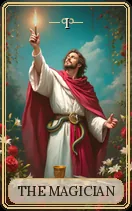 The Magician — Ingenuity and dexterity: the ability to handle several matters skilfully and make the most of all of them.
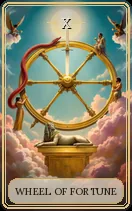 Wheel of Fortune — A phase of ups and downs that demands constant adaptation; luck that changes and has to be kept up with.
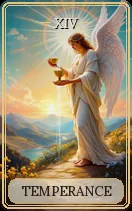 Temperance — Balance found: the right measure between work and rest, between giving and keeping.
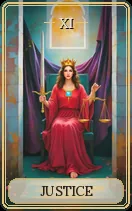 Justice — Accounts that need putting in order; a balance that calls for fair decisions.
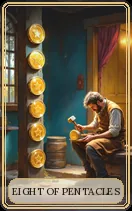 Eight of Pentacles — A great deal of work at once: two trades, overtime, learning while producing.
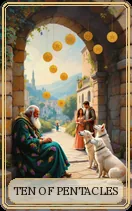 Ten of Pentacles — Managing the family’s assets or finances; responsibilities shared among several people.
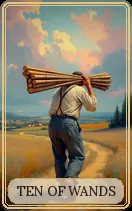 Ten of Wands — Overload: too many coins in the air and the weight beginning to show.
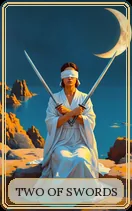 Two of Swords — A choice between two practical options that keeps being put off; balance hiding indecision.
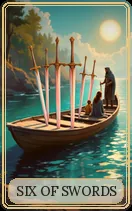 Six of Swords — A move of house or job that means reorganising everything.
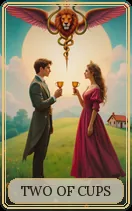 Two of Cups — A relationship that fits well with practical life; a partnership in which both adjust to each other.
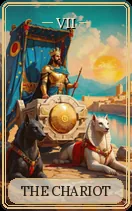 The Chariot — Control and direction: managing to steer two matters to a good end at the same time.
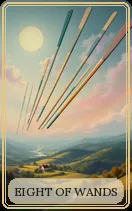 Eight of Wands — Everything happens fast; messages and changes that call for quick responses.
Frequently asked questions
What does the Two of Pentacles mean in tarot?
Balance and management: keeping several practical matters going at the same time, with flexibility and skill. It is the card of someone juggling two jobs, two priorities or the month’s bills.
Is the Two of Pentacles a yes or a no?
It is a ‘yes, but with good management’: the thing is possible, as long as it can be balanced with everything else. If the question is a choice between two options, the card says it has not yet been decided.
What does the Two of Pentacles mean in love?
A relationship that has to be reconciled with work and other responsibilities, or someone torn between two possibilities. It asks for time and attention so that love is not always left until later.
Is the Two of Pentacles reversed bad?
It is not a bad card, but it is a warning: the juggling act is no longer sustainable. There are too many commitments or expenses, and something has to be put down before it falls.
Why does the Two of Pentacles have the infinity sign?
In the Rider-Waite-Smith, the ribbon joining the two coins forms a figure of eight on its side, the sign of the continuous movement of giving and receiving. In the Marseille Tarot there was already a ribbon between the two coins; Waite and Pamela Colman Smith gave it that shape and that meaning.
No sign-up · Reading written on the spot · Free