
Two of Swords: meaning and symbolism of the tarot card
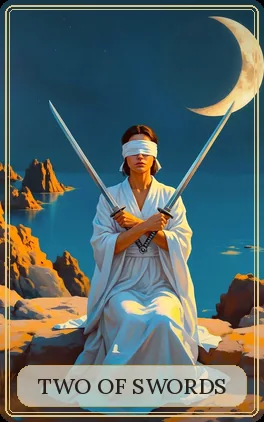
The Two of Swords is the card of stalemate. A woman dressed in white sits blindfolded, her arms crossed over her chest and a sword in each hand, and behind her the sea stretches out in the moonlight. She does not move, does not look, does not choose. The two blades balance each other, and as long as she stays still, nothing happens.
In a spread, the Two of Swords speaks of a postponed decision — of two options that cancel each other out, of a conflict frozen into a truce, of a truth you would rather not see. It is an apparent calm: inside, the tension goes on. The card does not condemn the pause, which is sometimes wise; it simply reminds you that a blindfold protects, but it also stops you seeing the way ahead.
The card at a glance
| Card | Two |
|---|---|
| Suit | Swords |
| Element | Air |
| Astrology | Moon in Libra (Golden Dawn) |
| Keywords | stalemate, truce, indecision, fragile balance, defence, denial, forced calm, postponed choice |
| Reversed | decision that cannot wait, blindfold slipping, truth that forces its way in, end of the stalemate, tension that bursts |
| Yes or no | Not yet — the answer depends on a choice still to be made |
The image on the card
In the Sol da Alma Tarot, a dark-haired woman sits on a rock by the sea, at night. She wears a long white tunic with wide sleeves, tied at the waist with a sash, and her eyes are covered by a white blindfold knotted at the back of her head. She holds her head level, facing straight ahead. Her arms are crossed over her chest, and each hand grips a long sword with a dark hilt, its blade rising past the opposite shoulder and high above her head: the two blades open out in a V. Behind her, the sea is calm and blue, with orange-tinted rocks rising out of the water; the sky is dark blue, with a few stars, and a large crescent moon shines in the top right-hand corner. The rocks she sits on catch a golden light.
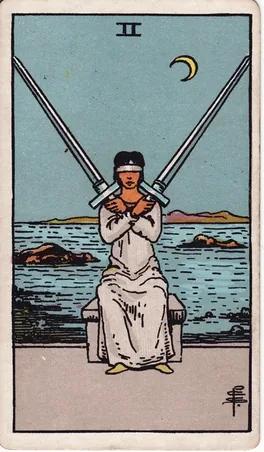
In the 1909 Rider-Waite-Smith, the scene is essentially the same, and it was the starting point for the Sol da Alma painting: a woman in a white tunic, blindfolded, seated with her back to water dotted with rocks, arms crossed over her chest; each hand holds a sword resting on the opposite shoulder, and the blades open outwards in a V. In the sky, a crescent moon. The Sol da Alma follows this composition: the crossed arms, the swords in a V, the level head and the crescent are all the same. What changes is the setting — she sits on a rock rather than a stone bench, the scene is set at night under the stars, and a warm light falls on the rocks.
In the Marseille Tarot, the numbered cards have no scene. The Marseille swords are curved blades that interlace, with flowers and foliage between them; in the Two, the two blades cross to form a kind of oval, with a flower in the middle. The blindfolded woman is a creation of the Rider-Waite-Smith.
The symbolism, detail by detail
Everything in this card is suspended: the swords, the figure, the sea. Each detail says something about the price, and the usefulness, of not deciding.
- The blindfold
- The refusal to see — out of fear, prudence or weariness. It can be a protection: you do not look so as not to be swept along. But whoever does not see cannot choose with full knowledge either.
- The two crossed swords
- Two ideas, two options, two reasons that balance each other exactly. As long as they stay crossed, neither moves forward. It is the image of stalemate: equal force on both sides.
- The position of the hands
- The arms crossed over the chest close off the heart, as in a defence, and each hand holds a sword against the opposite shoulder. The Sol da Alma keeps the Rider-Waite-Smith gesture: a wall, made of thought, between her and the world.
- The level head
- In the Sol da Alma, as in the Rider-Waite-Smith, the woman holds her head level, facing forward. She cannot see, but she does not turn away: she faces what she has to decide.
- The white tunic
- Innocence, calm, the wish to keep things clean. It is also the neutrality of someone who does not want to take sides.
- The sea
- The emotions, which lie behind her, out of sight. They are calm for now; the card suggests that the true decision also runs through them, and not only through the head.
- The rocks
- The obstacles hidden in the water, which she does not see. A passage that calls for care.
- The moon
- Intuition, night, what is uncertain. In both the Rider-Waite-Smith and the Sol da Alma it is a crescent: a partial light, not yet enough to see everything by.
The history of the Two of Swords
The tarot was born in northern Italy in the fifteenth century as a card game — the tarocchi — with the four suits of the Latin cards. In the oldest decks, such as those painted for the Visconti and the Sforza in Milan around 1450, and later in the Marseille decks, which settled into their form between the seventeenth and eighteenth centuries, the numbered cards showed only the suit symbols. The Two of Swords was a pair of interlaced blades, and its meaning came from the suit and the number.
The Hermetic Order of the Golden Dawn, at the end of the nineteenth century, gave each numbered card a planet in a sign and a title. The Two of Swords is the Moon in Libra, with the title ‘Lord of Peace Restored’. It is a more serene reading than the one usually given to the card today: peace after conflict, balance found again.
The blindfolded woman was born with the Rider-Waite-Smith, drawn by Pamela Colman Smith under the direction of Arthur Edward Waite and published in 1909 — the first widely circulated deck with scenes on all the Minors. Waite gives the card the meanings of conformity and equipoise, of courage, of friendship and of ‘concord in a state of arms’; reversed, it speaks of imposture, falsehood and duplicity. It was from the image — the blindfold, the crossed swords — that modern readers arrived at the most common reading today: stalemate, the avoided decision. That is the one the Sol da Alma follows, without forgetting the fragile peace the Golden Dawn spoke of.
The Two of Swords upright: the meaning
Upright, the Two of Swords is the armed truce. There are two options on the table, and the person chooses neither. It may be for fear of getting it wrong, for lack of full information, or from realising that any choice will hurt someone. While no decision is made, everything is held in balance — and that balance, in itself, is a kind of peace.
It is also the card of defence. The blindfold and the crossed swords close the person off from what comes from outside: they do not want to hear any more opinions, do not want to see what would force them to act. In many readings, it describes someone protecting themselves from a painful truth, or two people who have stopped arguing without having resolved anything.
The card does not say this is wrong. Sometimes stopping and not deciding is the wisest course — when tempers are running high, when something is still unknown. What the Two of Swords reminds you is that the truce has an expiry date. Swords are heavy, and nobody can hold them up for ever.
The Two of Swords reversed
Reversed, the Two of Swords does not become its own opposite: it is the same stalemate reaching its limit. The blindfold begins to slip, the arms grow tired, and the decision that was being avoided can no longer wait. It may be news that forces a choice, a truth that can no longer be ignored, or simply the exhaustion of someone who has stood still for too long. Very often, it is good news: what was frozen starts moving again.
It can also speak of stalemate taken to excess — indecision that has turned into paralysis, the anxiety of someone who thinks about everything and chooses nothing, or information that arrives in bits and pieces and confuses things even more. In both cases, the advice is the same: take off the blindfold, look both options in the face and accept that neither is perfect.
The Two of Swords in love
In love, the Two of Swords describes a relationship on hold. It may be a doubt between two people, between staying or leaving, between speaking or keeping quiet. It often speaks of a couple who have stopped arguing without having made peace: there is calm, but no closeness. Or of someone who does not want to see a sign that is right in front of their eyes.
For those who are single, it may point to a heart closed off out of caution after a disappointment: the person defends themselves, and in doing so lets nobody in either. Reversed, it announces the end of indecision — a conversation that can no longer be put off, a choice that is finally made, a truth that comes to the surface.
The Two of Swords in work and money
At work, it is the card of pending decisions: two offers, two paths, a stalled negotiation, colleagues or partners who are no longer speaking to each other. It can also describe a defensive position — someone who stays neutral in a conflict so as not to have to take sides. It asks you to gather the information you are missing and set a deadline for deciding.
With money, it speaks of a postponed choice: an investment, a purchase, a debt you avoid looking at. The stability is only apparent. Reversed, it warns that the decision will be made — preferably by the person asking, before circumstances make it for them.
The Two of Swords in health and wellbeing
In questions about wellbeing, the Two of Swords speaks of contained tension: the body holding on to what the mind cannot resolve, the held breath, the rest that does not rest. It asks for moments of real calm, not just of silence. Reversed, it is a reminder that accumulated tiredness needs to be listened to. The cards are no substitute for any kind of health care: here, as with any other card, the reading speaks of attitude, not of diagnosis.
The Two of Swords in spiritual life
On the inner path, the Two of Swords can be read in two ways. In the first, it is stillness: closing your eyes to the world, balancing opposites, waiting for the answer to come from within — the posture of someone meditating. In the second, it is denial: the blindfold put on so as not to see what it would cost to change. The card invites us to ask which of the two is ours, and to remember that true calm does not need raised swords to defend itself.
The Two of Swords as advice
As advice, the Two of Swords says: do not rush, but do not stay here for ever. If you need time, take it — but decide how much. Look for the information you are missing, listen to what you feel and not only to what you think, and then take off the blindfold. Neither option will be perfect; stalemate has a price too, and it is usually the highest.
The Two of Swords in the positions of a spread
- In the past
- A postponed decision, or a truce that still weighs: what was not resolved at the time continues to influence the present.
- In the present
- A stalemate: two options, neither chosen, and a calm that hides tension.
- In the future
- A moment of choice on its way, or a necessary pause before moving forward.
- As an obstacle
- The refusal to see, indecision, the fear of hurting someone or of getting it wrong.
- As the outcome
- The matter remains on hold for now. The answer depends on the person taking off the blindfold.
Numerology and correspondences
The Two is the pair and the choice: two things set face to face, balancing or measuring each other. In the suit of Swords — the suit of Air, of thought, of speech and of conflict — that pair is two ideas, two reasons, two sides of an argument. After the whole clarity of the Ace, the mind discovers that there is more than one truth, and stops to weigh them. The balance is real, but it is a balance of opposing forces, and so it is fragile.
In the Golden Dawn tradition, the Two of Swords corresponds to the Moon in Libra and bears the title ‘Lord of Peace Restored’. Libra, an Air sign, is the sign of balance, justice and relationships; the Moon brings it change, oscillation, sensitivity. Together, they give the card that peace which depends on the moment — real, but always on the verge of tipping to one side.
Combinations with other cards
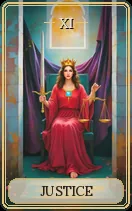 Justice — A decision that must be made fairly; weigh both sides carefully before choosing.
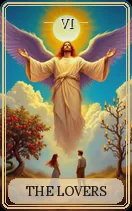 The Lovers — A romantic choice put off: torn between two people or two paths.
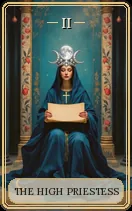 The High Priestess — The answer lies within: listen to your intuition to break the stalemate.
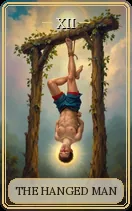 The Hanged Man — A prolonged wait, a situation at a standstill — but one that may bring a new perspective.
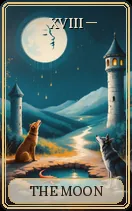 The Moon — Confusion and doubt doubled: nothing can be seen, and what is imagined is more frightening than the truth.
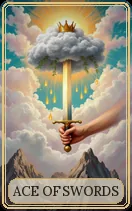 Ace of Swords — The clarity that breaks the stalemate: the blindfold falls and the decision becomes obvious.
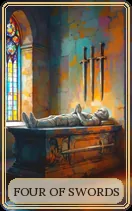 Four of Swords — A necessary pause before deciding; withdrawing to think.
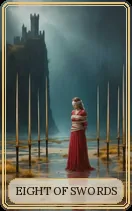 Eight of Swords — Feeling trapped by your own indecision; the bonds are more mental than real.
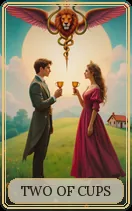 Two of Cups — A reconciliation is possible, if both lower their defences.
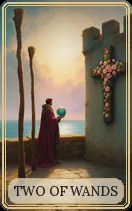 Two of Wands — Two possible futures: the path must be chosen before setting out.
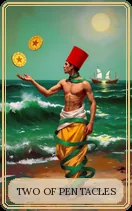 Two of Pentacles — Balancing two obligations or two expenses, without deciding which to let go.
Frequently asked questions
What does the Two of Swords mean in tarot?
A stalemate: two options that balance each other and a postponed decision. It is an apparent calm, a truce, a refusal to see that protects but also prevents you moving forward.
What does the Two of Swords mean in love?
A relationship on hold, a doubt between two people or two paths, or a heart closed off out of caution. Reversed, it announces the end of indecision.
Is the Two of Swords a yes or a no?
It leans towards ‘not yet’. The answer depends on a choice still to be made; once it is made, the situation unblocks.
Is the Two of Swords reversed bad?
Not necessarily. Reversed, the blindfold falls and the decision can no longer wait — which may be costly, but it unblocks what was at a standstill.
Why is the woman in the Two of Swords blindfolded?
The blindfold represents the refusal to see — to protect herself, to avoid taking sides, or to look for the answer within. The card asks whether that blindfold is protecting or holding back.
No sign-up · Reading written on the spot · Free