
Six of Swords: meaning and symbolism of the tarot card
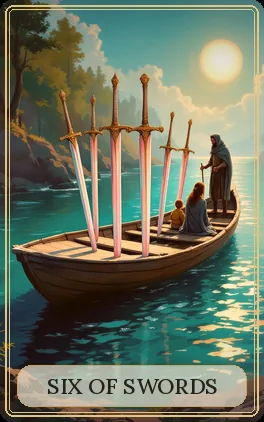
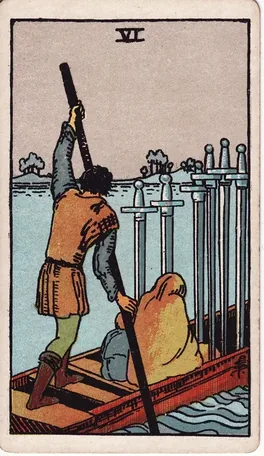
The Six of Swords is the card of the crossing. A wooden boat glides over calm water, with six swords standing upright in its bottom. A ferryman steers; a woman and a child sit with their backs to us, looking towards the far shore. Nobody speaks, nobody celebrates. They are leaving something behind, on their way to a quieter place.
In a spread, the Six of Swords speaks of a passage: coming out of a difficult phase, moving house, city, job or relationship, stepping away from a conflict. It is a change made with some sadness, but one that brings relief. After the struggles of the Five, the suit of Swords finds a way out — and takes the swords along, because what has been lived through is not left on the other shore.
The card at a glance
| Card | Six |
|---|---|
| Suit | Swords |
| Element | Air |
| Astrology | Mercury in Aquarius (Golden Dawn) |
| Keywords | crossing, passage, change, relief, departure, journey, recovery, leaving behind |
| Reversed | postponed crossing, heavy baggage, going back to what was left, difficult move, reluctance to leave |
| Yes or no | Yes — slowly, but in the right direction |
The image on the card
In the Sol da Alma Tarot, a long wooden boat with crosswise benches sits on very calm turquoise water that glitters with golden reflections. Standing upright in the bottom of the boat are six swords with golden hilts and guards, their blades a pinkish hue. At the stern, on the right, a bearded man in a grey hooded cloak stands leaning on a pole. In front of him, seated with their backs to the viewer, are a woman with long red hair, wrapped in a grey shawl, and a small child dressed in yellow. On the left, the shore is a rocky slope covered in trees; in the background, on the right, a large, hazy sun lights up bluish mountains and the surface of the water.
In the 1909 Rider-Waite-Smith, the scene is essentially the same, and it was the starting point for the Sol da Alma painting: a ferryman poles a narrow punt in which a hooded woman and a child are seated, with six swords standing upright in front of them, on their way to a shore with trees. But there the ferryman has his back to us, pushing hard on the pole, and the water is smooth on one side and choppy on the other; the sky is pale and sunless. The Sol da Alma turns the ferryman to face us, calms all the water, adds a sun and a landscape of forest and mountain, and gives the blades a pinkish colour.
In the Marseille Tarot, the numbered cards have no scene. The Six of Swords shows curved blades interlaced in a kind of oval, with a flower in the centre. The boat crossing is a creation of the Rider-Waite-Smith.
The symbolism, detail by detail
This card is all slow movement: nothing is agitated, but everything moves forward. Each detail adds a nuance to the idea of passage.
- The boat
- The means of passage, what carries you from one place to another. This is not a crossing made by swimming: it needs support, a vessel, someone to steer.
- The six swords
- The thoughts, the memories, the wounds of what has been lived through. They travel in the boat: they are not left on the shore of departure. Change does not erase the past, but carries it somewhere else.
- The upright blades
- The swords are not being wielded or attacking anyone: they are fixed, still. The conflict is over; what remains is its weight.
- The ferryman
- The guide, the help, the person or circumstance that steers the crossing. In the Sol da Alma, hooded and bearded, he recalls a pilgrim or an old sage. He is the one who knows the way.
- The pole
- Patient effort, pushing the boat along unhurriedly. The crossing is not quick, but it is steady.
- The woman and the child
- Those being carried — the part of us that needs protecting, or the people who depend on us. They sit with their backs turned: they no longer look at what they are leaving.
- The calm water
- Relief, the lull after the storm. In the Rider-Waite-Smith, the water is rough on one side and smooth on the other: the boat goes from turmoil to calm. In the Sol da Alma, the calm has already arrived.
- The wooded shore
- The destination, or what is being left. Firm ground, green, full of life: there is somewhere to go.
- The hazy sun
- An addition of the Sol da Alma: a soft light, still veiled, on the horizon. The future is not dazzling, but it is bright.
The history of the Six of Swords
The tarot was born in northern Italy in the fifteenth century as a card game — the tarocchi — with the four suits of the Latin cards. In the oldest decks, such as those painted for the Visconti and the Sforza in Milan around 1450, and later in the Marseille decks, which settled into their form between the seventeenth and eighteenth centuries, the numbered cards showed only the suit symbols. The Six of Swords was an arrangement of interlaced blades, and its meaning came from the suit and the number.
The Hermetic Order of the Golden Dawn, at the end of the nineteenth century, gave each numbered card a planet in a sign and a title. The Six of Swords is Mercury in Aquarius, with the title ‘Lord of Earned Success’. It is one of the most favourable moments in a difficult suit: the effort of the mind finally pays off.
The boat scene was born with the Rider-Waite-Smith, drawn by Pamela Colman Smith under the direction of Arthur Edward Waite and published in 1909 — the first widely circulated deck with scenes on all the Minors. Waite describes a ferryman carrying passengers in his punt to the further shore, on a smooth course, with a light freight, and gives the card the meanings of journey by water, way, route, envoy, expedient. The modern reading has added the idea of an inner passage — from difficulty to relief — and that is the one the Sol da Alma follows.
The Six of Swords upright: the meaning
Upright, the Six of Swords is the crossing. You move out of a difficult situation into a calmer one: the end of a period of conflict, stress or sadness. It is neither a victory nor a celebration — it is relief. Whoever draws this card is usually leaving something behind, with a certain melancholy, but with the feeling that it is the right thing.
It is also the card of concrete changes: moving house, city or country, a journey, especially by water, a transfer, a new job. It is often a change chosen out of necessity rather than desire — but one that turns out to do you good.
Finally, it speaks of help. The boat has a ferryman: nobody makes this crossing alone. It may be a person who guides, support that arrives, advice that shows the way. The card asks you to accept that help, and to be patient with the slow pace of the passage.
The Six of Swords reversed
Reversed, the Six of Swords does not become its own opposite: it is the same crossing, held back. It may be postponed — the change you know is necessary and do not make, out of fear, lack of means, or attachment to the familiar. It may be stuck halfway — the boat stopped in mid-water, neither going back nor arriving.
Or it may be made with too much baggage: you leave, but you take everything, and what you wanted to leave behind comes along too. The person changes place and repeats the same problems. In both cases, the card asks the same thing — decide what goes in the boat and what stays on the shore, and accept that the other shore can only be reached by crossing.
The Six of Swords in love
In love, the Six of Swords speaks of a passage into a calmer phase. In a relationship, it may be the end of a crisis — the arguments die down, the couple finds another way of being together. It may also be a change made as a couple: moving in together, moving to another city, starting again somewhere else.
Sometimes it is the crossing after a separation: stepping away from a relationship that was hurting, with sadness, but with the feeling of heading for something better. For those who are single, it speaks of leaving an old story behind before beginning another. Reversed, it warns against bringing the ghosts of the last relationship into the next, or against the temptation to go back to what you already knew did not work.
The Six of Swords in work and money
At work, it announces a transition: a change of job, team or workplace, the end of a complicated period. It may point to business travel or a transfer. It is a favourable card for anyone who wants to get out of a tense environment: the way out exists, and it leads somewhere better.
With money, it speaks of a gradual improvement — getting out of a tight spot, stabilising your finances after a difficult phase. It is not quick riches, it is recovery. Reversed, it warns of delays, changes that cost more than expected, or difficulty letting go of a commitment that is no longer worth it.
The Six of Swords in health and wellbeing
In questions about wellbeing, the Six of Swords speaks of slow recovery and relief: coming out of a phase of tiredness or tension, a change of surroundings, breathing different air. It may suggest that a break, a trip or a place near water would do you good. The cards are no substitute for any kind of health care: here, as with any other card, the reading speaks of attitude, not of diagnosis.
The Six of Swords in spiritual life
On the inner path, the Six of Swords is the image of passing from one shore to another — an ancient motif in many traditions, where crossing water means changing state. It is the card of someone who leaves behind a suffering, a belief, a phase of life, and agrees to be guided by something greater than their own will. The swords travel in the boat: wisdom does not come from forgetting what it cost, but from carrying it with serenity.
The Six of Swords as advice
As advice, the Six of Swords says: move on. Leave the shore of troubled waters, even if it hurts, even if you go slowly. Accept help from those who know the way, and do not look back too much. But it also says: choose what you take with you. Some swords have to go with you; others can, and should, stay behind.
The Six of Swords in the positions of a spread
- In the past
- A change or departure that has already happened, and that brought the person to where they are today.
- In the present
- A transition under way: coming out of a difficult phase, heading for something calmer.
- In the future
- A change on its way — a journey, a move of house or of direction, a lull after the storm.
- As an obstacle
- Difficulty in leaving, or the weight of what you insist on taking along.
- As the outcome
- The situation improves slowly. You reach calmer waters, with the experience of what you have been through.
Numerology and correspondences
The Six is passage: after the test comes relief, the fair exchange, the crossing to calmer ground. In the suit of Swords — the suit of Air, of thought, of speech and of conflict — that passage is the way out of the struggle of the Five. The mind finds a path out of the conflict: it does not resolve it with a victory, but moves away from it, with the lessons it brought. It is perhaps the number most literally visible in a card, in the image of the boat.
In the Golden Dawn tradition, the Six of Swords corresponds to Mercury in Aquarius and bears the title ‘Lord of Earned Success’. Mercury is the planet of the mind, communication and travel; Aquarius, an Air sign, is the sign of detachment, the broad view and the future. The two together give the card the intelligence that finds a way out, and the ability to see things from afar, already on the way.
Combinations with other cards
 The Fool — A departure, a move of house or country, a fresh start somewhere else.
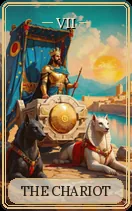 The Chariot — A journey or a change made with determination; moving forward without looking back.
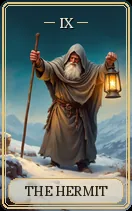 The Hermit — An inner crossing, made in silence; stepping away to find answers.
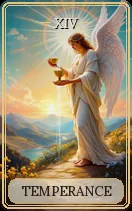 Temperance — A serene recovery; the passage made in its own time, without forcing.
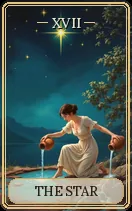 The Star — After the crossing, hope: reaching a place where you can begin again.
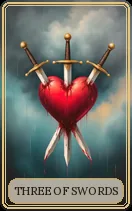 Three of Swords — Moving away from heartbreak; the pain travels in the boat, but the boat is moving.
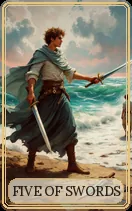 Five of Swords — Leaving a conflict instead of winning it; choosing peace.
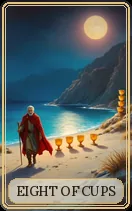 Eight of Cups — Leaving behind an emotional situation that no longer satisfies; setting out in search of something else.
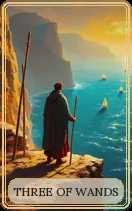 Three of Wands — New horizons; a journey that opens up opportunities, perhaps abroad.
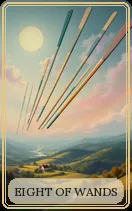 Eight of Wands — A quick move or journey; things move forward fast.
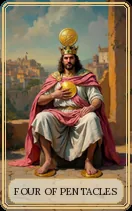 Four of Pentacles — Difficulty letting go of security; the crossing stalls out of attachment to what you have.
Frequently asked questions
What does the Six of Swords mean in tarot?
A crossing: coming out of a difficult phase into a calmer one. It speaks of changes, journeys, relief and leaving something behind, with some sadness but in the right direction.
Does the Six of Swords indicate a journey?
It can, especially journeys by water or moves of house, city or country. But it also speaks of an inner passage: coming out of a complicated period.
What does the Six of Swords mean in love?
A calmer phase after a crisis, a change made as a couple, or stepping away from a relationship that was hurting. Reversed, it warns against bringing the past into the next relationship.
Is the Six of Swords reversed bad?
It is not bad, it is held back: the change is postponed, stuck halfway, or made with too much weight. It asks you to decide what to take and what to leave.
Is the Six of Swords a yes or a no?
It leans towards yes, but a slow yes: the situation improves, but it calls for patience and the courage to leave something behind.
No sign-up · Reading written on the spot · Free