
Justice: meaning and symbolism of the tarot card
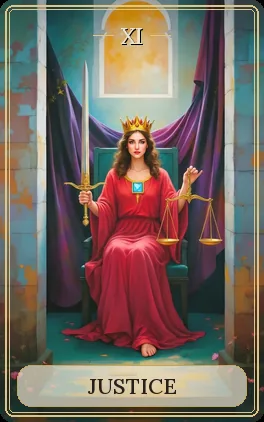
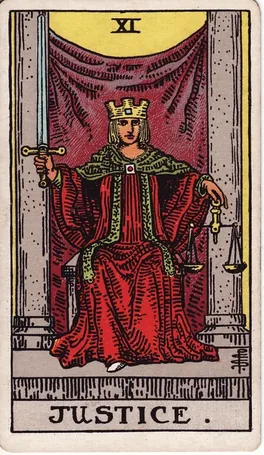
Justice is the card of measure. A crowned figure, seated facing us between two columns, with a sword and a pair of scales, looks straight at the viewer. She neither smiles nor threatens: she weighs. It is one of the most sober cards in the tarot, and one of the clearest — it says that things will be seen as they are, and that each of us will receive according to what we have given.
In a reading, Justice speaks of decisions, balance and truth. It can announce a formal matter — a contract, a legal case, a negotiation, an account to be settled — or simply the moment when the pros and cons need to be weighed and a choice made with sound judgement. For someone who has acted honestly, it is a reassuring card; for someone who has not, it is a warning. Either way, it asks you to look at the facts without dressing them up.
The card at a glance
| Number | XI (VIII in the Tarot de Marseille) |
|---|---|
| Arcana | Major Arcana |
| Historical names | La Giustizia (Italy); La Justice (Marseille); Justice (Rider-Waite-Smith) |
| Element | Air |
| Astrology | Libra (Golden Dawn) |
| Hebrew letter | Lamed (ל), according to the Golden Dawn |
| Keywords | measure, balance, truth, decision, responsibility, contracts, consequence |
| Reversed | imbalance, biased judgement, unpaid debt, injustice, a decision put off |
| Yes or no | Yes, if what you are asking for is fair; the answer depends on the facts |
The image on the card
In the Sol da Alma Tarot, Justice is a woman with wavy brown hair and a gold crown set with red stones, dressed in a loose red robe with a square turquoise jewel, set in gold, at her breast. She sits facing us in a dark green high-backed chair and looks straight at the viewer; one bare foot shows beneath the robe. In her right hand she holds a long sword with a golden hilt, raised, point upwards; in her left, lifted to shoulder height, she holds a pair of scales with golden pans. Behind her falls a purple curtain, and above it opens an arched window with a warm yellow light. On either side are columns of weathered stone, and on the floor, pink petals.
In the Rider-Waite-Smith of 1909, the figure is essentially the same: a crowned figure in a red robe and green cloak, seated facing us between two grey columns, with a reddish-purple curtain behind and a yellow background above, holding the sword raised, point upwards, in her right hand, and the scales in her left. The Sol da Alma deck follows it closely: it kept the crown, the red, the columns, the curtain, the direct gaze and the yellow light, and, as there, it placed the sword in her right hand and the scales in her left. The differences are matters of detail: there is no green cloak, the scales are lifted to shoulder height rather than hanging near her lap, and the foot showing beneath the robe is bare, where the Rider-Waite-Smith shows a white shoe.
In the Tarot de Marseille, the card is numbered VIII and is called La Justice. A crowned woman, facing us, seated on a throne, holds the sword raised in one hand and the scales in the other. Neither in the Marseille deck, nor in the Rider-Waite-Smith, nor in the Sol da Alma Tarot is she blindfolded, unlike many statues of Justice in law courts.
The symbolism, detail by detail
Justice has almost no setting: everything about her serves to measure and to decide. Each element has a precise function.
- The scales
- Balance, comparison, the weight of each thing. Setting two sides against each other and seeing which weighs more — without favouring either from the outset.
- The sword
- Decision, the cut, clarity. After weighing, you have to decide, and a decision separates. It is the same sword as the suit of Swords: the thought that tells the true from the false.
- A sword in one hand, the scales in the other
- As in the Rider-Waite-Smith, the figure holds both at once: there is no fair decision without careful weighing, and no useful weighing without a decision. The raised sword is held still, point upwards: it stands for firmness, not attack.
- The direct gaze
- Truth without evasion. Justice does not look sideways or lower her eyes: she sees what is there and lets herself be seen. That is why she wears no blindfold — in the tarot, justice is clear-sighted, not blind.
- The crown
- The authority of law and reason. It is not the power of a king; it is the power of a rule that applies to everyone.
- The raised scales
- In the Sol da Alma deck, the figure lifts the scales to shoulder height, in full view of whoever looks at her. The weighing is done openly, without haste and without hiding either pan.
- The red robe
- Action, concrete life, responsibility in the world. The justice of this card is not abstract: it has real consequences.
- The columns
- Structure, the law, the two sides of a question. They also appear in The High Priestess and The Hierophant: they are the threshold of a place where things are put in order.
- The curtain and the window
- The curtain hides what lies behind; the window of light above shows that there is a greater understanding than what can be seen. The decision is made with what is known, under a light that comes from above.
The history of Justice
Justice is one of the four cardinal virtues of the classical and Christian tradition — Justice, Fortitude, Temperance and Prudence — and has been in the tarot since the first Italian decks of the fifteenth century, with the sword and scales that were already her attributes in medieval art. In the decks painted for the Visconti and the Sforza in Milan around 1450, she is a crowned woman holding those same two objects. The blindfold, seen today on so many statues of Justice, is a later addition to the iconography, and never made its way into the tarot.
In the Tarot de Marseille, which took shape between the seventeenth and eighteenth centuries, La Justice is numbered VIII, and Strength XI. The swap came at the end of the nineteenth century, with the Hermetic Order of the Golden Dawn, which matched Justice with the sign of Libra and Strength with Leo; since Leo comes before Libra in the order of the signs, Strength moved to VIII and Justice to XI. Arthur Edward Waite and Pamela Colman Smith followed that order in the 1909 deck, and most modern decks, including the Sol da Alma Tarot, do the same.
Position XI gives Justice an interesting symbolic place: it sits halfway through the twenty-two Major Arcana, straight after Wheel of Fortune. After chance comes measure; after what happens to us comes what we do with it. Many modern readers see this as the axis of the whole series.
Justice upright: the meaning
Upright, Justice is the card of balance restored. It says that the truth will come out, that things will be weighed fairly and that each of us will reap what we have sown. In a situation where there has been dishonesty or imbalance, it is a card of redress. In a situation where the person has acted well, it is a confirmation.
It is also the card of the considered decision. It asks you to weigh the facts, to hear both sides, to decide with your head and not only with your feelings. It is not cold, but it is impartial. It favours well-thought-out choices, frank conversations and balanced agreements, in which no one loses out.
It often speaks of formal matters: contracts, paperwork, court cases, inheritances, divorces, negotiations, questions of tax or accounts. Upright, it indicates that these matters tend to be resolved fairly — which does not always mean in favour of the person asking, but does mean in accordance with the facts. And it speaks of responsibility: owning up to what you have done, and to its consequences.
Justice reversed
Reversed, Justice does not become pure injustice: it is the same pair of scales, but out of true. It can point to biased judgement — on the part of others or of the person themselves — or to a decision based on incomplete information, prejudice or self-interest. It can speak of an unbalanced agreement, of a debt left unpaid, of a responsibility someone refused to take on.
Often, the scales that are out of true lie within the person asking: the difficulty of looking honestly at their own part in a situation, the tendency to blame only others or, on the contrary, to blame themselves for everything. In formal matters, it can point to delays, complications, badly prepared paperwork. The advice is to return to the facts — put everything on the table, honestly, and let the scales do their work.
Justice in love
In love, Justice speaks of balance and reciprocity: a relationship in which giving and receiving are in equal measure, with honesty and respect. In a troubled relationship, it asks for a frank conversation in which each person takes responsibility for their part. It can also announce an important decision — a commitment, a separation, an agreement about life together.
For those who are single, it says that what you look for should match what you offer, and that considered choices will work out better than impulsive ones. Reversed, it can speak of an unbalanced relationship, in which one gives far more than the other, of dishonesty, or of resentment over things that were never resolved.
Justice in work and money
At work, Justice favours contracts, agreements, appraisals, pay negotiations and anything that calls for rigour. It is the card of those who work with laws, figures, rules, arbitration and decisions — and of those recognised on merit, not through favour. In a matter involving colleagues or managers, it says the truth will be seen; in a job application, that it will be judged on sound criteria.
With money, it asks for your accounts to be in order: taxes, debts, paperwork, the division of assets. Upright, it indicates that money goes where it is owed — a payment that arrives, a fair settling of accounts. Reversed, it warns against contracts not properly read, ignored debts, imbalances that will build up, or cases that drag on. It is a card that tells you to read the small print.
Justice in health and wellbeing
In questions about wellbeing, Justice speaks of balance: between work and rest, between what you demand of your body and what you give it. Reversed, it points to excess on one side or the other. The cards are no substitute for any kind of health care: the reading speaks of attitude, not of diagnosis.
Justice in spiritual life
On the inner path, Justice is honesty with oneself. It asks you to look at your life with the same impartiality with which you would look at someone else’s: acknowledging what you have done well and what you have done badly, without vanity and without punishment. Many readers associate it with the idea of karma — the law of cause and effect — and with the responsibility to act in accordance with what you know to be right.
Justice as advice
As advice, Justice says: be fair and be clear. Weigh the facts before deciding, hear both sides, take responsibility for your part. Put anything important in writing. And do not fear the truth: if you have acted honestly, it is on your side.
Justice in the positions of a spread
- In the past
- A decision, an agreement or an action whose consequences are now arriving; or a situation that was resolved fairly.
- In the present
- A moment of decision or assessment. The person needs to weigh everything carefully, or is being assessed.
- In the future
- A matter that will be decided fairly — a contract, a legal case, an important choice.
- As an obstacle
- An imbalance still to be corrected, a decision put off, a bias that prevents clear sight — or red tape.
- As the outcome
- Everyone receives what is due to them: the matter comes into balance.
Numerology and correspondences
Eleven is the first number after the end of the cycle: ten closed one count, and eleven begins another, on a different plane. It is made of two ones side by side, like the two pans of the scales or the two columns of the card — two equal forces face to face. In the Marseille deck, where Justice is VIII, it is eight that is linked to her: the number of order, work and regular repetition, with its two equal halves.
In the Golden Dawn tradition, it corresponds to the sign of Libra, an Air sign ruled by Venus, and to the Hebrew letter Lamed, which is associated with the goad used to drive oxen — what keeps them on the path. Libra gives it a sense of balance, harmony and relationship with others; Air, the clarity of the thought that decides.
Combinations with other cards
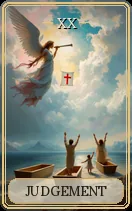 Judgement — A judgement, a final decision, a truth that comes out and changes everything.
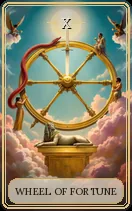 Wheel of Fortune — Consequences: what was done comes back, for good and for ill.
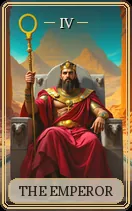 The Emperor — Laws, rules, authority: an official or legal matter of some weight.
 The Hierophant — A formal contract, a marriage, a commitment made before witnesses.
 The Lovers — A choice in love that needs to be made with the head, not only with the heart.
 Two of Swords — A decision put off; it is time to take off the blindfold and choose.
 Five of Swords — A conflict in which someone wins by less than clean means; a victory that is not fair.
 Page of Swords — Documents, investigations, information that needs to be checked.
 Six of Pentacles — A fair exchange: a payment owed, a favour returned.
 Two of Cups — A balanced relationship, a partnership agreement, a mutual commitment.
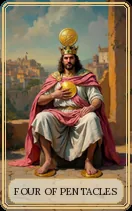 Four of Pentacles — Accounts, inheritances, property: material matters that need to be put in order.
Frequently asked questions
What does Justice mean in tarot?
Balance, truth and fair decisions: things will be weighed as they are, and everyone will receive according to what they have given. It also speaks of contracts, agreements and formal matters.
Why is Justice card XI in some decks and VIII in others?
In the Tarot de Marseille it is VIII and Strength is XI. The Golden Dawn swapped them at the end of the nineteenth century, to link Justice to Libra and Strength to Leo following the order of the signs. The 1909 Rider-Waite-Smith and the Sol da Alma Tarot follow that order.
What does Justice mean in love?
A balanced and honest relationship, or an important decision about the relationship. Reversed, it speaks of imbalance — one gives more than the other — or of matters left unresolved.
Is Justice reversed bad?
It is not a condemnation. It shows the scales out of true: biased judgement, unpaid debts, decisions put off. It asks you to return to the facts honestly.
Is Justice a yes or a no?
It depends on what is fair. If the request is reasonable and the person has acted well, it is a yes; if not, the card does not give what is not due.
No sign-up · Reading written on the spot · Free