The Chariot: meaning and symbolism of the tarot card
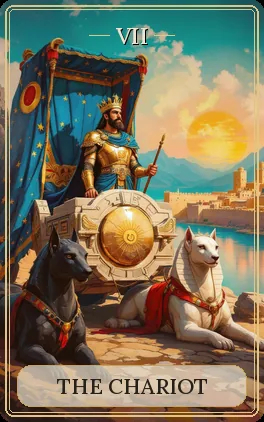
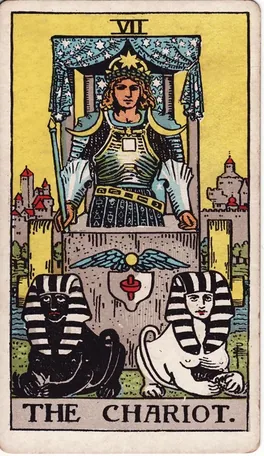
The Chariot is the seventh card of the Major Arcana and the first in which the main figure sets off. A crowned prince in armour stands in a chariot, ready to leave. In front of him, two animals — horses in the old decks, sphinxes or beasts in the modern ones — pull in different directions, or rest, waiting. He holds no reins. He guides them by will.
In a reading, The Chariot speaks of advance, victory, determination and mastery over opposing forces. It is the moment when doubts are left behind and you set off with conviction. After the choice of The Lovers comes movement: the decision has been made, and now it has to be followed through. It is one of the most dynamic cards in the deck — but also one of the most demanding, because the victory it promises depends on keeping control over whatever pulls in opposite directions.
The card at a glance
| Number | VII |
|---|---|
| Arcana | Major Arcana |
| Historical names | Il Carro (Italy); Le Chariot (Marseille); The Chariot (Rider-Waite-Smith) |
| Element | Water (through the sign of Cancer) |
| Astrology | Cancer (Golden Dawn) |
| Hebrew letter | Cheth (ח), according to the Golden Dawn |
| Keywords | victory, a direction taken, mastery of forces, advance, determination, travel, self-control |
| Reversed | lost course, effort without an axis, arrogance, haste, inner conflict, blockage |
| Yes or no | Yes — as long as you keep your direction and your control |
The image on the card
In the Sol da Alma Tarot, The Chariot is a dark-bearded man with a golden crown, standing in a chariot of pale carved stone. He wears golden armour and a blue cloak, and holds a slender, gold-tipped spear in his left hand. Behind him rises a dark blue canopy scattered with golden stars, with gold fringes and a red and gold disc embroidered on the side. On the front of the chariot shines a large round shield of gold, engraved with a sun. Lying in front, two animals rest side by side: one black, with pointed ears, and one white, with a striped headdress in the manner of the Egyptian sphinxes; both wear red and gold harnesses. Behind, to the right, a walled city of ochre towers rises on the bank of a wide river, with blue mountains in the distance and a great yellow sun among the clouds.
The Rider-Waite-Smith of 1909 has the same composition, and it was the starting point for the Sol da Alma painting: the armoured prince standing in the chariot, the wand in his hand, the blue canopy of stars, the two figures — one black and one white — lying in front, the walled city and the river behind. The differences are in the details: in the RWS the figures are clearly sphinxes, with human faces; the charioteer is beardless, wears a crown with a star and has crescent moons on his shoulders; on the front of the chariot there is a winged disc and a shield; the sky is yellow. In the Sol da Alma deck the sphinxes have gained dog or jackal heads, the solar shield takes up the front of the chariot and the landscape opens onto a sunset or sunrise.
In the Tarot de Marseille, Le Chariot is a chariot seen from the front, with a canopy on four columns, driven by a crowned young man in armour holding a sceptre. It is pulled by two horses looking in different directions. This is the scene the Sol da Alma table describes: a prince in a chariot drawn by two mismatched horses, with no reins in his hands.
The symbolism, detail by detail
Everything in this card speaks of moving forward without falling apart: of getting different forces to work in the same direction. Each element adds a nuance to that idea.
- The two animals
- The opposing forces the person has to master: reason and emotion, desire and duty, fear and courage. One black and one white, like the pillars of The High Priestess. If each pulls its own way, the chariot does not move.
- The absence of reins
- Mastery that is not achieved by the strength of the hands, but by will and concentration. The charioteer steers without pulling: that is the true victory of The Chariot.
- The armour
- Protection, discipline, preparation. Whoever sets out to win goes well equipped.
- The crown
- Victory, and also authority over oneself. The charioteer is master of his own path.
- The canopy of stars
- Protection from above, the inspiration that accompanies the journey. The charioteer moves forward on the earth, but beneath the sky.
- The spear or the wand
- Directed will, the same as The Magician’s, now set in motion.
- The solar shield
- In the Sol da Alma deck, on the front of the chariot: the energy and clarity that clear the way. In the RWS the place is taken by a winged disc, a sign of movement and elevation.
- The walled city
- What is left behind — safety, the familiar — in order to set out and conquer what lies ahead.
- The river
- The flow of life, the emotions that run through it; Cancer, a water sign, is the sign of the card.
- The stone chariot
- A heavy vehicle that does not move on its own: what makes it go is the will of whoever rides in it.
The history of The Chariot
The Chariot has been in the tarot since the Italian decks of the fifteenth century, under the name Il Carro. In the Visconti-Sforza, painted in Milan around 1450, it is driven by a crowned woman seated in a chariot drawn by white horses. The image recalled the triumphal processions of the Renaissance — the ‘triumphs’, parades in which allegorical figures passed by on decorated carts. It is one of the cards that help to explain why the first trumps of the tarot were called trionfi.
In the Tarot de Marseille, which took shape between the seventeenth and eighteenth centuries, Le Chariot is a young crowned warrior standing in a canopied chariot, drawn by two horses each looking its own way. The front of the chariot is painted so flatly that the horses seem to emerge straight out of it, with no visible reins or harness.
In the nineteenth century, Éliphas Lévi drew his own Chariot, with two sphinxes, one black and one white, in place of the horses. The Golden Dawn assigned the card the sign of Cancer and the letter Cheth. In the 1909 deck, Arthur Edward Waite and Pamela Colman Smith followed Lévi’s idea and placed the two sphinxes before the chariot, with a walled city behind. It is from this model that the Sol da Alma deck starts, with the black and white animals in front.
The Chariot upright: the meaning
Upright, The Chariot is the card of advance. It says that the forces have come together and that it is time to set off: a project getting properly under way, a decision put into action, an achievement within reach. After hesitating, the person knows where they are going and goes with conviction.
It is also the card of victory — but a victory won, not handed over. The Chariot wins because it masters: it masters doubts, contrary impulses, distractions and fears. The strength it shows is above all self-control. It can point to a competition won, an obstacle overcome, a goal reached through effort and discipline.
Finally, The Chariot speaks of movement in the literal sense: travel, journeys, moving house or city, cars and transport. Where the situation had stalled, it announces that things are about to start moving — and quickly.
The Chariot reversed
Reversed, The Chariot does not become its own opposite: it is the same movement without an axis. There is effort, there is energy, there is haste — but there is no direction. The two animals each pull their own way, and the chariot goes round in circles or stands still. It can speak of inner conflict, of contradictory goals, of someone who wants everything at once and gets nowhere.
It can also speak of excess: will that turns into stubbornness, determination that turns into arrogance, victory sought at any price that ends up costing more than it is worth. Or, on the contrary, of the brakes being applied — a project that runs aground, a postponed journey, a loss of confidence. The advice is to stop, find your course again and bring the forces back into agreement before accelerating.
The Chariot in love
In love, The Chariot speaks of a relationship that moves forward: a decision made, a step taken, the will to make things work. For those who are single, it can announce a phase of initiative, in which you go after what you want instead of waiting. It can also speak of a relationship that begins on a journey or at a distance, or of someone determined and independent.
It does, however, have its side of tension: in a relationship, The Chariot can point to two people pulling in different directions, or to someone who wants to control where the couple is heading. Reversed, it speaks of clashes of will, of a relationship that goes nowhere, or of someone more interested in winning than in sharing.
The Chariot in work and money
At work, The Chariot is a card of success and progression: a promotion, a goal achieved, a project moving fast, a competition won. It favours those with ambition and discipline, and professions connected with movement, transport, travel, sport and leadership. It says the person is in a position to win, if they keep their focus.
With money, it speaks of gains won through effort and of decisions taken firmly. Reversed, it warns of resources spread too thin, of rash decisions, or of expenses connected with travel, cars and transport.
The Chariot in health and wellbeing
In questions about wellbeing, The Chariot speaks of energy, willpower and discipline: the determination to stick to an exercise goal or a change of habits. Reversed, it points to tension, to the tiredness of someone who pushes too hard, or to the haste that leads to carelessness. The cards are no substitute for any kind of health care: the reading speaks of attitude, not of diagnosis.
The Chariot in spiritual life
On the inner path, The Chariot is self-mastery: the ability to bring into agreement the opposing forces each of us carries within — instinct and reason, fear and courage, shadow and light. It is the card of someone who moves forward on the path with discipline and conviction, without letting emotions or doubts take the reins. The victory it announces is, first and foremost, a victory over oneself. Reversed, it can point to an inner division that prevents any progress, or to a practice carried out with more pride than truth.
The Chariot as advice
As advice, The Chariot says: go forward. You have already decided; now hold your direction. Concentrate on the goal, do not let distractions or doubts pull you off to the sides, and trust your own will to steer what is difficult. But remember: the charioteer of The Chariot uses no reins. The strength that works is control over yourself, not over others.
The Chariot in the positions of a spread
- In the past
- A victory or a firm decision that set the situation in motion; an important journey or change.
- In the present
- The moment to move forward with determination: the forces are gathered and the direction is clear.
- In the future
- An achievement on its way, swift progress, a journey or a change.
- As an obstacle
- Forces in conflict, scattered energy, stubbornness, or the wish to control everything.
- As the outcome
- Victory: the goal is reached thanks to persistence and self-mastery.
Numerology and correspondences
Seven is what is done alone: without support or rule any more, at the risk and on the account of whoever does it. After the six of The Lovers, which chooses, seven sets off. The charioteer of The Chariot is alone in his vehicle — no master, no partner, no one to decide for him. It is the number of autonomy won, and also of full responsibility for the path taken.
In the Golden Dawn tradition, The Chariot corresponds to the sign of Cancer — a water sign, the sign of protection, of the home and of the shell that guards what is fragile — and to the Hebrew letter Cheth, whose name is usually associated with a fence or an enclosure. Both images help us understand the charioteer’s armour: on the outside, protection and firmness; on the inside, a sensitivity kept safe. It is this mixture of hardness and emotion that The Chariot has to steer.
Combinations with other cards
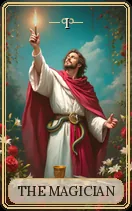 The Magician — Will and action: a project launched with determination and skill.
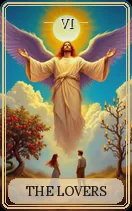 The Lovers — A choice made and put into motion; following the heart with firmness.
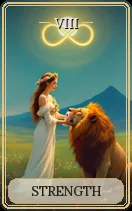 Strength — Inner strength and victory: mastering the situation with courage and patience.
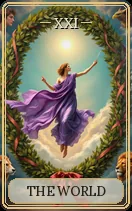 The World — A great success; an important journey; the victorious end of a path.
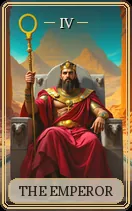 The Emperor — Leadership and discipline: a goal reached with method and authority.
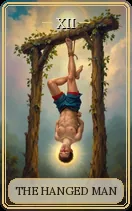 The Hanged Man — An enforced pause in the advance; you need to stop and see the situation from another angle.
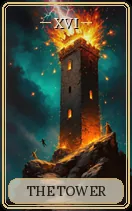 The Tower — A fall after a rise that was too fast; the arrogance that brings on the shock.
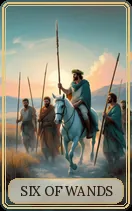 Six of Wands — Victory publicly recognised, success, applause.
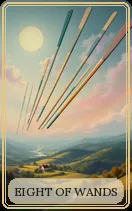 Eight of Wands — Everything speeds up: a quick journey, news, events in rapid succession.
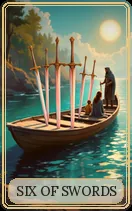 Six of Swords — A journey or a change that leads to calmer waters.
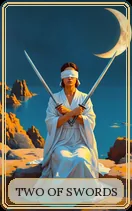 Two of Swords — The chariot at a standstill: indecision, forces at an impasse, progress blocked.
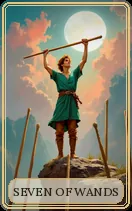 Seven of Wands — Defending the position you have won against opposition; fighting for what you have achieved.
Frequently asked questions
What does The Chariot mean in tarot?
Advance, victory and determination: the moment when you set off with conviction and master whatever pulls in opposite directions. It also speaks of travel and movement.
Is The Chariot a yes or a no?
It is a clear yes, as long as you keep your direction and your control. Victory is possible, but it has to be won.
What does The Chariot mean in love?
A relationship moving forward, a decision made, initiative. It can also speak of two people pulling in opposite directions. Reversed, it speaks of clashes of will or of a relationship that goes nowhere.
Is The Chariot reversed bad?
It is not a card of doom. Reversed, it speaks of the same movement without an axis: haste, scattered energy, stubbornness, or a sudden halt. It asks you to find your course again before accelerating.
Why does the charioteer in The Chariot have no reins?
Because the card speaks of a mastery that is not achieved by the strength of the hands, but by will. The animals are opposing forces that he steers from within, through concentration and self-control.
Does The Chariot indicate travel?
Often, yes: it is one of the tarot cards most closely linked to journeys, moves and transport. The context of the question and the surrounding cards will confirm it.
No sign-up · Reading written on the spot · Free