
Ace of Pentacles: meaning and symbolism of the tarot card
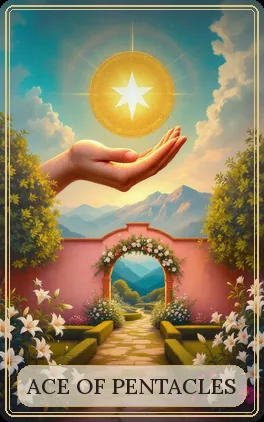
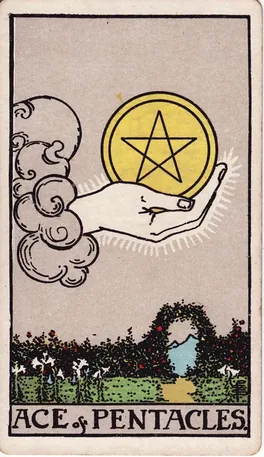
The Ace of Pentacles is the first card of the suit of Earth, and perhaps the most reassuring card in the whole deck. A hand reaches out over an enclosed garden and shows, on its open palm, a gold coin. There is no hurry and no drama in this image: there is something solid, real, something you can pick up. That is how the card speaks — of opportunities that are not promises floating in the air but concrete offers, with weight and with value.
In a spread, the Ace of Pentacles announces a beginning in the material world: a job, a business, money coming in, a home, a project that finally takes shape. But a seed is not yet a tree. The card offers; it is up to the person who receives it to plant, water and wait. That is its most important lesson, and it is also its only warning.
The card at a glance
| Card | Ace |
|---|---|
| Suit | Pentacles |
| Element | Earth |
| Astrology | Root of Earth (Golden Dawn: ‘the Root of the Powers of Earth’) |
| Keywords | material seed, concrete opportunity, gift, prosperity, stability, solid beginning, the body |
| Reversed | missed opportunity, gain held back, delayed beginning, ambition without footing, fear of loss |
| Yes or no | Yes — above all in matters of money, work and home |
The image on the card
In the Sol da Alma Tarot, a hand comes in from the left-hand edge of the card, palm upwards, and above it — without touching it — floats a large golden disc with a bright white star at its centre, from which fine rays spread out in every direction. Behind the disc the sky is turquoise blue, with pale clouds gilded by the sun, and in the distance bluish mountains rise. Below, a pink wall runs across the card; in the middle of it opens an arch covered in white and pink roses, and through the arch you can see a green valley and more mountains. A path of stone slabs, lined with low box hedges, leads from the foreground up to the arch. White lilies grow on both sides, and in the corners there are trees with full foliage.
In the 1909 Rider-Waite-Smith, the main elements are the same, and it was from them that the Sol da Alma painting set out: a hand comes out of a cloud and holds a large golden pentacle — a coin bearing a five-pointed star —; below there is a garden of lilies, a hedge with an open arch and, through the arch, mountains in the distance. The Sol da Alma changes a few details with purpose: the cloud disappears and the hand seems to come from the world itself; the coin does not rest on the fingers but floats above the palm, like a gift that has not yet been taken; the five-pointed star gives way to a star of light; and the garden gains a stone path that invites you in.
In the Marseille Tarot there is no hand, no garden, no landscape: the Ace of Pentacles is a single large coin, drawn as an ornate disc, surrounded by stylised foliage and flowers. It is the image of the suit in its pure state, with no scene.
The symbolism, detail by detail
Everything in this card speaks of something offered and of a place where it can grow. The hand gives, the garden receives; between the two lies the decision of the person asking.
- The open hand
- The gesture of offering. The Aces of the Rider-Waite-Smith all show a hand holding out the symbol of the suit: the power comes from outside, like an opportunity. In the Sol da Alma the palm faces upwards and is open — it is a gift with no conditions, but also with no guarantee that anyone will take it.
- The gold coin
- Concrete value: money, possessions, paid work, everything that can be measured and used. It is the symbol of the whole suit, not yet divided — matter in its simplest and fullest form.
- The star
- In the Rider-Waite-Smith, the five-pointed star of the pentacle represents the human being with arms and legs outstretched, or the five senses: spirit within matter. In the Sol da Alma it is a star of white light, which gives the gold a meaning that goes beyond money — value that shines of its own accord.
- The floating disc
- Particular to the Sol da Alma painting: the coin is not yet in the hand. The opportunity is present and visible, but the gesture of holding it is still missing.
- The enclosed garden
- The protected, cultivated space where things grow with care. It is the image of home, of an orderly life, of prepared ground where the seed can be planted.
- The rose arch
- The way through. The garden is not a prison: it has a door to the world. What begins here can lead further — to the mountains seen through the arch.
- The stone path
- In the Sol da Alma painting, a path of slabs leads up to the arch. The prosperity of the Ace is not a leap: it is a steady journey, made step by step, on solid ground.
- The white lilies
- Purity of intention. The same lilies appear in The Magician of the Rider-Waite-Smith, beside the roses: clean desire, gain that has no need to be hidden.
- The distant mountains
- The greater goals, the heights reached with time and effort. They are far away, but they are in sight: the Ace is the first step on a road that can lead high.
The history of the Ace of Pentacles
Tarot was born in northern Italy in the fifteenth century as a card game, and its four suits — cups, swords, batons and coins — are the same as those of the Latin-suited cards still played in Portugal and Spain today. The suit known in Portuguese as ouros was the suit of coins: in Italian it was called denari, and in French deniers, pieces of money. In the decks painted for the Visconti and the Sforza in Milan around 1450, and later in the Marseille decks of the seventeenth and eighteenth centuries, the Ace was simply a large coin, often the most decorated card of the suit.
With the occultists of the nineteenth century, the coins gained another name and another meaning. The Hermetic Order of the Golden Dawn linked the four suits to the four elements and gave the coins the element of Earth; its members also called them discs or pentacles, and placed magical symbols on them. The Aces became the ‘roots’ of the elements: the Ace of Pentacles is ‘the Root of the Powers of Earth’.
Arthur Edward Waite, who had belonged to the Golden Dawn, adopted the name Pentacles in the deck that Pamela Colman Smith drew and that was published in 1909, and every coin came to bear a five-pointed star. In the description he left of the card, Waite speaks of a hand coming out of a cloud and holding a pentacle, and gives it the meanings of perfect contentment, felicity and gold. The image of the hand above the garden became the best-known version of the Ace of Pentacles, and it is the one the Sol da Alma follows, with its own painting.
The Ace of Pentacles upright: the meaning
Upright, the Ace of Pentacles is the card of concrete opportunity. It announces a beginning on the material plane: a job offer, a pay rise, a business getting off the ground, a home, unexpected money, an investment that makes sense. It is the moment when an idea stops being just an idea and finds its footing — a budget, a place, a date, a contract.
It also speaks of stability and of confidence in the future. Whoever draws the Ace of Pentacles is usually at a point where the foundations have been laid or are about to be: the soil is good, the seed is good. It is one of the most favourable cards in the deck for anything involving security, comfort and physical wellbeing.
But the Ace is a seed, not a harvest. The card does not promise instant wealth: it promises a real possibility, which only bears fruit with work, patience and care. It is a card of the suit of Earth, and the earth keeps its own time. Whoever receives it should ask not ‘how much will I make?’ but ‘what am I going to do with this?’.
The Ace of Pentacles reversed
Reversed, the Ace of Pentacles does not turn into its opposite: the gift is still there, but held back. The opportunity exists and is not taken — out of fear, out of distraction, out of waiting for something bigger —, or it is taken and then stored away, never planted. It is money that comes in and is spent without building anything, the project that has everything it needs to start and does not start, the offer that is allowed to slip by.
It can also point to a delayed beginning: the thing comes, but later, or in a smaller amount than expected. At times it points to excess on the side of possession — thinking so much about gain that you lose sight of everything else, or clinging so tightly to security that nothing new has room to come in. The advice is the same in every case: look at what is in your hand now, and decide what to do with it.
The Ace of Pentacles in love
In love, the Ace of Pentacles speaks of a relationship with its feet on the ground. For someone who is single, it can announce a reliable, present person who shows what they feel through deeds rather than words — or a meeting that comes about through work, a shared project, everyday practical life. It is not the card of sweeping passion; it is the card of the relationship that is built and that lasts.
Within a relationship, it usually indicates a concrete step: moving in together, buying a home, pooling finances, making serious plans. It is a card of commitment and emotional security. Reversed, it can point to a relationship in which material things weigh too heavily — money as a source of tension, comfort that has taken the place of affection —, or to a chance at love that is let go out of too much caution.
The Ace of Pentacles in work and money
It is in work and money that the Ace of Pentacles feels most at home. It announces a new job, a promotion, an important client, approved funding, a business that finally gets going. For anyone thinking of launching a project, it is a clear sign that the material conditions are there. In a question about an offer, it says the offer is sound and worth taking.
With money, it is one of the best cards in the deck: money coming in, an investment with a future, savings that begin, a foundation being created. But it reminds you that the money of the Ace is a seed — it grows if it is used well. Reversed, it warns against spending what has only just arrived, against investments made in a hurry, or against letting a good opportunity slip away through too much hesitation.
The Ace of Pentacles in health and wellbeing
In questions about wellbeing, the Ace of Pentacles speaks of the body and of the routines that sustain it: starting to look after your diet, your sleep, your exercise, having time for yourself again. It is a card of quiet vitality and of habits built through consistency. Reversed, it recalls the body that has been put off until later. The cards are no substitute for any kind of healthcare: here, as with any other card, the reading speaks of attitude, not diagnosis.
The Ace of Pentacles in spiritual life
On the inner path, the Ace of Pentacles reminds us that the spiritual is also lived in concrete things: in the body, in work well done, in a tidy home, in attention to simple things. It is the card of someone who begins a practice with discipline and regularity rather than with enthusiasm. The star within the coin says that matter is not the opposite of spirit — it is the place where spirit becomes visible.
The Ace of Pentacles as advice
As advice, the Ace of Pentacles says: take what is being offered to you, and plant it. Do not wait for the perfect opportunity; make the most of the concrete opportunity in front of you. Do the sums, take the first practical step, put the idea on paper and then into the ground. And be patient: what begins well, in the earth, grows slowly and lasts.
The Ace of Pentacles in the positions of a spread
- In the past
- An opportunity that laid the foundations of the present situation — a job, a home, some money, a practical decision that is still bearing fruit.
- In the present
- A concrete offer is on the table. The question is whether it will be taken up.
- In the future
- A solid beginning on its way: an offer, money coming in, a project taking shape.
- As an obstacle
- Attachment to security that prevents any risk-taking, or an opportunity wasted through lack of action.
- As the outcome
- A firm foundation to build on. The matter is resolved in a concrete and lasting way.
Numerology and correspondences
The Ace is the seed of the suit: its whole strength, not yet spent, offered like a hand held out. In the suit of Pentacles — the suit of Earth, of the body, of money, of craft, of home and of the slow time of things that are built —, that seed is everything that may come to have form and value. The other nine numbered cards of the suit show what becomes of that seed: the balance of the Two, the work of the Three, the possession of the Four, the want of the Five, and so on up to the abundance of the Ten.
In the Golden Dawn tradition, the Ace of Pentacles has no planet or sign: it is ‘the Root of the Powers of Earth’, the element at its source, before it divides. Earth is the element of stability, patience and fertility — what receives, keeps and makes things grow. That is why this Ace, unlike the Ace of Wands, is not an impulse: it is a foundation.
Combinations with other cards
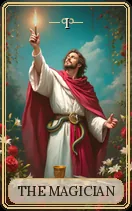 The Magician — An idea that now has the means to become real: the start of a business or a project of your own.
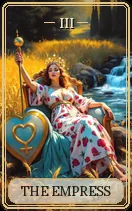 The Empress — Fertility and material abundance: a project that grows, a home that fills up, a period of prosperity.
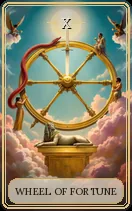 Wheel of Fortune — An opportunity that arrives by luck, at the right moment; a favourable change of circumstances.
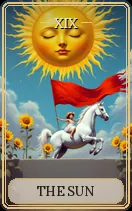 The Sun — Clear, well-deserved success: one of the most favourable combinations for money and work.
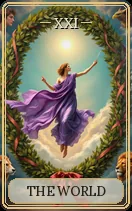 The World — A material goal fulfilled in its entirety, or the start of a new cycle on solid foundations.
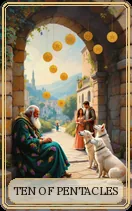 Ten of Pentacles — From beginning to end: a seed that turns into lasting wealth, security for the family.
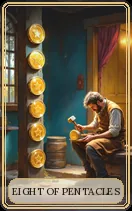 Eight of Pentacles — A work opportunity that calls for dedication and learning; a craft that begins.
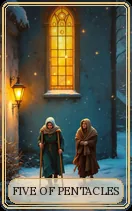 Five of Pentacles — Concrete help that arrives after a difficult period; the end of a tight spot.
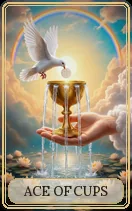 Ace of Cups — A beginning that brings together affection and security: a relationship that finds a home, or work done with pleasure.
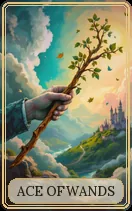 Ace of Wands — Energy and means at the same time: a new project with everything it needs to take off.
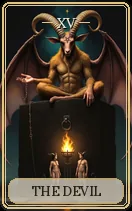 The Devil — The risk of opportunity turning into attachment: money that binds instead of setting free.
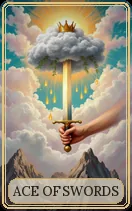 Ace of Swords — A clear decision that opens the way to a concrete gain; a well-thought-out contract.
Frequently asked questions
What does the Ace of Pentacles mean in tarot?
A concrete opportunity on the material plane: money, work, a home, a project taking shape. It is a seed — it offers a real possibility, which bears fruit with work and patience.
Is the Ace of Pentacles a yes or a no?
It is a clear yes, above all in questions about money, jobs, business and home. It is a yes that calls for action: the opportunity has to be taken.
What does the Ace of Pentacles mean in love?
A stable, down-to-earth relationship, or a concrete step as a couple — living together, making plans. For someone who is single, it can announce a reliable, present person.
Is the Ace of Pentacles reversed bad?
It is not a bad card. Reversed, it is the same opportunity held back: delayed, wasted or grasped with fear. It asks you to pay attention to what is already in your hand, before it slips away.
Does the Ace of Pentacles talk about money?
Yes, it is one of the cards most closely linked to money, but not only that: it speaks of everything that is concrete and has value — work, home, the body, security. And it reminds you that the money of the Ace is there to be planted, not merely kept.
No sign-up · Reading written on the spot · Free