
Eight of Pentacles: meaning and symbolism of the tarot card
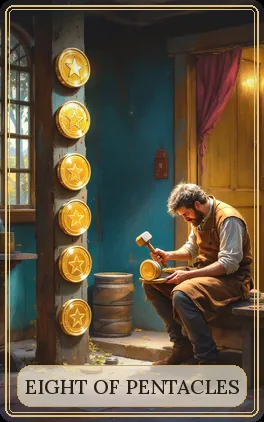
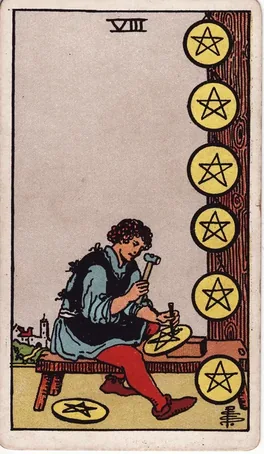
The Eight of Pentacles is the card of the craftsman. Seated on a bench, a man works a gold coin with a small hammer, his eyes fixed on the piece, and around him are the others he has already finished, hung on a post as if to show what he can do. There are no strokes of luck here, no inheritances, no miracles: there is a person repeating the same gesture until it comes out right. It is the most honest image of work that the tarot has.
In a spread, the Eight of Pentacles speaks of learning, dedication and skill. It can herald a course, a new job, a period of training, or simply the need to get down to work and be patient. Its meaning is almost always favourable, but slow: it says the result will come, and that it will come through effort. The risk lies on the other side of the same gesture — when repetition stops teaching and becomes mere routine.
The card at a glance
| Card | Eight |
|---|---|
| Suit | Pentacles |
| Element | Earth |
| Astrology | Sun in Virgo (Golden Dawn) |
| Keywords | craft, learning, dedication, patience, skill, work well done, repetition that perfects |
| Reversed | sterile routine, soulless work, perfectionism, haste, carelessness, misdirected effort |
| Yes or no | Yes, with work — the result comes through persistence, not luck |
The image on the card
In the Sol da Alma Tarot, the scene takes place inside an old workshop, with turquoise walls worn by time. On the left, a window of many panes lets in the daylight; on the right, a yellow wooden door, with a red curtain drawn to one side. On an upright wooden post six gold coins are nailed, one above the other, each with a five-pointed star in relief. The craftsman — a man with a short beard and tousled hair, in a grey shirt with rolled-up sleeves and a brown leather apron — sits on a bench and strikes a seventh coin with a small light-headed hammer, holding it on a wooden block in his lap. The eighth lies on the floor by his feet, among golden shavings scattered across the floorboards. Beside him there is a wooden barrel, and on the wall a small red box. The light is warm and golden, and the man has the focused, calm air of someone who enjoys what he does.
In the 1909 Rider-Waite-Smith, the composition is essentially the same, and it was from it that the Sol da Alma painting set out: a young man in a blue tunic, dark apron and red hose, seated on a bench, engraves a pentacle on a coin with a chisel and hammer; six coins are fixed to a wooden post on the right, and an eighth lies on the ground at his feet. The difference is the setting. In the Rider-Waite-Smith the craftsman works outdoors, with a small town in the distance on the left — as if he had withdrawn from it to learn his trade in peace. In the Sol da Alma he is indoors, in an enclosed workshop full of everyday details. The coins bear stars in relief rather than drawn pentacles, and the craftsman is no longer a lad: he is a grown man who knows what he is doing.
In the Marseille Tarot, the Huit de Deniers has no scene: it is eight coins arranged in columns among foliage ornaments. The whole story of the workshop and the apprentice is a creation of the Rider-Waite-Smith.
The symbolism, detail by detail
Everything in this card speaks of one thing: the value created by hand, slowly. Each detail adds a nuance.
- The seated craftsman
- Dedication. He is not standing, nor passing through: he has sat down to stay. The Eight of Pentacles is the card of someone who commits to a task and gives it the time it asks for.
- The hammer
- The repeated gesture. Each blow is small, and none of them alone makes the coin — it is their sum that makes it. It is the image of daily discipline.
- The coin in his lap
- The work in progress, the piece not yet finished. The craftsman looks only at it: his whole attention on what he is doing now.
- The six coins on the post
- The work already done, on display. It is proof of what has been learnt, the craftsman’s portfolio. It also shows that he did not stop after the first one: he carries on.
- The coin on the floor
- What is still to be done — or a piece set aside, waiting to be taken up again. It is a reminder that the craft is never complete.
- The stars in relief
- In the Sol da Alma painting, each coin bears a star: material work with a small gleam of the ideal. Work well done is not only technique — it is also care.
- The leather apron
- The condition of the worker. It protects and identifies: whoever wears it is there to get their hands dirty.
- The golden shavings on the floor
- The natural waste of any learning. There is no work without offcuts, and no skill without failed attempts.
- The enclosed workshop
- The withdrawal of work. The world stays outside, beyond the door and the window; in here there is only the task.
- The number eight
- Work and movement: the hand that repeats, the craft being practised. In Pentacles, the suit of Earth, it is the number of work in the most literal sense.
The history of the Eight of Pentacles
The suit of Pentacles has existed since the first tarot decks, painted in northern Italy in the fifteenth century. In Italian it was called denari — the coins, the money —, and in the Marseille decks, which took their settled form between the seventeenth and eighteenth centuries, deniers. In those decks the Eight of Pentacles was a pip card: eight coins drawn, with no figure. It was used for the game of tarocchi and had no divinatory meaning of its own.
At the end of the nineteenth century, the Hermetic Order of the Golden Dawn gave each numbered card a title and an astrological attribution, and called the suit ‘Disks’. The Eight was given the Sun in Virgo and the title ‘Lord of Prudence’ — the prudence of someone who looks after the detail, measures, repeats and does not risk what they do not know.
In 1909, Arthur Edward Waite and Pamela Colman Smith gave it the scene everyone recognises today, in the first widely circulated deck with pictures on all the Minor cards. In the book that accompanied the deck, Waite described ‘an artist in stone’ at his work, which he exhibits in the form of trophies, and gave as its meanings work, employment, commission, craftsmanship, skill in craft and business — ‘perhaps in the preparatory stage’. It is this last note that gave the card its sense of learning. The Sol da Alma Tarot follows the scene and the reading, and takes the craftsman inside a workshop.
The Eight of Pentacles upright: the meaning
Upright, the Eight of Pentacles is the card of work well done. It speaks of someone who applies themselves, who learns a trade, who hones a skill, who gives a task the attention it deserves. It can herald a course, some training, an internship, a new job in which everything has to be learnt — or a phase of intense, productive work in which things move forward because time is devoted to them.
It is also the card of skill. Whoever draws it knows how to do things, or is learning how. The card values what is concrete and verifiable: the finished piece, the report handed in, the competence that can be shown. It does not promise quick success, but it guarantees that the effort is not lost — every coin made stays hanging on the post.
There is a quiet satisfaction in it. The craftsman does not work out of obligation or ambition: he works because the work itself gives him meaning. The Eight of Pentacles is a reminder that there is a joy of its own in a task well done, and that this joy does not depend on anyone’s applause.
The Eight of Pentacles reversed
Reversed, the Eight of Pentacles is still a card of work: it is the same gesture without soul. Repetition, which used to perfect, becomes mere routine. The person keeps striking with the hammer, but no longer learns anything from it — doing it for the sake of doing it, because it has to be done, without pleasure or attention. It is the card of the job that drains you, of the mechanical task, of work that keeps the hands busy while the mind is elsewhere.
It can also speak of an excess of the same zeal: the perfectionism that never considers the piece finished, the work that eats up the rest of life, the obsession with detail that loses sight of the whole. Or, in the opposite direction, of haste — wanting the result without going through the learning, cutting corners, handing in shoddy work. The card asks us to find the meaning of what we do again, or to have the courage to admit that this craft is no longer ours.
The Eight of Pentacles in love
In love, the Eight of Pentacles is not a card of passion: it is a card of building. It speaks of a relationship that is worked on every day, with small gestures, attention and patience. It says that what exists between two people is made, not found ready-made — and that the effort is worth it. For a couple, it is a good sign: there is commitment on both sides.
For someone who is single, it can indicate a phase in which attention is turned towards work or study, and love takes a back seat; or it can say that the meeting will come by that route — on a course, at work, in a shared craft. Reversed, it warns against a relationship that has fallen into routine and that nobody tends any more, or against someone who devotes so much time to work that they leave the other person alone.
The Eight of Pentacles in work and money
At work, it is one of the best cards in the deck. It favours training, specialisation, learning a trade, manual and technical work, and all professions in which quality shows in the result. In a question about a new job, it says the job will demand a great deal, but that you will learn. In a question about a promotion, it says that it depends on the work you have shown — the coins on the post.
With money, it speaks of income earned through effort, of a steady salary, of small savings built up with consistency. It is not a card of sudden gains. It is the card of someone who builds their assets coin by coin. Reversed, it can indicate work that is poorly paid for the effort it demands, or the opposite — earning without enjoyment, in a job that only serves to pay the bills.
The Eight of Pentacles in health and wellbeing
In questions about wellbeing, the Eight of Pentacles speaks of habits: of consistency, of a healthy routine built day after day, of patient work with one’s own body. Reversed, it points to the excesses of work — the long hours without a break, the accumulated tiredness, the forgotten posture. The cards are no substitute for any kind of healthcare: the reading speaks of attitude and tendency, not diagnosis.
The Eight of Pentacles in spiritual life
On the inner path, the Eight of Pentacles is practice. It does not speak of revelations or great experiences: it speaks of daily discipline, of meditation done every day at the same hour, of patient study, of prayer that is repeated. It is a reminder that inner growth is also a craft, and that it is learnt like any other — through attentive repetition. Many traditions give manual work done with presence the value of a spiritual practice, and this card is its image.
The Eight of Pentacles as advice
As advice, the Eight of Pentacles says: get down to work. Learn what you need to learn, give the task the time it asks for, repeat until it is done well. Do not look for shortcuts. And it also says: pay attention to what you are doing. A repeated gesture only teaches when it is done with attention — otherwise, it is just tiredness.
The Eight of Pentacles in the positions of a spread
- In the past
- A period of learning or intense work that laid the foundations of what you have today.
- In the present
- A phase of dedication: it is a time to study, to work, to refine, not to wait.
- In the future
- Training, a new job, a skill to acquire — or the fruits of an effort being made now.
- As an obstacle
- Routine that no longer teaches, perfectionism, or the haste of someone who wants results without going through the learning.
- As the outcome
- The matter is resolved through work: a solid result, won with patience and skill.
Numerology and correspondences
Eight is work and movement: the hand that repeats, the thing that moves along, the craft being practised. In Pentacles — the suit of Earth, of the body, of money and of the slow time of things that are built —, it is the number in its most literal sense. After the Seven, when you stop to assess the harvest and wonder whether it was worth it, the Eight answers: you go back to work, but now with method, and learning from what has been done.
In the Golden Dawn tradition, the card corresponds to the Sun in Virgo. Virgo is the Earth sign of detail, method, service and craft; the Sun is vitality, consciousness and one’s own radiance. Together they describe the craftsman of the card well: someone who puts all their energy and all their identity into meticulous work, and finds their light in it. Hence the title the order gave it, ‘Lord of Prudence’.
Combinations with other cards
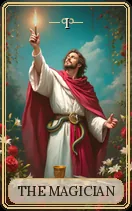 The Magician — Talent that turns into skill: natural ability put at the service of a craft.
 The Hermit — In-depth study, specialisation; learning alone, with patience and method.
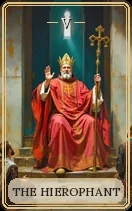 The Hierophant — Traditional training, a course, a master to learn from.
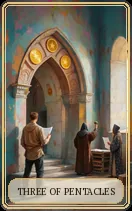 Three of Pentacles — Teamwork in which each person contributes their skill; recognition of what you know how to do.
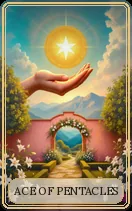 Ace of Pentacles — A concrete opportunity for work or training that is worth seizing.
 Page of Pentacles — An apprentice at the start of the road; a course of study that is beginning and will demand application.
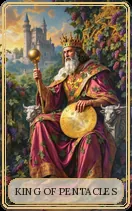 King of Pentacles — From apprentice to master: skill that, over time, turns into prosperity.
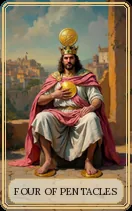 Four of Pentacles — Secure but closed work; beware of the routine that becomes a prison.
 Ten of Wands — Overwork, too many hours, a load that is already heavy.
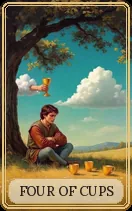 Four of Cups — Boredom at work; the task that no longer excites.
 Strength — Persistent effort and patience: the strength to carry on.
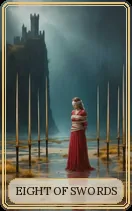 Eight of Swords — Feeling trapped in a dead-end job; routine as a snare.
Frequently asked questions
What does the Eight of Pentacles mean in tarot?
Patient craft: learning, dedication and work well done. It says the result comes through repeated, attentive effort, not through luck.
What does the Eight of Pentacles mean in love?
A relationship built with commitment and small daily gestures. Reversed, it warns against routine in the couple or against giving more attention to work than to the other person.
Is the Eight of Pentacles a yes or a no?
It is a yes, but with work. What you are asking about is possible, if there is dedication and patience.
Is the Eight of Pentacles reversed bad?
No. It is the same work without meaning: sterile routine, perfectionism or haste. It asks you to find the pleasure in what you do again, or to change your craft.
Does the Eight of Pentacles speak of studies?
Yes, it is one of the clearest cards about studies and training. It favours courses, exams and all learning that demands consistency.
No sign-up · Reading written on the spot · Free