
Ten of Wands: meaning and symbolism of the tarot card
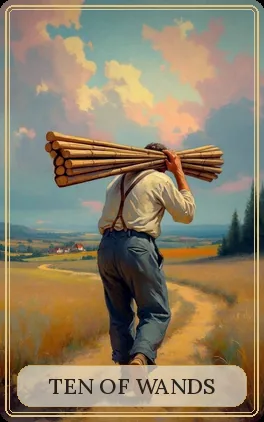
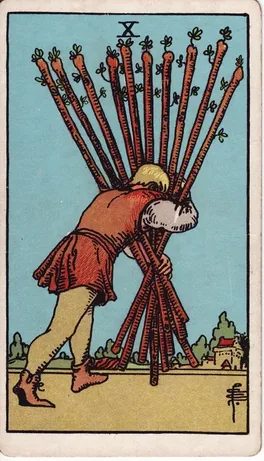
The Ten of Wands is the last numbered card in the suit of Fire, and the heaviest. A man carries a bundle of wands on his back and walks along a dirt road towards a village that is still far away. He does not stop, does not set the load down, does not ask for help. What the Ace gave him as a single flame has become, by the end of the whole cycle, a bundle of firewood that he has to carry home.
In a spread, this card speaks of responsibility and effort: of someone who has taken on a lot — sometimes too much — and is carrying it all through to the end. It is an honest card. It says the goal will be reached, but it does not hide the cost, and it asks, bluntly, whether all that load really needs to be carried on the same back.
The card at a glance
| Card | Ten |
|---|---|
| Suit | Wands |
| Element | Fire |
| Astrology | Saturn in Sagittarius (Golden Dawn) |
| Keywords | burden, responsibility, final effort, duty done, overload, end of a cycle |
| Reversed | excessive load, exhaustion, dropping the weight, delegating, difficulty saying no |
| Yes or no | Yes, but at a price — the result comes, with a great deal of effort |
The image on the card
In the Sol da Alma Tarot, we see a man from behind, walking along a dirt road that winds between fields of golden grass. He wears a white shirt with rolled-up sleeves, brown braces, loose blue-grey trousers and leather shoes. Over his right shoulder he carries, horizontally, a bundle of long, thick wands, which he holds with one raised hand. His body is upright, his head held high, and the road ahead is clear. In the distance, on the left, a village of red roofs; on the right, a cluster of dark pines; above, a vast sky of pink, golden and bluish clouds, in the warm light of late afternoon.
In the 1909 Rider-Waite-Smith, the idea is the same, and it was the starting point for the Sol da Alma painting: a man carries ten wands towards a house or a small settlement. But the attitude is very different. In Pamela Colman Smith’s deck, the man clutches the wands upright in front of his body, bent under the weight, his face buried in the bundle — so laden that he cannot even see where he is going. In the Sol da Alma the load is neatly set on his shoulder, his body stays upright and his gaze has the road ahead: the weight is great, but it is carried with more control. The clothing, too, is no longer medieval: it is that of a farm labourer of a hundred years ago, which brings the card closer to everyday work.
In the Marseille Tarot, as with all the numbered Minors, there is no figure: the card shows only the ten staffs of the suit, crossed in a lattice, with plant motifs in the gaps. The image of the man bowed under the weight is a creation of the Rider-Waite-Smith.
The symbolism, detail by detail
All the symbolism of the Ten of Wands revolves around weight: where it comes from, how it is carried, and where it is going. Each detail gives a different nuance to the same responsibility.
- The bundle of wands
- All the tasks, duties and commitments together. Each wand, on its own, would be light; the problem is having them all at once. It is the Fire of the suit turned into accumulated work.
- The shoulder
- In the Sol da Alma, the load rests on his shoulder, not in front of his eyes. It says the person can still see the road — the weight is tiring, but it does not blind.
- The man seen from behind
- We do not see his face: we see the effort. He is an everyman figure, moving forward without complaint and without looking back.
- The dirt road
- The long, winding way to the end. It is neither paved nor easy, but it is marked out.
- The village in the distance
- The destination, the place where the load can at last be set down. It is in sight, but still far off — the end exists, and there is little left to go, even if it seems a lot.
- The golden fields
- The harvest, the end of summer. The firewood on his back can be seen as the fruit of the work being carried home: the weight is also a result.
- The rolled-up sleeves
- Manual labour, the willingness to do what is needed. This is not the burden of a king or a hero, but of someone who works.
- The late-afternoon sky
- The day is drawing to a close, just like the cycle of the suit. This is the last effort before rest.
- The ten
- The end of the numbered series. Everything Fire could give has been given — and what began as enthusiasm has become responsibility.
The history of the Ten of Wands
In the earliest Italian tarots of the fifteenth century and in the Marseille decks, which took their settled form between the seventeenth and eighteenth centuries, the Ten of Wands was a pip card: ten staffs in a lattice, with no figure. It was used for the game of tarocchi and had no divinatory meaning of its own.
At the end of the nineteenth century, the Hermetic Order of the Golden Dawn gave each numbered card a title and an astrological attribution. The Ten of Wands was given Saturn in Sagittarius and the title ‘the Lord of Oppression’ — the harshest of the titles in the suit, and the one that most shaped the modern reading of the card.
In 1909, Arthur Edward Waite and Pamela Colman Smith gave it the scene that everyone recognises today. In the book that accompanied the deck, Waite described a man oppressed by the weight of the ten wands he carries, and added to the idea of oppression another, less remembered one: the card can speak of fortune, of gain, of success of any kind — and then of the weight that those very successes bring. The Sol da Alma Tarot follows this reading and this scene, with a more upright figure and a more open road.
The Ten of Wands upright: the meaning
Upright, the Ten of Wands is the card of the burden carried to the end. The person has taken on many responsibilities — at work, in the family, in a project — and is carrying them alone. They are tired, but they do not stop, because they know there is little left to go. The card acknowledges that effort and says it will pay off: what is carried home gets home.
It is also the card of success that weighs heavy. Often, the load of the Ten of Wands comes from good things: a business that has grown, a promotion, a family that has got bigger, a project that went almost too well. The initial enthusiasm of the suit has borne fruit, and now it has to be managed. The problem is not what has been achieved, but trying to hold it all with the same two hands.
That is why the card always brings a question. Are all these wands really mine? Could some of them be shared, handed over, or simply put down? The Ten of Wands does not condemn effort — it condemns needless effort, and the pride of someone who will not accept help.
The Ten of Wands reversed
Reversed, the Ten of Wands does not become the opposite of the burden: it is the same burden grown excessive, or finally allowed to fall. In the first case, it speaks of overload and exhaustion — the person has gone past the point where the weight can be borne. It can describe someone who cannot say no, who takes on other people’s tasks, or who feels responsible for everything and everyone.
In the second case, it is the moment when the load is set down. Sometimes it is a wise decision — delegating, asking for help, letting go of a commitment that no longer makes sense. At other times it is a fall: the person drops everything at once, out of tiredness, and is left feeling they have failed.
Either way, the reversed card is a useful warning. It says the system has reached its limit, and that carrying on in the same way is not an option. Putting something down is not giving up — it is the only way to reach the end with the rest.
The Ten of Wands in love
In love, the Ten of Wands speaks of a relationship in which one partner carries more than the other: the decisions, the bills, the caring, the effort of keeping everything going. It can also describe a phase in which work and responsibilities leave little room for affection — the relationship goes on, but tired. The card asks for sharing: for the weight to be divided, and for each to look at the other again, not just at the road.
For those who are single, it can point to someone so busy with obligations that they have neither the time nor the energy to meet anyone, or who is still carrying the weight of a previous relationship. Reversed, it speaks of the wish to leave a relationship that has become nothing but duty, or of the relief that comes when the couple finally share out the load.
The Ten of Wands in work and money
In work, it is the card of too many tasks: deadlines piling up, too many responsibilities, the feeling of being the only person keeping things going. It can also describe the final phase of a demanding project, when you have to hold out until delivery. The advice is clear: organise, delegate, and do not accept more than you can carry. For those who manage people, it is a warning that centralising everything has its limits.
In money, it speaks of commitments: debts to pay, a home to keep up, a family depending on a single income. The effort brings results, but leaves little breathing space. Reversed, it can point to the moment to renegotiate commitments, to cut expenses, or to let go of an investment that brings nothing but work.
The Ten of Wands in health and wellbeing
In questions about wellbeing, the Ten of Wands speaks of accumulated tiredness, of tension, of an excessive pace. It asks for breaks, for tasks to be shared out and for attention to your own limits. The cards are no substitute for any kind of health care: the reading speaks of attitudes and tendencies, and never of diagnoses.
The Ten of Wands in spiritual life
On the inner path, the Ten of Wands is the weight of obligations taken on as a virtue: the idea that to be worth something is to carry, and that to rest is to fail. The card invites you to look at each wand and ask where it came from — many belong to others, or to other times. Lightness, here, is not laziness: it is a return to what is essential, after the cycle has piled up too much.
The Ten of Wands as advice
As advice, the Ten of Wands says: carry through to the end what is yours, and only what is yours. Finish what you started, but put the rest down. Ask for help, share the weight, say no to what does not fit. The destination is in sight — and you get there better with less to carry.
The Ten of Wands in the positions of a spread
- In the past
- A period of great effort and responsibility that left tiredness behind, but results too.
- In the present
- The person is carrying too much, and is on the home straight; it is time to see what can be put down or shared.
- In the future
- More responsibilities on the way — a success that will bring work, or a demanding phase.
- As an obstacle
- Overload, the inability to delegate, the pride of wanting to do everything alone.
- As the outcome
- The goal is reached, but with effort; a heavy cycle that closes and allows for rest.
Numerology and correspondences
Ten is the end of the cycle: everything the suit could give has been given, with all the abundance and weight that brings. In Fire, this ending takes a particular form. The will that was a single flame in the Ace has grown, multiplied, fought and sped up — and ends up turned into obligation. It is the fate of all energy that is not renewed: it becomes weight. But the Ten is also a passage: after it come the court cards, and the cycle begins again on another plane.
In the Golden Dawn tradition, the Ten of Wands corresponds to Saturn in Sagittarius. Saturn is the planet of limits, duty and time; Sagittarius, a Fire sign, that of the urge to go far and of enthusiasm. The combination describes precisely what the card shows: enthusiasm that has run up against the limits of reality. Hence the title the order gave it, ‘the Lord of Oppression’ — a harsh word, which the modern reading prefers to understand as the weight one takes on and which, at a certain point, one has to learn to let go of.
Combinations with other cards
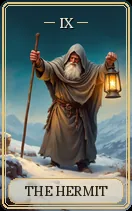 The Hermit — Withdrawing to set the weight down; a time of solitude and rest after the effort.
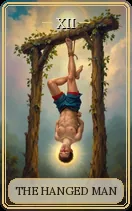 The Hanged Man — A situation that traps and drains; the need to change perspective in order to let it go.
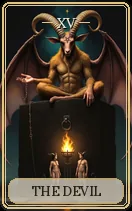 The Devil — Obligations that have become a prison; compulsive work or dependence on a role.
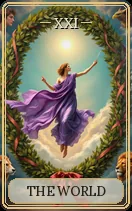 The World — Mission accomplished: the burden leads to the end of a cycle and a well-earned rest.
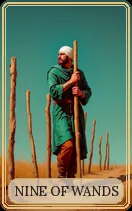 Nine of Wands — Exhaustion after a long resistance; time to ask for help.
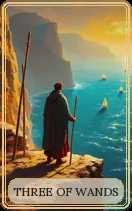 Three of Wands — A project that has grown and brought more responsibility than expected.
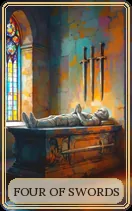 Four of Swords — A necessary pause: setting down the load to recover your strength.
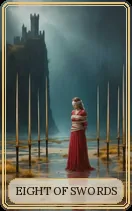 Eight of Swords — Feeling trapped by obligations, with no way out in sight; there is a way out, but it means letting go of something.
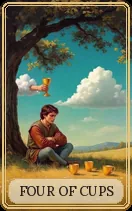 Four of Cups — Tiredness that takes the pleasure out of things; indifference born of too much duty.
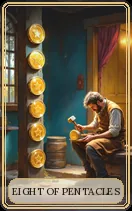 Eight of Pentacles — Overwork: long hours, many tasks, little breathing space.
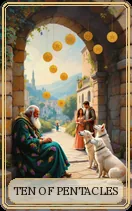 Ten of Pentacles — The weight of family or of property; keeping up a household or an inheritance.
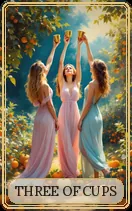 Three of Cups — Sharing the weight: friends or colleagues who help carry the load.
Frequently asked questions
What does the Ten of Wands mean in tarot?
Responsibility and effort: a burden carried to the end, often alone. It says the goal is close, but asks you to see what could be shared or put down.
Is the Ten of Wands a yes or a no?
It is a yes with a price: the result comes, but with a great deal of effort. Reversed, it leans towards ‘not yet’, until the load is lightened.
What does the Ten of Wands mean in love?
A relationship in which one partner carries too much, or a phase in which obligations leave little room for affection. It asks for the weight to be shared.
Is the Ten of Wands reversed good or bad?
It depends on what you do with it. It can speak of exhaustion and overload, or of the relief of finally putting down what is not yours. It is a warning of a limit, not a condemnation.
Does the Ten of Wands mean too much work?
Often, yes. It is one of the clearest cards in the tarot about having too many tasks and finding it hard to delegate, especially alongside the Eight of Pentacles or the Nine of Wands.
No sign-up · Reading written on the spot · Free