
Two of Cups: meaning and symbolism of the tarot card
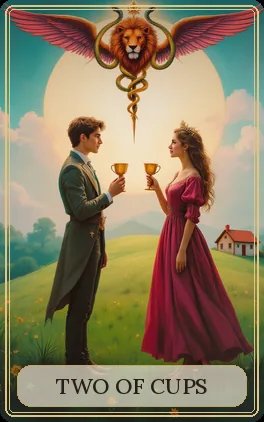
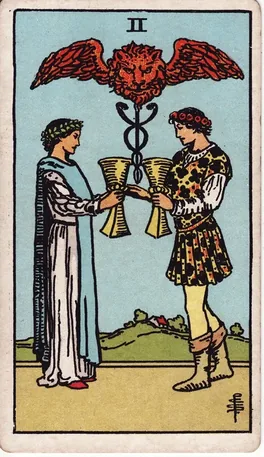
The Two of Cups is the card of meeting. A man and a woman stand face to face, each with a cup in hand, and raise them towards each other as if making a toast or a promise. They look into each other’s eyes. Above them, a lion with outstretched wings and two intertwined serpents preside over the scene like a seal.
In a spread, the Two of Cups speaks of reciprocity: two parties who recognise and choose each other. It is the classic card of the start of a romance, of an engagement, of a reconciliation — but it also applies to true friendship, to a partnership being sealed, to any agreement in which both sides give and both receive. After the seed of the Ace, it is the first bond.
The card at a glance
| Card | Two |
|---|---|
| Suit | Cups |
| Element | Water |
| Astrology | Venus in Cancer (Golden Dawn) |
| Keywords | alliance, meeting, reciprocity, attraction, partnership, reconciliation, commitment |
| Reversed | being out of step, broken pact, imbalance, a relationship where only one gives, misunderstanding |
| Yes or no | Yes, when the question depends on another person or on an agreement |
The image on the card
In the Sol da Alma Tarot, a young man with brown hair, in a long-tailed dark green frock coat, a belt and boots, stands on the left; on the right, a young woman with long wavy hair, a golden diadem and a crimson dress with puffed sleeves looks at him. Each raises a golden cup to face height, and the two cups almost touch in the middle. They stand in a green meadow dotted with yellow flowers; on the right, on a hill, there is a little white house with a red roof, and in the background bluish mountains and trees. Behind them rises a large pale disc, like a wan sun. High up, over that disc, a lion’s head with large pink and red wings rests on two intertwined green serpents, which run downwards to end in a sharp point; above the lion shines a small crown.
In the 1909 Rider-Waite-Smith, the scene is essentially the same, and it was the starting point for the Sol da Alma painting: a youth and a maiden exchange cups, and above the cups rises the caduceus of Hermes — the staff with two serpents — topped by a lion’s head with red wings; in the background there is a house on a hill. But the positions are reversed: in the 1909 deck it is the woman who stands on the left, dressed in white and blue and wearing a laurel wreath, and the man on the right, with a garland of flowers and a patterned tunic, reaching out towards her cup. The Sol da Alma dresses the figures more romantically, holds the cups up in the air instead of having them touch, and adds the disc of light, the crown above the lion and the flowery meadow.
In the Marseille Tarot there is no scene at all: the Two of Cups shows only two cups, set apart and framed by leafy ornaments. The meeting of two people is a reading that the Rider-Waite-Smith made visible.
The symbolism, detail by detail
This card is built entirely as a mirror: two figures, two cups, two serpents. What it says lies in the balance between the two halves.
- The two figures face to face
- Equality. Neither stands above the other, neither arrives on bended knee. The bond of the Two of Cups is between equals who choose each other.
- The raised cups
- What each has to give. It is not one person filling the other’s cup: each brings their own, and it is the gesture of bringing them together that creates the alliance.
- The gaze
- Recognition. The two look each other in the eye, and that is what sets this meeting apart from any other: there is attention, there is truth.
- The caduceus
- The staff of Hermes with two coiled serpents is an ancient symbol of mediation, exchange and balance between opposing forces. Here it is the image of a relationship that brings together two different natures without erasing either.
- The winged lion
- Passion and strength, lifted up by the wings. Many readers see in it desire made noble, or the energy that the union of the two gives birth to.
- The crown above the lion
- Unique to the Sol da Alma painting: the consecration of the bond, the idea of a commitment that is honoured.
- The house on the hill
- The possible home, the shared future. It is small and in the background: not yet the present, but already in sight.
- The disc of light
- In the Sol da Alma painting, a large pale sun rises behind the two. It is the luminous beginning, the moment when a bond is still all promise.
The history of the Two of Cups
The tarot was born in northern Italy in the fifteenth century as a card game, and its four suits — cups, swords, batons and coins — are the same as those of the Latin-suited cards still played today in Portugal and Spain. In the earliest decks, such as those painted for the Visconti and Sforza in Milan around 1450, and later in the Marseille decks of the seventeenth and eighteenth centuries, the numbered cards had no scene: the Two of Cups was simply a pair of cups with ornaments.
It was the Rider-Waite-Smith, drawn by Pamela Colman Smith under the direction of Arthur Edward Waite and published in 1909, that was the first widely circulated deck to put a scene on every Minor. On the Two of Cups, Waite describes a youth and a maiden pledging one another, with the caduceus of Hermes rising between them, and gives the card the meanings of love, friendship, affinity and concord.
The caduceus and the lion were not chosen at random. Waite had belonged to the Hermetic Order of the Golden Dawn, which at the end of the nineteenth century had assigned each numbered card a planet in a sign and a title. The Two of Cups is Venus in Cancer, and its title is ‘the Lord of Love’. The 1909 image is, to a large extent, that idea translated into figures, and it is the one most modern decks, the Sol da Alma included, follow today.
The Two of Cups upright: the meaning
Upright, the Two of Cups is the card of reciprocity. It speaks of two people who are attracted to each other, understand each other and choose each other: a romance beginning, a relationship deepening, a commitment made. But its scope is wider than romantic love. It is also the friendship you can rely on, the working partnership in which both sides contribute, the fair agreement, the reconciliation after a disagreement.
What defines the card is balance. Nobody dominates, nobody disappears; each gives what they have and receives what the other brings. That makes it a good card for any question that depends on another person: it says there is willingness on the other side, and that the meeting can happen.
It can also point to recognising someone you already knew but suddenly see in a different light — the moment when a friendship reveals itself as affection, or when a colleague becomes an ally.
The Two of Cups reversed
Reversed, the Two of Cups does not become its own opposite: the bond is still there, but out of step. It may be the relationship in which only one side serves, gives or makes an effort; the misunderstanding that drives apart two people who care for each other; the agreement in which interests no longer coincide; the promise that one of the two has stopped keeping.
It can also be a connection that has stalled — the affection that exists but does not find its moment, or that one side is not yet ready to acknowledge. And in the more serious cases it can speak of a pact that breaks. Even then, the card asks for dialogue before decisions: reversed, the Two of Cups is often a matter of adjusting the balance, not of ending the bond.
The Two of Cups in love
In love, it is one of the best cards in the deck. For someone who is single, it announces a meeting with true reciprocity — someone who returns your feelings. For someone in a relationship, it speaks of harmony, of closeness, of a step forward: an official relationship, an engagement, a wedding, the decision to live together. After a quarrel, it is the card of reconciliation.
Reversed, it warns against imbalance: one of the two giving much more, different expectations, a lack of communication. It does not condemn the relationship, but it says you need to look each other in the eye again, like the two figures on the card.
The Two of Cups in work and money
In work, the Two of Cups is the card of partnership: a business partnership being sealed, a colleague you work well with, a negotiation that reaches a good agreement, a client with whom trust is built. It favours everything done in pairs and the professions built on relationships — customer service, mediation, supporting people.
With money, it speaks of fair agreements, shared expenses, mutual support. Reversed, it asks you to watch out for lopsided contracts and for partnerships in which the accounts are not clear; it is also a warning that mixing money and friendship can spoil both.
The Two of Cups in health and wellbeing
In questions about wellbeing, the Two of Cups speaks of the importance of bonds: company that does you good, the support of someone close, the balance between what you give and what you keep for yourself. Reversed, it is a reminder that unbalanced relationships are tiring too. The cards are no substitute for any kind of healthcare; the reading speaks of attitudes and tendencies, not of diagnoses.
The Two of Cups in spiritual life
On the inner path, the Two of Cups is the card of meeting the other as a path in itself: the idea that we learn to love by loving someone in particular. For many readers, it also speaks of the union of the two halves of each person — what one feels and what one thinks, what one gives and what one receives. The caduceus, a symbol of balance between opposing forces, underlines this reading.
The Two of Cups as advice
As advice, the Two of Cups says: go and meet them. Reach out to the other person, propose the agreement, make peace, say what you feel. And it also says: be fair — give as much as you expect to receive, listen as much as you speak. A true bond is made with two cups, not with one.
The Two of Cups in the positions of a spread
- In the past
- An important relationship or alliance that shaped the present, or a reunion that changed things.
- In the present
- A bond taking shape or going well; a person with whom there is real affinity.
- In the future
- A meeting, a commitment, a reconciliation or an agreement on its way.
- As an obstacle
- Dependence on another person, or an unbalanced relationship that holds decisions back.
- As the outcome
- Understanding: the matter is resolved by coming together and by agreement between the parties.
Numerology and correspondences
The Two is the pair and the choice: two things set face to face, balancing or measuring each other. In the suit of Cups — the suit of Water, of feeling and of bonds — that pair is the meeting of two emotions, the moment when the affection sown in the Ace finds someone to turn to. In other suits the Two can be doubt or tension; in Cups it is, as a rule, harmony.
In the Golden Dawn tradition, the Two of Cups corresponds to Venus in Cancer and bears the title ‘Lord of Love’. Venus is the planet of attraction and harmony; Cancer, a Water sign, is the sign of care, of home and of family. Together they give the card its tone: a tender, protective love that wants to build something in common.
Combinations with other cards
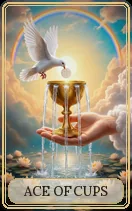 Ace of Cups — A new love that is returned; the beginning of a relationship with real feeling.
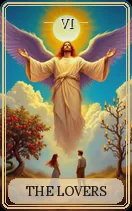 The Lovers — An important romantic choice, or a relationship that becomes a commitment.
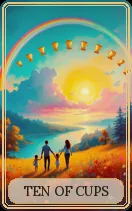 Ten of Cups — A relationship heading towards a shared life and a family.
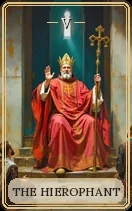 The Hierophant — Marriage, ceremony, a union recognised by others.
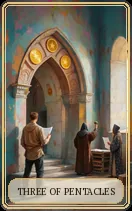 Three of Pentacles — A productive working partnership, in which each brings their own expertise.
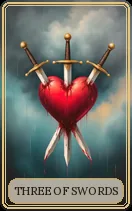 Three of Swords — A hurt relationship; jealousy, heartache or the interference of a third person.
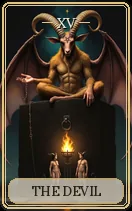 The Devil — A strong attraction that tends towards dependence; a bond that ties more than it unites.
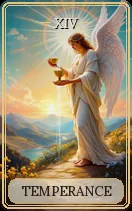 Temperance — A balanced, patient relationship; a reconciliation reached calmly.
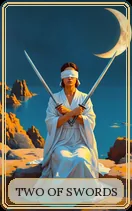 Two of Swords — A decision put off between two people; affection blocked by the fear of choosing.
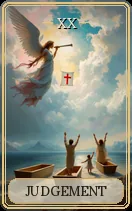 Judgement — A reunion with someone from the past; a relationship reborn.
Frequently asked questions
What does the Two of Cups mean in love?
Reciprocity: two people who are attracted to each other and choose each other. It can announce a romance, a commitment or a reconciliation. It is one of the most favourable cards for questions about love.
Is the Two of Cups a yes or a no?
Yes, especially when the answer depends on another person or on an agreement. Reversed, it is a ‘maybe’ that depends on getting the conversation going again.
Does the Two of Cups reversed mean a break-up?
Not always. It speaks of being out of step and of imbalance — someone giving more than they receive, a misunderstanding, an agreement that no longer works. It can go as far as a break, but first it asks for dialogue.
Can the Two of Cups be about friendship or business?
It can. It speaks of any bond between equals: a true friendship, a business partnership, a working partnership or a good agreement.
What is the winged lion on the Two of Cups?
A winged lion’s head above the caduceus of Hermes, introduced by the Rider-Waite-Smith in 1909. It is read as passion raised up and as the balance between two different forces.
No sign-up · Reading written on the spot · Free