
Temperance: meaning and symbolism of the tarot card
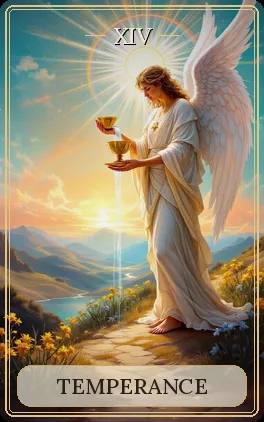
Temperance is one of the calmest cards in the tarot. A standing angel pours water from one cup into another, carefully, unhurriedly, without letting what matters go to waste. There is no conflict in the image, and no drama: there is a repeated, attentive gesture that blends two things until they are just right. It is the card of the right measure — neither too much nor too little.
In a reading, Temperance speaks of balance, patience and healing. It says that the situation will be resolved slowly, through the combination of different things, through moderation and the ability to wait. After Death, which cuts, comes Temperance, which puts things back together. It is a calm and positive card, but one that asks for time: whoever draws it will rarely get a quick answer — they will get a good one.
The card at a glance
| Number | XIV (written XIIII in the Tarot de Marseille) |
|---|---|
| Arcana | Major Arcana |
| Historical names | La Temperanza (Italy); Tempérance (Marseille); Temperance (Rider-Waite-Smith) |
| Element | Fire |
| Astrology | Sagittarius (Golden Dawn) |
| Hebrew letter | Samekh (ס), according to the Golden Dawn |
| Keywords | the right blend, patience, moderation, balance, healing, harmony, collaboration |
| Reversed | lack of measure, an impure mixture, haste, excess, imbalance, impatience |
| Yes or no | Yes, in time: the result will come, but not straight away |
The image on the card
In the Sol da Alma Tarot, Temperance is an angel with a woman’s face, light brown hair tied with a golden ribbon, large white wings and a cream-coloured robe that falls to her bare feet. On her breast is a small golden star. In her right hand she holds a golden cup up high and pours the water into another golden cup, on a stem, which she holds lower down; the water overflows from the lower cup and falls in a thin stream to the ground. The angel stands on a path of stone slabs, among yellow and blue flowers. Behind her head shines a radiant sun, circled by a ring of rainbow; below opens a valley at sunset, with bluish mountains and a river winding its way to a lake.
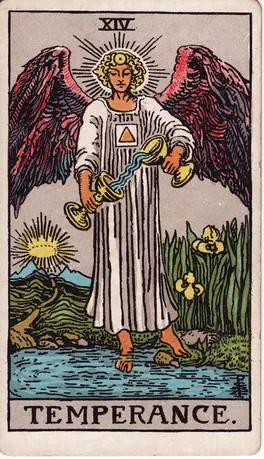
In the Rider-Waite-Smith of 1909, the angel is androgynous, with curly blond hair, a halo and a small solar disc on the forehead, red wings and a white robe with a triangle inside a square on the breast. It pours water from one cup into another in a slanting stream, with one foot in a pool and the other on firm ground. Beside it grow yellow irises, and a path rises from the water to the mountains, where a crown-shaped sun shines. The Sol da Alma deck kept the angel, the two cups, the gesture of pouring, the path, the yellow flowers and the sun in the distance; it gave her white wings and golden cups, placed her entirely on land, on a stone path, and replaced the pool at her feet with a distant river.
In the Tarot de Marseille, the card is called Tempérance and its number is written XIIII. A winged figure in a blue and red dress pours a liquid from one vessel into another, in a very similar gesture. The scene, with no landscape, is reduced to the essentials: two vessels and the hand that brings them into communication.
The symbolism, detail by detail
Temperance is a card of gesture: everything turns on the water passing from one cup to the other. The remaining details tell us under what conditions that passage takes place.
- The two cups
- Two different things that need each other: reason and emotion, work and rest, two points of view, two people. Balance lies in neither one nor the other, but in the flow between them.
- The water passing between them
- Life, emotion, energy in circulation. Pouring carefully means measuring out: giving each side what it needs, in the right amount.
- The water falling to the ground
- In the Sol da Alma deck, the water overflows from the lower cup and runs down to the earth. What is well blended is not kept stored away: it flows on to where it is needed, and nourishes.
- The angel
- A mediator between heaven and earth. Temperance is not merely a human balance: it is a harmony that seems to come from higher up.
- The wings
- Lightness and elevation. The moderation of this card is neither heavy nor sad; it is a form of freedom.
- The bare feet on the path
- Contact with the earth and with the concrete. In the Rider-Waite-Smith, one foot is in the water and the other on land — the balance between feeling and acting; in the Sol da Alma deck, both feet tread the stone path.
- The path
- The middle way, the road that leads into the distance. In the Rider-Waite-Smith it rises from the water to the mountains: the path of patience is long, but it leads somewhere.
- The yellow flowers
- Slow, natural growth. In the Rider-Waite-Smith they are irises, linked to Iris, the Greek goddess of the rainbow and messenger of the gods — which helps to explain the rainbow the Sol da Alma deck placed behind the angel.
- The sun and the rainbow
- The light that results from the right blend: the rainbow is what happens when light and water meet in exactly the right measure.
- The star on the breast
- In the Sol da Alma deck, a small golden star; in the Rider-Waite-Smith, a triangle inside a square. In both, the sign that spirit and matter are being brought into harmony.
The history of Temperance
Temperance is one of the four cardinal virtues of the classical and Christian tradition — Temperance, Fortitude, Justice and Prudence — and has been in the tarot since the first Italian decks of the fifteenth century. In medieval art it was often depicted as a woman pouring water into a vessel of wine: to ‘temper’ wine was to mix it with water to make it drinkable, and the verb ‘to temper’ still carries that sense of measuring out, of getting the mix just right. In the decks painted for the Visconti and the Sforza in Milan around 1450, she is a woman pouring liquid from one jug into another.
In the Tarot de Marseille, which took shape between the seventeenth and eighteenth centuries, she is called Tempérance, her number is written XIIII — as was customary in those decks, which also write XVIIII for The Sun — and she has gained wings. The winged figure has remained to this day.
At the end of the nineteenth century, the Hermetic Order of the Golden Dawn matched Temperance with the sign of Sagittarius and the Hebrew letter Samekh, and many occultists of the period read it as an image of alchemy: the art of uniting opposites and transforming matter through patient mixing. In the 1909 deck, Arthur Edward Waite and Pamela Colman Smith gave the angel one foot in the water and the other on land, the triangle in the square on the breast, the irises and the path to the mountains. It is from this image that most modern decks, including the Sol da Alma Tarot, start.
Temperance upright: the meaning
Upright, Temperance is the card of the right measure. It says that the way to resolve the situation is moderation: avoiding extremes, combining what seems opposed, finding the point of balance. It may be between work and personal life, between what you want and what you can have, between two people or two interests. Neither side wins: both are better off together.
It is also the card of patience. Results will come, but they come with time — like a good wine, like a healing, like a relationship that is built. Temperance does not like shortcuts. It favours those who persevere calmly, who adjust little by little, who accept that certain things need to mature.
It often speaks of healing and reconciliation: after a crisis or an ending, things slowly come back together. It can announce the easing of a conflict, the return of harmony in a relationship, the recovery of good spirits. And it speaks of collaboration: bringing different talents together, working as a team, creating something new out of ingredients that were not enough on their own.
Temperance reversed
Reversed, Temperance does not become its own opposite: it is the same blend, but gone wrong. It can be excess — working too much, spending too much, feeling too much, with no measure — or the haste of someone who wants results now and does not let things mature. The water spills outside the cups.
It can also be the impure mixture: joining what does not belong together, forcing compromises that serve neither side, trying to please everyone until you lose your own shape. Or the opposite — diluting so much that nothing has any flavour, a moderation so cautious that it turns into apathy. The advice is to return to the angel’s gesture: slowly, attentively, in the right measure.
Temperance in love
In love, Temperance is a card of harmony. It speaks of a balanced relationship, made of mutual understanding, patient adjustments and small gestures. In a relationship going through difficulties, it announces reconciliation and healing — provided both are willing to give way a little. For those who are single, it says that a meeting will come in time, and that it is worth not being in a hurry.
It is a card of mature love rather than blazing passion: love that is built, that blends two lives without either being lost. Reversed, it can point to imbalance — one gives and the other takes — to arguments caused by lack of patience, or to excesses that wear the relationship down.
Temperance in work and money
At work, Temperance favours collaboration, negotiation, mediation, teamwork and anything that calls for patience and common sense. It is a good card for long-term projects, and for those who work with people, in care, in teaching, or in crafts that require blending and measure. It says the results will come, as long as you do not force the pace.
With money, it asks for moderation: spending with judgement, saving regularly, balancing income and outgoings. It is not a card of sudden gains, but of stability built up over time. Reversed, it warns against excess, impulsive spending, an imbalance between what you earn and what you spend, or rash decisions made through lack of patience.
Temperance in health and wellbeing
In questions about wellbeing, Temperance is one of the most favourable cards: it speaks of balance, gradual recovery, moderation in your habits, a good relationship between rest and activity. Reversed, it points to excess. The cards are no substitute for any kind of health care: the reading speaks of attitude, not of diagnosis.
Temperance in spiritual life
On the inner path, Temperance is the card of integration. After Death, which cuts away what had to end, Temperance gathers what remains into a new form. For many readers, it is the image of inner alchemy: the slow transformation that makes a unity out of opposites — body and spirit, feeling and thinking, shadow and light. It is also the card of the guardian angel, the protective presence that accompanies you along the way.
Temperance as advice
As advice, Temperance says: take it easy and look for the middle ground. Do not overdo anything, do not force anything, do not be in a hurry. Blend whatever is needed — ideas, people, solutions — and let time do its work. The right answer rarely lies at an extreme.
Temperance in the positions of a spread
- In the past
- A phase of balance or recovery that prepared the present; a compromise well made.
- In the present
- The moment calls for patience and moderation. The situation is slowly coming back together.
- In the future
- Harmony, reconciliation or healing on its way — in time.
- As an obstacle
- Excess, impatience, or a moderation so cautious that it no longer lets anything happen.
- As the outcome
- A lasting balance: the matter is resolved through the right combination and through patience.
Numerology and correspondences
Fourteen is twice seven: seven is the number of what is done alone, at each person’s own risk, and fourteen joins two of those paths into one. Its digits added together make five, the number of trial and movement — as if the harmony of Temperance were always a balance won, not a static one. In the sequence of the Major Arcana, it comes between Death and The Devil: between the cut and the temptation of excess, measure.
In the Golden Dawn tradition, it corresponds to the sign of Sagittarius, a Fire sign ruled by Jupiter, and to the Hebrew letter Samekh, which is associated with support and with what sustains. Sagittarius gives it a broad vision, a love of the road and trust in the meaning of things; Fire, the slow heat that makes the mixture work.
Combinations with other cards
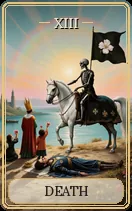 Death — After the ending, the reassembly: a transformation that happens calmly and ends well.
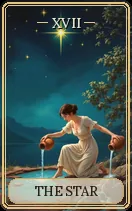 The Star — Healing and hope: a phase of quiet, luminous recovery.
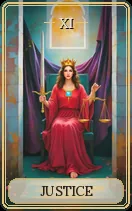 Justice — Balance and justice: a fair agreement, a solution that satisfies both sides.
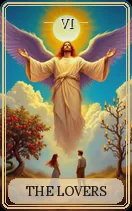 The Lovers — A harmonious relationship, in which the two complete each other; a choice made with balance.
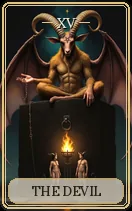 The Devil — The conflict between measure and excess — the need to moderate an impulse or a vice.
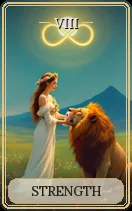 Strength — Patience and firmness: everything can be achieved with calm and persistence.
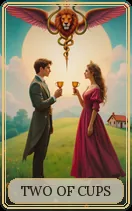 Two of Cups — A balanced union, a reconciliation, a bond that grows stronger.
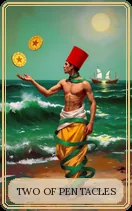 Two of Pentacles — Managing well what needs to be balanced: time, money, tasks.
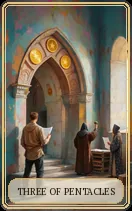 Three of Pentacles — Successful teamwork; different talents that complement one another.
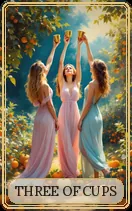 Three of Cups — Harmony among friends or in the family; celebration in moderation.
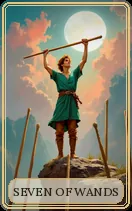 Seven of Wands — Defending your position without losing your calm; firmness without aggression.
Frequently asked questions
What does Temperance mean in tarot?
Balance, moderation and patience: the situation is resolved slowly, through the right combination of different elements. It also speaks of healing, reconciliation and collaboration.
What does Temperance mean in love?
A harmonious and balanced relationship, or a reconciliation after a difficult phase. It asks for patience and a willingness to give way. Reversed, it warns against imbalance and excess.
Is Temperance a good card?
Yes, it is one of the calmest and most favourable cards in the deck. But it asks for time: the results will come, but not straight away.
Is Temperance reversed bad?
It is not a condemnation. It shows the measure lost — excess, haste, mixtures that do not work — and asks you to return to balance.
Is Temperance a yes or a no?
Yes, but in time. It is a yes that depends on patience and moderation: the result will come, as long as you do not force it.
No sign-up · Reading written on the spot · Free