Wheel of Fortune: meaning and symbolism of the tarot card
Wheel of Fortune is the card of the movement we do not control. A great wheel turns in the sky: some are rising on one side, others are falling on the other, and someone, for now, is sitting at the top. No one stays in the same place for ever. It is the oldest law of human experience — everything changes — and this card places it at the centre of the reading.
In a reading, Wheel of Fortune announces a turning point: a change of luck, an opportunity that turns up, one cycle closing and another opening. Most of the time it is a favourable card, because it says that things are moving. But it also reminds us that what goes up must eventually come down, and that the only sensible attitude towards the wheel is to go with it: make the most of it when it is up, be patient when it is down, and do not cling to either point.
The card at a glance
| Number | X |
|---|---|
| Arcana | Major Arcana |
| Historical names | La Ruota (Italy); La Roue de Fortune (Marseille); Wheel of Fortune (Rider-Waite-Smith) |
| Element | Fire (a modern attribution, through the planet Jupiter) |
| Astrology | Jupiter (Golden Dawn) |
| Hebrew letter | Kaph (כ), according to the Golden Dawn |
| Keywords | cycle, turning point, luck, change, destiny, opportunity, the law of movement |
| Reversed | resistance to the cycle, repetition, apparent bad luck, delay, loss of control |
| Yes or no | Yes, if the moment is seized — the wheel is turning |
The image on the card
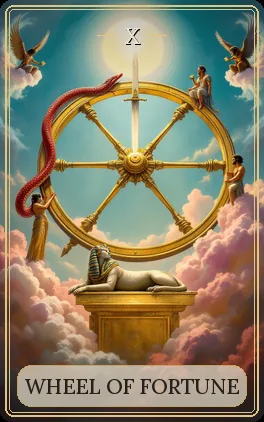
In the Sol da Alma Tarot, the Wheel is a great golden rim with eight spokes, with turned handles sticking out beyond the edge, like a ship’s wheel. From the centre, point upwards, rises the blade of a sword, against a pale sun. A red serpent coils around the left side of the wheel, its head at the top. Below, on the left, a woman in a golden dress pushes the wheel with her arms raised; on the right, a man in a loincloth clings to the rim; up at the top, another man sits on the rim with a cup in his hand. Beneath the wheel, lying on a golden pedestal, is a sphinx with an Egyptian headdress striped in blue and gold. Everything floats on pink clouds, and in the two upper corners two winged figures sit on clouds, holding books.
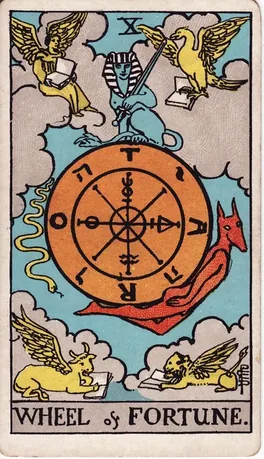
In the Rider-Waite-Smith of 1909, the wheel is an orange disc with letters around it — T, A, R, O and the four Hebrew letters of the divine name — and alchemical symbols on the spokes. At the top sits the sphinx, blue, with a sword; down the left side slides a yellow serpent; up the right side rises a red figure with a jackal’s head. In the four corners, on clouds, are an angel, an eagle, a bull and a lion, all winged and reading books. The Sol da Alma deck kept the wheel in the sky, the sphinx, the sword, the serpent and the clouds; it replaced the lettered disc with a spoked wheel, moved the sphinx down to the pedestal, gave the sword to the wheel itself and put human figures in place of the jackal-headed creature. Of the four winged beings in the corners, two remained.
In the Tarot de Marseille, La Roue de Fortune is simpler and stranger: a wooden wheel with a crank, mounted on a stand, to which three clothed creatures, half animal and half human, are clinging — one rising, another falling, and a third, crowned, with wings and a sword, seated on a platform at the top. There is no hand turning the crank.
The symbolism, detail by detail
The Wheel is one of the most symbol-laden cards in the tarot. Almost all its symbols speak of two things: what always changes, and what, in the midst of change, remains.
- The wheel
- The cycle: the seasons, the days, the stages of life, luck that comes and goes. It is a shape with no beginning and no end, which exists only by turning.
- The centre
- The only point on the wheel that does not move. In the traditional reading, it is the place of someone who understands the cycle and is no longer dragged along by it: to be at the hub, not on the rim.
- The eight spokes
- The link between the centre and the rim, and also the directions and phases of the cycle. In the Sol da Alma deck, the handles recall a ship’s wheel: the wheel turns by itself, but it can be steered.
- The sword
- Discernment and the justice of the cycle. In the Rider-Waite-Smith and the Marseille deck it is held by the figure at the top; in the Sol da Alma deck it rises from the hub itself, as if the wheel carried its own measure within it.
- The sphinx
- The riddle, the wisdom that observes without being carried away. It stays still while everything turns — it is the one who knows the answer the others are still looking for.
- The serpent
- The descent, the force that pulls down, loss. It is also life renewing itself by shedding its skin: the descent is part of the movement.
- The rising and falling figures
- All of us, at different heights on the wheel. Whoever is at the top holds the cup; whoever is at the bottom clings on or pushes. No position is final.
- The winged beings with books
- In the Rider-Waite-Smith, they are the four living creatures of the biblical visions — angel, eagle, bull and lion — who appear again in The World. The books speak of an order written behind chance. In the Sol da Alma deck there are two winged figures.
- The clouds
- The sky, what lies above human will. The wheel does not rest on the ground: what moves it cannot be seen.
- The number ten
- The end of a count and the return to one. It is the perfect number for a wheel: the cycle completes itself and begins again.
The history of Wheel of Fortune
The wheel of Fortune is much older than the tarot. The Romans depicted the goddess Fortuna with a wheel, and in the sixth century the philosopher Boethius, in ‘The Consolation of Philosophy’, made it one of the central images of medieval thought: Fortune turns the wheel, and no one should be surprised to be on top today and at the bottom tomorrow. In the Middle Ages the image spread through manuscripts, frescoes and cathedral rose windows, often with four figures around it — one who will reign, one who reigns, one who has reigned and one who has no kingdom left.
The first tarot decks, in fifteenth-century northern Italy, took up this image just as it was. In the decks painted for the Visconti and the Sforza in Milan around 1450, Fortune herself, blindfolded, stands at the centre of the wheel, with human figures clinging to the rim. In the Tarot de Marseille, which took shape between the seventeenth and eighteenth centuries, the goddess has disappeared and the figures have become half-animal creatures — but the idea is the same.
The modern image comes from the nineteenth century. Éliphas Lévi drew a wheel with a sphinx at the top, a jackal-headed figure rising and a serpent descending, and linked it to the divine name in Hebrew. The Hermetic Order of the Golden Dawn matched the card with the planet Jupiter and the letter Kaph. In the 1909 deck, Arthur Edward Waite and Pamela Colman Smith brought all of this together: the sphinx, the serpent, the jackal-headed creature, the letters, the alchemical symbols and the four winged beings. From then on, the Wheel was no longer just blind luck and came to be read also as cycle, law and destiny.
Wheel of Fortune upright: the meaning
Upright, Wheel of Fortune is the card of the turning point. Something is changing, often without the person having brought it about: an unexpected opportunity, a meeting, a piece of news, a change of circumstances that frees up what had stalled. In most questions it is a card of good luck — the movement favours the person asking.
It is also the card of cycles. It can point to the end of one phase and the start of another, to the return of an old situation in a new form, or to the realisation that there are patterns repeating themselves in one’s life. It asks you to pay attention to the rhythm of things: there are times for sowing and times for reaping, and forcing one against the other does not work.
Finally, it speaks of what does not depend on us. The Wheel is a reminder that will has its limits and that chance counts too. It is not a card of fatalism — it is a card of adaptation. You do not choose when the wheel turns, but you do choose what you do when it turns.
Wheel of Fortune reversed
Reversed, the Wheel does not stop turning: it is the person who resists the movement. It can point to someone clinging to a phase that is already over, trying to stay at the top of the wheel when it has already begun to go down; or to someone who repeats the same mistakes, the same patterns, the same relationships, expecting a different result.
It often speaks of a sense of bad luck — that things go wrong for no reason, that luck belongs to other people. The card does not deny that there are difficult phases, but it reminds us that the descent is part of the cycle, and that it passes too. It can also point to delays, changes that are slow to come, or a loss of control over a situation. The advice is the same as for the upright card, with more patience: let go of what no longer turns, learn from what keeps repeating, and wait for the wheel to rise again.
Wheel of Fortune in love
In love, the Wheel announces change. For those who are single, it can be an unexpected meeting, someone from the past who comes back, a phase that is finally unblocked. In a relationship, it speaks of a new stage — a step forward, a house move, a decision — or of a relationship with ups and downs, which needs to learn how to get through the less happy phases.
Sometimes it speaks of destiny: the feeling that a meeting ‘was meant to happen’. Reversed, it can point to a relationship that repeats old patterns, arguments that always come back to the same point, or difficulty in accepting that a relationship has changed.
Wheel of Fortune in work and money
At work, it is one of the cards most favourable to change: a promotion, an offer, a project gathering momentum, an opportunity that turns up at the right moment. It favours those who are alert and available. In a situation that has stalled, it says that movement will return. In a good situation, it is a reminder to prepare for when the cycle changes.
With money, it speaks of fluctuations: unexpected income, a lucky phase, but also the instability of depending on chance. Upright, it is a good card for financial opportunities; it is not, however, a licence to bet everything. Reversed, it warns against losses caused by stubbornness, against holding on to investments only because you have already invested, and against the idea that luck will sort out what planning did not.
Wheel of Fortune in health and wellbeing
In questions about wellbeing, the Wheel speaks of cycles and rhythms: energy that rises and falls, the need to respect the body’s phases, to change habits that no longer serve. Reversed, it points to repeated patterns that wear you out. The cards are no substitute for any kind of health care: the reading speaks of attitude, not of diagnosis.
Wheel of Fortune in spiritual life
On the inner path, the Wheel invites you to move from the rim to the centre — to stop being dragged along by the ups and downs and to find within yourself a point that does not move. For many readers, it is also the card of karma and of the cycles of learning: what has not been understood comes back, in different clothes, until it is understood. It is a card of active acceptance, not of resignation.
Wheel of Fortune as advice
As advice, the Wheel says: go with the movement. Seize the opportunity while it is there, without waiting for the perfect moment. Do not cling to what has passed or despair over what is down — everything turns. And watch the patterns: if something keeps repeating in your life, it is because there is something there to learn.
Wheel of Fortune in the positions of a spread
- In the past
- A turning point that changed everything — a stroke of luck, a loss, a chance event — whose effect is still felt.
- In the present
- Things are moving. It is a moment of change, and whatever is done now counts double.
- In the future
- A change of cycle on its way, usually a favourable one: a door that opens without anyone having knocked.
- As an obstacle
- Resistance to change, repeating patterns, or relying on luck instead of on decisions.
- As the outcome
- The matter turns: the situation takes on a new shape, and a new cycle begins.
Numerology and correspondences
Ten is the end of the cycle: everything the series could give has been given, and the count goes back to one. That is why Wheel of Fortune closes the first ten of the Major Arcana and opens the second. It comes straight after The Hermit — after withdrawal, the world starts moving again — and before Justice (in the Rider-Waite-Smith) or Strength (in the Marseille deck): after movement, measure or self-mastery.
In the Golden Dawn tradition, it corresponds to the planet Jupiter, the planet of expansion, luck and opportunity, and to the Hebrew letter Kaph, which is associated with the palm of the hand — the hand that receives and holds. That is where the generally favourable tone of the card comes from: the Wheel, as a rule, turns in favour of the person asking.
Combinations with other cards
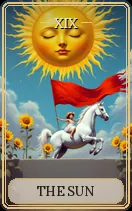 The Sun — A phase of great luck and joy: the wheel is at its highest point.
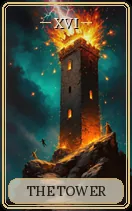 The Tower — A sudden, abrupt change, not chosen, but one that changes the course of things.
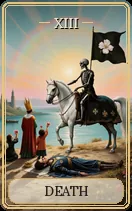 Death — The end of one cycle and the start of another: a deep and inevitable transformation.
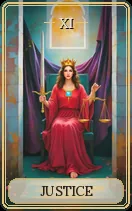 Justice — Consequences: what was sown comes back, for good and for ill.
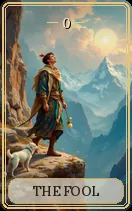 The Fool — An unexpected fresh start; an adventure that chance puts in your path.
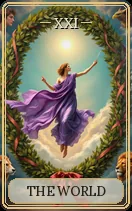 The World — The close of a great stage and the opening of an even greater one.
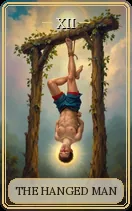 The Hanged Man — The wheel seems to stand still: a wait that prepares the turning point.
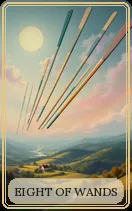 Eight of Wands — Things move suddenly and fast: news, travel, rapid change.
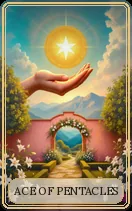 Ace of Pentacles — A financial or material opportunity that turns up by luck.
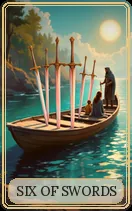 Six of Swords — A change of phase that leads to calmer waters.
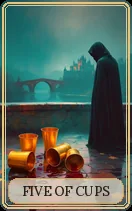 Five of Cups — A downturn of the wheel: a loss that is part of the cycle and that will also pass.
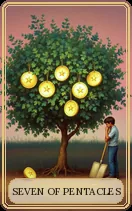 Seven of Pentacles — Waiting for the right time: the harvest comes with the cycle, and not before.
Frequently asked questions
What does Wheel of Fortune mean in tarot?
Change, cycle and a turn of luck: something is moving, often without depending on the person asking. In most readings it is favourable, but it reminds us that nothing stays the same for ever.
Is Wheel of Fortune a good card?
Generally, yes: it announces movement and opportunities. But it is a card of cycles — what is up comes down, what is down goes up — and the surrounding cards tell you which way the wheel is turning.
What does Wheel of Fortune mean in love?
A change: an unexpected meeting, someone coming back, a new stage in the relationship. Reversed, it can speak of repeated patterns or of difficulty in accepting that the relationship has changed.
Is Wheel of Fortune reversed bad luck?
Not exactly. It shows resistance to the cycle, delays or the repetition of the same mistakes. It asks for patience and a change of attitude, and reminds you that bad phases pass too.
Is Wheel of Fortune a yes or a no?
It leans towards yes, especially in questions about change or opportunities. It is a yes that asks you to seize the moment.
No sign-up · Reading written on the spot · Free