
Eight of Wands: meaning and symbolism of the tarot card
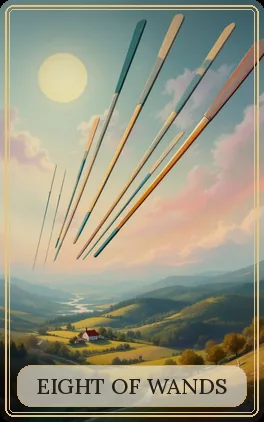
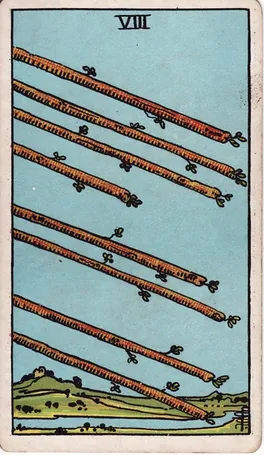
The Eight of Wands is one of the few cards in the tarot on which nobody appears. There is no figure, no face, no gesture: there are eight wands crossing the sky, thrown by a hand that cannot be seen, and coming down towards the earth. The whole card is movement. That is why it is almost always read the same way — something that had been standing still suddenly starts to move, and it moves fast.
In a spread, the Eight of Wands brings news, messages, answers, journeys, decisions made in a single day and events that follow one after another without leaving time to breathe. It is one of the most clearly favourable cards in the suit, because it says the wait is over. But it also says that the time for preparing has passed: the wands are in the air, and what was thrown will reach the ground just as it was thrown.
The card at a glance
| Card | Eight |
|---|---|
| Suit | Wands |
| Element | Fire |
| Astrology | Mercury in Sagittarius (Golden Dawn) |
| Keywords | speed, message, news, travel, movement, events coming to a head |
| Reversed | delay, lost message, disorderly haste, crossed wires, impatience |
| Yes or no | Yes — and quickly |
The image on the card
In the Sol da Alma Tarot, eight long, smooth wands cross the sky in parallel lines, all at the same angle, their tips pointing down and to the left. They are painted as shafts of finished wood — in shades of blue-green, cream, orange and coral red — and the perspective makes the nearest ones look large while the furthest taper away like needles, as if the flight came from behind the viewer and carried on towards the horizon. At the top left, a pale, round sun; on the right, pink and golden clouds. Below opens a wide green valley, with hills rolling one after another into the distance, a winding river, yellow fields, autumn trees and, in the centre, a white house with a red roof.
In the 1909 Rider-Waite-Smith, the idea is the same, and it was the starting point for the Sol da Alma painting: eight wands in parallel flight, with no human figure, over an open landscape with a river and a hill on which a small house can be seen. But there are clear differences. In Pamela Colman Smith’s deck the wands are rough wooden branches, with small sprouts of green leaves, and they come down from left to right against a plain blue sky, with no sun. In the Sol da Alma they have lost their leaves and gained colour and finish, and the sky has light, clouds and depth — the scene is less schematic and more luminous.
In the Marseille Tarot there is no scene at all. As with all the numbered Minors in that deck, the card shows only the suit symbols: eight long staffs, crossed in a lattice, with small plant motifs in the gaps. The sense of speed and flight, which today seems inseparable from the card, is a modern reading, given above all by the Rider-Waite-Smith image.
The symbolism, detail by detail
On a card without characters, everything speaks through direction and space. Each element adds a nuance to the same idea: what was still has begun to move.
- The wands in flight
- The energy of Fire already released, no longer in anyone’s hand. The push has been given; now it follows its course. It is the difference between wanting and watching it happen.
- The parallel lines
- All the wands travel in the same direction: there is no conflict, no crossed wands as in the Five of Wands. The forces have lined up and are pushing the same way — which is why things move.
- The descent
- The tips point downwards, towards the earth. The flight is ending: what was thrown is about to arrive. Many readers see here the landing of a piece of news or the conclusion of a matter.
- The absence of a figure
- Nobody is in control of what is happening. The card describes events, not people: things that arrive from outside, at their own pace, and to which one can only respond.
- The perspective
- In the Sol da Alma, the large wands in front and the thin ones far off give the feeling of a movement that starts close by and heads far away — the message that sets off, the journey that begins, the distance that shrinks.
- The valley and the river
- The open space through which the wands pass unhindered. The river flowing in the background is another image of the same flow: the way is clear.
- The red-roofed house
- The destination, the place where the message will land. Small and isolated in the middle of the valley, it is a reminder that all the speed of the card ends at a real door — that of the person asking.
- The pale sun
- A clear light, without drama. This is not a card of storms: it is a card of open weather, good for travelling and for receiving news.
- The leafless wands
- In the Rider-Waite-Smith the wands are still sprouting, a sign of life; in the Sol da Alma they are smooth, painted shafts, closer to spears or arrows. The emphasis shifts from growth to direction and aim.
The history of the Eight of Wands
The suit of Wands is one of the four Latin suits — cups, swords, coins and batons — that the tarot shares with Italian and Spanish playing cards. In the earliest tarots, painted in northern Italy in the fifteenth century, it was called bastoni; in the Marseille decks, which took their settled form between the seventeenth and eighteenth centuries, bâtons. In none of these decks did the Eight of Wands have a scene: it was a pip card, with eight staffs laid out in a lattice, used for playing tarocchi rather than for telling fortunes.
The image of the wands in flight was born in 1909, with the deck of Arthur Edward Waite and Pamela Colman Smith — the first widely circulated deck to give a scene to all the Minors. In the book that accompanied the deck, Waite described the card as a flight of wands through open country and gave it the meanings of activity, the swiftness of an express messenger, great haste and great hope; he also added, as a possible reading, ‘the arrows of love’ — and, reversed, the arrows of jealousy and quarrels.
Before that, the Hermetic Order of the Golden Dawn, at the end of the nineteenth century, had already given each numbered card a title and an astrological correspondence. The Eight of Wands was named ‘the Lord of Swiftness’ and assigned Mercury in Sagittarius. It is from this tradition that the modern reading of the card as message, travel and speed comes, and it is this tradition that the Sol da Alma follows.
The Eight of Wands upright: the meaning
Upright, the Eight of Wands is the card of acceleration. A matter that has been stuck for weeks is settled in days; an answer that would not come arrives all at once; several things happen at the same time. It is the card of messages — phone calls, emails, invitations, offers — and of journeys, especially those decided on quickly. In a spread that spoke of waiting, it is the sign that the wait is over.
It also speaks of clarity of direction. The eight wands do not fly at random: they all fly the same way. When the card appears, the obstacles have usually cleared and conditions are lining up in your favour. Whatever has been set in motion has a good chance of reaching its destination, as long as there is no hesitating halfway.
It is, at heart, the good kind of hurry. Not the anxious hurry of someone running without knowing where to, but that of someone who sees things moving and goes with the current. The Eight of Wands asks for a quick reply, a ready decision and availability — the moment favours those who are prepared to act when the message arrives.
The Eight of Wands reversed
Reversed, the Eight of Wands does not become the opposite of speed: it is the same speed held back or thrown into disorder. The most common case is delay — the message that does not arrive, the postponed journey, the process that gets stuck on a piece of paperwork, the message lost along the way. The wands have been thrown, but they are stuck in mid-air.
At other times it is excess: everything happens too fast, and things trip over one another. Crossed messages, decisions taken without thinking, answers given in a hurry that later have to be taken back. It is also the card of impatience — of someone who wants everything to move faster than it can, and wears themselves out pushing what is not yet ripe.
Waite linked the reversed card to jealousy and quarrels, and that reading is still useful for questions about relationships: the movement turns inwards and becomes restlessness. In any case, the card asks for the same thing — to work out whether the delay is a real obstacle or simply the normal pace of things, and not to throw more wands while the first ones have yet to land.
The Eight of Wands in love
In love, the Eight of Wands brings movement: a message from the person you have been waiting for, a reunion, an invitation, a beginning that happens suddenly. For those who are single, it speaks of a quick attraction, of a passion that flares up without warning — the ‘arrows of love’ Waite wrote about. In a relationship, it can announce a phase of novelty, a trip together, or a step taken sooner than expected.
In long-distance relationships it is one of the most encouraging cards: it shortens the distance, brings frequent contact, sometimes the visit itself. The caution lies in the speed. What starts very quickly needs time to take root, and the card does not say whether it will last — it says that it begins. Reversed, it speaks of messages that do not arrive, of silences, of misunderstandings for lack of conversation, or of jealousy and mistrust fed by the waiting.
The Eight of Wands in work and money
In work, it is an excellent card for anyone waiting for an answer: the application gets a reply, the proposal is accepted, the project moves forward. It points to very busy phases — tight deadlines, back-to-back meetings, travel, lots of contacts — and favours professions linked to communication, sales, transport and travel. It can announce a quick change of role or an opportunity that has to be seized on the spot.
In money, it speaks of rapid movements: payments coming in, deals being closed, financial decisions that cannot wait. It is not a card of accumulation, but of circulation. Reversed, it warns against late payments, red tape that gets stuck and impulse purchases, and asks you to read carefully what you are signing before replying in a hurry.
The Eight of Wands in health and wellbeing
In questions about wellbeing, the Eight of Wands speaks of energy in motion, of a desire for physical activity, of a phase in which things improve quickly. Reversed, it points to the risk of an excessive pace and of a restlessness that allows no rest. As always, the cards are no substitute for any kind of health care: the reading speaks of attitudes and tendencies, and never of diagnoses.
The Eight of Wands in spiritual life
On the inner path, the Eight of Wands is the moment when an understanding arrives all at once: an idea that becomes clear, a synchronicity, an answer that appears after a long time of searching. It says that the intention you sent out is reaching its destination. It also asks that you know how to slow down afterwards — what arrives quickly needs to be lived slowly to become part of who we are.
The Eight of Wands as advice
As advice, the Eight of Wands says: reply, act, do not let it go cold. The moment is now, and conditions are in your favour. Send the message, book the journey, settle the matter. But it also says: take good aim before you throw — because, once in the air, the wand goes where it was sent.
The Eight of Wands in the positions of a spread
- In the past
- A very busy phase that brought the situation to where it is now, or a quick decision whose consequences are still arriving.
- In the present
- Everything is speeding up: the person is in the middle of events that follow one after another, and what matters is keeping up with the pace without losing direction.
- In the future
- News, an answer or a journey on its way — and soon.
- As an obstacle
- Haste, impatience, slapdash communication; or a delay that does not depend on the person asking.
- As the outcome
- The matter gets unstuck and is settled quickly, usually in a favourable way.
Numerology and correspondences
Eight is work and movement: the hand that repeats, the thing that moves, the craft being practised. After the solitary courage of the Seven, the Eight no longer fights — it carries out. In the suit of Fire, that carrying out gains speed: the will, which in the Ace was a seed and in the Seven was defence, becomes pure action here, with no resistance, on its way to the end of the cycle that the Nine and the Ten will complete.
In the Golden Dawn tradition, the Eight of Wands corresponds to Mercury in Sagittarius. Mercury is the planet of messages, exchanges and journeys; Sagittarius, a Fire sign, is the sign of the long journey, of distance and the horizon. Together they describe the card well: the word that travels far, and fast. The title the order gave it, ‘the Lord of Swiftness’, says the same in a few words.
Combinations with other cards
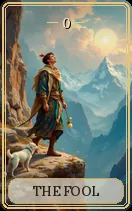 The Fool — Everything happens quickly: an imminent journey or change, decided almost overnight.
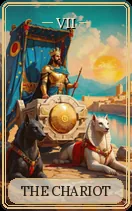 The Chariot — A swift journey, determined progress; a matter won through speed.
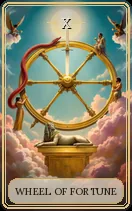 Wheel of Fortune — A sudden turnaround: luck changes all at once, and things come to a head.
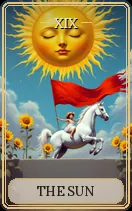 The Sun — Excellent news that arrives quickly; fast, visible success.
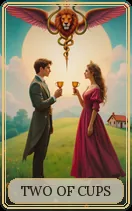 Two of Cups — A passion that begins suddenly, or a long-awaited message of love.
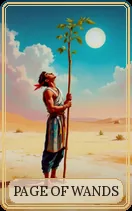 Page of Wands — Exciting news; a young person bringing a message or an offer.
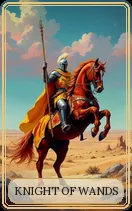 Knight of Wands — Travel, a move of house or country; a quick, decisive departure.
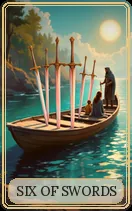 Six of Swords — A journey, a crossing; getting out of a difficult situation quickly.
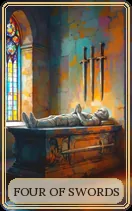 Four of Swords — An enforced pause: the matter slows down, and you need to wait before acting again.
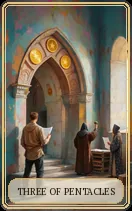 Three of Pentacles — A work project that moves forward quickly, with several people involved.
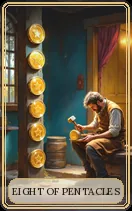 Eight of Pentacles — A lot of work all at once: orders, tight deadlines, high productivity.
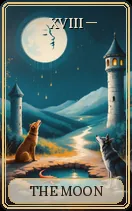 The Moon — Confused or incomplete news; best to check before acting.
Frequently asked questions
What does the Eight of Wands mean in tarot?
Speed, messages and events coming to a head. It is the card of a wait that ends: news, answers, journeys and decisions that arrive suddenly, usually in a favourable way.
Is the Eight of Wands a yes or a no?
It is a clear yes, and a quick one. Reversed, the yes may come late, or after some confusion that needs clearing up.
What does the Eight of Wands mean in love?
Movement: a message from the person you are waiting for, a sudden meeting, a passion that flares up quickly. Reversed, it speaks of silences, delays in communication or jealousy.
Is the Eight of Wands reversed bad?
It is not a bad card: it is the same speed held back or thrown into disorder. It speaks of delays, lost messages or excessive haste, and asks for patience and clarity before acting again.
Does the Eight of Wands indicate travel?
Often, yes. It is one of the travel cards of the tarot, especially when it appears alongside the Six of Swords, the Knight of Wands or The Chariot.
Why are there no figures on the Eight of Wands?
Because it is a card of events, not of people. In the Rider-Waite-Smith, Pamela Colman Smith painted only the wands in flight, and the Sol da Alma followed that idea. In the Marseille Tarot, as with all the numbered Minors, there are no figures either: only the eight staffs of the suit.
No sign-up · Reading written on the spot · Free