Three of Pentacles: meaning and symbolism of the tarot card
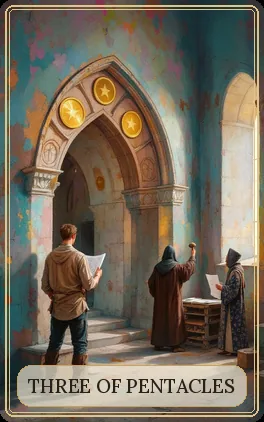
The Three of Pentacles is the card of the work raised by many hands. In a church or a building under construction, three people work around a stone arch: one studies the plan, another works on the wall, another oversees and checks. None of them does everything alone, and that is precisely why the work moves forward. It is one of the most concrete cards in the tarot — it speaks of work, of competence and of results that can be seen.
In a spread, the Three of Pentacles announces that an effort is starting to bear fruit: a project taking shape, a talent being recognised, a team that works. It is the first visible achievement of the suit of Earth. It is not yet the final success, but it is already more than a promise: it is proof that you know how to do the job.
The card at a glance
| Card | Three |
|---|---|
| Suit | Pentacles |
| Element | Earth |
| Astrology | Mars in Capricorn (Golden Dawn) |
| Keywords | teamwork, craft, competence, recognition, planning, building, collaboration |
| Reversed | work falling apart, misunderstanding, poorly paid work, lack of quality, plan that goes nowhere |
| Yes or no | Yes, if there is work and collaboration to back up the request |
The image on the card
In the Sol da Alma Tarot, the scene takes place inside a stone building, with walls painted in patches of blue, pink, orange and green, like old frescoes worn by time. At the centre a large pointed arch of pale stone opens above two pillars with carved capitals; inside, a few steps climb into the half-light. Set into the arch are three gold coins, each with a white star, and between them two carved stone rosettes; at the far end of the passage a small golden disc also shines. On the left, with his back to us, a young man in a hooded beige tunic, blue trousers and tall boots holds a large unfolded sheet in both hands — the plan of the building — and studies it. In the middle, a figure in a brown habit and black hood raises an arm towards the wall, holding a small object that looks like a wooden mallet. On the right, beside a wooden box covered in papers, another hooded figure, in a dark-blue cloak printed with flowers, reads a sheet of paper. Daylight comes in through a tall window, also arched.
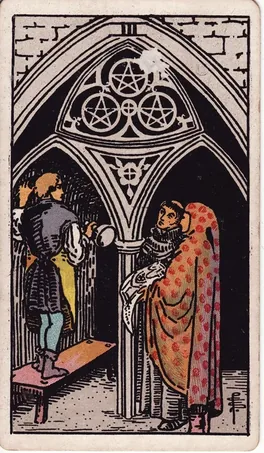
In the 1909 Rider-Waite-Smith, the scene is essentially the same, and it was from it that the Sol da Alma painting set out: beneath a Gothic arch with three pentacles set in a trefoil, a stonemason standing on a bench works the stone with a mallet, while a monk, holding an unfolded sheet, and a figure in a hood and a cloak with red spots watch him and talk to him. The Sol da Alma redistributes the roles: the craftsman is no longer up on the bench; the young man studying the plan moves into the foreground, with his back turned, as if he were the querent looking at the work; and the gesture of working on the wall passes to the figure in the habit. The walls gain colour, and the three coins are placed in the arch itself, like the stones of a finished building.
In the Marseille Tarot there is no building and there are no people: the Three of Pentacles shows only three coins — one above and two below, or the other way round, depending on the deck — among stylised foliage. The theme of craft and shared work is a reading that the Rider-Waite-Smith made visible.
The symbolism, detail by detail
This card speaks of the meeting of three things that any work needs: the plan, the hand that carries it out and the eye that checks it. Each figure and each stone stands for one of those parts.
- The stone arch
- The work itself: solid, well thought out, made to last. It is a structure that only stays standing if every stone is in its place — the perfect image of teamwork.
- The three coins in the arch
- The value that work creates and that becomes part of the building. They are up there, in plain sight: the effort has already turned into something that can be recognised.
- The unfolded plan
- The project, the technical know-how, the plan that guides the hands. Without it, the work would be done blindly; with it, each person knows what is theirs to do.
- The young man seen from behind
- Particular to the Sol da Alma painting: he is in the foreground, studying the plan, and he sees the work as we see it. He is the apprentice who has become competent, or the person asking, standing before their own project.
- The figure in the habit with the mallet
- The hand that carries out the work. The gesture is simple and repeated: striking the stone until it takes shape. In the Rider-Waite-Smith it is the stonemason, the craftsman; here the gesture passes to a figure in a habit, as if everyone were putting their hand to the work.
- The figure in the blue cloak
- The one who oversees, checks and decides — the client, the person in charge, the master. He holds a sheet of paper: the work is discussed and compared with what was agreed.
- The habits and the religious building
- Work done with dedication, almost as a form of service. For centuries, the great works in stone were churches and monasteries, built by generations of craftsmen.
- The lit window
- Clarity. Light enters the work and shows what has been done well. The Three of Pentacles is a card of work done in the open, with nothing to hide.
- The coloured walls
- In the Sol da Alma painting, the patches of colour recall old frescoes: the work of those who came before, still present. Every work rests on the craft of others.
The history of the Three of Pentacles
Tarot was born in northern Italy in the fifteenth century as a card game, and its four suits — cups, swords, batons and coins — are the same as those of the Latin-suited cards still played in Portugal and Spain today. In the earliest decks and in the Marseille decks, which took their settled form in the seventeenth and eighteenth centuries, the numbered cards had no scene: the Three of Pentacles was an arrangement of three coins among foliage.
At the end of the nineteenth century, the Hermetic Order of the Golden Dawn assigned each numbered card a planet in a sign and a title. The Three of Pentacles was given Mars in Capricorn and the title ‘Lord of Material Works’. Mars brings energy and effort; Capricorn, patience and structure. The title says it all: this is the card of work that produces real things.
It was the Rider-Waite-Smith, drawn by Pamela Colman Smith under the direction of Arthur Edward Waite and published in 1909, that became the first widely circulated deck to give a scene to every Minor card. Waite describes the card as a sculptor at work in a monastery, and links it to the Eight of Pentacles: the apprentice of the Eight has received his reward and is now at work in earnest. He gives it the meanings of trade, profession and skilled labour, and adds that it was often read as nobility, renown and glory as well. The scene of the arch and the three workers became the classic image of the card, and it is the one the Sol da Alma follows, with its own painting.
The Three of Pentacles upright: the meaning
Upright, the Three of Pentacles is the card of work well done and recognised. It indicates that the competence of the person asking is being seen: a manager who takes notice, a satisfied client, an approved project, a recommendation. After the Ace, which offers, and the Two, which manages, the Three produces — the work exists and can be shown.
Above all, it is a card of collaboration. It says that success depends on bringing together people with different skills and on each of them doing their part well: the one who plans, the one who carries out, the one who decides. It favours teams, partnerships, business ventures, work on the house, training courses, everything that is built with method and with others.
It also speaks of learning and of a mastery that is just beginning. This is not yet the finished master; it is someone who already knows enough to be taken seriously, and who keeps learning from those around them. The Three of Pentacles asks for quality, attention to detail and respect for the plan.
The Three of Pentacles reversed
Reversed, the Three of Pentacles does not turn into its opposite: the work is still there, but falling apart. People do not understand one another, each pulls in their own direction, or someone is not doing their part. The plan exists but is not followed, or is followed carelessly. It is the card of building works that drag on, of projects in which nobody really knows who is in charge, of jobs that end up with defects.
It can also indicate a craft that is poorly paid or poorly used: a talent that goes unrecognised, an effort that others put their name to, a competence that finds no place. Or, turned inwards, the temptation to do everything alone, refusing the help that would make the work possible. The card asks you to go back to the plan, review who does what, and restore quality before haste.
The Three of Pentacles in love
In love, the Three of Pentacles speaks of a relationship built with work and cooperation. It is not the card of passion; it is the card of the couple who make plans, share tasks and build a life together stone by stone. It is very favourable for projects as a couple: work on the house, a joint business, organising a wedding. For someone who is single, it can indicate a meeting at work, on a course or in a project — someone you get to know by doing things together.
It can also point to help from others: friends or family who support the relationship. Reversed, it warns against a lack of collaboration — one of the two carries everything —, against outside interference that gets in the way, or against a relationship in which more time goes into discussing the work than into living the affection.
The Three of Pentacles in work and money
It is at work that the Three of Pentacles shows its full strength. It announces professional recognition, a positive appraisal, a well-deserved promotion, a project that is moving along well as a team. It is excellent for skilled and technical professions — building, architecture, crafts, engineering, design —, but it applies to any work in which quality counts. It also favours studies, internships and training that give practical competence.
With money, it indicates income linked to work and competence: fair payment for a service, a contract, a client who comes back. It is not easy money; it is earned money. Reversed, it speaks of poorly paid work, of budgets that spiral, of a job that costs more than it should because it was badly planned or badly carried out.
The Three of Pentacles in health and wellbeing
In questions about wellbeing, the Three of Pentacles reminds you that caring for the body is also a shared work: following a plan with discipline, relying on those who know, being patient with the results. Reversed, it points to the temptation to abandon the plan halfway. The cards are no substitute for any kind of healthcare: here, as with any other card, the reading speaks of attitude, not diagnosis.
The Three of Pentacles in spiritual life
On the inner path, the Three of Pentacles speaks of shared practice: the group, the community, the teacher and one’s companions. It reminds us that spiritual growth is also a craft, learnt with method and with others, and that it can express itself in work well done. The religious building in the image says just that: for centuries, building was a way of praying.
The Three of Pentacles as advice
As advice, the Three of Pentacles says: work with others and do your part well. Ask for help from those who know, listen to opinions, follow the plan, take care over the details. Show what you can do — without vanity, but without hiding. A work raised by many hands goes further than one made alone.
The Three of Pentacles in the positions of a spread
- In the past
- A job, a training course or a collaboration that gave you competence and laid the foundations of the present situation.
- In the present
- Work in progress, with several people involved. The effort is being noticed and is bearing fruit.
- In the future
- Recognition on its way, a useful partnership, or a project that will take shape with the right help.
- As an obstacle
- Disagreement in the team, a lack of quality, or a refusal to work with others.
- As the outcome
- A solid, recognised piece of work: what was done together reaches a good end.
Numerology and correspondences
Three is the first creation: what is born from bringing two things together, and can already be seen from outside. In the suit of Pentacles — the suit of Earth, of the body, of money, of craft and of the slow time of things that are built —, that creation is literal: a building, a product, a finished piece of work. The balance of the Two has turned into something concrete, with three points of support, like a tripod that can already stand on its own.
In the Golden Dawn tradition, the Three of Pentacles corresponds to Mars in Capricorn and bears the title ‘Lord of Material Works’. Mars is the planet of energy, effort and action; Capricorn, an Earth sign, is the sign of patient ambition and structure. The meeting of the two gives the card its tone: well-directed energy, placed at the service of a work meant to last.
Combinations with other cards
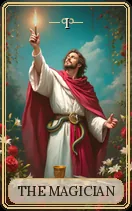 The Magician — Talent and technique at the service of a project: skill that becomes a craft.
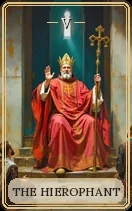 The Hierophant — Learning from a master, a recognised qualification, an institution that supports the work.
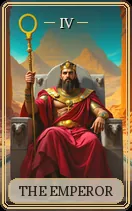 The Emperor — A solid structure, a well-organised company, a project with clear leadership.
 The Sun — Visible success and public recognition of the work done.
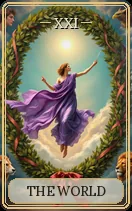 The World — A work completed successfully; a project that reaches its end and is presented.
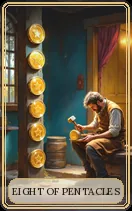 Eight of Pentacles — Dedication to the craft: the apprentice who becomes a master through sheer hard work.
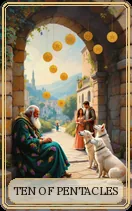 Ten of Pentacles — A family business, a work that spans generations, wealth built up over time.
 Three of Cups — A team that gets on well, colleagues who become friends, a celebration at work.
 Three of Wands — A project that expands, partnerships abroad, work that begins to reach further.
 Five of Swords — Conflict in the team; someone working against the common effort.
 Five of Pentacles — Poorly paid work or a period with no orders; the need to look for another team.
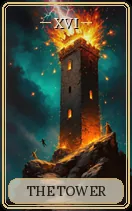 The Tower — A work that has to be rebuilt from the foundations; a project that collapses because of a basic error.
Frequently asked questions
What does the Three of Pentacles mean in tarot?
Teamwork, competence and recognition: a work that rises because each person does their part well. It is the card of craft and of effort that begins to bear visible fruit.
Is the Three of Pentacles a yes or a no?
It leans towards yes, especially in questions about work, studies and projects. It is a yes that depends on effort and collaboration: the result comes, but it has to be built.
What does the Three of Pentacles mean in love?
A relationship built on cooperation and shared plans. It can also indicate a meeting at work or in a project, with someone you get to know by doing things together.
Is the Three of Pentacles reversed bad?
It is not a bad card. Reversed, it indicates that the work is falling apart: there is a lack of understanding, quality or recognition. It is an invitation to review the plan and the way of working together.
What does the Three of Pentacles mean for work?
It is one of the best cards for work: recognition, a positive appraisal, promotion, a team that works. It especially favours technical and skilled professions, as well as studies and practical training.
No sign-up · Reading written on the spot · Free