
Four of Pentacles: meaning and symbolism of the tarot card
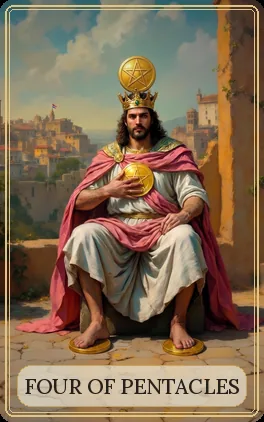
The Four of Pentacles is the card of the one who holds on. A man with a crown on his head sits in front of his city and holds a gold coin to his chest with one hand; another balances on top of his crown, and two more lie under his feet. He does not move. Everything he has is right there, within reach, and his whole attention is fixed on not letting it get away.
In a spread, the Four of Pentacles speaks of material security, of saving and of control — good things, which give life a footing. But it also speaks of the other side of the same coin: attachment, fear of loss, the hand that closes so tightly it can no longer receive anything. It is a card of stability, and its question is always the same: how tightly do you really need to hold on?
The card at a glance
| Card | Four |
|---|---|
| Suit | Pentacles |
| Element | Earth |
| Astrology | Sun in Capricorn (Golden Dawn) |
| Keywords | possession, security, savings, control, stability, conservation, prudence |
| Reversed | miserliness, attachment, fear of loss, letting go of what you cling to, reckless spending after a tight spell |
| Yes or no | Yes, if the question is about keeping or protecting; ‘no’ if it is about letting go or taking a risk |
The image on the card
In the Sol da Alma Tarot, a man with a black beard and long hair, also dark, sits barefoot on a stone, on a floor of worn flagstones gilded by the sun. On his head he wears a gold crown with a green stone at its centre, and on top of the crown, balanced, sits a gold coin engraved with a pentagram. With one hand he clutches a second, matching coin to his chest, also bearing the pentagram; his other hand rests on his thigh. He wears a loose white tunic with a gold belt and, over his shoulders, a pink cloak that crosses his body and falls to the ground; at his neck, a collar embroidered in green and blue, fastened with a round gold clasp. His bare feet rest on the other two coins, which lie on the ground. He looks straight ahead, serious, unsmiling. Behind him stretches a town of ochre houses with red roofs on a hillside, with towers, a flag flying high and trees; on the right rises a tall stone wall covered in climbing plants, and the sky is blue with pale clouds.
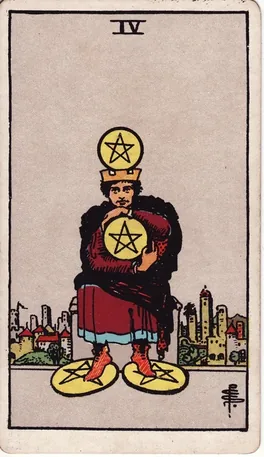
In the 1909 Rider-Waite-Smith, the scene is essentially the same, and the Sol da Alma painting follows it closely: a crowned figure, with a pentacle on top of the crown, holds another to his chest and has two under his feet, with a city in the background. As in the 1909 deck, the coins bear the five-pointed star — clearly visible on the one on the crown and the one at his chest — and the two lower ones sit under his feet. The Sol da Alma changes a few details: the man is barefoot and gains a beard, a pink cloak and an expression that is more firm than miserly; he holds the coin at his chest with a single hand, where the 1909 figure wraps his hands and arms around it; and the city, which in the 1909 deck is a strip of houses behind a figure, becomes here a warm, luminous landscape.
In the Marseille Tarot there is no figure and no city: the Four of Pentacles shows four coins arranged in a square, with an ornament of flowers or foliage in the middle. The geometry already says something — four sides, a closed shape —, but it was the Rider-Waite-Smith that gave the card its man clutching his coin.
The symbolism, detail by detail
Everything in this card speaks of holding on. Each coin is in a different place on the body, and each shows a different way of keeping.
- The coin pressed to the chest
- What is kept with the heart: money, but also affections, ideas, control. Clutching it like this, his hand pressed over it, he protects it — and closes himself off. A hand busy holding on cannot receive anything else.
- The coin on the crown
- Money on the mind: thoughts taken up with possessions, security, the accounts. It is also power balanced up high — and it could fall at the first sudden movement.
- The two coins under his feet
- The material foundations: a home, land, a fixed income. As in the Rider-Waite-Smith, they lie under his feet, foundations trodden down firmly: they give support, but they also pin down whoever will not step off them.
- The crown
- Authority over what is his. He is lord of his own small kingdom, and the Four of Pentacles is indeed a card of material mastery — but of a mastery that is defended more than it is exercised.
- The bare feet
- Particular to the Sol da Alma painting, where the 1909 figure wears shoes: the man rests his bare feet on the coins. However much gold he has, his security is simple and direct; it is not luxury.
- The stone he sits on
- Immobility. He has settled in and does not intend to get up. This is the strength of the Four — stability — and its danger: standing still.
- The town in the background
- The world, exchange, social life. He has his back to it: he keeps what he has, but he does not take part. The town goes on living without him.
- The stone wall
- Protection, the boundary, the limit between what is mine and what belongs to others. The climbing plants say the wall has been there for a long time.
- The pentagram on the coins
- As in the Rider-Waite-Smith and the other cards of the suit, the coins bear the five-pointed star. It is the sign of the Pentacles: gold not only as metal, but as value, work and form given to matter.
The history of the Four of Pentacles
Tarot was born in northern Italy in the fifteenth century as a card game, and its four suits — cups, swords, batons and coins — are the same as those of the Latin-suited cards still played in Portugal and Spain today. In the earliest decks and in the Marseille decks, which took their settled form in the seventeenth and eighteenth centuries, the numbered cards had no scene: the Four of Pentacles was a square of four coins with an ornament at the centre.
At the end of the nineteenth century, the Hermetic Order of the Golden Dawn assigned each numbered card a planet in a sign and a title. The Four of Pentacles was given the Sun in Capricorn and the title ‘Lord of Earthly Power’. It is a more favourable title than the modern image would suggest: the card was, first and foremost, the card of power and security won in the material world.
It was the Rider-Waite-Smith, drawn by Pamela Colman Smith under the direction of Arthur Edward Waite and published in 1909, that gave a scene to all the Minor cards. Waite describes a crowned figure holding a pentacle with his hands and arms, with another on his crown and two under his feet, and sums it up in a phrase: he holds fast to what he has. He gives it the meanings of the surety of possessions, of cleaving to what one has, and also of gift, legacy and inheritance; reversed, of suspense, delay and opposition. It was from this image that the current reading of the Four of Pentacles as the card of possession and attachment was born, and it is the one the Sol da Alma follows, with its own painting.
The Four of Pentacles upright: the meaning
Upright, the Four of Pentacles is the card of material security. It speaks of someone who has won something — money, a home, a position, stability — and wants to protect it. It is savings, a budget kept under control, assets that are preserved, a secure job. In a time of uncertainty, it is good news: there is ground beneath your feet.
It is also the card of control. Whoever draws it likes to know where everything is, to decide alone, to depend on nobody. That can be a virtue — prudence, discipline, responsibility — or it can be going too far. The card does not judge; it shows the position and asks whether it still serves.
Because the Four of Pentacles has two sides, and both are in the same image. Keeping is necessary; gripping too tightly turns into fear. Money that is only kept does not circulate, a relationship that is only controlled cannot breathe, an idea that is never shared does not grow. The reading depends a great deal on the question and on the cards beside it: sometimes the card says ‘protect what you have’, at other times it says ‘notice what you are losing by not letting go’.
The Four of Pentacles reversed
Reversed, the Four of Pentacles does not turn into its opposite: it is the same fist, which either squeezes too hard or starts to open. In one sense, it is miserliness taking hold — the fear of loss that no longer lets anything through, mistrust, a refusal to share, security that has become a prison. The man grips the coin so hard that he has stopped living.
In the other sense, it is the moment of letting go. It can be a release — detaching yourself from a possession, from a form of control, from a fixed idea that was stifling you — or it can be the reckless spending of someone who held on too tightly for too long and now lets everything slip at once. It can also indicate a loss that forces you to open your hands, or a delay in a material matter. The card asks for a middle way: neither shutting everything in nor throwing everything away.
The Four of Pentacles in love
In love, the Four of Pentacles speaks of a stable, secure relationship, with commitment and solid foundations — but also, quite often, a closed one. It can describe a couple who value security above all else, a relationship without surprises, or someone who finds it hard to show what they feel. The affection is there, but it is kept locked away.
The risk is jealousy and possessiveness: treating the other person as something you own, controlling, being afraid of losing them. For someone who is single, it can indicate a person who protects themselves so much that they let nobody in, or who only opens up when they have guarantees. Reversed, it warns against control that stifles — or it announces the moment when someone finally lets go and opens their heart.
The Four of Pentacles in work and money
At work, the Four of Pentacles indicates a stable, secure position that you want to keep. It is a good card for someone with a permanent job or an established business, but it can point to resistance to change, difficulty in delegating, or fear of taking a risk on a new project. It can also speak of someone who keeps information or power to themselves.
With money, it is the card of saving, of prudent management and of assets. It favours anyone who wants to put money aside, pay off debts, protect what they have. Upright, it says your finances are under control. The warning is against miserliness that stands in the way of necessary investments or of spending that would improve your quality of life. Reversed, it can indicate losses, impulsive spending after a period of tightening the belt, or the need to let go of a possession in order to move forward.
The Four of Pentacles in health and wellbeing
In questions about wellbeing, the Four of Pentacles speaks of accumulated tension and of everything that is held in — worries, tiredness, bottled-up emotions. It is a reminder of how important it is to loosen up, to breathe, to let go of control from time to time. The cards are no substitute for any kind of healthcare: here, as with any other card, the reading speaks of attitude, not diagnosis.
The Four of Pentacles in spiritual life
On the inner path, the Four of Pentacles is an invitation to non-attachment. It is not about rejecting material things, but about realising that what we cling to out of fear ends up owning us. It can also speak of certainties and beliefs that someone clings to so as not to have to change. The card’s lesson is simple and difficult: an open hand can receive; a closed hand can only keep.
The Four of Pentacles as advice
As advice, the Four of Pentacles says: protect what is yours, but do not shut yourself away. Do the sums, save, look after your security — and then ask yourself whether you are holding on out of prudence or out of fear. Sometimes the advice really is to tighten your belt; at other times it is to open your hand a little and let in what is new.
The Four of Pentacles in the positions of a spread
- In the past
- A phase of accumulating or protecting that gave security, or an attachment that left its mark and still weighs on you.
- In the present
- The situation is stable and under control. The question is whether that control is protecting you or holding you back.
- In the future
- A period of consolidation: keeping, organising, securing what has been won.
- As an obstacle
- Attachment, fear of loss, resistance to change or difficulty in sharing.
- As the outcome
- Security won and maintained. The matter settles — with a warning not to close yourself off too much.
Numerology and correspondences
Four is settling: what has taken shape, closes and keeps — and that is why it can also get stuck. In the suit of Pentacles — the suit of Earth, of the body, of money and of home —, it is the number most at ease: Earth likes solidity, and Four is the square, the base, the house with four walls. After the work of the Three comes the moment to keep it safe. But the Five, which follows, shows what happens to a form that closes too tightly: it breaks.
In the Golden Dawn tradition, the Four of Pentacles corresponds to the Sun in Capricorn and bears the title ‘Lord of Earthly Power’. The Sun is vitality, identity, the radiance of who you are; Capricorn, an Earth sign, is the sign of ambition, structure and responsibility. The meeting of the two gives the card its tone: the power of someone who has built something and knows how to keep it — and the risk of confusing who you are with what you have.
Combinations with other cards
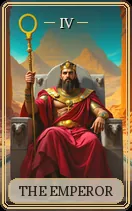 The Emperor — Firm control over possessions and decisions; material authority, or rigidity that allows no discussion.
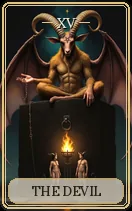 The Devil — Attachment that binds: miserliness, dependence on money, or a possessive relationship.
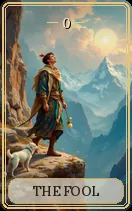 The Fool — The conflict between the desire to leave and the need for security.
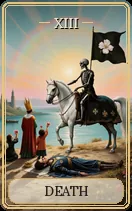 Death — Having to let go of what you were clinging to; the end of a phase of possession or control.
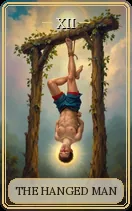 The Hanged Man — A material situation at a standstill; the need to see things from another perspective before letting go.
 Five of Pentacles — The fear of loss comes true, or holding on too tightly leads to a feeling of want.
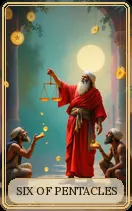 Six of Pentacles — Opening your hand: learning to give and receive after a period of holding back.
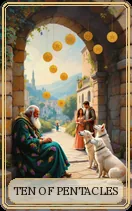 Ten of Pentacles — Assets, inheritance, family possessions that are kept and protected.
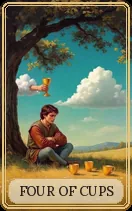 Four of Cups — A double closing-off: material security and emotions kept locked away; someone who will not let themselves be touched.
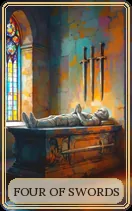 Four of Swords — A prudent pause: consolidating and resting before acting again.
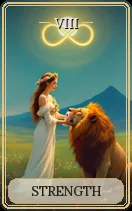 Strength — Self-mastery: holding firmly, but without force; the quiet strength of someone who does not need to squeeze.
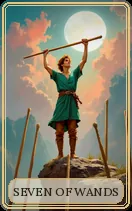 Seven of Wands — Defending what you have against outside pressure; a position held with effort.
Frequently asked questions
What does the Four of Pentacles mean in tarot?
Security, possession and control: keeping what you have won. It is a card of material stability, with a warning about attachment and the fear of loss.
Is the Four of Pentacles a yes or a no?
It depends on the question. If it is about keeping, protecting or saving, it is a yes. If it is about taking a risk, changing or letting go of something, it leans towards no.
What does the Four of Pentacles mean in love?
A stable, secure relationship, but one that may be closed or possessive. It speaks of someone who keeps their feelings to themselves and is afraid of losing the other person.
Is the Four of Pentacles reversed bad?
Not necessarily. Reversed, it is the fist that squeezes too hard or that finally opens: it may be miserliness, it may be a release. The neighbouring cards tell you which.
Does the Four of Pentacles mean greed?
It can, but that is not its only meaning. It is, above all, the card of material security and of saving. Greed is the excess of that quality — when keeping turns into fear.
No sign-up · Reading written on the spot · Free