
The World: meaning and symbolism of the tarot card
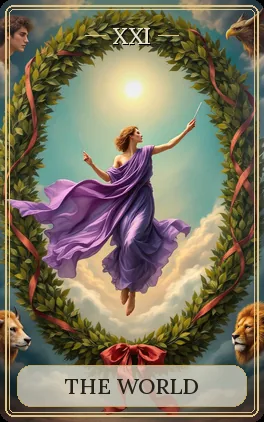
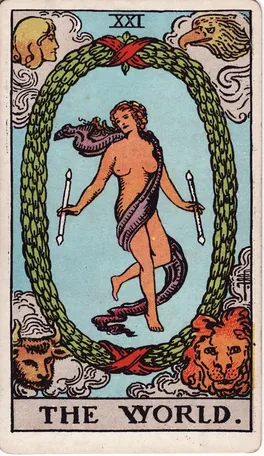
The World is the twenty-first card and the last of the Major Arcana. At the centre of a great wreath of leaves, a figure dances suspended in the air, with a wand in each hand; in the four corners of the card, four beings — a human face, an eagle, a bull and a lion — look on. Everything is in its place. It is the image of a complete cycle.
In a spread, The World speaks of completion and fulfilment: a finished work, a goal achieved, a cycle closing well, recognition arriving. It is one of the most favourable cards in the deck. But it is also a threshold: when the circle closes, another round opens. In the modern reading, after The World comes The Fool once again — and the journey begins anew, on another level.
The card at a glance
| Number | XXI |
|---|---|
| Arcana | Major Arcana |
| Historical names | Il Mondo (Italy); Le Monde (Marseille); The World (Rider-Waite-Smith) |
| Element | Earth |
| Astrology | Saturn (Golden Dawn); also associated with Earth |
| Hebrew letter | Tav (ת), according to the Golden Dawn |
| Keywords | completion, fulfilment, accomplishment, recognition, integration, travel, a cycle closed |
| Reversed | work left unfinished, a cycle in suspense, the last step missing, recognition slow to arrive |
| Yes or no | Yes — a complete yes, above all when the question is about finishing or achieving |
The image on the card
In the Sol da Alma Tarot, a great oval wreath of green leaves, wound about with a spiralling red ribbon and finished at the bottom with a large red bow, fills almost the whole card. Inside it, against a pale sky with golden clouds and a faint sun above, a barefoot woman with auburn hair floats lightly, wrapped in a violet cloak billowing in the wind. Her arms are open, and in each hand she holds a slender, pale wand. In the four corners, outside the wreath, four heads appear: a young man with brown hair in the top left corner, an eagle in the top right, a bull in the bottom left and a lion in the bottom right.
In the Rider-Waite-Smith of 1909, the composition is the same: a naked figure, wrapped only in a violet sash, dances inside an oval wreath of leaves tied at top and bottom with red ribbons, a wand in each hand; in the four corners, among clouds, are a human face, an eagle, a bull and a lion. The Sol da Alma follows this imagery closely, but clothes the figure in a full violet cloak, has her float rather than dance on one leg, adds a sun at the centre and winds the red ribbon around the whole wreath.
In the Tarot de Marseille, Le Monde likewise has the naked figure with a veil inside an oval garland, and the four beings in the corners: the angel, the eagle, the lion and the animal at bottom left, usually read as a bull or an ox. The figure holds a wand in one hand. The structure of the card has changed little since then.
The symbolism, detail by detail
Almost everything in this card speaks of wholeness: of different parts that finally form a whole. Each detail adds a nuance to that idea.
- The wreath of leaves
- Victory and the completed cycle. In antiquity, laurel wreaths crowned the victors; here the wreath is also a circle — without beginning or end, like the cycles of life.
- The oval shape
- A closed, protected space, which many readers compare to an egg or a doorway. It is at once the end of one road and the passage to another.
- The red ribbons
- The tie that joins what was separate. In the Rider-Waite-Smith they bind the wreath at top and bottom; in the Sol da Alma they wrap all the way round it and close it with a bow, like a gift.
- The dancing figure
- The whole human being, in harmony with themselves and with the world. She neither works nor struggles: she dances, because the work is done. In the Sol da Alma she floats — weightless at last.
- The two wands
- The balance between opposing forces — giving and receiving, acting and waiting. In The Magician there was a single raised wand; here there are two, and the figure holds them effortlessly.
- The violet cloak
- Violet is traditionally the colour of wisdom and dignity. The cloak covers without constraining: it moves with her.
- The sun at the centre
- Unique to the Sol da Alma: the light at the heart of the circle, the consciousness that illuminates the finished work.
- The four beings
- The tetramorph — the man, the eagle, the bull and the lion — which comes from the visions of Ezekiel and the Book of Revelation and which Christian art associated with the four evangelists. In modern tarot they are often read as the four fixed signs (Aquarius, Scorpio, Taurus and Leo) and the four elements: the whole world, gathered around the centre.
- The clouds
- The open sky, elevation. The card takes place between earth and heaven, at the point where the two meet.
The history of The World
Since the Italian decks of the fifteenth century, The World has been one of the highest cards in the sequence of trumps, and in most orderings the highest of all. In the Visconti-Sforza decks painted in Milan around 1450, the image is very different from today’s: two winged children hold up in the air a globe showing a city or a castle — the world as an inhabited place.
In the Marseille decks, which took their settled form between the seventeenth and eighteenth centuries, the composition that became classic appears: the naked figure within the garland and the four beings in the corners. This structure closely recalls the medieval images of Christ in Majesty surrounded by the symbols of the four evangelists — a resemblance many scholars point out, and one that helps explain the card’s solemnity.
At the end of the nineteenth century, the Golden Dawn assigned it Saturn, the last of the planets visible to the naked eye, and the letter Tav, the last of the Hebrew alphabet, and also associated it with the element of Earth. In 1909, Arthur Edward Waite and Pamela Colman Smith kept the Marseille composition, placing a wand in each of the figure’s hands and tying the wreath with red ribbons. It is this version that the Sol da Alma follows.
The World upright: the meaning
Upright, The World is the card of completion. It heralds something coming to an end in the best possible way: a project finished, a goal achieved, a course completed, a phase of life closing meaningfully. It is the feeling of mission accomplished, of having done what there was to do. Few cards give such a positive answer.
It is also the card of fulfilment and recognition: feeling that you are where you belong, in harmony with who you are and what you have; being seen and valued by others. In many readings it speaks of integration — the various parts of life, which had been at odds, finally find a balance.
Finally, The World is the card of wide horizons: travel, especially long journeys, contact with other cultures, international projects, an opening to the world in the literal sense. And it is always the card of a threshold. The cycle closes, but what was learnt in it remains, and prepares the next round.
The World reversed
Reversed, The World is not failure. It is the same work, but unfinished: the last step is missing, the close is slow to come, the cycle hangs in suspense. The person is very near completion, but something stops them reaching it — a detail still to be resolved, a fear of finishing, a recognition that has not yet arrived.
It can also indicate difficulty letting go of a cycle that has already ended: clinging to the familiar for fear of what comes next, or refusing to conclude out of perfectionism. Sometimes it speaks of shortcuts — wanting to reach the end without having walked the whole road. The card then asks you to identify what is missing, and to find the courage to finish.
The World in love
In love, The World is a card of fulfilment: a mature, balanced relationship in which both people feel whole and at peace. It can herald a commitment, a new stage as a couple, a journey together, or the realisation of a shared plan. For someone who is single, it speaks of a phase in which the person feels complete in themselves — and it is often precisely then that an important meeting happens, sometimes with someone from far away.
It can also indicate the natural end of a relationship that has run its course, lived without drama and with gratitude. Reversed, it speaks of a relationship that does not move on to the next step, of something missing for it to feel complete, or of difficulty in closing an old chapter.
The World in work and money
At work, The World heralds accomplishment and success: a project successfully completed, a qualification, a promotion, recognition for long work. It favours international careers, business travel and everything involving contact with other countries. It is the moment to reap the fruits of a long effort — and to think about the next step.
With money, it indicates stability, security and the successful conclusion of financial matters. Reversed, it asks you to finish outstanding business before starting anything new, and warns against the temptation to stop halfway towards a goal that is almost reached.
The World in health and wellbeing
In questions about wellbeing, The World speaks of balance and harmony between body and spirit, of the end of a period of tiredness and of the feeling of being at ease with yourself. Reversed, it asks you to complete what you began doing for yourself. The cards are no substitute for any kind of healthcare: here, as with any other card, the reading speaks of attitude, not of diagnosis.
The World in spiritual life
On the inner path, The World is integration: the moment when the various parts of yourself, and the various stages of the journey, come together into a meaningful whole. In the modern reading of the Fool’s journey, it is the arrival — but an arrival that does not stand still: the figure keeps on dancing. Many readers see in this card the experience of unity, of being at peace with the world and with oneself, with no need to flee or to search.
The World as advice
As advice, The World says: bring it to a close. Finish what you started, tie up the loose ends, take the last step. Then acknowledge the road you have travelled and celebrate it. And do not be afraid of what comes next: a cycle that closes well is the best preparation for the one that follows. If a journey or an opening is on its way, accept it.
The World in the positions of a spread
- In the past
- A completed cycle, an achievement or a period of accomplishment that gives the person the foundation they are now building from.
- In the present
- A moment of fulfilment, or the completion of something important. The person is where they are meant to be.
- In the future
- Accomplishment on the way: the goal will be reached, the cycle will close well.
- As an obstacle
- The fear of finishing, perfectionism, or difficulty letting go of a cycle that has already ended.
- As the outcome
- The best possible outcome: success, completion and recognition — and the door open to a new stage.
Numerology and correspondences
The number XXI reduces to 3 (2 + 1), the number of The Empress: if The Empress is creation in bloom, The World is creation finished and complete. XXI is also the reverse of XII, The Hanged Man: the figure on the card often has one leg crossed behind the other, like The Hanged Man, but here upright and dancing — the same gesture, turned towards freedom. In the Golden Dawn tradition, the card corresponds to Saturn — the planet of time, structure and limits — and to the Hebrew letter Tav, the last of the alphabet, which marks the end and the seal. It is also associated with the element of Earth: the work that has become concrete.
Combinations with other cards
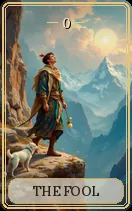 The Fool — The end of one cycle and the start of another: a journey, a change of phase, beginning again with everything you have learnt.
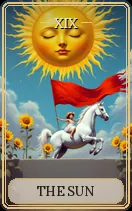 The Sun — Complete success and joy; an achievement celebrated.
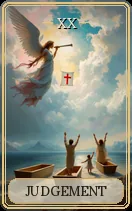 Judgement — The final reckoning of a cycle and the passage to a new life.
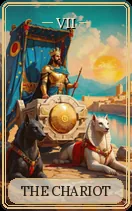 The Chariot — A well-earned victory; a goal achieved after much effort.
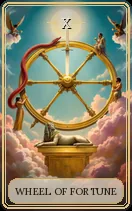 Wheel of Fortune — One cycle completing and another beginning; a favourable turn of fate.
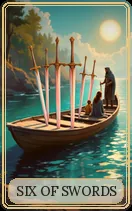 Six of Swords — A long journey or a move to another country.
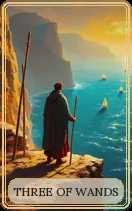 Three of Wands — International expansion; projects that reach far.
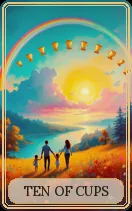 Ten of Cups — Family and emotional fulfilment; complete happiness at home.
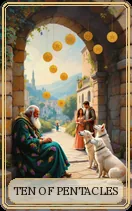 Ten of Pentacles — Lasting material accomplishment; security built up over time.
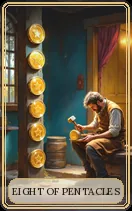 Eight of Pentacles — Patient work reaching its end; mastery achieved.
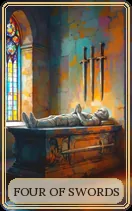 Four of Swords — A pause before the finish; the last step is still to come, but it is wise to rest before taking it.
Frequently asked questions
Is The World a good card?
Yes, it is one of the most favourable cards in the tarot. It speaks of completion, fulfilment, success and recognition. As the last card of the Major Arcana, it represents the complete cycle.
What does The World mean in love?
A mature and balanced relationship, a commitment, a new stage as a couple, or the feeling of being complete. Reversed, a relationship that is not moving forward, or an old story that is hard to close.
Is The World a yes or a no?
Yes — a complete yes, especially in questions about finishing, achieving or bringing something to fruition.
Is The World reversed bad?
No. Reversed, the work is simply not yet finished: one last step is missing, the close is taking its time. Completion is near, and the card asks you to identify what is missing.
What are the four creatures on The World card?
They are the tetramorph — man, eagle, bull and lion — which comes from the biblical visions of Ezekiel and the Book of Revelation and which Christian art associated with the four evangelists. In modern tarot they are also read as the four fixed signs and the four elements.
No sign-up · Reading written on the spot · Free