
Three of Wands: meaning and symbolism of the tarot card
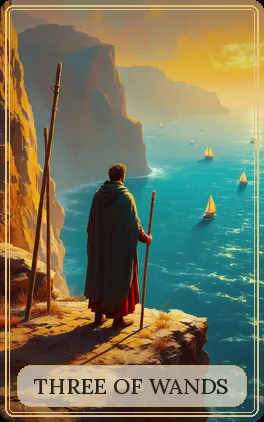
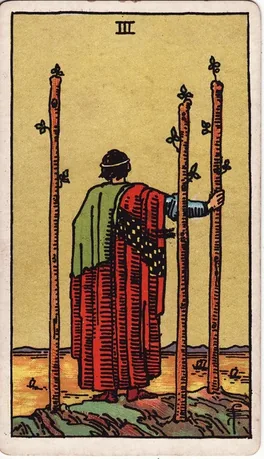
The Three of Wands is the card of what has already been launched. A man stands at the edge of a cliff, his back to us, leaning on a staff, watching sailing ships move away across the sea. He is not planning, as in the Two of Wands: he has already decided, already invested, already sent out his ships. Now he waits — but he waits standing, looking ahead, with the confidence of someone who has done his part.
In a spread, it speaks of expansion, of projects that grow beyond their original ground, of business, travel, contacts abroad, of a broad view of the future. It is an optimistic card, but one with a dimension of time: what has been launched is on its way, and has not yet arrived.
The card at a glance
| Card | Three |
|---|---|
| Suit | Wands |
| Element | Fire |
| Astrology | Sun in Aries (Golden Dawn: ‘the Lord of Established Strength’) |
| Keywords | expansion, venture launched, broad vision, trade, initiative, active waiting, far away |
| Reversed | waiting in vain, stalled trade, delay, plans that do not come back, closed horizon |
| Yes or no | Yes — but with a timescale: the result is coming, just not right away |
The image on the card
In the Sol da Alma Tarot, a man with curly brown hair stands with his back to us at the top of a cliff of golden rock, above a very blue, almost turquoise sea. He wears a dark green hooded cloak over a red tunic, and leather boots. In his hand he holds a tall wooden staff, resting on the rocky ground. Two other staffs stand upright on the left, propped against the cliff wall. Before him, the sea opens between great rocks, and several ships with pale sails are heading away — some still close, others already dots on the horizon. The sky is golden and orange, with an end-of-day light that illuminates the cliffs.
In the 1909 Rider-Waite-Smith, the scene is very similar: a man seen from behind, in a green and red cloak with a band round his head, stands on a hill, holding one of the three staffs planted around him, and looks out over a yellow, almost sandy sea on which a few ships are passing. The Sol da Alma kept the man seen from behind, the green and red cloak, the three staffs and the ships, but placed him at the tip of a cliff above a truly blue sea, with the cliffs in the foreground, and grouped two of the staffs on the left instead of surrounding him with them.
In the Marseille Tarot, the Three of Wands has no scene: it shows two crossed staffs and a third, vertical one running through their centre, with ornamental foliage. The traveller gazing at the sea is an image from Waite and Smith’s deck.
The symbolism, detail by detail
This is the card of someone looking at what they have launched. Each element of the image speaks of the relationship between the effort already made and the result still on its way.
- The sailing ships
- What has already set out: an investment, an application, a project, a message, a cargo. Waite read them as the man’s own ships, laden with what is his.
- The man seen from behind
- The person asking is facing the future. He does not look back at what it cost; he looks ahead, to what is going to arrive.
- The cliff
- A high position from which one can see far. The card gives perspective: it lets you see the whole, calculate, anticipate.
- The staff in his hand
- The support he keeps. One of the forces stays with him while the others have set out: not everything is staked; a base is held back.
- The two staffs propped up
- What was left behind and is secure: the work done, the base that made it possible to launch the ships.
- The open sea
- Foreign lands, markets, distant places, the as yet unknown. The Three of Wands is often the card of what comes from afar or goes far away.
- The green cloak over the red
- The green of growth over the red of Fire: the energy of the suit placed at the service of something that is growing.
- The golden light
- The Sun, the card’s planet in the Golden Dawn. Everything is lit up: it is a card of clarity, confidence and success in sight.
The history of the Three of Wands
In the fifteenth-century Italian decks, such as those painted for the Visconti and the Sforza in Milan, and in the Marseille Tarot, which settled into its form in the seventeenth and eighteenth centuries, the Three of Wands was simply an arrangement of three staffs. The numbered cards served the game of tarocchi and needed no other image. Those who later used them to tell fortunes had to give them meanings based on number and suit.
At the end of the nineteenth century the Golden Dawn assigned it the Sun in Aries and the title ‘Lord of Established Strength’: the force of the Ace which, after the choice of the Two, has consolidated enough to act in the world. The Sun is exalted in Aries — one of the places where, in traditional astrology, its strength is greatest — which gives the card a tone of confidence and success.
Arthur Edward Waite and Pamela Colman Smith, in the 1909 deck, gave it the scene that defines it today: the calm man, seen from behind, watching ships go by from the edge of a cliff. In his book on the deck, Waite described him as a calm, stately figure and read the card as established strength, enterprise, effort, trade and discovery — the ships are his, and they carry his merchandise. This is the reading that has come down to most modern decks, the Sol da Alma included.
The Three of Wands upright: the meaning
Upright, the Three of Wands is the card of expansion. What was planned is already under way, and it is starting to reach further than expected. It may be a business opening up to new markets, a project that is scaling up, an application sent off, a journey, a move to another place. The card says the first step was well taken and that it is time to look to the horizon with confidence.
It is also the card of broad vision. Whoever draws it can see the whole picture, anticipate, think long-term. They have a vantage point from which to see far, and should use it to prepare what comes next: the return of the ships, the harvest of what was sown, the next stage.
There is a dimension of waiting in it, but not of passivity. The man is standing, staff in hand, alert. It is the waiting of someone who has done what they had to do and trusts in the result, but does not let themselves doze off. That is why the card advises active patience: keep working, keep up your contacts, prepare the ground, while what you have launched makes its way.
The Three of Wands reversed
Reversed, the Three of Wands is the same expansion held back. The ships have sailed but are slow to return; the answer you were waiting for does not come; the project that was launched does not reach the scale you imagined. It is a wait that drags on and begins to weigh — stalled trade, an application with no reply, an investment that has not yet paid off.
In other readings, it speaks of a vision that has narrowed: the person has stopped looking into the distance and become stuck in the details, or has given up on going beyond their own ground out of fear. It can also point to poorly calculated plans that did not allow for delays, or to an impatience that spoils what was still growing. The card does not say that what was launched is lost; it says the timescale is longer than one would like, and it asks you to review the plan without abandoning the idea.
The Three of Wands in love
In love, the Three of Wands speaks of a relationship that is growing and broadening its horizons: plans for the future, a trip together, the decision to take a bigger step. It is also, very often, the card of long-distance relationships, or of someone who comes from far away — another country, another city, another background. For someone who is single, it may point to a meeting while travelling or outside the usual circle.
It can also describe a wait: someone awaiting an answer, a return, a sign from the other person. Upright, the card says the wait is worth it. Reversed, it speaks of a relationship that stays at the same point, of a person who is far away and cannot make up their mind to come back, or of expectations that have grown bigger than reality.
The Three of Wands in work and money
In work, it is one of the clearest cards in the suit for business, trade and expansion: exports, new clients, partnerships abroad, growing projects, applications running their course. It favours those who work in trade, travel, logistics, international communication. It says the effort made is starting to pay off and that there is room to go further.
With money, it points to investments that are working, income on its way, a phase in which you reap what you have sown — still without haste. It calls for a long-term view and patience. Reversed, it warns against expecting quick gains, against delays in payments or orders, and against projects launched without properly calculating how long they will take to pay back.
The Three of Wands in health and wellbeing
In questions about wellbeing, the Three of Wands speaks of open horizons: fresh air, travel, breaking the routine, giving a new habit time to take effect. Reversed, it points to the impatience of someone who wants immediate results. The cards are no substitute for any kind of healthcare, and this reading speaks only of attitudes and tendencies.
The Three of Wands in spiritual life
On the inner path, the Three of Wands is trust in the process. After beginning a practice or a search comes the phase in which the fruits cannot yet be seen and one must carry on. The card also speaks of widening one’s gaze: learning from other cultures, other teachers, other ways of seeing. It asks you to hold your course without demanding immediate results.
The Three of Wands as advice
As advice, the Three of Wands says: think big and give things time. What you have launched is on its way. Stay alert, keep working, prepare the ground for what is going to arrive. And do not be afraid to go further — to look elsewhere for what no longer fits at home.
The Three of Wands in the positions of a spread
- In the past
- An initiative launched some time ago whose results are only now beginning to show.
- In the present
- A phase of expansion and active waiting: what has been done is under way, and the horizon is opening up.
- In the future
- Opportunities coming from afar, a journey, a project that scales up.
- As an obstacle
- Impatience, or a wait that drags on and erodes confidence.
- As the outcome
- The ships come home: what was launched bears fruit, often beyond the original ground.
Numerology and correspondences
The Three is the first work: what is born of bringing two things together, and can already be seen from outside. In the suit of Wands, the work is will put into action — the choice of the Two has become a concrete initiative, and the departing ships are that initiative made visible. After the spark and the plan comes the first result in the world.
In the Golden Dawn tradition, the card corresponds to the Sun in Aries. The Sun is the centre, consciousness, vitality; in Aries it is exalted, and its strength is frank and confident. It is the second of the three Aries cards in the suit of Wands: after Mars, which decides, comes the Sun, which illuminates and makes things grow, and then Venus, in the Four of Wands, which celebrates and settles.
Combinations with other cards
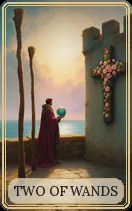 Two of Wands — The plan turns into action: the decision has been made and the ships begin to set sail.
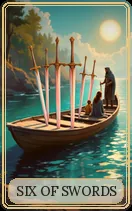 Six of Swords — A journey or a move far away, a passage to another country or another phase.
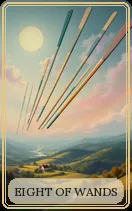 Eight of Wands — News arrives quickly: the answer you were waiting for is on its way.
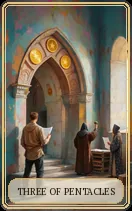 Three of Pentacles — A collaborative project: expansion happens as a team, with work well done.
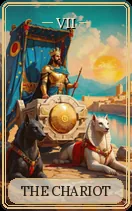 The Chariot — Determined progress, new ground won, a journey with a purpose.
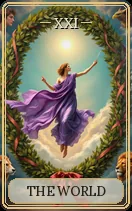 The World — International horizons and complete success: what was launched reaches its end successfully.
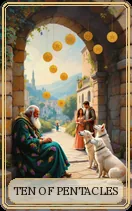 Ten of Pentacles — A business that grows and becomes established, with a future beyond whoever started it.
 The Hermit — A long and solitary wait; the result is slow in coming and calls for patience.
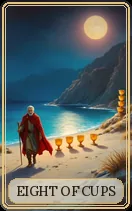 Eight of Cups — Going far away and leaving something behind; seeking elsewhere what is missing here.
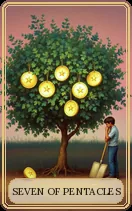 Seven of Pentacles — Waiting for the harvest: the investment has been made and needs time to pay off.
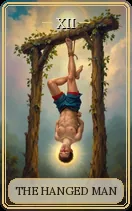 The Hanged Man — A project on hold: the ships have sailed, but everything is suspended, waiting.
Frequently asked questions
What does the Three of Wands mean in tarot?
Expansion, initiative and broad vision: what was planned has already been launched and is on its way. It speaks of business, travel, distant contacts and confident waiting for a result.
What does the Three of Wands mean in love?
A relationship that broadens its horizons, plans for the future, trips together or long-distance relationships. It can also speak of waiting for a sign or for someone’s return.
Is the Three of Wands a yes or a no?
Yes, but with a timescale: what you want is on its way and will not arrive immediately. It calls for active patience.
Is the Three of Wands reversed bad?
It is not bad: it is expansion held back. It speaks of delays, a wait that drags on or poorly calculated plans. It asks you to review the plan, not to give up.
Does the Three of Wands speak of travel?
Often, yes. The sea and the ships link it to travel, to foreign lands, to trade and to everything that comes from afar or goes far away.
No sign-up · Reading written on the spot · Free