
Five of Pentacles: meaning and symbolism of the tarot card
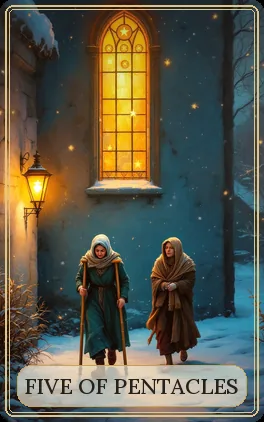
The Five of Pentacles is the card of the cold. On a snowy night, two poorly wrapped figures pass by the wall of a church, where a window glows, golden and warm. One of them walks on crutches. They do not go in; perhaps they do not even notice the light. The image is one of the saddest in the tarot, and one of the easiest to recognise: we have all been through a phase when it seemed that comfort was on the other side of the glass.
In a spread, the Five of Pentacles speaks of hardship — money running short, work being lost, a period of insecurity — or of a feeling of exclusion, of being on the outside. But it is not a card of hopeless misfortune. There are two people, not one; there is a lit window, right there. The Five is the trial, not the end, and it almost always carries within it the question: where is the door?
The card at a glance
| Card | Five |
|---|---|
| Suit | Pentacles |
| Element | Earth |
| Astrology | Mercury in Taurus (Golden Dawn) |
| Keywords | hardship, financial strain, material difficulty, exclusion, cold, insecurity, company in adversity |
| Reversed | end of hardship, shelter found, slow recovery, help accepted, or pride that refuses the open door |
| Yes or no | ‘No’, for now — or ‘yes, but with effort and help’ |
The image on the card
In the Sol da Alma Tarot, it is night and it is snowing. Behind the scene rises the dark-blue wall of a stone church, with snow piled on the roof in the upper left-hand corner. In the middle of that wall shines a tall, narrow window with a pointed arch, filled with amber stained glass in which stars and small golden circles are traced; the light pouring out of it is warm, almost fiery. Lower down, on the left, an iron lantern fixed to the wall is lit. Flakes and specks of golden light float in the air. On the right there are bare trees and, on the ground, snow covers everything with a bluish sheen. In the foreground, two figures walk side by side. The one on the left wears a dark-green tunic tied with a cord, has a pale shawl over the head and shoulders, and moves forward leaning on two wooden crutches, looking down. The one on the right is wrapped in a brown shawl and hood, hands clasped in front of the chest, and looks ahead, grave. Both are wearing boots.
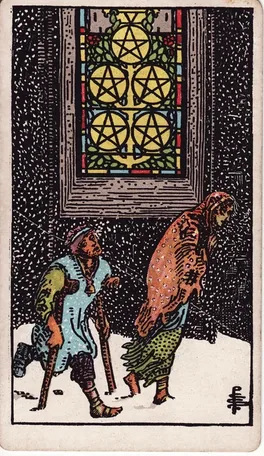
In the 1909 Rider-Waite-Smith, the scene is essentially the same, and it was from it that the Sol da Alma painting set out: two beggars cross the snow on a black night, beneath a coloured stained-glass window showing five pentacles among branches; one of them, with a bandaged head and a bell round his neck, walks on crutches, and the other, barefoot, is wrapped in a tattered shawl. The Sol da Alma softens the destitution: the figures are poorly dressed but not in rags, and they have shoes on; the bell disappears; the five coins of the stained glass give way to a window of stars and circles, all in gold; and a lit lantern is added on the wall — a second light, even closer to the path.
In the Marseille Tarot there is no church, no snow and no figures: the Five of Pentacles shows five coins, four in the corners and one in the centre, among foliage ornaments. The theme of hardship at the door of the light is a reading that the Rider-Waite-Smith made visible.
The symbolism, detail by detail
This card is built entirely on a contrast: the cold outside and the light within. What it has to say lies in the distance — a short one — between the two.
- The snow and the night
- Hard times: the winter of material life, the phase in which everything costs more. The snow does not last for ever, but while it lasts it has to be crossed.
- The lit window
- Comfort, help, community, the things that are missed. It is right there, on the wall beside them — but the figures walk past it without seeing it, or without feeling they have the right to go in.
- The starry stained glass
- In the Rider-Waite-Smith, the stained-glass window shows the five pentacles: value that exists, but on the inside. In the Sol da Alma it is a window of golden stars: light, hope, the dimension that hardship cannot put out.
- The lit lantern
- Particular to the Sol da Alma painting: a smaller, closer light, at the height of those who pass by. It is a reminder that not all help is large — sometimes a light beside the path is enough.
- The crutches
- Fragility, the support needed to keep going. Whoever uses them is still walking: the card speaks of limitation, not of coming to a halt.
- The two figures
- Company in adversity. There is want, but not complete loneliness: two people cross the night together. It is also a reminder that the same difficulty can be shared by a couple, a family, a group.
- The headscarves and shawls
- What protection there is. The little one has, used to hold out against the cold. It is the image of someone who makes do with what there is.
- The church
- The institution, the community, the place of welcome. It can be literal — help from an organisation, a family, a group — or symbolic: faith, meaning, what warms from within.
- The bare trees
- The season in which nothing grows. But leafless trees are not dead: they are waiting. The Five is a winter, and after winter comes the Six.
The history of the Five of Pentacles
Tarot was born in northern Italy in the fifteenth century as a card game, and its four suits — cups, swords, batons and coins — are the same as those of the Latin-suited cards still played in Portugal and Spain today. In the earliest decks and in the Marseille decks, which took their settled form in the seventeenth and eighteenth centuries, the numbered cards had no scene: the Five of Pentacles was five coins arranged like the spots on a die.
At the end of the nineteenth century, the Hermetic Order of the Golden Dawn assigned each numbered card a planet in a sign and a title. The Five of Pentacles was given Mercury in Taurus and the title ‘Lord of Material Trouble’. In every suit, the Fives are the cards of trial, and in the suit of Earth the trial is concrete: a lack of means, of work, of security.
It was the Rider-Waite-Smith, drawn by Pamela Colman Smith under the direction of Arthur Edward Waite and published in 1909, that gave a scene to all the Minor cards. Waite describes two mendicants passing a lighted window in a snowstorm, and gives the card the meaning of material trouble, above all destitution. Curiously, he adds that some card readers read it as a card of love and lovers, of affinities and concordance — perhaps because of the two figures walking together. The scene of the snow and the stained-glass window became the classic image of the card, and it is the one the Sol da Alma follows, with its own painting.
The Five of Pentacles upright: the meaning
Upright, the Five of Pentacles is the card of want. It can be a lack of money — an unexpected expense, a loss of income, a hard month —, of work, of a home, of security. It indicates a period of hardship, when every coin has to be counted and you have to hold on. The stable form of the Four has broken, and another has to be found.
But the Five of Pentacles also speaks of a want that is not only material: the feeling of exclusion, of not belonging, of being on the outside while others are inside, in the warm. It can describe someone who feels left out in a group, a family, a job — or who leaves themselves out, through shame or through pride.
And this is where the card holds its key. The window is lit, right next to them. Help exists, often closer than you think, and what is missing is asking for it, seeing it, or accepting it. The Five of Pentacles does not promise that the winter will pass by itself, but it reminds you that nobody has to get through it without shelter.
The Five of Pentacles reversed
Reversed, the Five of Pentacles does not turn into its opposite: it is the same trial, losing its force or turning inwards. At best, it is the shelter found — the help that arrives, the work that turns up, the door that was right there all along. The hardship begins to ease, slowly; the cold can still be felt, but the way out is already in sight. It is a recovery rather than a victory.
In other cases, the difficulty drags on because the open door is refused: pride that will not let you ask, shame that makes you hide the situation, the habit of feeling left out even when you no longer are. The card can also indicate a poverty that is more inner than outer — having enough and living as if nothing were ever enough. The advice is the same: lift your eyes to the window and knock on the door.
The Five of Pentacles in love
In love, the Five of Pentacles speaks of a difficult phase lived through as a couple, or of a feeling of abandonment. It can describe a couple going through financial difficulties and being put to the test — but walking together, like the two figures in the snow. The card says the bond can come out stronger if neither lets go of the other’s hand.
It can also speak of emotional loneliness, of feeling that love is on the other side of the glass, or of a relationship in which one of the two feels left out. For someone who is single, it indicates a phase of emotional need in which you must take care not to accept just any shelter. Reversed, it announces the end of a cold spell: a reconciliation, a door that opens, someone who finally lets themselves be helped.
The Five of Pentacles in work and money
At work, the Five of Pentacles can indicate a period without work or with insecure work, a drop in orders, a company in difficulty, or the feeling of having no place in a team. It does not say the situation is permanent; it says it is hard, and that it calls for resources — support, training, a network of contacts — to be overcome.
With money, it is the clearest card in the suit about hardship: outgoings greater than income, a loss, debts, the need to cut back. The advice is practical: do not hide the situation, look for help and information, accept the support that exists. Reversed, it indicates a gradual financial recovery, help that arrives, or a solution that was closer than you thought.
The Five of Pentacles in health and wellbeing
In questions about wellbeing, the Five of Pentacles speaks of a phase of tiredness and fragility, in which it is important not to isolate yourself and to accept support from others. The crutches in the image are a reminder that there is nothing wrong with needing help. The cards are no substitute for any kind of healthcare: here, as with any other card, the reading speaks of attitude, not diagnosis.
The Five of Pentacles in spiritual life
On the inner path, the Five of Pentacles is the card of someone who feels far from the light — without faith, without meaning, without community. The image says that the light has not gone out: it is still burning in the window, waiting. It is often the moments of want that lead someone to look for what really matters. The starry stained glass is a reminder that there is a wealth the cold cannot touch.
The Five of Pentacles as advice
As advice, the Five of Pentacles says: do not stay at the door. Ask for help, look for those who can support you, do not let pride or shame keep you out in the cold. Take care of the essentials, save where you can, and do not go through alone what you can go through with company. The lit window is closer than it seems.
The Five of Pentacles in the positions of a spread
- In the past
- A phase of hardship or exclusion that left its mark and still influences the way you deal with money or with other people.
- In the present
- A difficult period of want or insecurity. Help exists, but it has not yet been sought or accepted.
- In the future
- A warning: a phase of belt-tightening on its way, which it is wise to prepare for right now.
- As an obstacle
- The fear of going without, the feeling of exclusion, or the pride that stops you asking for help.
- As the outcome
- A trial to be got through. If the neighbouring cards are favourable, it indicates that you will come out of it with the right help.
Numerology and correspondences
Five is the trial: the form of the Four breaks, and there is loss, friction or want. It is the step that forces you to move. In the suit of Pentacles — the suit of Earth, of the body, of money and of home —, the trial is the most concrete of all: the security won in the Four is no longer guaranteed. The man who clung to his coin becomes, one card later, the one walking through the snow with none. But the Five is not the end of the series: it is the step that forces you to look for the Six, the fair exchange, the help that arrives.
In the Golden Dawn tradition, the Five of Pentacles corresponds to Mercury in Taurus and bears the title ‘Lord of Material Trouble’. Mercury is the planet of the mind, of exchange and of movement; Taurus, an Earth sign, is the sign of comfort, possession and stability. The meeting of the two gives the card its tone: a restlessness that unsettles what should be solid, and that calls for ingenuity to find a way out.
Combinations with other cards
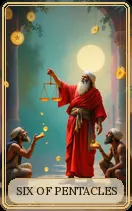 Six of Pentacles — The help that arrives after hardship; charity, support, the exchange that restores balance.
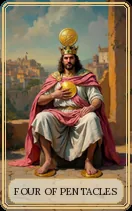 Four of Pentacles — The fear of loss that deepens the feeling of want; saving out of panic rather than prudence.
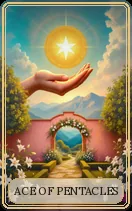 Ace of Pentacles — A concrete opportunity that puts an end to hardship; a material fresh start.
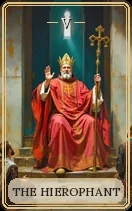 The Hierophant — Support from an institution, a community or someone in authority; the church door that opens.
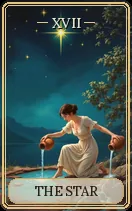 The Star — Hope returning after a difficult period; the light at the end of winter.
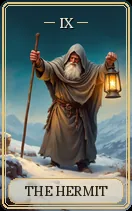 The Hermit — Isolation and withdrawal in a time of want; or finding within yourself what is missing outside.
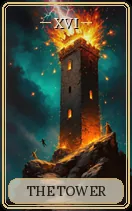 The Tower — A sudden loss that leaves you out in the cold; the collapse of material security.
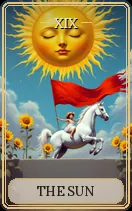 The Sun — The end of winter: the situation clearly improves and the light comes back in.
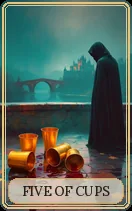 Five of Cups — Sadness and want at the same time: a loss felt both in the pocket and in the heart.
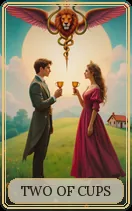 Two of Cups — A bond that withstands difficulty; a couple who get through the hard phase together.
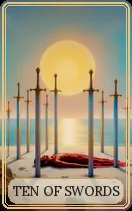 Ten of Swords — Hitting rock bottom — and, for that very reason, the only way from here is up.
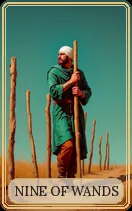 Nine of Wands — Resilience and perseverance in a hard phase; holding on a little longer, with caution.
Frequently asked questions
What does the Five of Pentacles mean in tarot?
Hardship and difficulty: financial strain, insecurity, or the feeling of being shut out. But the image has a lit window beside it: help exists, and it has to be sought.
Is the Five of Pentacles a yes or a no?
It leans towards no, or towards a ‘not yet’. If the question is about resolving a difficulty, it says it is possible, but with effort and with help.
What does the Five of Pentacles mean in love?
A difficult phase lived through as a couple, or a feeling of emotional need and abandonment. If the two walk together, the relationship can come out of the trial stronger.
Is the Five of Pentacles reversed good?
It is often better than upright: it indicates that the hardship is beginning to ease, that shelter or help is being found. It can also warn against the pride that refuses the open door.
Does the Five of Pentacles mean poverty?
It can indicate financial strain, but it is not a sentence. It speaks of a difficult, passing phase, and also of other kinds of want — of support, of belonging, of confidence — that cannot be measured in money.
No sign-up · Reading written on the spot · Free