The Emperor: meaning and symbolism of the tarot card
The Emperor is the fourth card of the Major Arcana and the partner of The Empress. A crowned man sits on a stone throne, sceptre in hand, serious and steady. He does not rise and he does not stir: he governs. Where The Empress makes things grow, The Emperor organises them; where she gives life, he gives it a skeleton. This is the card of order — structure, law, the boundary that makes building possible.
In a spread, The Emperor speaks of authority, stability, responsibility and firm decisions. He can represent a father, a boss, an institution, or the ability of the person asking to put their life in order. It is a solid and protective card, but with an obvious risk: the order that protects can harden and become control. As always, the question and the neighbouring cards say which side it is on.
The card at a glance
| Number | IV |
|---|---|
| Arcana | Major Arcana |
| Historical names | L’Imperatore (Italy); L’Empereur (Marseille); The Emperor (Rider-Waite-Smith) |
| Element | Fire (through the sign of Aries) |
| Astrology | Aries (Golden Dawn) |
| Hebrew letter | Heh (ה), according to the Golden Dawn |
| Keywords | order, rightful authority, structure, stability, responsibility, protection, firm decisions |
| Reversed | rigidity, imposed dominance, hollow authority, stubbornness, control, lack of structure |
| Yes or no | Yes — if there is a plan, discipline and the patience to build |
The image on the card
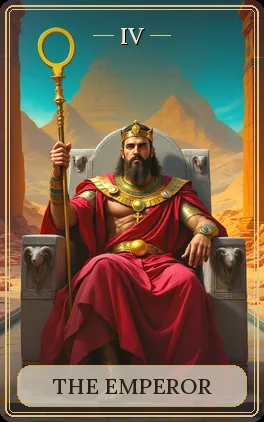
In the Sol da Alma Tarot, The Emperor is a man with dark hair and a dark beard, seated facing forward on a grey stone throne. The throne has four carved rams’ heads: two at the top of the backrest, two at the ends of the arms. He wears a red cloak that leaves part of his chest bare, a large gold collar set with blue stones, golden bracelets and armbands, and a gold belt with an orb at its centre; from his chest hangs a small golden ankh. On his head is a gold crown. In his right hand he holds a tall golden sceptre topped with a ring; his left hand rests on the arm of the throne. Behind him stretch dry ochre mountains, almost pyramid-shaped, under a blue-green sky, between two walls of orange stone.
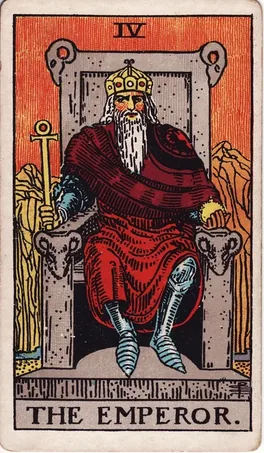
The Rider-Waite-Smith of 1909 shows the same scene, and it was the starting point for the Sol da Alma painting: the stone throne with the rams’ heads, the red cloak, the crown, the ankh-shaped sceptre, the barren mountains. The differences are clear. In the RWS the Emperor is an old man with a long white beard, wearing armour beneath his cloak, and he holds a golden orb in his left hand; the sky is orange. In the Sol da Alma he is a man in his prime, without armour and with no orb in his hand — the orb has moved to his belt — and the ankh appears as a pendant on his chest, with the sceptre reduced to a ring at the top.
In the Tarot de Marseille, L’Empereur is a different image, and it is the one the Sol da Alma table describes: a man seen in profile, seated on or leaning against the throne, with his legs crossed so as to form the shape of a four, the sceptre in his hand and, at his feet, a shield bearing an eagle. There are no rams and no mountains; there is the figure of the sovereign, with the insignia of empire.
The symbolism, detail by detail
Everything in this card speaks of structure: of what is built firmly, of what holds, of what gives shape. Each element adds a nuance to that idea.
- The stone throne
- Solidity, permanence, what does not bend with the wind. It is a throne made to last, not to be comfortable.
- The rams’ heads
- The sign of Aries, which the Golden Dawn assigned to this card: initiative, courage, the energy that clears a path and takes the lead.
- The sceptre
- The power to decide and to govern. In the RWS it takes the form of an ankh, the Egyptian sign of life — authority placed at the service of what lives.
- The orb
- The world being governed. In the RWS it is in the Emperor’s left hand; in the Sol da Alma, at the centre of his belt, like the axis of the body.
- The crown
- Recognised authority, responsibility taken on. Whoever wears the crown answers for what they govern.
- The red cloak
- Energy, action, the will to get things done. It is the colour of Aries and of fire.
- The armour
- In the RWS, beneath the cloak: the readiness to defend what has been built. The Sol da Alma took it away, giving the figure a less warlike and more sovereign air.
- The barren mountains
- Difficult terrain that demands effort, and the stability of things that last. Nothing grows there without work — the contrast with The Empress’s fertile field.
- The legs crossed in a four
- In the Tarot de Marseille the Emperor crosses his legs to draw the card’s number. It is the mark of stability: four sides, four corners, a firm base.
The history of The Emperor
The Emperor has been in the tarot since the first decks painted in northern Italy in the fifteenth century. In the Visconti-Sforza, made in Milan around 1450, he appears crowned and bearing the insignia of imperial power. For those who played tarocchi the image was clear: the Holy Roman Emperor, the highest temporal authority, alongside the Empress, the Pope and the Popess. The four together formed the hierarchy of the world.
In the Tarot de Marseille, which took its settled form between the seventeenth and eighteenth centuries, L’Empereur is the sovereign in profile, with his legs crossed and the eagle shield at his feet. The eagle, symbol of empire, links him directly to the Empress, who has an identical shield.
The Golden Dawn, at the end of the nineteenth century, assigned him the sign of Aries and the letter Heh. That is why, in the 1909 deck, Arthur Edward Waite and Pamela Colman Smith filled his throne with rams’ heads and swapped the eagle for the ankh. They turned him from profile to face the viewer, and gave him a backdrop of red, dry mountains. The Emperor was no longer just the figure of the monarch but became the image of the will that organises and the law that gives shape. That is the image the Sol da Alma starts from.
The Emperor upright: the meaning
Upright, The Emperor is the card of order. He says the situation calls for structure: a plan, clear rules, defined priorities, someone who takes responsibility. It is the moment to organise, to set boundaries, to make firm decisions and stick to them. What was scattered takes shape.
It is also the card of rightful authority — not the kind imposed by force, but the kind that is recognised because it protects and delivers. He can represent a father, a boss, a mentor, an institution, someone who can be trusted. Or he can describe the person themselves, taking charge of their own life.
Finally, The Emperor speaks of stability and security: solid foundations, commitments honoured, projects thought through for the long term. It is not a card of haste or of sudden inspiration — it is the card of someone who builds brick by brick, and so builds things that last.
The Emperor reversed
Reversed, The Emperor does not become his own opposite: it is the same order, hardened or drained of strength. In excess, it speaks of rigidity, control, stubbornness, an authority that no longer listens to anyone and holds on only by imposing itself. It can describe an authoritarian boss, a controlling father, a rule that no longer makes sense but is still being enforced.
In deficiency, it speaks of a structure that cannot hold: disorganisation, difficulty setting boundaries, responsibilities no one takes on, a hollow authority without the strength to decide. In both cases the advice is the same: recover true order, the kind that serves life, not the kind that constricts it.
The Emperor in love
In love, The Emperor speaks of stability, commitment and protection. It is a serious relationship, on firm foundations, with someone who keeps their word. For those who are single, it can herald a mature, secure, responsible person — or say that it is time to look for a relationship with a future, not just with emotion. In a relationship, it points to a phase of consolidation: concrete plans, decisions made together, the building of a shared life.
Reversed, it asks you to watch out for control and rigidity: a partner who wants to decide everything, possessive jealousy, emotional coldness, a relationship in which affection has been lost behind the rules. It can also speak of difficulty in making a commitment.
The Emperor in work and money
At work, The Emperor is the card of leadership, management and organisation. It favours those who take on responsibility, who lead, who set up a company or bring order to a project. It can herald a promotion, a management role, or dealings with a demanding but fair superior. It favours professions connected with management, law, administration, engineering and security.
With money, it speaks of control and planning: budgets, saving, safe investments, assets built up methodically. Reversed, it warns of poor management, conflicts with authority, or a rigidity that prevents you from seizing an opportunity.
The Emperor in health and wellbeing
In questions about wellbeing, The Emperor speaks of discipline and routine: regular hours, consistent exercise, habits that are kept up. Reversed, it points to the built-up tension of someone who controls everything and never rests, or to a lack of regularity. The cards are no substitute for any kind of healthcare: the reading speaks of attitude, not diagnosis.
The Emperor in spiritual life
On the inner path, The Emperor is discipline: regular practice, commitment to a path, the ability to bring order to one’s own thoughts and desires. He is a reminder that spiritual life also needs structure — set times, constancy, responsibility towards oneself. He also shows inner authority: the person as master of themselves, not ruled by their impulses. Reversed, he can point to a practice that has become too rigid and lost its meaning, or to a lack of discipline that prevents progress.
The Emperor as advice
As advice, The Emperor says: take charge. Make a plan, set boundaries, decide and follow through. Do not wait for others to organise what is your responsibility. But he also says: govern fairly — firmness is there to protect and to build, not to control.
The Emperor in the positions of a spread
- In the past
- A structure that mattered — a strict upbringing, a father figure, a firm decision that set the course.
- In the present
- The moment to organise and take on responsibility; or a person in authority who carries weight in the situation.
- In the future
- Stability on its way: a project that consolidates, a serious commitment, a position of responsibility.
- As the obstacle
- Rigidity, someone’s control, a rule that no longer serves, or a lack of structure and decision.
- As the outcome
- A stable, well-grounded situation: what has been built stays standing.
Numerology and correspondences
Four is settling: what has taken shape, closes in and is kept — and so it can also get stuck. After The Empress’s three, which creates, four stabilises. It is the four sides of the square, the four points of the compass, the four legs of a table: whatever stands firm. The danger of four is the same as The Emperor’s: what is firm can become rigid.
In the Golden Dawn tradition, The Emperor corresponds to the sign of Aries — the first of the zodiac, a fire sign, the sign of initiative and leadership — and to the Hebrew letter Heh, which is usually associated with the window. From a window you can see far: it is the image of someone who governs and needs a vision that reaches beyond the immediate.
Combinations with other cards
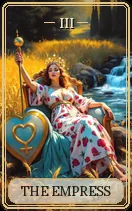 The Empress — Creation and structure together: a solid couple, a well-grounded family, a project that grows in an orderly way.
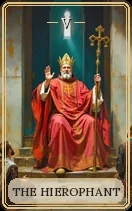 The Hierophant — Authority and tradition: institutions, rules, formal commitments; sometimes, too much conservatism.
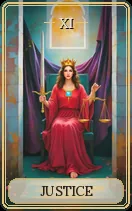 Justice — Law and order: legal proceedings, contracts, fair and well-founded decisions.
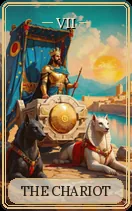 The Chariot — Leadership in action: a victory won with discipline and command.
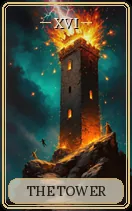 The Tower — A structure that falls, an authority called into question; rigidity that triggers the rupture.
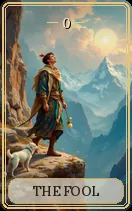 The Fool — The conflict between order and freedom: the rule against the urge to leave.
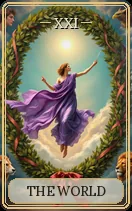 The World — A project brought to a successful close; a position of authority attained.
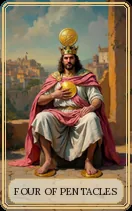 Four of Pentacles — Material control, financial security; or excessive attachment to what you have.
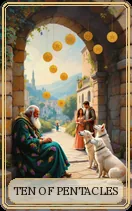 Ten of Pentacles — Assets, a family business, long-term stability.
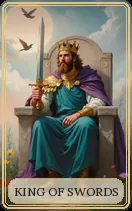 King of Swords — Intellectual authority and firmness in decisions; a judge, an expert, an exacting person.
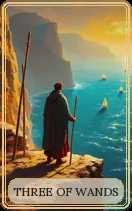 Three of Wands — Planned expansion: a well-thought-out strategy that begins to bear fruit.
Frequently asked questions
What does The Emperor mean in tarot?
Order, structure and rightful authority: the ability to organise, to decide and to take on responsibility. It is a card of stability and long-term building.
Is The Emperor a yes or a no?
It is a yes, provided there is a plan and discipline. It says the situation will be resolved with firmness and method, not with haste.
What does The Emperor mean in love?
A stable, serious and protective relationship; commitment and concrete plans. Reversed, it can speak of control, rigidity or emotional coldness.
Is The Emperor reversed bad?
It is not a card of misfortune. Reversed, it speaks of the same order hardened — control, stubbornness — or weakened — disorganisation, a lack of boundaries. It asks for a fairer and more balanced authority.
Does The Emperor represent a man?
It can: a father, a boss, a person in authority. But often it represents a quality — organisation, firmness, responsibility — in whoever is asking.
No sign-up · Reading written on the spot · Free