
The Tower: meaning and symbolism of the tarot card
The Tower is the sixteenth card of the Major Arcana and the card of the changes nobody chooses. A bolt of lightning strikes the top of a tower, the crown that caps it is blown off, and the people who were inside fall. There is no warning and no time to prepare anything: what seemed solid turns out to be fragile in an instant.
It is one of the most feared cards in the deck, and it is easy to see why. But The Tower is not a card of punishment. What falls, falls because it could not hold — because it was built on a false idea, a relationship that was no longer true, a security that existed only on the outside. The upheaval hurts, but it leaves the ground clear. In a spread, the question it asks is: what was already cracking that you did not yet want to see?
The card at a glance
| Number | XVI |
|---|---|
| Arcana | Major Arcana |
| Historical names | La Maison Dieu (Marseille); The Tower (Rider-Waite-Smith) |
| Element | Fire |
| Astrology | Mars (Golden Dawn) |
| Hebrew letter | Peh (פ), according to the Golden Dawn |
| Keywords | rupture, sudden revelation, downfall, shock, liberation, truth breaking through |
| Reversed | upheaval held back, ruin postponed, fear of change, inner crisis, a crack ignored |
| Yes or no | No, or not in the way you expected; yes only when the question is about leaving or ending something |
The image on the card
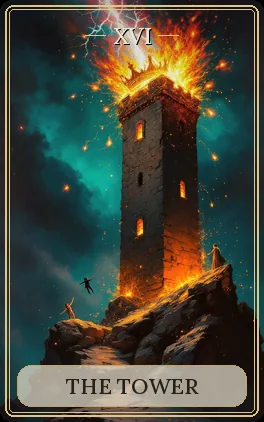
In the Sol da Alma Tarot, a tall tower of dark stone rises from a rocky crag against a sky of black and blue-green clouds. A white bolt of lightning comes down from the top of the card and strikes its summit, where a golden crown bursts into flames and sparks. Through the small windows you can see firelight inside, and the base of the tower is glowing too. All around, sparks scatter across the sky. Three small figures are outside the tower: one is falling through the air, arms outstretched; another, on the left, is on the rocks with one arm raised; and on the right, at the edge of the crag, a third figure in a pale tunic stands and watches.
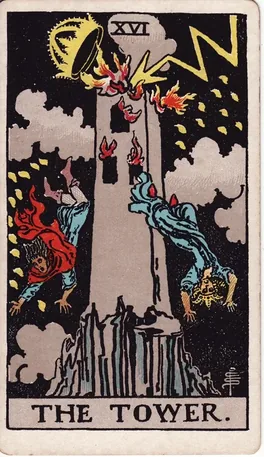
In the Rider-Waite-Smith of 1909, the tower is grey and stands on an isolated peak; a yellow zigzag of lightning tears off its crown, flames pour from the windows and small yellow drops shaped like flames fall through the air. Two men fall headfirst, one on each side — one of them still wearing a crown. The Sol da Alma follows this imagery in essence — the tower, the lightning, the crown, the fall — but paints it with more fire and more night, and adds a third figure who has stayed on their feet and looks on. It is a difference that matters: not everyone falls in the same way.
In the Tarot de Marseille, it is called La Maison Dieu. The tower is flesh-coloured, and its crown-shaped top is torn away by a kind of flame or plume that comes down from the corner of the sky. Two men fall to the ground, and the air is full of small coloured balls. There is no night and no blaze: there is a house suddenly opening up.
The symbolism, detail by detail
Everything in this card speaks of the meeting between what has been built and what comes from outside to put it to the test.
- The tower
- Everything built in order to feel safe: a career, a marriage, a public image, a belief system. It is tall and imposing, but isolated. The higher it is, the harder the fall.
- The lightning
- The truth that arrives without asking permission: an event, a piece of news, a sudden understanding. It comes from above and from outside, and there is no negotiating with it.
- The crown torn off
- Pride, the claim to control, the idea that one stands above events. It is the first thing to fall.
- The fire
- In the Sol da Alma, fire consumes the summit and glows inside. But what the card shows is not so much a blaze as a sudden crack: the fire is the sign that the change is total and there is no going back.
- The falling figures
- The people who lived inside the structure and are thrown out of it. The fall is involuntary — and that is what makes the card so hard.
- The standing figure
- Unique to the Sol da Alma: someone who has stayed at the edge of the crag and looks on. It is a reminder that some people come through the upheaval with their feet on the ground — and that, after the fall, there is always someone left who can begin again.
- The sparks
- In the Rider-Waite-Smith they are drops of fire; here, sparks that scatter. Seeds of light in the midst of destruction: the energy released by the fall.
- The crag
- The real ground, which does not fall. The tower crumbles, but the rock is still there: it is on this that building will begin again.
- The night
- The darkest moment, when all seems lost. In the sequence of the Arcana, it is straight after this night that The Star appears.
The history of The Tower
The Tower is one of the most mysterious cards as far as its origins go. In the Visconti-Sforza decks painted in Milan around 1450, which have come down to us incomplete, it is missing — just like The Devil. We therefore do not know what the earliest image looked like, and it is better not to invent it.
In the Marseille decks, which took their settled form between the seventeenth and eighteenth centuries, it is called La Maison Dieu — ‘the House of God’. The name is still puzzling today, and the explanations put forward vary: some see in it the Tower of Babel, some link it to the old hospitals known as Hôtel-Dieu, and some read in it the idea of a house opened by heaven. None has been proven. What is certain is the image: a crowned tower, struck from above, and two figures falling.
The occultists of the nineteenth century read it as the fall of pride and of false construction, and the Golden Dawn assigned it the planet Mars and the Hebrew letter Peh. It was from there that Arthur Edward Waite and Pamela Colman Smith, in 1909, set down the version known today — the zigzag lightning, the crown flying off, the two men falling headfirst — and that is the imagery the Sol da Alma follows.
The Tower upright: the meaning
Upright, The Tower heralds a sudden change without warning: a rupture, a revelation, news that changes the plan, an event that undoes what was taken for certain. It may be the end of a relationship, the loss of a job, the discovery of a lie, an argument that brings everything crashing down. It is neither gentle nor negotiable.
What the card says, behind the shock, is that what falls was not holding up. The Tower knocks down what is false — the structure kept standing out of habit, for appearances, out of fear of change. Often, whoever draws it had already felt the signs and was pretending not to see them. That is why, looking back, The Tower is frequently remembered as the day things finally became clear.
It is also the card of inner revelation: an abrupt realisation, a jolt of awareness, the collapse of an illusion about oneself. The lightning lights up everything for an instant. After the upheaval comes the work of rebuilding — but on rock, not on sand.
The Tower reversed
Reversed, The Tower does not mean the fall has been avoided. It is the same upheaval, but held back, postponed or lived inwardly. It may be the crisis you can hear cracking and pretend not to hear; the fear of change prolonging a situation that can no longer hold; the ruin that keeps being pushed off until tomorrow. The longer it is put off, the heavier the fall may be when it comes.
It can also speak of a transformation that happens inside, with no outward crash: a belief that crumbles in silence, a heartbreak lived alone. Sometimes it indicates that the worst is over and the person is climbing out of the rubble. Either way, the card asks you to let fall what has to fall, instead of spending your strength holding up cracked walls.
The Tower in love
In love, The Tower is the shock: an argument that changes everything, a revelation, a sudden break-up, the discovery of something that was hidden. It can also be the collapse of an illusion about the other person — realising, all of a sudden, that the relationship was not what you thought. For someone who is single, it can herald a meeting that turns life upside down, with the intensity of a lightning bolt.
It is not always the end. Sometimes The Tower knocks down only the old form of the relationship, so that it can be rebuilt in a different, truer way. Reversed, it often speaks of the crisis being avoided: the conversations put off, the tension building up, the separation that keeps being delayed.
The Tower in work and money
At work, The Tower heralds unexpected changes: a restructuring, a redundancy, the end of a project, a change of management, a conflict that blows up. It can also be the sudden decision to leave — the day you simply cannot take any more. Hard as it may be, it often opens the way to something better suited to whoever draws it.
With money, it calls for caution: unexpected losses, unforeseen expenses, investments that fall. It is a card that advises against risky bets. Reversed, it can point to a financial problem that keeps being put off and is best faced before it blows up.
The Tower in health and wellbeing
In questions about wellbeing, The Tower speaks of built-up tension, of tiredness that is being ignored, of the need to stop before you are forced to. It asks you to pay attention to the body’s signals and to stress. The cards are no substitute for any kind of healthcare: here, as with any other card, the reading speaks of attitude, not of diagnosis.
The Tower in spiritual life
On the inner path, The Tower is the abrupt awakening: the collapse of a certainty, of a self-image, of a faith once thought unshakeable. Many traditions know this moment — the crisis that dissolves the ego and leaves a person more exposed, but more genuine. It is not pleasant, but it is often the start of a more honest spirituality, built on experience rather than inherited belief.
The Tower as advice
As advice, The Tower says: let fall what can no longer stand. Do not spend your strength propping up a structure that is collapsing, and do not cling to the crown. Speak the truth that still needs saying, and accept the change that has already begun. And after the fall, look at the ground that remains — it is firmer than it seems.
The Tower in the positions of a spread
- In the past
- An upheaval that changed everything — a loss, a rupture, a revelation — whose consequences still shape the present.
- In the present
- A change under way, sudden and out of control. The person is in the middle of the upheaval, or very close to it.
- In the future
- A rupture on its way. It is worth reviewing whatever stands on shaky foundations, because that is what tends to fall.
- As an obstacle
- The fear of change, attachment to a structure that no longer serves, or the instability that makes it impossible to build.
- As the outcome
- The end of a situation as it currently stands. It is not the end of everything: it is the cleared ground on which to begin again.
Numerology and correspondences
The number XVI reduces to 7 (1 + 6), the number of The Chariot: if The Chariot is the victory of the one holding the reins, The Tower is the moment when the reins slip out of our hands. In the Golden Dawn tradition, the card corresponds to Mars — the planet of force, of cutting and of conflict — and to the Hebrew letter Peh, whose name means ‘mouth’: the word that is spoken, the truth that breaks through. Its element is Fire, which destroys and, at the same time, cleanses.
Combinations with other cards
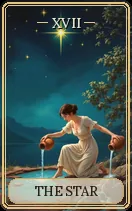 The Star — Hope after the upheaval: the healing and trust that arrive once the dust has settled.
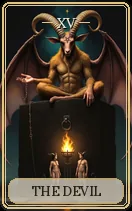 The Devil — Sudden release from a bond, a dependence or a situation that held you captive.
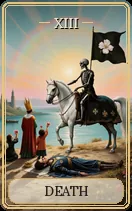 Death — A deep and definitive change: an ending with no way back, which opens the way to another phase.
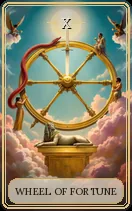 Wheel of Fortune — A twist of fate, unforeseen and swift.
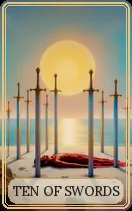 Ten of Swords — The lowest point of a crisis — but also its end.
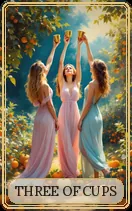 Three of Cups — A surprise that shakes a group of friends, or a celebration cut short.
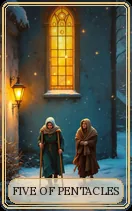 Five of Pentacles — A sudden material loss; a period of hardship after an unexpected change.
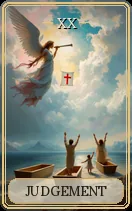 Judgement — An awakening: the upheaval forces you to take stock and answer a calling.
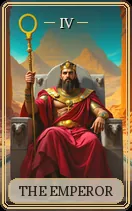 The Emperor — The fall of an authority, a rigid structure, a power that seemed untouchable.
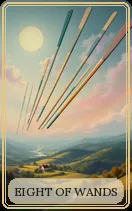 Eight of Wands — Sudden news that changes everything fast.
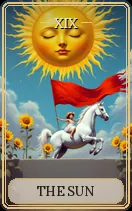 The Sun — After the storm, clarity: the upheaval reveals a truth that ends up bringing joy.
Frequently asked questions
Is The Tower the worst card in the tarot?
It is one of the hardest, because it heralds sudden changes beyond anyone’s control. But it is not a card of punishment: it knocks down what was badly built and leaves room for something truer.
What does The Tower mean in love?
A shock to the relationship — an argument, a revelation, a break-up or the collapse of an illusion. Sometimes it is the end; at other times, the chance to rebuild the relationship on more honest foundations.
Is The Tower a yes or a no?
Generally no, or not in the way you expect. When the question is about leaving a situation or putting an end to something, it can be an abrupt yes.
Is The Tower reversed better than upright?
Not necessarily. Reversed, the upheaval is held back or postponed, which can prolong a situation that can no longer hold. It can also indicate a crisis lived inwardly, or that the worst is over.
Why is The Tower called the Maison Dieu in the Tarot de Marseille?
Nobody knows for certain. Several explanations are put forward — the Tower of Babel, the old hospitals known as Hôtel-Dieu, a house opened by heaven — but none has been proven.
No sign-up · Reading written on the spot · Free