Nine of Wands: meaning and symbolism of the tarot card
The Nine of Wands shows a man who has been through a great deal. He is standing, gripping his wand, looking sideways — not in fear, but with the alertness of someone who knows the next blow may come from where it is least expected. Behind and around him, the other wands are driven into the ground like a fence. He is neither attacking nor running away. He is keeping guard.
In a spread, this card speaks of resilience: of someone who has fought, has grown tired and, even so, carries on. It is the second-to-last card of the suit, the point at which there is little left to go, and at which the temptation to give up is strongest. The Nine of Wands says to hold on — but it also asks whether the guard is still needed, or whether it has become a habit.
The card at a glance
| Card | Nine |
|---|---|
| Suit | Wands |
| Element | Fire |
| Astrology | Moon in Sagittarius (Golden Dawn) |
| Keywords | resilience, vigilance, perseverance, defence, experience, final effort |
| Reversed | exhaustion, lowered guard, excessive mistrust, rigidity, giving up close to the end |
| Yes or no | Yes, but with effort — you need to hold on a little longer |
The image on the card
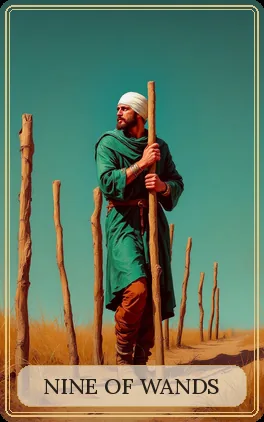
In the Sol da Alma Tarot, a dark-bearded man, his head wrapped in a white cloth, stands in a field of dry, golden grass. He wears a long dark-green tunic, with a cloak of the same colour thrown over one shoulder, a leather belt, brick-coloured trousers and worn boots; he has bracelets on both wrists. With both hands he holds a tall, rough wand planted in the ground, and he looks over his shoulder, back and to the side, his face tense. Around him, other staves of rough wood are stuck into the earth in a row, along a sandy path that stretches away to the horizon. The sky is a plain, cloudless blue-green, and the low sun casts long shadows on the ground.
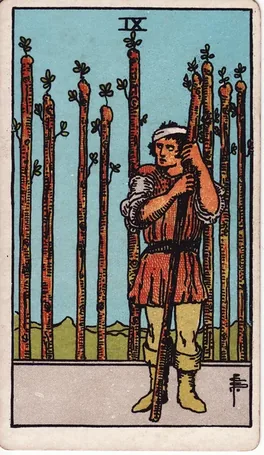
In the 1909 Rider-Waite-Smith, the scene is essentially the same, and it was the starting point for the Sol da Alma painting: a man with a bandaged head, gripping a wand, glances sideways, with eight wands lined up behind him like a palisade. But there are differences. In Pamela Colman Smith’s deck the bandage is clearly that of a wounded man, the wands have sprouting leaves and stand all together in a tight row, on grey ground with green hills in the background. In the Sol da Alma the white cloth looks more like a turban than a dressing — the wound is suggested, not shown — the wands are dry, leafless stakes, and instead of a closed palisade they form a line of markers running along the path, like fence posts across a vast, arid territory.
In the Marseille Tarot there is no figure: the card shows only the nine staffs of the suit, crossed in a lattice, with a vertical staff running through the centre and small plant motifs in the gaps. The image of the wounded guard is a creation of the Rider-Waite-Smith.
The symbolism, detail by detail
Everything on the card speaks of a strength that has already been put to the test. The man is not a fresh hero: he is someone who has learnt from his battles, and every detail shows the price and the value of that experience.
- The wand in his hands
- The last resource, the strength that is left. He does not raise it to strike: he clings to it, leans on it. It is both weapon and walking stick.
- The look over the shoulder
- Vigilance, and mistrust too. Someone who has been caught off guard once always looks behind them. It is both the virtue of the card and its risk.
- The cloth on his head
- In the Rider-Waite-Smith it is a bandage: the mark of an earlier wound. In the Sol da Alma it is a wrapped white cloth, which could be either a dressing or protection from the sun. Either way, it is a reminder that he has already taken some blows.
- The wands driven into the ground
- The defences built up over time: boundaries, experience, lessons learnt. They serve to protect — but they can also shut in.
- The path stretching away
- In the Sol da Alma, the line of stakes follows a path to the horizon. The road is long and not yet over, but it is marked: you know which way to go.
- The dry grass
- Arid ground, worn by the sun. The struggle has been long and has left its marks; there is no abundance around any more, only what has endured.
- The green of his clothes
- Life that goes on in spite of everything. In the middle of the dry field, the figure is the only patch of green — the resilience that is still alive.
- The long shadows
- A low, late-afternoon sun. The day is drawing to a close, just like the cycle of the suit: there is little left to go.
- The nine
- The second-to-last card of the suit. Fire has reached its extreme: it is no longer the enthusiasm of the beginning, but the determination of someone who will not let go.
The history of the Nine of Wands
In the earliest tarots, painted in northern Italy in the fifteenth century, and later in the Marseille decks, which took their settled form between the seventeenth and eighteenth centuries, the Nine of Wands was just a pip card: nine staffs laid out in a lattice, used for playing tarocchi. It had no figure and no story of its own.
The first layer of meaning came from the Golden Dawn, at the end of the nineteenth century, which gave each numbered card a title and an astrological correspondence. The Nine of Wands was assigned the Moon in Sagittarius and the title ‘the Lord of Great Strength’. Strength here is not violence: it is the solidity of someone who stands firm.
The image everyone knows today was born in 1909, in the deck of Arthur Edward Waite and Pamela Colman Smith. In the book that accompanied it, Waite described the figure as someone leaning on his staff and waiting, with an expectant look, as if awaiting an enemy, and the eight wands behind him as a palisade in good order. He gave it the meaning of strength in opposition: if attacked, the person will meet the onslaught boldly. The Sol da Alma Tarot follows that reading and that scene, with a painting of its own.
The Nine of Wands upright: the meaning
Upright, the Nine of Wands is the card of resilience. The person has been through difficulties, has probably already taken some blows, and is tired — but is still standing. It says there is little left to go, that the essential work has been done, and that this is not the moment to let go. It is the card of the final effort, the home straight, the perseverance that separates those who arrive from those who give up at the door.
It also speaks of experience. The man in the Nine of Wands is no longer naive: he knows what can go wrong, and he prepares for it. In a reading, this is a strength — attentiveness, prudence, the ability to anticipate problems and to defend what has been built. The wands driven into the ground are boundaries he set himself, and they protect him.
It is, finally, a card of dignity. It does not promise ease: it promises that the person has enough strength to endure what is still to come. It often appears to those who are about to give up, precisely to say that now is not the time.
The Nine of Wands reversed
Reversed, the Nine of Wands does not become the opposite of resilience: it is the same guard worn out, or turned against the one keeping it. The first meaning is exhaustion — the person has held on for so long that they cannot go on, and the guard comes down out of weariness, not by choice. It can point to a wish to give up close to the end, or to a real need to stop and recover one’s strength.
The second meaning is excess: the guard kept up when there is no longer any reason for it. Mistrust becomes a habit, boundaries become walls, and the person treats as an enemy anyone who comes close to help. It is the card of defensive rigidity, of ‘I’ve been fooled once already’, of the old wound that still dictates today’s reactions.
In both cases, the card asks an honest question: what am I really defending myself against? Sometimes the answer is to put the wand down and rest; at other times it is to open the fence and let someone in.
The Nine of Wands in love
In love, the Nine of Wands speaks of someone who has been hurt and has stayed on guard. For those who are single, it can point to a certain difficulty in trusting, a tendency to test the other person before letting go, or the fear of repeating an old story. It does not stand in the way of love, but it asks for time: trust is built slowly.
In a relationship, it is the card of those who have come through a difficult phase and are still together — the resilience of a couple who did not give up. It may ask for one more effort to get past a crisis that is almost resolved. Reversed, it warns against jealousy, constant defensiveness, arguments born of old wounds, or against the weariness of someone who no longer has the strength to fight for a relationship that only one side is holding up.
The Nine of Wands in work and money
In work, the Nine of Wands describes the home straight of a difficult project, a period of pressure, a position that has to be defended. It says the effort will be worth it and that this is no time to walk away. It favours those who are persistent and those with experience: you know where the problems lie, and that is an advantage. It can also speak of competition, of having to protect a position or an idea against those who want to take it.
In money, it calls for prudence and reserves. It is not a card of easy gains, but of holding on to what you have, of getting through a tight period until things improve. Reversed, it warns against burnout — working beyond your strength — and against the mistrust that stops you accepting support, partners or useful advice.
The Nine of Wands in health and wellbeing
In questions about wellbeing, the Nine of Wands speaks of resilience, of the capacity to recover and to carry on. Reversed, it is a reminder that accumulated tiredness needs real rest, and that holding on is not the same as being well. The cards are no substitute for any kind of health care: the reading offers attitudes and tendencies, never diagnoses.
The Nine of Wands in spiritual life
On the inner path, the Nine of Wands is perseverance in a practice that is hard going, faithfulness to a purpose once the initial enthusiasm has passed. It also speaks of the defences built up over a lifetime: some protect, others now only isolate. The work of this card is to tell one from the other — to stay vigilant without letting vigilance turn into fear.
The Nine of Wands as advice
As advice, the Nine of Wands says: hold on, there is little left to go. Do not let go now of what has cost so much to sustain. But it also says: look at what surrounds you — if your defences still serve you, keep them; if they only shut you in, open a gap. Resisting is a virtue for as long as there is a reason for it.
The Nine of Wands in the positions of a spread
- In the past
- A long struggle that left its marks and its lessons; the experience that explains today’s caution.
- In the present
- The home straight of a difficult phase: real tiredness, but enough strength to reach the end.
- In the future
- One last challenge to face; one more effort will be needed, and the person has what it takes.
- As an obstacle
- Mistrust, defensiveness, old wounds that stop you moving forward; or exhaustion.
- As the outcome
- The matter holds together and reaches its end — with effort, but still standing.
Numerology and correspondences
Nine is the extreme of the suit: its quality taken to the limit, for better and for worse. In Fire, the extreme of wanting is the will that does not surrender. That is why the Nine of Wands can be the admirable strength of one who perseveres or the stubbornness of one who no longer knows how to stop — the same flame, at two different intensities. After the speed of the Eight, the movement has slowed; and before the weight of the Ten, there is still strength to hold on.
In the Golden Dawn tradition, the Nine of Wands corresponds to the Moon in Sagittarius. The Moon speaks of instinct, memory and the reactions that come from within; Sagittarius, a Fire sign, of the distant goal and the energy to get there. The combination describes the card well: a strength that comes from lived experience, and a goal that has not yet been lost from sight. The order’s title, ‘the Lord of Great Strength’, speaks of a strength measured by the capacity to endure.
Combinations with other cards
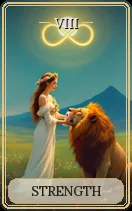 Strength — Immense inner strength: resilience that comes from calm, not from aggression.
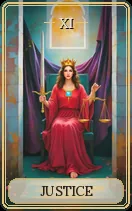 Justice — Defending what is right; a cause that demands firmness to the end.
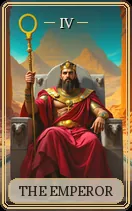 The Emperor — Protecting a position with discipline and structure; authority that withstands pressure.
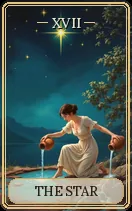 The Star — Hope returning after the struggle; the wound begins to heal.
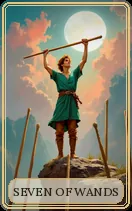 Seven of Wands — A drawn-out struggle: defending your position on several fronts at once.
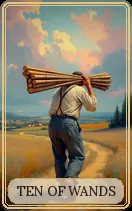 Ten of Wands — Exhaustion: carrying too much after having already endured a great deal. Time to ask for help.
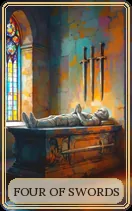 Four of Swords — Much-needed rest: stopping to recover before the final effort.
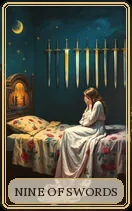 Nine of Swords — Worry and sleepless nights; vigilance turned into anxiety.
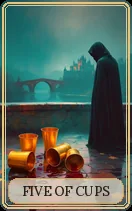 Five of Cups — The wound of a loss that still colours your ability to trust.
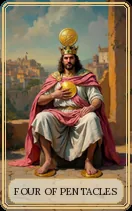 Four of Pentacles — Defending what you have tooth and nail; fear of losing.
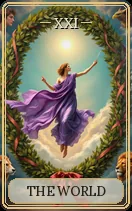 The World — The end of a difficult cycle is in sight: resilience will be rewarded.
Frequently asked questions
What does the Nine of Wands mean in tarot?
Resilience and vigilance: someone who has been through battles, is tired, but is still standing and alert, near the end of a difficult phase. It asks you to hold on a little longer.
Is the Nine of Wands a yes or a no?
It is a yes, but with effort. The outcome is possible if the person does not give up now. Reversed, it leans towards ‘not yet’ — first you need to recover your strength.
What does the Nine of Wands mean in love?
Someone who has been hurt and has stayed on guard, finding it hard to trust; or a couple holding out through a difficult phase. Reversed, it warns against jealousy, defensiveness and weariness.
Is the Nine of Wands reversed bad?
It is not a condemnation: it is the same guard grown weary or overdone. It speaks of exhaustion or of mistrust without cause, and asks for rest or openness.
Why does the man in the Nine of Wands have a bandaged head?
In the Rider-Waite-Smith, the bandage shows that he has already been wounded in an earlier fight — which is why he is on the alert. In the Sol da Alma, the white cloth is more discreet, but it holds the same idea: this is someone who has taken some blows and learnt from them.
No sign-up · Reading written on the spot · Free