
Four of Swords: meaning and symbolism of the tarot card
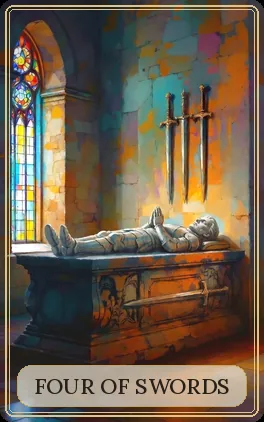
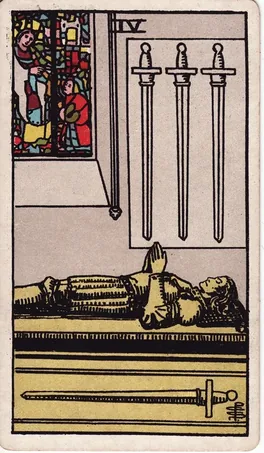
The Four of Swords is the card of silence. In a stone chapel, the stone effigy of a knight lies motionless on a carved stone tomb, with three swords hanging on the wall above him and the fourth lying along the tomb. Light comes in through a coloured stained-glass window. Nobody fights, nobody speaks. After the wounds of the Three, the suit of Swords stops to catch its breath.
In a spread, the Four of Swords speaks of rest and recovery — of a pause that is chosen, of a retreat, of time to think away from the noise. It is neither defeat nor giving up: the swords are there, ready, but for now they stay on the wall. It is the card of someone who has realised that carrying on fighting while exhausted only adds more wounds, and that sometimes the strongest thing to do is to stop.
The card at a glance
| Card | Four |
|---|---|
| Suit | Swords |
| Element | Air |
| Astrology | Jupiter in Libra (Golden Dawn) |
| Keywords | rest, pause, recovery, retreat, silence, convalescence, reflection, truce |
| Reversed | returning to the fight too soon, interrupted rest, exhaustion, prolonged isolation, stagnation |
| Yes or no | Not yet — rest first |
The image on the card
In the Sol da Alma Tarot, the scene takes place inside a stone chapel or crypt. On the left, a tall arched window has stained glass of coloured circles and lozenges — blue, red, yellow, green — and lets in a strong light. In the centre, on a large stone tomb carved with leafy ornaments, lies the stone effigy of a knight in armour, on his back, his head resting on a pillow, his eyes closed and his hands joined in prayer on his chest. Above him, on the wall, hang three swords, side by side, points downwards; the fourth lies horizontally along the side of the tomb. The walls are of stone, painted with patches of blue, orange, pink and yellow, as if the light from the window were spreading through the whole room.
In the 1909 Rider-Waite-Smith, the scene is essentially the same, and it was the starting point for the Sol da Alma painting: a knight lying on a tomb in a church, with a stained-glass window in the corner. The painting follows it in the main details: the figure is a stone effigy, hands joined in prayer; three swords hang on the wall and the fourth lies along the tomb. The differences that remain are the window, which shows human figures in the Rider-Waite-Smith and is made of circles and lozenges in the Sol da Alma, and the colour, which in the Sol da Alma fills the whole room.
In the Marseille Tarot, the numbered cards have no scene. The Four of Swords shows curved blades interlaced in a kind of oval, with a flower in the centre. The knight at rest is a creation of the Rider-Waite-Smith.
The symbolism, detail by detail
In this card everything is paused, and everything is protected. Each detail says something about the difference between giving up and resting.
- The reclining figure
- A stone effigy: rest, sleep, convalescence. It is someone who has stopped completely — body and mind. The closed eyes say that, for now, there is nothing to see and nothing to decide.
- The armour
- This is a warrior, not just any man: someone who has fought and will fight again. Rest is part of the battle, not its end.
- The hands
- They are joined in prayer on the chest, as in the Rider-Waite-Smith: rest as recollection, not merely as sleep. Whoever rests like this does not simply stop; they give themselves over to silence.
- The swords on the wall
- Thoughts, conflicts and worries, hung up for now. They have not gone away — they are within arm’s reach — but they are no longer being wielded.
- The points turned downwards
- The swords point at the figure, but do not touch it. Worries hover over whoever is resting; rest is precisely not picking them up.
- The tomb and the fourth sword
- Firmness, stillness, a solid place to lie down. The retreat is a small symbolic death, a withdrawal from the world, from which you return renewed. The fourth sword, lying along the tomb, is the only one not hung up: the one that stays beside whoever is resting.
- The stained-glass window
- The light coming in, filtered and coloured. Even in withdrawal, something from outside gets through — an inspiration, a hope. In the Sol da Alma painting, that light tints the whole room.
- The chapel
- A place set apart, of silence and recollection. The rest of the Four of Swords calls for a protected space, away from the noise.
The history of the Four of Swords
The tarot was born in northern Italy in the fifteenth century as a card game — the tarocchi — with the four suits of the Latin cards. In the oldest decks, such as those painted for the Visconti and the Sforza in Milan around 1450, and later in the Marseille decks, which settled into their form between the seventeenth and eighteenth centuries, the numbered cards showed only the suit symbols. The Four of Swords was an arrangement of interlaced blades, and its meaning came from the suit and the number.
The Hermetic Order of the Golden Dawn, at the end of the nineteenth century, gave each numbered card a planet in a sign and a title. The Four of Swords is Jupiter in Libra, with the title ‘Lord of Rest from Strife’. The title alone already says almost everything the card would come to mean.
The scene of the reclining knight was born with the Rider-Waite-Smith, drawn by Pamela Colman Smith under the direction of Arthur Edward Waite and published in 1909 — the first widely circulated deck with scenes on all the Minors. Waite describes the effigy of a knight in the attitude of prayer, at full length upon his tomb, and gives the card the meanings of vigilance, retreat, solitude, hermit’s repose and exile. The modern reading has kept above all retreat and rest, and that is the one the Sol da Alma follows.
The Four of Swords upright: the meaning
Upright, the Four of Swords is rest. After a period of conflict, stress or pain, the moment comes to stop. It may be a holiday, a weekend without the phone, sick leave, a pause in a project, or simply the decision not to think about a problem for a few days. The card says that this pause is not time wasted: it is what allows you to come back with your strength restored.
It is also the card of retreat and reflection. The silence of the chapel is an invitation to put your thoughts in order, to see things from a distance, to hear what the noise would not let you hear. Often, the answers that would not come in the thick of the struggle appear during rest.
Finally, it is the card of convalescence, in the broad sense: recovery after a blow, the slow return of strength. It asks for no hurry. The knight will not get up tomorrow — and he does not need to.
The Four of Swords reversed
Reversed, the Four of Swords does not become its own opposite: it is the same rest out of proportion. It may be rest interrupted — going back into the fight before you are ready, the holiday in which you never switch off, the pause that someone or something will not let you take. The result is usually accumulated tiredness, and wounds that never quite close.
Or it may be the opposite: a rest that has gone on too long. The retreat has become isolation, the pause has become an escape, and the knight no longer knows how to get up. In both cases, the card asks the same thing — find the right measure. Rest enough to recover, and then pick up the swords again.
The Four of Swords in love
In love, the Four of Swords speaks of a pause. It may be time a couple gives themselves after a crisis, a relationship that calms down after a phase of arguments, or someone who needs space to think. It is not necessarily an ending: it is a truce that can help to rebuild.
For those who are single, it may be a time of withdrawal after a separation — a heart that is not yet ready, and does well not to rush. Reversed, it warns against prolonged isolation, or against going back to a relationship, or to an argument, before the wound has healed.
The Four of Swords in work and money
At work, it asks for a pause: a holiday, a day off, a quieter period, a project put on hold. It can also indicate that a matter is at a standstill for now — a decision postponed, a negotiation suspended. It is not a bad sign: it is time to review the strategy and get your breath back before the next phase.
With money, it speaks of prudence: this is not the time for big moves, but for consolidating, for going over the accounts calmly, for letting what has been done settle. Reversed, it warns against burnout from overwork, or against the stagnation of someone who has been putting off a necessary decision for too long.
The Four of Swords in health and wellbeing
In questions about wellbeing, the Four of Swords is perhaps the clearest card in the whole deck: it asks for rest. Sleep, slow down, give your body and mind the time they need. Reversed, it is a reminder of the signs of tiredness that are being ignored. The cards are no substitute for any kind of health care: here, as with any other card, the reading speaks of attitude, not of diagnosis.
The Four of Swords in spiritual life
On the inner path, the Four of Swords is the card of recollection: meditation, retreat, prayer, chosen silence. It is the moment when the weapons of the mind — arguments, worries, plans — are laid down, and you simply let yourself be. Many traditions know this gesture: withdrawing from the world for a time in order to return to it with new eyes.
The Four of Swords as advice
As advice, the Four of Swords says: stop. Not out of giving up, but out of good sense. Hang the swords on the wall, close your eyes, give yourself time. The problem will still be there tomorrow, but you will meet it with more strength to face it. And it also says: set a date to come back. Rest heals when it has a beginning and an end.
The Four of Swords in the positions of a spread
- In the past
- A period of pause or recovery that made it possible to get this far — or a withdrawal that is still felt.
- In the present
- A time of rest, needed or already under way. The situation is on hold, and it is good that it is.
- In the future
- A pause on its way: a holiday, a retreat, a slowing down that will be much needed.
- As an obstacle
- Tiredness, a lack of energy to act, or an isolation that has gone on too long.
- As the outcome
- The situation calms down. There is neither victory nor defeat, but there is time to recover.
Numerology and correspondences
The Four is settlement: what has taken shape, closes in on itself and is kept safe — and can therefore also seize up. In the suit of Swords — the suit of Air, of thought, of speech and of conflict — that settlement is the pause of the mind. After the clarity of the Ace, the stalemate of the Two and the wound of the Three, thought stops churning and withdraws. The swords stay still, in order: three hanging side by side, the fourth lying along the tomb. It is a stability that protects, and that can turn into inertia if it lasts too long.
In the Golden Dawn tradition, the Four of Swords corresponds to Jupiter in Libra and bears the title ‘Lord of Rest from Strife’. Jupiter is the planet of expansion, protection and benevolence; Libra, an Air sign, is the sign of balance and peace. Together, they give the card a benevolent truce — the balance that is found again when the fighting stops.
Combinations with other cards
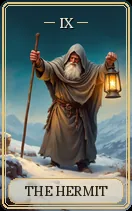 The Hermit — A deep retreat, a solitude chosen in order to think and find answers.
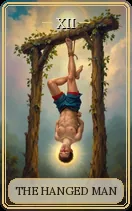 The Hanged Man — An enforced pause that ends up bringing a new perspective.
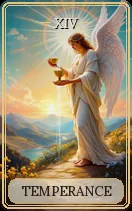 Temperance — Slow, balanced recovery; the right time for everything.
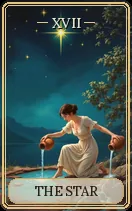 The Star — Rest that restores hope; renewal after a difficult period.
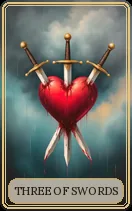 Three of Swords — Recovering from heartbreak: the pain needs time and silence.
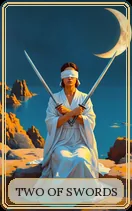 Two of Swords — A truce: stopping before deciding, in order to see more clearly.
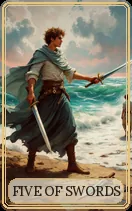 Five of Swords — Stepping away from a conflict so as not to win a bitter victory.
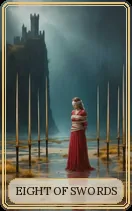 Eight of Swords — Feeling stuck with no way out; rest turns into a prison if there is no movement.
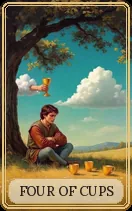 Four of Cups — Withdrawal and detachment: take care that the pause does not turn into indifference.
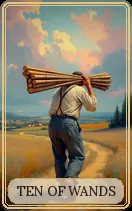 Ten of Wands — The rest that is needed after great effort; putting down the load before it gets the better of you.
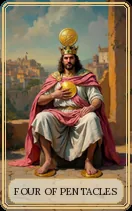 Four of Pentacles — Consolidate and save; this is not the time for big moves.
Frequently asked questions
What does the Four of Swords mean in tarot?
Rest, pause and recovery: stopping by your own choice, withdrawing to think, giving body and mind time after a period of struggle.
Is the Four of Swords a good or a bad card?
It is a peaceful and generally positive card, because it asks for the rest that is needed. It does not bring action or immediate results: it brings time to recover.
What does the Four of Swords mean in love?
A pause in the relationship, a lull after a crisis, or a time of withdrawal after a separation. It is not necessarily an ending.
Is the Four of Swords reversed bad?
It is the same pause out of proportion: either going back into the fight too soon, or a rest that has dragged on and turned into isolation. It calls for balance, not alarm.
Is the Four of Swords a yes or a no?
It leans towards ‘not yet’. The card asks first for rest and reflection; the answer will come when there is the strength and clarity to act.
No sign-up · Reading written on the spot · Free