
The Moon: meaning and symbolism of the tarot card
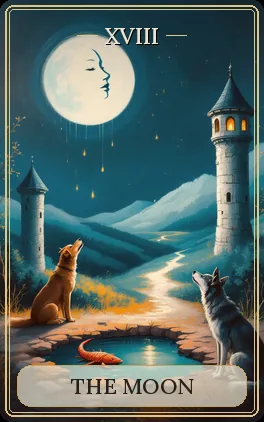
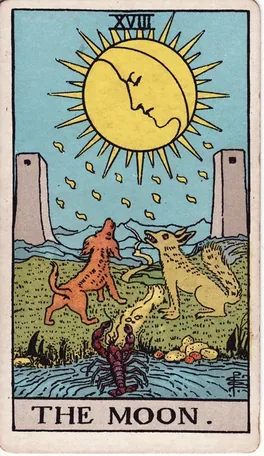
The Moon is the eighteenth card of the Major Arcana, and perhaps the most enigmatic of them all. At night, between two towers, a dog and a wolf howl at a moon with a human face, and a crayfish appears in a pool of water. A narrow path winds away towards the mountains. Everything can be seen, but only dimly: by moonlight, shapes deceive.
In a spread, The Moon speaks of what is not yet clear. Dreams, old fears, hunches, fantasies, misunderstandings — everything we see as we wish or fear it to be. The card does not lie, but it shows things by reflection, and so it calls for caution: do not decide in the dark, wait for the light, be wary of appearances and, at the same time, listen to your intuition, which speaks louder at night.
The card at a glance
| Number | XVIII |
|---|---|
| Arcana | Major Arcana |
| Historical names | La Luna (Italy); La Lune (Marseille); The Moon (Rider-Waite-Smith) |
| Element | Water |
| Astrology | Pisces (Golden Dawn) |
| Hebrew letter | Qoph (ק), according to the Golden Dawn |
| Keywords | illusion, dreams, intuition, fear, imagination, uncertainty, the unconscious |
| Reversed | deception dispelled, fear dissolving, truth emerging; or confusion taken for truth |
| Yes or no | ‘It isn’t known yet’ — the situation is unclear; it is best to wait before deciding |
The image on the card
In the Sol da Alma Tarot, a very bright full moon, almost white, dominates the deep blue sky. On its disc is drawn a serene female profile with closed eyes, and small golden drops fall from it. Below, two towers of pale stone with conical roofs flank the landscape: the one on the left is smaller and darker; the one on the right, taller, has lit windows. On the left, a brownish dog with a collar sits with its muzzle raised towards the moon; on the right, a grey wolf does the same. Between them, a small pool ringed with stones reflects the light, and in it is a red crayfish. From the pool a pale path sets off, winding through the valleys to the bluish mountains in the background.
In the Rider-Waite-Smith of 1909, the elements are the same: the moon with a face in profile inside a rayed yellow disc, falling drops, two grey towers, a dog and a wolf howling, a crayfish crawling out of a pool, and a path that disappears among the mountains. The Sol da Alma follows this imagery very closely, but paints it in the real colours of night — blue, moonlight white — instead of the pale sky and yellow moon of the Rider-Waite-Smith, and keeps the crayfish in the water rather than emerging from it.
In the Tarot de Marseille, La Lune shows a moon with a face in profile, coloured drops in the air, two towers, two dogs barking at each other and at the sky, and, below, a crayfish in a pool of blue water. The essential scene — the two animals, the towers and the creature from the water — is already there.
The symbolism, detail by detail
Almost everything in this card speaks of the difference between what is seen and what is. Each detail adds a nuance to that idea.
- The moon
- Reflected light: it illuminates, but does not show everything, and it changes shape every night. It is the world of dreams, of imagination and of emotions that rise without explanation.
- The face with closed eyes
- In the Sol da Alma, the moon is dreaming. It is the mind that sees inwardly rather than outwardly — intuition, but also illusion.
- The falling drops
- What the moon sheds on the earth: influences, moods, impressions hard to explain. In the Rider-Waite-Smith, they recall the shape of the Hebrew letter Yod.
- The dog
- The tamed side of instinct: the part of us that has learnt the rules, that is loyal and afraid. It howls because it does not understand what it sees.
- The wolf
- The wild side of instinct, which has never been tamed. Dog and wolf are kin: the card sets the civilised and the primitive side by side, both stirred by the same light.
- The crayfish
- What comes from the depths: old fears, memories, impulses rising from the unconscious. In the Rider-Waite-Smith it is climbing out of the water; in the Sol da Alma it is still inside, yet to be revealed.
- The pool of water
- The unconscious, the emotional depths. It reflects the moon — it is also the mirror in which everything appears reversed.
- The two towers
- A passage, a gateway between two worlds. In the Sol da Alma, one has lit windows and the other does not: the known and the unknown, side by side.
- The path
- Narrow and winding, it crosses the landscape between the animals and the towers. It is the path you take even without seeing clearly — carefully, step by step.
- The mountains in the distance
- The destination glimpsed from afar but not yet reached. The card does not say you will not get there; it says you will not get there just yet.
The history of The Moon
The Moon has been among the trumps since the Italian decks of the fifteenth century, where it appears with The Star and The Sun in a series of three heavenly lights. In the Visconti-Sforza decks painted in Milan around 1450, the image is very simple: a standing figure holds a crescent moon in one hand. There are no dogs, towers or crayfish.
The scene known today — the two animals barking, the towers, the creature emerging from the water — became fixed in the Marseille decks between the seventeenth and eighteenth centuries. In the nineteenth century, occultists read it as the image of the psychic world, of dreams and of the dangers of the imagination, and the Golden Dawn associated it with the sign of Pisces and the Hebrew letter Qoph.
In the deck of Arthur Edward Waite and Pamela Colman Smith, in 1909, one of the two animals is a wolf, underlining the contrast between tamed and wild instinct, and the path crosses the landscape towards the mountains. It is this version that the Sol da Alma follows.
The Moon upright: the meaning
Upright, The Moon is the card of uncertainty. It says the situation is not clear, that there are things not yet known, and that the person’s own perception may be skewed by fear or by desire. It is a card of possible illusions — one’s own or other people’s — of misunderstandings and incomplete information. Above all, it calls for caution: do not make important decisions until the mist lifts.
It is also the card of fears: old anxieties that return, insecurities that loom larger at night, ghosts that exist only in the imagination. Often, The Moon shows that the danger is smaller than it seems — but that the fear itself is real and needs attending to.
It is not, however, a card only of shadow. The Moon is also the card of intuition, of dreams and of creative imagination. It favours artists, dreamers and anyone who works with the unconscious. It asks you to listen to your hunches — without mistaking them for certainties. It is at night that the stars can be seen, and it is in uncertainty that intuition works best.
The Moon reversed
Reversed, The Moon does not turn into The Sun. It is the same mist, but on the move. In most readings, it shows the deception beginning to clear: a fear that is named and shrinks, a truth that comes to the surface, a misunderstanding that is cleared up. The crayfish finally leaves the water, and you can see what it was.
There is, however, another reading. Reversed, The Moon can show confusion growing worse, turned inwards: anxiety feeding on itself, fantasy taken for truth, a deception clung to because one does not want to see. The neighbouring cards tell you which of the two it is. In both cases, it asks you to look for the light — a frank conversation, a checked fact, advice from someone you trust.
The Moon in love
In love, The Moon speaks of uncertainty: confused feelings, doubts about what the other person feels, a relationship not yet defined. It can indicate idealisation — seeing in the other what you want to see — jealousy fed by the imagination, or things left unsaid. In certain cases it points to secrets or a hidden relationship, and asks you to pay attention to the signs.
It also has its romantic side: The Moon is the card of mysterious attraction, of shared dreams, of an intimacy that lives more in feeling than in words. For someone who is single, it asks you not to be carried away by illusions. Reversed, it often heralds the end of a misunderstanding, or the moment when the truth of a relationship becomes clear.
The Moon in work and money
At work, The Moon indicates an unclear situation: missing information, intrigue, vague instructions, a project heading in an uncertain direction. It asks you to check everything, to sign nothing in a hurry, and to be wary of promises that sound too good. On the other hand, it favours creative and intuitive professions — art, writing, therapies, night work.
With money, it is a card of caution: unclear accounts, dubious offers, risks that are hard to see. This is not the moment for risky investments. Reversed, it can indicate that a confused situation is clearing up, or that a mistake or a deception is discovered in time.
The Moon in health and wellbeing
In questions about wellbeing, The Moon speaks of sleep, dreams, anxiety and emotions running close to the surface. It asks for rest, calm routines and attention to whatever disturbs your nights. The cards are no substitute for any kind of healthcare: here, as with any other card, the reading speaks of attitude, not of diagnosis.
The Moon in spiritual life
On the inner path, The Moon is the crossing of the night: contact with the unconscious, with dreams, with images rising from the depths. It is a phase that is both fertile and dangerous — rich in intuitions, but prone to illusions. At this point many traditions call for discernment: welcome what comes from dreams and intuition, but test it against waking life. The path between the towers is walked slowly.
The Moon as advice
As advice, The Moon says: wait for the light. Do not decide under the sway of fear or of enthusiasm; look for the missing facts. Listen to your intuition, but do not mistake it for certainty. Give your fears a name — many of them shrink when seen up close. And move forward, if you must, carefully and step by step, like someone walking a path at night.
The Moon in the positions of a spread
- In the past
- A period of confusion, fear or deception that still influences the way the person sees the situation.
- In the present
- An uncertain phase: information is missing, and emotions cloud the view. This is not the time for final decisions.
- In the future
- A period of doubt on its way, or something still to be revealed. It is best to take nothing for granted.
- As an obstacle
- Fear, anxiety or an illusion that prevents you from seeing clearly; sometimes, someone who is not telling the whole truth.
- As the outcome
- The situation remains unclear, or the outcome depends on something not yet known. It is worth asking the question again later.
Numerology and correspondences
The number XVIII reduces to 9 (1 + 8), the number of The Hermit: if The Hermit carries his own lantern through the night, The Moon is the night in which only reflected light guides us. In the Golden Dawn tradition, the card corresponds to Pisces — the sign of deep waters, sensitivity, imagination and dissolution — and to the Hebrew letter Qoph, usually translated as ‘nape’ or ‘back of the head’. Its element is Water, the world of emotions and the unconscious.
Combinations with other cards
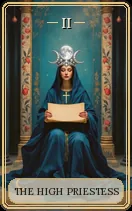 The High Priestess — Very strong intuition; secrets sensed before they are known.
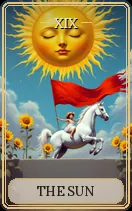 The Sun — The mist lifting: after doubt, clarity and the truth in plain view.
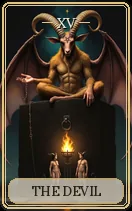 The Devil — Deception and dependence: manipulation, secrets, a situation best viewed with suspicion.
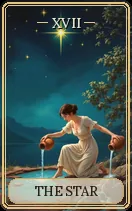 The Star — Hope that guides through uncertainty; trusting the direction even without seeing everything.
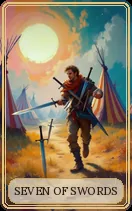 Seven of Swords — A hidden lie or betrayal; someone who is not being honest.
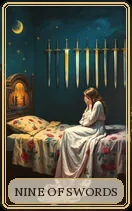 Nine of Swords — Anxiety and sleepless nights; fears that grow in the imagination.
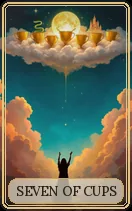 Seven of Cups — Fantasies and illusions: many possibilities, few of them real.
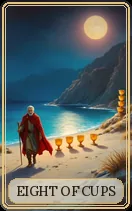 Eight of Cups — Setting off without quite knowing where to; leaving behind something that no longer satisfies, guided by intuition.
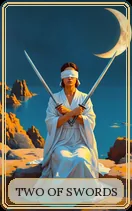 Two of Swords — A decision put off for lack of information; the indecision of someone who cannot see.
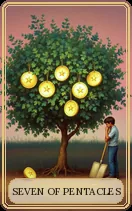 Seven of Pentacles — Waiting to see: results that cannot yet be judged.
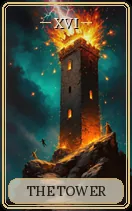 The Tower — A sudden revelation that shatters an illusion.
Frequently asked questions
Is The Moon a bad card?
No. It is a card of uncertainty and possible illusions, and so it calls for caution. But it is also the card of intuition, dreams and imagination. Its main advice is to wait for the light before deciding.
What does The Moon mean in love?
Confused feelings, doubts, idealisation or things left unsaid. It can also speak of a mysterious, romantic attraction. Reversed, it usually shows that a misunderstanding is being cleared up.
Is The Moon a yes or a no?
Neither yes nor no: it shows that the situation is not yet clear. The best thing is to wait, look for more information and ask again later.
Is The Moon reversed good?
Often, yes: it shows that the confusion is clearing and the truth is coming to the surface. But it can also show anxiety growing worse; the neighbouring cards make it clear.
What do the dog and the wolf mean in The Moon card?
The two sides of instinct: the dog is the tamed one, the wolf the wild one. Both howl at the same moon, stirred by what they do not understand — the part of us that reacts to the unknown.
No sign-up · Reading written on the spot · Free