
Seven of Wands: meaning and symbolism of the tarot card
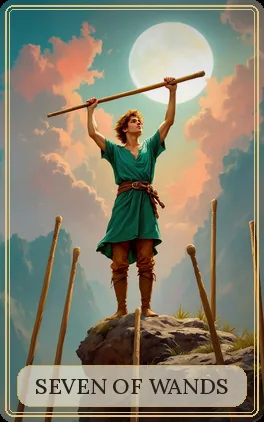
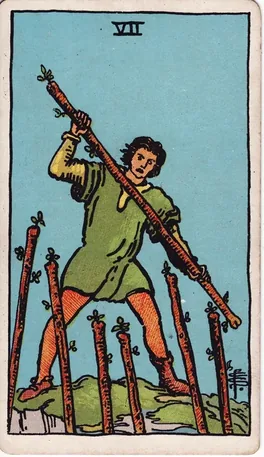
The Seven of Wands is the card of someone who stays on their feet. A young man stands on top of a rock with his staff raised, and around him, coming up from below, six others rise. He is alone against many, but he is higher than all of them. He has not fled, he has not given way: he is holding his position.
In a spread, it speaks of defending what is yours — an idea, a place, a project, a decision — in an environment of pressure, competition or criticism. It is a card of courage and conviction, but also of effort: whoever stands on high has the advantage, and also has to hold out. After the victory of the Six of Wands comes the less glamorous task of keeping it.
The card at a glance
| Card | Seven |
|---|---|
| Suit | Wands |
| Element | Fire |
| Astrology | Mars in Leo (Golden Dawn: ‘the Lord of Valour’) |
| Keywords | holding your ground, courage in position, conviction, resistance, firmness, challenge, advantage |
| Reversed | siege, ground giving way, weariness, defensiveness, stubbornness, a fight no longer worth it |
| Yes or no | Yes, if you hold your position firmly |
The image on the card
In the Sol da Alma Tarot, a young man with curly auburn hair stands on top of a grey rock with tufts of grass. He wears an open-necked green tunic fastened with a broad leather belt, brown trousers and tall laced leather boots. With both arms stretched above his head, he holds a long staff horizontally, and he looks upwards, towards the sky. Behind him shines a large, white full moon, surrounded by salmon-coloured clouds against a blue-green sky; on either side, blue mountains are wrapped in mist. Around the rock, coming up from below, six staffs of pale wood rise, some with rounded tips, as if held by people who cannot be seen.
In the 1909 Rider-Waite-Smith, the scene is essentially the same, but the gesture is different: the young man, in a green tunic, holds his staff diagonally across the middle of his body, in a clearly defensive stance, against six staffs rising towards him from below. He stands on a small rise under a plain blue sky, his face tense. There is a well-known curious detail in this card: the young man appears to be wearing a shoe on one foot and a boot on the other. The Sol da Alma kept the young man in the green tunic on high, the raised staff and the six staffs rising from below, but swapped the fighting stance for a more open gesture, arms in the air — somewhere between defence and affirmation — added the full moon and the mountains, and gave him a matching pair of boots.
In the Marseille Tarot, the Seven of Wands has no scene: it shows the staffs crossed in a pattern, with a vertical staff in the centre, and ornamental foliage. The young man on the rock is a creation of Waite and Smith’s deck.
The symbolism, detail by detail
This is a card about position: where you stand, what you are defending, and what it costs not to leave your place. Each element adds a nuance to that idea.
- The rock
- The advantage. Whoever is on high sees more and is harder to reach. The card says the position of the person asking is, in principle, the better one.
- The raised staff
- Conviction and the will to defend it. In the Sol da Alma, held horizontally above the head, it is both a barrier and an affirmation — ‘this is mine, and I am keeping it’.
- The six rising staffs
- Pressure from outside: competition, criticism, demands, objections. They come from below, from a weaker position, and there are many of them.
- The invisible hands
- The opponents cannot be seen. The pressure may come from actual people, but also from circumstances, from expectations, or from one’s own doubts.
- The young man alone
- Seven is the number of what one does alone. Nobody helps him: the firmness has to come from within.
- The upward gaze
- A detail of the Sol da Alma painting: the young man does not look at the staffs, he looks upwards. The strength to hold out comes from what one believes, not from fear of the attackers.
- The full moon
- Also unique to the Sol da Alma: light at night, the time when things are harder to see clearly. Defence is often carried out without complete certainty, with whatever light there is.
- The green tunic
- Youth and vitality. It is the same energy of the suit, now put to the test in a lasting effort.
The history of the Seven of Wands
In the fifteenth-century Italian decks and in the Marseille Tarot, which settled into its form in the seventeenth and eighteenth centuries, the Seven of Wands was an arrangement of seven staffs, with no human figure. It served the game of tarocchi, and the meanings given to it today were built up later, based on number and suit.
At the end of the nineteenth century the Golden Dawn assigned it Mars in Leo and the title ‘Lord of Valour’. Mars is the planet of struggle and courage; Leo, of pride and firmness. It is the third and last Leo card in the suit of Wands: after the struggle of the Five and the victory of the Six, the courage to keep what has been won.
Arthur Edward Waite and Pamela Colman Smith, in the 1909 deck, gave it the scene of the young man on a rock, brandishing a staff against six rising from below. In his book on the deck, Waite read it as valour, and also as discussion, negotiation, war of trade, competition — and he added that it is a card of success, because the combatant is on top and his enemies may be unable to reach him. The Sol da Alma follows this iconography with its own painting.
The Seven of Wands upright: the meaning
Upright, the Seven of Wands is the card of holding your ground. Whoever draws it has something to protect — a place, a project, an opinion, a decision, a personal boundary — and is under pressure. It may be competition at work, criticism of a choice, the demands of several people at once, or simply the need to say no.
The card says the position is a good one and worth holding. Whoever is on high has the advantage, and the courage not to back down is usually rewarded. It speaks of conviction, firmness, confidence in one’s own reasons, resistance to pressure. It is not a card of attack: the young man does not come down from the rock; he stays where he is and holds on.
But it is also a card of effort. Defending is costly, and defending alone is costlier still. The Seven of Wands asks you to choose carefully what you defend, to hold out with energy for as long as necessary, and to recognise when the position is secure and the staff can be lowered.
The Seven of Wands reversed
Reversed, the Seven of Wands is the same defence, but giving way. The siege tightens, weariness weighs, and the person begins to lose ground — or goes on defending without conviction, out of habit or pride. It can indicate that one is being overwhelmed by the pressure, that one’s strength is running out, that the position is no longer as good as it was.
In other readings, it speaks of excessive defensiveness: the person who feels attacked by everything, who answers criticisms that do not exist, who shuts themselves off from any differing opinion. Or of the stubbornness of someone defending ground that was not worth it, and spending their strength on a fight that no longer serves any purpose. The card asks you to review your position: if it is worth it, strengthen your defence and ask for help; if it is not, leave the rock without shame.
The Seven of Wands in love
In love, the Seven of Wands speaks of defending the relationship, or one’s own space within it. It can point to a couple holding out against outside pressures — a family that does not approve, rivals, difficult circumstances — or to a person who needs to assert their boundaries and their needs. For someone who is single, it may describe a phase of being very demanding of oneself, or the defence of a space that was hard won.
Sometimes, too, it is the card of someone on the defensive: hurt in the past, they protect themselves from further pain and let nobody come close. Reversed, it may point to the strain of repeated arguments, jealousy, the feeling of always having to justify oneself, or a relationship defended more out of pride than out of love.
The Seven of Wands in work and money
In work, it is the card of competition and of a position won: defending a post, a client, a project, an idea in a difficult meeting. It says the person asking has the advantage, the knowledge and the merit, and should hold on to them firmly. It favours those who work in competitive environments, those who have to negotiate, those who take on a leadership role exposed to criticism.
With money, it asks you to protect what you have: not giving in to pressure to spend or invest, defending your own interests in negotiations, holding a firm position in the face of debts or demands. Reversed, it warns against the exhaustion of trying to hold everything together alone, and against financial conflicts dragged out through stubbornness.
The Seven of Wands in health and wellbeing
In questions about wellbeing, the Seven of Wands speaks of stamina, of energy to get through a demanding phase, and of the importance of protecting your own time and space. Reversed, it points to the tiredness of someone who is always on guard. The cards are no substitute for any kind of healthcare; the reading speaks of attitudes and tendencies, not of diagnoses.
The Seven of Wands in spiritual life
On the inner path, the Seven of Wands is faithfulness to one’s own convictions, even when others do not understand them. It is the card of someone who keeps up a practice, a choice, a way of life against the current. It asks, however, that firmness be told apart from rigidity: defend what is essential, not every detail, so that conviction does not turn into a wall.
The Seven of Wands as advice
As advice, the Seven of Wands says: do not back down. Hold your position, defend what is yours, trust your reasons. The advantage is on your side. And choose your battles well — defend what is worth defending, and save your strength for the rest.
The Seven of Wands in the positions of a spread
- In the past
- A phase in which the person had to fight to hold a position, and which gave them their present firmness.
- In the present
- Pressure from several sides: a position, an idea or a boundary needs defending.
- In the future
- A challenge on its way, which will call for firmness and the courage not to give in.
- As an obstacle
- Excessive defensiveness, stubbornness, or the weariness of always being on guard.
- As the outcome
- The position holds: the person does not back down and in the end overcomes the pressure.
Numerology and correspondences
The Seven is what one does alone: without support or rule any more, at the doer’s own risk. In the suit of Wands, it is individual courage — the young man on the rock has no procession, unlike the rider of the Six; he has only his will and his position. The Fire of the suit, which in the Six was celebrated by all, must now sustain itself.
In the Golden Dawn tradition, the card corresponds to Mars in Leo. Mars is struggle, courage, fighting energy; Leo is pride, firmness, the will to shine. Together they give the bravery of someone who does not back down — and, in excess, the stubbornness of someone who does not know how to yield. It closes the sequence of the three Leo cards in the suit of Wands: the struggle, the victory and the defence.
Combinations with other cards
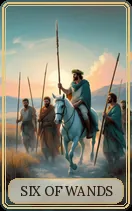 Six of Wands — Defending the victory you have won: success attracts competition.
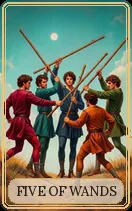 Five of Wands — Strong competition, but with the advantage of position: stay firm in the midst of the contest.
 Strength — Calm courage: firmness comes from within and needs no aggression.
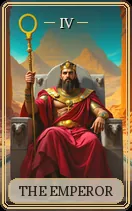 The Emperor — Authority put to the test; defending a structure or a post.
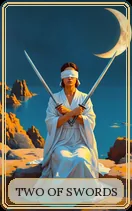 Two of Swords — A defence that has become a blockage: the person refuses to see what they are being told.
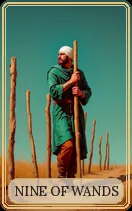 Nine of Wands — Holding out to the end: weariness, but also the strength of someone who has already endured a great deal.
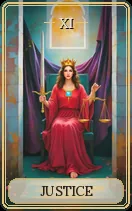 Justice — Defending your own rights; a legal matter or a fair dispute.
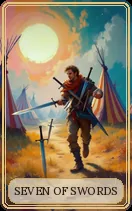 Seven of Swords — Protecting yourself from someone disloyal; keeping your guard up.
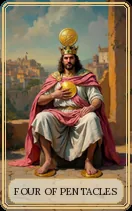 Four of Pentacles — Protecting possessions or material security firmly, sometimes excessively.
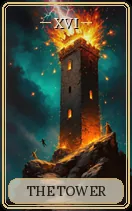 The Tower — The position suddenly falls: a defence that can hold no longer.
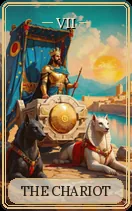 The Chariot — From defence to advance: after holding out, victory and movement.
Frequently asked questions
What does the Seven of Wands mean in tarot?
Holding your ground, courage, conviction and firmness: someone in a position of advantage keeping what is theirs against various pressures.
What does the Seven of Wands mean in love?
Defending the relationship against outside pressures, or asserting your own boundaries within it. It can also speak of someone who is on the defensive and lets nobody come close.
Is the Seven of Wands a yes or a no?
Yes, provided you hold your position firmly. It is a yes that demands effort and courage.
Is the Seven of Wands reversed bad?
No. Reversed, it is the same defence giving way: weariness, siege, stubbornness or excessive defensiveness. It asks you to review what is worth defending.
Why is the young man in the Seven of Wands wearing odd footwear?
In the Rider-Waite-Smith, the young man appears to have a shoe on one foot and a boot on the other. The authors gave no explanation; many readers see in it the haste of someone who had to defend himself with no time to get ready. In the Sol da Alma Tarot, he wears a matching pair of boots.
No sign-up · Reading written on the spot · Free