
The Fool: meaning and symbolism of the tarot card
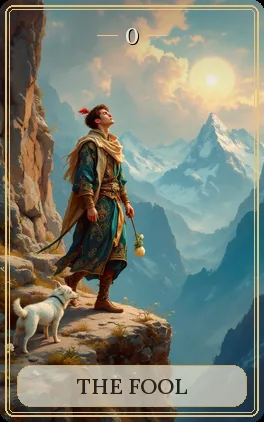
The Fool is the card that opens — or closes — the twenty-two Major Arcana, and the only one with no fixed place in the sequence. A young man walks towards the edge of a precipice, his eyes on the sky, with a light bundle and a dog at his feet. He does not look at the ground, he does not seem afraid, and he does not know what comes next. That is exactly what the card says: there are moments when life asks us to set out without having all the answers.
In a spread, The Fool speaks of beginnings, freedom and trust — but also of the risk that comes with them. It is one of the most ambiguous cards in the deck: it can be the brave leap that changes a life just as easily as the misstep of someone who would not look where they were putting their feet. What decides it is the question and the cards beside it.
The card at a glance
| Number | 0 (unnumbered in the old decks) |
|---|---|
| Arcana | Major Arcana |
| Historical names | Il Matto, Il Folle (Italy); Le Mat (Marseille); The Fool (Rider-Waite-Smith) |
| Element | Air |
| Astrology | Air (Golden Dawn); Uranus, in the modern reading |
| Hebrew letter | Aleph (א), according to the Golden Dawn |
| Keywords | beginning, freedom, trust, risk, spontaneity, innocence |
| Reversed | recklessness, scattered energy, premature leap, escape, irresponsibility |
| Yes or no | Yes, if there is the courage to begin; ‘not yet’, if preparation is lacking |
The image on the card
In the Sol da Alma Tarot, The Fool stands on the tip of a rock, above a valley of blue mountains with snow-capped peaks. He wears a green tunic embroidered with gold, a cream-coloured shawl lifted by the wind and traveller’s boots; there is a red feather in his hair. He looks upwards, at a pale sun surrounded by golden clouds, and holds a slender staff from which a small white bundle hangs. At his feet, a white dog looks up at him — or at the edge of the rock, which he does not see.
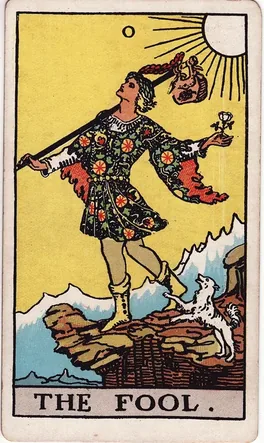
In the Rider-Waite-Smith of 1909 the scene is almost the same, and it was the starting point for the Sol da Alma painting: a young man in colourful clothes, with a white rose in one hand and a staff with a bundle over his shoulder, steps towards the edge of a cliff, with the yellow sun behind him and a white dog leaping at his feet. In the Tarot de Marseille the image is older and rougher: a vagabond in a jester’s cap with bells walks to the right with his bundle on his back, and an animal — dog or cat — tears at his breeches from behind. There is no precipice at all there; there is a man going his own way, paying no mind to what is biting him.
The symbolism, detail by detail
Almost everything in this card speaks of the difference between what we know and what we trust. Each element adds a nuance to that idea.
- The precipice
- The unknown, the moment when there is no turning back. The card does not say whether he will fall or fly — it says he has reached the edge.
- The gaze towards the sky
- Trust, idealism, attention fixed on what does not yet exist. It is also his weakness: whoever looks up does not see where they are treading.
- The light bundle
- Everything he carries fits in one hand. It is the experience he does not yet have, and the freedom of someone who carries nothing to tie him down.
- The staff
- The will, still little used. In The Magician the same wand appears raised and directed; here it is merely a support for the road.
- The white flower
- Purity of intention and innocence. In the Rider-Waite-Smith it is a white rose, a symbol of desire without stain.
- The dog
- Instinct, loyalty, the part of a person that senses danger. It can be a warning or a companion — in the old cards it is the animal that bites him and that he ignores.
- The red feather
- Passion and life, the fire of someone setting out. In tradition, feathers in the hair were also a mark of the madman and the jester.
- The mountains
- The challenges that lie ahead, whose cost he has no idea of yet. The snow-capped peaks speak of heights that can be reached, but in time.
- The sun
- The awareness that lights the way, still distant. It is on the side he is looking towards: for all that, the card is a bright one.
- The zero
- Nothing and everything at once: the point before the beginning, the potential that has not yet chosen a form. That is why The Fool can stand at the start or at the end of the sequence.
The history of The Fool
The Fool is as old as the tarot itself. In the hand-painted decks made for the Visconti and Sforza court in Milan around 1450, he appears as a ragged man with feathers in his hair and bare feet — the beggar and the jester, the figure the society of the time left on the margins. He was called Il Matto or Il Folle, and he had no number.
There was a practical reason for this. The tarot was born as a card game — tarocchi — and in that game The Fool was not a trump: he was the ‘excuse’, the card that could be played in any trick to avoid having to follow suit. In the Marseille decks, which took their settled form between the seventeenth and eighteenth centuries, he is called Le Mat and remains unnumbered, unlike the other twenty-one.
The zero arrived with the occultists. In 1781 Antoine Court de Gébelin, convinced that the tarot held a lost Egyptian wisdom, placed The Fool at the start of the sequence. In the nineteenth century Éliphas Lévi preferred to put him between Judgement and The World, and associated him with the Hebrew letter Shin. It was the Hermetic Order of the Golden Dawn, at the end of the nineteenth century, that gave him once and for all the number 0, the letter Aleph and the element of Air — the order that Arthur Edward Waite and Pamela Colman Smith followed in the 1909 deck, and which most modern decks, the Sol da Alma included, use today.
It was also from then on that The Fool came to be read as the protagonist of a journey: the other twenty-one cards would be the stages he passes through, from The Magician to The World. The idea is modern — it is not in the old decks — but it has become one of the most widely used keys for reading the Major Arcana.
The Fool upright: the meaning
Upright, The Fool is the card of beginnings: a new project, a journey, a change of life, a relationship that does not yet have a name. It says this is a time to move forward lightly, without demanding guarantees that no one can give. It asks for trust — in others, in life and, above all, in yourself.
It is also the card of spontaneity and freedom: acting out of enthusiasm, experimenting, saying yes to whatever comes along. In many readings it brings a breath of fresh air to a situation that has stalled. Whoever draws it is often at a point where the old rules no longer work and the new ones do not yet exist.
It is not, however, an irresponsible card. The Fool’s innocence is not foolishness: it is openness. He does not know what is coming, but he goes open to whatever comes. The advice is to set out — but to set out with your eyes open.
The Fool reversed
Reversed, The Fool does not become his own opposite: it is the same energy without a centre. Impulse turns into haste, freedom into scattered energy, trust into recklessness. It can point to a decision taken out of restlessness rather than will, a leap taken too soon, or running away from a responsibility disguised as adventure.
Sometimes it speaks of the exact opposite: the fear of beginning. The person has been standing at the edge of the precipice for so long that the moment has passed, and they are still there, neither going forward nor stepping back. In both cases the card asks for the same thing — look at the ground before taking the step, and decide whether the step really is meant to be taken.
The Fool in love
In love, The Fool heralds a beginning: an unexpected meeting, a light-hearted and fun relationship, or a new phase in an old one. It is a card of passion without calculation, of someone who falls in love without thinking about what comes next. For those who are single, it usually says that love arrives when least expected — and away from the usual places.
The other side is a lack of commitment. The Fool does not always want to stay: it can speak of someone who is not ready for a serious relationship, or of a relationship that lives for the moment and has no plans. Reversed, it is often the warning of a person who runs away when things get serious, or of a passion that cannot withstand everyday life.
The Fool in work and money
At work, it is the card of a change of direction: a new job, a different field, starting a business of your own, an idea no one else had thought of. It favours those who take risks and those who learn quickly. In a question about an offer, it says it is worth going ahead, even without quite knowing where it will lead.
With money, it calls for care. The Fool is generous and pays little attention to the accounts: it can speak of impulse spending, poorly researched investments or a phase in which money comes in and goes out with no control. Upright, it is an invitation to take risks in moderation; reversed, a clear warning against the blind gamble.
The Fool in health and wellbeing
In questions about wellbeing, The Fool speaks of new energy, the urge to move the body, the need for fresh air and for changing habits. Reversed, it points to the small lapses — the misstep, the tiredness ignored, the excess. The cards are no substitute for any kind of healthcare: here, as with any other card, the reading speaks of attitude, not diagnosis.
The Fool in spiritual life
On the inner path, The Fool is the beginning of everything: the beginner’s mind, which arrives without preconceptions and learns from whatever it finds. It is the card of someone starting a practice, a search, a faith — or of someone leaving old certainties behind in order to ask again. For many readers it is also the image of the soul before incarnation, free of any form.
The Fool as advice
As advice, The Fool says: begin. Do not wait for the perfect moment, do not ask for more guarantees, trust the first step. But it also says: travel light — without carrying more than you need, without promising more than you know. It is the advice for someone who has already thought enough and now needs to act.
The Fool in the positions of a spread
- In the past
- A beginning that set everything in motion, or an impulsive decision whose consequences are still being felt.
- In the present
- A turning point: the person is on the brink of something new, and the question is whether they will take the step.
- In the future
- A beginning on its way — a door opening, a journey, a change that cannot yet be seen.
- As the obstacle
- Recklessness, the lack of a plan, or the fear of taking a risk that stops you moving forward.
- As the outcome
- A new cycle. The matter is not resolved: it turns into a beginning.
Numerology and correspondences
Zero is not a number like the others: it is the emptiness before counting begins, and also the circle that contains everything. That is why The Fool can be read at the start of the sequence, before The Magician, or at the end, after The World, starting over. In the Golden Dawn tradition it corresponds to the element of Air — breath, open space — and to the letter Aleph, the first of the Hebrew alphabet, which represents the breath before the word. Modern astrology associates it with Uranus, the planet of ruptures and the unexpected.
Combinations with other cards
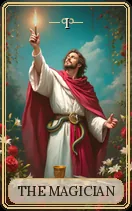 The Magician — An idea that moves from will to action: the beginning now has tools and direction.
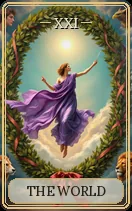 The World — The end of one cycle and the start of another — a journey, a change of phase, a return to zero with everything learnt.
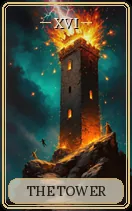 The Tower — A sudden rupture that forces you to start again from nothing; or the warning that recklessness could bring down what was standing.
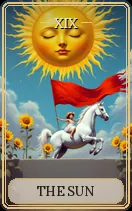 The Sun — Joy, spontaneity and success: a very happy beginning.
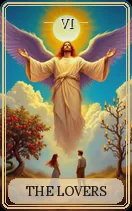 The Lovers — A passion that begins all of a sudden, or a choice made with the heart.
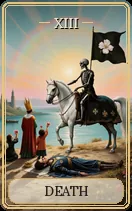 Death — An ending that sets you free: what comes to an end clears the way to begin again.
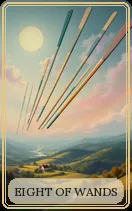 Eight of Wands — Everything happens quickly: a journey or a move is imminent.
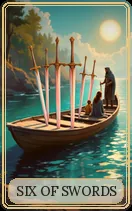 Six of Swords — A departure, a move of house or of country, the crossing to calmer ground.
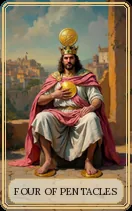 Four of Pentacles — The conflict between the desire to leave and the need for security.
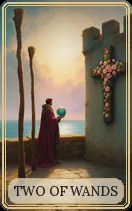 Two of Wands — Planning before leaping: the horizon is there, the path still has to be mapped out.
Frequently asked questions
Is The Fool a good or a bad card?
Neither one nor the other. It is a card of beginnings and freedom, generally positive, but it always carries a warning about risk. Upright, it tends to be favourable; reversed, it calls for caution.
Why does The Fool have the number zero?
In the old decks it had no number at all, because in the game of tarot it was not a trump. The zero was given to it by the occultists of the eighteenth and nineteenth centuries and fixed by the Golden Dawn, which placed it at the start of the Major Arcana.
What does The Fool mean in love?
A light, passionate beginning, an unexpected meeting or a relationship that lives for the moment. Reversed, it can speak of a lack of commitment or of someone who runs away when the relationship gets serious.
Is The Fool reversed always negative?
No. Reversed, it is the same energy gone astray: haste, recklessness or, on the contrary, the fear of beginning. It is a warning to stop and think before taking the step, not a condemnation.
Is The Fool a yes or a no?
It leans towards yes, especially when the question is about starting something. But it is a yes with conditions: if the plan is poorly prepared, the card says ‘not yet’.
No sign-up · Reading written on the spot · Free