
Page of Wands: meaning and symbolism of the tarot card
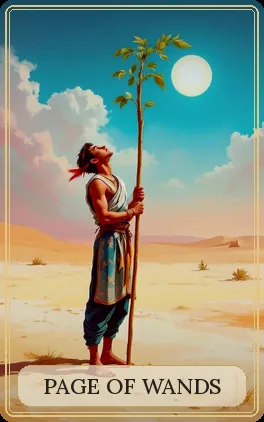
The Page of Wands is the first of the four court cards of the suit of Fire, and the youngest. A barefoot boy stands in a desert, holding a wand that opens out into green leaves at the top. He does not look at the viewer: he looks up, at what the wand is bringing into being, with the attention and wonder of someone discovering something for the first time.
In a spread, the Page of Wands brings the start of an enthusiasm: news that sparks things off, an idea that has not yet left the page, the urge to learn, to try things out, to go. It may be an event — a message, an offer — or a young person full of energy. In either reading, the card has the same quality: plenty of fire, not much craft yet, and all the will in the world to begin.
The card at a glance
| Card | Page |
|---|---|
| Suit | Wands |
| Element | Fire |
| Astrology | Varies between schools |
| Keywords | enthusiasm, news, new idea, curiosity, learning, youthful courage |
| Reversed | impatience, careless message, passing enthusiasm, immaturity, plans that never get off the ground |
| Yes or no | Yes — especially for starting something |
The image on the card
In the Sol da Alma Tarot, a dark-haired, barefoot young man stands on the pale sand of a desert. He wears a sleeveless white tunic crossed over the chest, a long blue-green apron with orange motifs, an orange sash at the waist and loose trousers of the same bluish colour, gathered at the ankle. He has bracelets on his wrist and a red ribbon tied in his hair, its ends lifted by the wind. In his right hand he holds a tall, slender wand resting on the ground, which at the top turns into a small branch of green leaves, like a young tree. His head is tilted back and his eyes are fixed on those leaves. Around him, the sand is almost white, with tufts of dry grass and low dunes in the background; the sky is turquoise, with a round white sun and pinkish clouds.
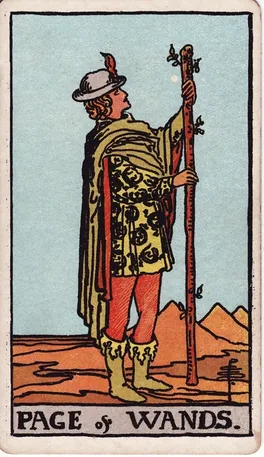
In the 1909 Rider-Waite-Smith, the scene is a close relative, and it was the starting point for the Sol da Alma painting: a young man standing in a desert holds a sprouting wand and looks at its top. But there the page is dressed as a page of the court: a hat with a red feather, a cape, a yellow tunic decorated with salamanders, boots, and in the background three pyramid-shaped mounds. In the Sol da Alma the hat, the boots and the salamanders have gone; the young man is barefoot, dressed more simply and in an eastern style, and the wand no longer has just a few sprouts — it grows into foliage at the top, as if he were holding a living plant. The upward gaze is more marked: it is not that of someone proclaiming, but of someone filled with wonder.
In the Marseille Tarot, the Valet de Bâton is also a young man standing, with a large staff, but with no desert or landscape: the figure takes up the whole card, and the staff, massive and smooth, looks more like a club than a living branch.
The symbolism, detail by detail
Almost everything on the card speaks of the relationship between a young man and what he has just discovered. Each detail adds a nuance to that first enthusiasm.
- The leafy wand
- The living idea, the energy of Fire putting out its first shoots. In the Sol da Alma it looks like a young tree: the project is being born, and it is still fragile.
- The upward gaze
- Curiosity, wonder, inspiration. The young man is fascinated by what he holds — that is his strength and his risk, because whoever looks up does not see the ground.
- The bare feet
- Simplicity, direct contact with the earth, a lack of preparation. He does not yet have the means of the Knight or the standing of the King: he has only the will.
- The red ribbon in the wind
- Fire and passion, youth in motion. It is the Sol da Alma’s echo of the red feather the Rider-Waite-Smith page wears in his hat.
- The desert
- Ground not yet cultivated. The Fire of the suit is alone in an empty space: everything is still to be done, and that is what makes the moment so open.
- The white sand and the tufts of grass
- Little life around, but some. The first grasses in the desert echo the idea of the flowering wand: growth is possible, even on difficult ground.
- The white sun
- The light of Fire, clear and intense. It is on the side the young man is looking towards: the direction is a bright one.
- The light clothing
- No armour, no crown. The Page neither protects himself nor rules — he learns, receives, passes on.
The history of the Page of Wands
The tarots born in northern Italy in the fifteenth century have four court figures in each suit: the page, the knight, the queen and the king. The page — in Italian fante, the servant or foot soldier — was the lowest figure, a young man in the service of the court. In the Marseille decks, which took their settled form between the seventeenth and eighteenth centuries, he is called the Valet de Bâton and appears standing, with a large staff.
In 1909, Arthur Edward Waite and Pamela Colman Smith made him the Page of Wands and gave him the desert, the pyramids and the salamanders — the creature that, according to tradition, lives in fire, and which Pamela Colman Smith used on several figures in the suit. In the book that accompanied the deck, Waite described him as a young man in the act of proclamation, a faithful messenger whose tidings are strange.
In the Golden Dawn, the court cards changed their names and the Page became the Princess; the elemental and astrological attributions of the court cards vary from school to school, and none can be taken as settled. What the traditions share is the essential point: the Page is the apprentice and the messenger, the youthful age of the suit. That is the Sol da Alma’s reading.
The Page of Wands upright: the meaning
Upright, the Page of Wands is the card of first enthusiasm. It announces news that sparks things off — an invitation, an offer, a chance to travel, an idea that turns up out of nowhere and keeps you awake at night. It is the start of something that has no shape yet, but already has energy.
It also speaks of learning and discovery. The Page does not yet know how to do things, but wants to know: he is ready to try, to make mistakes, to start from scratch. In a spread, it can point to a course, a new field, an interest that is awakening, or simply a period in which the person feels curiosity and drive again.
Like all the court cards, it can also represent someone: a young person, or someone young at heart, full of ideas, lively, restless, with the courage to start and little patience to finish. Whether event or person, the Page of Wands brings new fire to a situation.
The Page of Wands reversed
Reversed, the Page of Wands does not lose its fire: it handles it badly. The enthusiasm is still there, but it burns out before it bears fruit — lots of ideas, none carried through; projects started and abandoned; the excitement of day one that never makes it to day two. It is also the card of the careless message: news given too soon, a message sent in the heat of the moment, a promise made without thinking.
It can describe impatience and immaturity — wanting instant results, giving up at the first difficulty, reacting with irritation when things do not move at the desired speed. Sometimes, on the contrary, it is the fire turned inwards: the idea that cannot be set in motion, the urge to start held back by fear or by a lack of means.
In any case, the reversed card does not say the idea is a bad one. It says it needs more patience, more preparation, or simply someone to see it through to the end.
The Page of Wands in love
In love, the Page of Wands brings the start of a passion: a flirtation, a lively message, an attraction that takes you by surprise. For those who are single, it is a very encouraging card — it speaks of meetings, of exciting conversations, of someone who makes you laugh and shakes up your routine. In a relationship, it can bring a phase of novelty, adventure and rediscovery.
Its weak spot is constancy. The Page falls in love quickly and can lose interest just as fast. Reversed, it warns against flash-in-the-pan romances, promises that are not kept, impulsive messages that are regretted afterwards, or someone who is not yet ready for commitment.
The Page of Wands in work and money
In work, it announces something new: an offer, an interview, news about a project, an idea worth developing. It is an excellent card for anyone starting out — an internship, a first job, a training course, a change of field. It favours creativity, fields linked to communication, and any work that calls for initiative. The warning is the usual one: enthusiasm without method does not get far.
In money, it speaks of small opportunities, of ideas that could bring in an income if they are worked on. It is not a card of big gains, but of beginnings. Reversed, it asks for care with impulsive spending and with investments made out of enthusiasm, without research.
The Page of Wands in health and wellbeing
In questions about wellbeing, the Page of Wands speaks of energy, of the urge to take up a new activity, of renewed get-up-and-go. Reversed, it points to irregularity — starting strongly and stopping soon after — and asks for consistency. The cards are no substitute for any kind of health care: the reading offers attitudes and tendencies, never diagnoses.
The Page of Wands in spiritual life
On the inner path, the Page of Wands is the awakening of an interest: a book that opens a door, a practice you discover, a question that suddenly seems urgent. It is the fervour of the beginner, full of energy and faith. The challenge is to keep that flame alive once the novelty wears off — to turn the enthusiasm of the first day into an everyday discipline.
The Page of Wands as a person
When it represents someone, the Page of Wands is a young person — in years or in spirit — enthusiastic, curious, creative, talkative, always with a new plan. It may be a son or daughter, a pupil, a newly arrived colleague, or a messenger bringing news from someone else. Charming and full of energy, but still learning to finish what they start.
The Page of Wands as advice
As advice, the Page of Wands says: follow your curiosity. Try things out, learn, make room for the new idea, share the news you have to share. But it also says: look after the plant you hold in your hands — enthusiasm is the beginning, not the whole road.
The Page of Wands in the positions of a spread
- In the past
- An idea or a piece of news that set everything in motion; an enthusiasm that gave rise to the present situation.
- In the present
- A moment of beginning and discovery: there is new energy, and it is worth making the most of it.
- In the future
- News, an offer or a young person who will bring movement.
- As an obstacle
- Impatience, scattered energy, lack of preparation; or a careless message.
- As the outcome
- A new beginning full of energy — which will need follow-through to bear fruit.
The Page and the suit of Wands
The Page is the one who learns and the one who announces: the youthful age of the suit, full of will and not yet skilled in the craft. In the suit of Wands, which is that of Fire — will, drive, the work that gets under way — this makes for a figure of almost pure enthusiasm. The Ace was the flame offered; the Page is the first to pick it up, look at it and run off to tell everyone.
In the tarot, the court cards have no fixed astrological attribution: each school gives its own, and they do not agree. The safest reading is that of the hierarchy within the suit. The Page is the rung of the apprentice and the messenger, before the movement of the Knight, the maturity of the Queen and the rule of the King — and it is because he stands on the first rung that he can be either a promise or an impatience.
Combinations with other cards
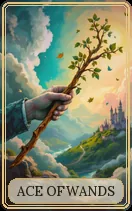 Ace of Wands — An idea or a project born full of strength; the launch of something new.
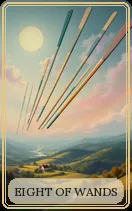 Eight of Wands — Quick, exciting news; a message that arrives suddenly.
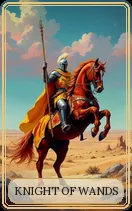 Knight of Wands — From idea to action: enthusiasm turns into a departure or a journey.
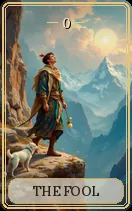 The Fool — A spontaneous start, with no plan; adventure and curiosity in their purest form.
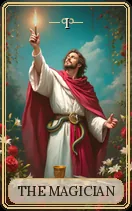 The Magician — A talent awakening; learning to use your own tools.
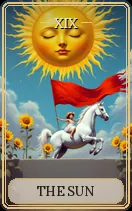 The Sun — Joy, creativity, happy news; sometimes a child or a very bright young person.
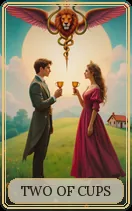 Two of Cups — The start of a passion; a love message or an invitation.
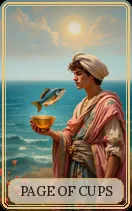 Page of Cups — A sensitive, creative young person; a romantic or artistic proposal.
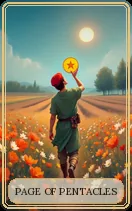 Page of Pentacles — An opportunity to study or train; an idea that could bring in an income.
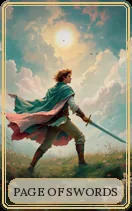 Page of Swords — News that brings tension; impulsive messages, hurtful words.
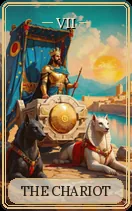 The Chariot — Enthusiasm with direction: youthful drive finds a course and moves forward.
Frequently asked questions
What does the Page of Wands mean in tarot?
The fiery messenger: exciting news, a new idea, the urge to start and to learn. It can also represent a young person, full of energy and ideas.
Is the Page of Wands a yes or a no?
It leans towards yes, especially when the question is about starting something. Reversed, it is a ‘not yet’ — preparation or patience is lacking.
What does the Page of Wands mean in love?
A passion that is beginning, a flirtation, a lively message. Reversed, it warns against passing infatuations and promises made without thinking.
Is the Page of Wands reversed bad?
No. It is the same enthusiasm badly handled: impatience, scattered energy, careless messages. It asks for calm and follow-through, not for giving up.
What kind of person does the Page of Wands represent?
A young person, or someone young at heart: enthusiastic, creative, curious, talkative. Sometimes it is simply the bearer of a piece of news.
No sign-up · Reading written on the spot · Free