Knight of Wands: meaning and symbolism of the tarot card
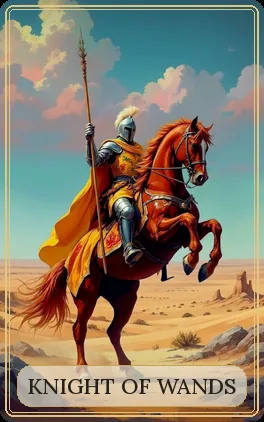
The Knight of Wands is Fire on horseback. A knight in armour, a yellow cloak billowing behind him, rears his chestnut horse in the middle of a desert. The animal is up on its hind legs, forelegs in the air, ready to charge off. Where to, we do not yet know — but we know he is going, and going now.
In a spread, this card speaks of departure and movement: a journey, a move of house or a change of life, a decision taken on the spur of the moment, a person who arrives full of energy and may leave just as quickly. It is one of the most courageous cards in the deck, and one of the most restless. What it brings at its best and at its worst is the same thing: it does not know how to wait.
The card at a glance
| Card | Knight |
|---|---|
| Suit | Wands |
| Element | Fire |
| Astrology | Varies between schools |
| Keywords | drive, departure, travel, change, courage, adventure, passion |
| Reversed | blind haste, aimless departure, impulsiveness, instability, things left half-done |
| Yes or no | Yes — if it means acting now |
The image on the card
In the Sol da Alma Tarot, a knight in full armour of silvery metal rides a rearing chestnut horse, facing right, its forelegs in the air and its reddish mane and tail streaming in the wind. His helmet is closed, the visor lowered, with a pale plume on top. Over his armour, the knight wears a yellow surcoat with red designs, like heraldic figures, and a yellow-orange cloak that the movement throws back. The saddle cloth is the same colour and bears the same designs. In his right hand he holds upright a long, slender wand tipped with a metal point, almost like a lance. All around stretches a sandy desert with grey stones, dry shrubs and tall rocks in the background, under a turquoise sky with pink clouds.
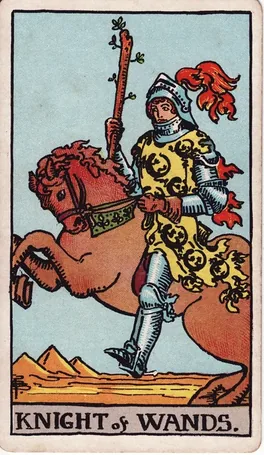
In the 1909 Rider-Waite-Smith, the main elements are the same, and they were the starting point for the Sol da Alma painting: a knight in armour, with a yellow tunic, on a rearing horse, in a desert. But in Pamela Colman Smith’s deck the horse faces left, the knight’s face is uncovered and he wears a red plume like a flame, his tunic is covered in salamanders, the wand is short and has green shoots, and in the background three pyramid-shaped mounds can be seen. In the Sol da Alma the face is hidden behind the helmet, the salamanders give way to less defined red figures, and the wand, long and pointed, has taken on a more warlike air. The desert has changed too: instead of the pyramids, there are rocks and mesas, as in a landscape of travel.
In the Marseille Tarot, the Cavalier de Bâton is a mounted knight holding a large staff, with no landscape around him; the figure and the horse fill the card. The desert, the salamanders and the rearing horse are creations of the Rider-Waite-Smith.
The symbolism, detail by detail
Everything about the Knight of Wands is pent-up movement about to break loose. Each detail shows a different face of the same impulse.
- The rearing horse
- Energy at its peak, ready to burst out. The horse is not galloping: it is in the instant before, forelegs in the air. It is drive in its purest form — and also the difficulty of controlling it.
- The chestnut
- A fire-coloured horse, in keeping with the suit. The mount is as fiery as its rider.
- The armour
- Courage and readiness to face whatever comes. The Knight does not set off unprotected — but nor does he travel light.
- The closed helmet
- In the Sol da Alma, the face cannot be seen. The Knight is pure action: he does not show what he thinks or feels. It can be read as determination, or as someone who charges ahead without looking properly around him.
- The long wand
- Directed will, pointing upwards. In the Sol da Alma it looks like a lance: the Fire of the suit has become an instrument of conquest.
- The cloak in the wind
- Movement, haste, passion. It is the colour of the suit being carried along by speed.
- The red figures
- In the Rider-Waite-Smith they are salamanders, the creatures that tradition said lived in fire. In the Sol da Alma they appear as red heraldic designs on the yellow: the same emblem of the element.
- The desert
- Open space without roads, where anything can be crossed. It is also arid territory: the Knight of Wands goes where others do not, but does not always find what he is looking for.
- The rocks in the background
- The horizon, the distant obstacles, the goal not yet reached. The journey is a long one.
The history of the Knight of Wands
The knight is the figure that sets the tarot apart from ordinary playing cards. In today’s French-suited decks, each suit has three court cards — jack, queen and king — and in Spanish decks also three — sota, caballo and rey. The tarots of fifteenth-century northern Italy, and later those of Marseille, which took their settled form between the seventeenth and eighteenth centuries, have four: page, knight, queen and king. In the Marseille deck, this card is called the Cavalier de Bâton.
In 1909, Arthur Edward Waite and Pamela Colman Smith gave it the rearing horse, the desert and the pyramids. In the book that accompanied the deck, Waite wrote that the knight appears to be on a journey, armed with a short wand, and that although he is in armour he is not on a warlike errand; he added that the motion of the horse is a key to the character of its rider. As meanings, he gave it departure, absence, flight, emigration and change of residence.
The astrological and elemental attributions of the court cards vary from school to school — the Golden Dawn itself reorganised the names of the court figures differently from the other traditions — and none can be taken as settled. The reading common to all of them is that of the card as the suit set in motion. That is the Sol da Alma’s reading.
The Knight of Wands upright: the meaning
Upright, the Knight of Wands is the card of someone who dashes off. It may be a journey, a move of house, town or country, leaving a job, the launch of a project — any decision taken with courage and without waiting for perfect conditions. It says the energy is there and that this is a time to act.
It speaks of daring, adventure and passion. The Knight of Wands does not ask permission: he goes, and sorts things out later. In a spread where things have stalled, it is the sign that matters are about to move quickly and visibly. In a question about a decision, it is almost always an encouragement — the card favours those who take the initiative.
As a court card, it can represent a person: someone energetic, charismatic, passionate, adventurous, who walks into a room and fills it. Here too, virtue and flaw coincide. The Knight brings life and movement, but has little taste for routine, and is better at starting than at staying.
The Knight of Wands reversed
Reversed, the Knight of Wands does not lose his drive: he loses the rein. Courage turns into blind haste, adventure into escape, decision into impulse. It can point to a departure with no direction — leaving for the sake of leaving — a move made to escape a problem rather than to head towards anything, or a tendency to leave unfinished things in one’s wake.
It can also speak of frustration: the wish to leave is there, but something holds it back — delays to a journey, a postponed move, the feeling of being stuck when you wanted to run. The horse rears and goes nowhere. In that case, the energy that finds no outlet turns into irritation and impatience.
In either reading, the card asks for the same thing: before letting the horse go, know where you are heading. Impulse is good; impulse without direction wears out both the one who has it and those around them.
The Knight of Wands in love
In love, the Knight of Wands is passion arriving at a gallop: an intense meeting, a strong attraction, someone who wins you over through energy and daring. For those who are single, it announces movement, sometimes during a journey, or with someone from elsewhere. In a relationship, it can bring a phase of adventure, of novelty, of rekindling the flame — or of a change made together, such as moving somewhere else.
Its weak point is staying power. The Knight of Wands is excellent for starting a story and less good at keeping it going. Reversed, it warns against someone who turns up with plenty of fire and vanishes without explanation, against relationships lived in a rush, and against jealousy or arguments born of impulsiveness.
The Knight of Wands in work and money
In work, it is the card of change and initiative: a new role, a transfer, an opportunity somewhere else, the courage to launch your own business. It favours professions with movement — travel, sales, sport, communication — and those who enjoy a challenge. It can announce a period of intense activity, in which things move forward on sheer energy.
In money, it calls for caution. The Knight of Wands takes risks, and does not always weigh them up. It can bring quick gains, but also impulsive spending, especially on travel or on projects that fire the imagination. Reversed, it warns against financial decisions taken in the heat of the moment and against giving up something secure for a poorly researched adventure.
The Knight of Wands in health and wellbeing
In questions about wellbeing, the Knight of Wands speaks of vitality, of a desire for movement, of sport and the outdoors. Reversed, it points to the risks of haste and overexertion. The cards are no substitute for any kind of health care: the reading offers attitudes and tendencies, never diagnoses.
The Knight of Wands in spiritual life
On the inner path, the Knight of Wands is the seeker who sets off on an adventure: the pilgrimage, the journey that changes one’s perspective, enthusiasm for a new quest. His lesson is that of movement with meaning — telling the true search apart from the restlessness that jumps from one thing to another without ever going deep.
The Knight of Wands as a person
When it represents someone, the Knight of Wands is an energetic, charismatic, adventurous person, usually young or young at heart. They like challenges, travel, a change of scene; they are fun, brave, persuasive. They can also be impatient, inconstant and hard to pin down. This is the friend who suggests leaving tomorrow, the colleague who gets the project off the ground, the lover who turns up out of the blue.
The Knight of Wands as advice
As advice, the Knight of Wands says: go. Do not wait for perfect conditions, trust your energy, take the leap. But it also says: hold the reins — a rearing horse needs a direction, or it wears itself out on the spot.
The Knight of Wands in the positions of a spread
- In the past
- A departure, a change or a quick decision that altered the course of things.
- In the present
- Energy to act and the urge to leave; this is a time for movement.
- In the future
- A journey, a move of house or a change of situation, or someone arriving full of energy.
- As an obstacle
- Impulsiveness, lack of patience, a tendency to run away or leave everything half-done.
- As the outcome
- A change carried through; the matter moves forward through initiative and courage.
The Knight and the suit of Wands
The Knight is the one who sets off: the suit set in motion, on its way somewhere, with the haste and courage of someone going. In Wands, the suit of Fire — will, impulse, the energy spent making things happen — this makes for the most dynamic figure in the whole deck: Fire upon Fire, the will that no longer stays at the level of an idea, as with the Page, but throws itself onto the road.
In the tarot there is no fixed astrological attribution for the knights: the schools are divided, and it is best not to take any as settled. The safe reading is that of the Knight’s position in the hierarchy of the suit: after the Page, who discovers and announces, and before the Queen and the King, who sustain and rule, the Knight is the one who carries things out — the moment the fire leaves home.
Combinations with other cards
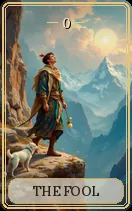 The Fool — A sudden departure with no plan; pure adventure, with all the risk it brings.
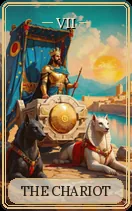 The Chariot — A road trip or a determined move; victory through determination.
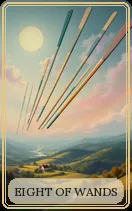 Eight of Wands — Travel, a move of house or country; everything happens very quickly.
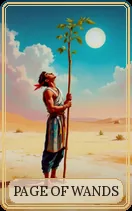 Page of Wands — From news to action: enthusiasm turns into departure.
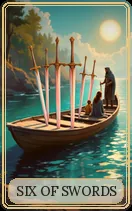 Six of Swords — A change for the better; leaving a difficult situation behind.
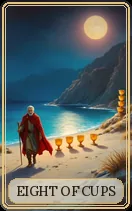 Eight of Cups — Setting off in search of something more meaningful; leaving behind what no longer satisfies.
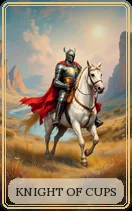 Knight of Cups — An intense, romantic passion; a meeting while travelling.
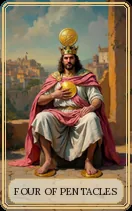 Four of Pentacles — The wish to leave against the need for security; conflict between going and staying.
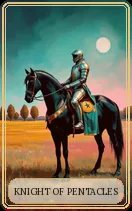 Knight of Pentacles — Haste against patience: best to slow down and plan before moving forward.
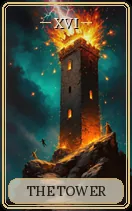 The Tower — An abrupt, unexpected change; a forced departure or a break.
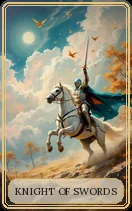 Knight of Swords — Rashness: decisions made too quickly, conflicts born of impatience.
Frequently asked questions
What does the Knight of Wands mean in tarot?
Drive and departure: a journey, a change, a decision taken with courage and without waiting for perfect conditions. It can also represent an energetic, adventurous person.
Is the Knight of Wands a yes or a no?
It is a yes, especially for acting now. Reversed, it is a hasty yes, or a ‘not yet’ — it is worth thinking about where you are going before you set off.
What does the Knight of Wands mean in love?
Passion arriving at a gallop: intense, exciting, full of energy. The caution is about constancy — it may leave as quickly as it came.
Does the Knight of Wands indicate travel?
Yes, it is one of the clearest cards in the tarot for travel and moving house, especially alongside the Eight of Wands or the Six of Swords.
Is the Knight of Wands reversed bad?
It is not a condemnation. It is the same drive with no rein: haste, impulsiveness, aimless departures or changes that get delayed. It asks for direction and patience.
No sign-up · Reading written on the spot · Free