
Four of Cups: meaning and symbolism of the tarot card
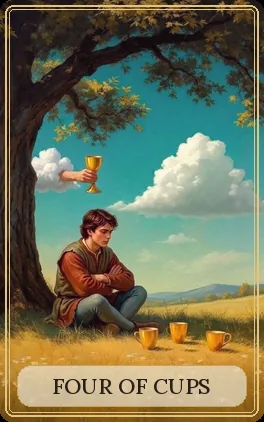
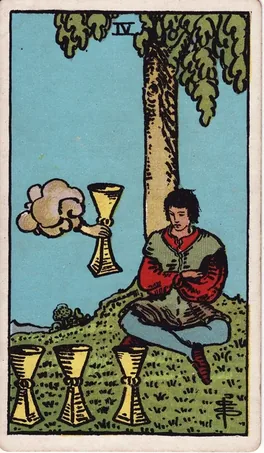
The Four of Cups is the card of someone who has everything and feels nothing. A young man sits under a tree, arms folded, with three cups on the ground in front of him. Beside him, a hand coming out of a cloud holds out a fourth cup — and he does not see it. He is turned inwards, tired of what he has and closed to what he is being offered.
In a spread, the Four of Cups speaks of satiety and boredom: a phase in which things are stable but no longer exciting; in which, out of habit or low spirits, you turn down what could change the picture. It is not a card of loss — nothing is missing. It is a card of lost appetite, and of an opportunity passing you by.
The card at a glance
| Card | Four |
|---|---|
| Suit | Cups |
| Element | Water |
| Astrology | Moon in Cancer (Golden Dawn) |
| Keywords | satiety, boredom, apathy, introspection, dissatisfaction, unseen gift, pause |
| Reversed | waking from boredom, a gift accepted, interest returning, or apathy that drags on |
| Yes or no | ‘Not yet’ — or ‘yes, if you look at what you are being offered’ |
The image on the card
In the Sol da Alma Tarot, a young man with brown hair, in a rust-coloured shirt, a green waistcoat and blue trousers, sits cross-legged on dry grass, leaning against the trunk of a large tree with green and golden leaves. His arms are folded across his chest and his eyes are on the ground. In front of him, on the straw-coloured grass, three golden cups with handles stand in a row. Behind him, next to the trunk, an arm comes out of a small white cloud and holds out a tall-stemmed golden cup to him. The sky is blue and clear, with a large white cloud on the right, and in the background a plain stretches away towards bluish hills.
In the 1909 Rider-Waite-Smith, the scene is essentially the same, and it was the starting point for the Sol da Alma painting: a young man sitting under a tree, arms folded, three cups on the grass and a hand coming out of a cloud to offer him the fourth. The differences are in the details. There the four cups are all the same, tall-stemmed, and the three on the ground are on the left, near the offering hand; the grass is green, and the young man, in a green tunic with red sleeves, looks heavier. In the Sol da Alma, the cups on the ground have handles and sit on the side opposite the hand, the landscape has the dry colours of late summer and the sky opens wide behind the tree.
In the Marseille Tarot, the numbered cards have no scene: the Four of Cups shows four cups arranged symmetrically among leafy ornaments. The uninterested young man and the offering hand are a creation of the Rider-Waite-Smith.
The symbolism, detail by detail
On this card, what matters is not what is missing: it is what goes unseen. Every detail speaks of attention turned the wrong way.
- The folded arms
- Refusal, defensiveness, closing off. It is the gesture of someone who wants nothing more — neither from what they have, nor from what they are being offered.
- The downward gaze
- Introspection, which may be meditation or may be brooding. The young man is not asleep: he is absorbed, turning things over, and that stops him seeing what is right beside him.
- The three cups on the ground
- What one already has: a stable life, familiar relationships, routines. They are full and within reach, but they no longer arouse any interest.
- The offered cup
- The new opportunity, the invitation, the help, the grace — the same gesture as the Ace of Cups, which here is not received. It is the key to the card: there is a gift, and it is going unnoticed.
- The cloud
- What comes from outside and unexpectedly. The hand comes out of the sky, not from a particular person: the offer does not always arrive through the door you are expecting.
- The tree
- Shelter, stability, the place one does not leave. It gives comfort and shade — and also an excuse to stay still.
- The dry grass
- Unique to the Sol da Alma painting: the straw-coloured landscape says the same as the young man’s face — a time without freshness, in which things have lost their flavour.
The history of the Four of Cups
The tarot was born in northern Italy in the fifteenth century as a card game, with the four Latin suits — cups, swords, batons and coins — that are still used today in Portuguese playing cards. In the first decks, such as those painted for the Visconti and Sforza in Milan around 1450, and in the Marseille decks, which settled into their form between the seventeenth and eighteenth centuries, the numbered cards had no figures: the Four of Cups was an arrangement of four cups.
The scene of the young man under the tree was born with the Rider-Waite-Smith, drawn by Pamela Colman Smith under the direction of Arthur Edward Waite and published in 1909 — the first widely circulated deck with figures on all the Minors. Waite describes a young man contemplating the three cups before him while an arm coming out of a cloud offers him another, and says his expression is one of discontent with his surroundings. The meanings he gives it are weariness, disgust, aversion and imaginary vexations.
The Hermetic Order of the Golden Dawn, to which Waite belonged, had given this card, at the end of the nineteenth century, the Moon in Cancer and the title ‘Lord of Blended Pleasure’ — a pleasure that is no longer whole, because it comes with something bitter or weary in it. The 1909 image puts that idea on stage, and it is the one most modern decks follow, the Sol da Alma included.
The Four of Cups upright: the meaning
Upright, the Four of Cups is the card of satiety and boredom. It describes someone who has enough — a stable relationship, a secure job, an organised life — and who, despite this, is dissatisfied, unenthusiastic, with the feeling that nothing tastes of anything. There is no crisis: there is a kind of apathy.
The central point is the unseen opportunity. While the person shuts themselves away in what they have or in what displeases them, something new is being offered — an invitation, some help, an idea, a person. The card warns that this offer may pass by if they do not look up.
It is not always a negative card, however. Four is the number of settling, of what closes and is kept, and sometimes withdrawal is necessary: a pause to think, a time of retreat before deciding, the right to say no to what does not interest you. The question is whether the person is resting or giving up.
The Four of Cups reversed
Reversed, the Four of Cups does not become its own opposite: it is the same satiety beginning to stir. In most readings, it is the awakening — the person comes out of their apathy, looks up, notices what was being offered and accepts it. Interest comes back, the desire to do new things returns, and what looked like a dead end reveals a way out just to one side.
It can also speak of an apathy that deepens and turns even further inwards: low spirits that are no longer just boredom, prolonged isolation, the systematic refusal of everything that is suggested. The neighbouring cards tell you which way the movement is going. Either way, the card’s question is the same: what is there beside you that you have not yet seen?
The Four of Cups in love
In love, the Four of Cups speaks of a relationship that has fallen into routine: nothing is wrong, but the flame has cooled, and one of the two — or both — is distracted, uninterested or sitting with arms folded. It can also describe someone who turns down another person’s advances without even considering them, out of tiredness or because they are still tied to the past.
For someone who is single, it warns that someone’s interest may be going unnoticed. Reversed, it is a good sign: the relationship comes back to life, or the person is once again open to meeting someone.
The Four of Cups in work and money
In work, it describes professional boredom: a job that no longer motivates you, repetitive tasks, the feeling of standing still. The card advises you not to turn down, out of habit, the offers that come along — a training course, a change of role, a new project — and to look carefully at what is being offered.
With money, it speaks of a situation that is stable but not growing, and sometimes of dissatisfaction with what you have, even when it is enough. Reversed, it indicates that an opportunity that was in plain sight is finally taken up, or that the motivation to change things returns.
The Four of Cups in health and wellbeing
In questions about wellbeing, the Four of Cups speaks of tiredness and low spirits, of a need for rest and for new stimulation. If the low mood goes on for a long time, it is wise to talk to someone you trust or to a professional. The cards are no substitute for any kind of healthcare; the reading speaks of attitudes and tendencies, not of diagnoses.
The Four of Cups in spiritual life
On the inner path, the Four of Cups has two faces. It can be the image of retreat and meditation — sitting under a tree, closing your eyes to the world, turning inwards. And it can be the warning against closing off: the person so absorbed in their own questions that they do not notice the answer being held out to them. The hand coming out of the cloud is, for many readers, grace offered to anyone who is willing to see it.
The Four of Cups as advice
As advice, the Four of Cups says: unfold your arms. Look around you before saying there is nothing new. Take stock of what you have, be grateful for it, and keep an eye out for what is coming from another direction. If you need a pause, take one — but let it be for resting, not for shutting yourself away.
The Four of Cups in the positions of a spread
- In the past
- A phase of low spirits or routine, or an opportunity that was allowed to pass.
- In the present
- Boredom, dissatisfaction or withdrawal; something is being offered that has not yet been seen.
- In the future
- A period of pause or satiety — or an offer that is on its way and that is best not turned down out of habit.
- As an obstacle
- Apathy, mistrust or a closed attitude that stops you seeing the way out.
- As the outcome
- The matter settles, but without much enthusiasm; or it is resolved once what was right beside you is accepted.
Numerology and correspondences
The Four is settling: what has taken shape, closes and is kept — and can therefore also get stuck. In the suit of Cups — the suit of Water, of feeling and of bonds — the settling is emotional: emotional life has become stable, but still water loses its freshness. After the celebration of the Three comes the morning after, when the cups are still full and no longer appeal.
In the Golden Dawn tradition, the Four of Cups corresponds to the Moon in Cancer and bears the title ‘Lord of Blended Pleasure’. The Moon is the planet of moods and inner tides, and it is in Cancer, a Water sign that it rules. It is a combination of very strong sensitivity, turned inwards — which explains both the card’s withdrawal and its melancholy.
Combinations with other cards
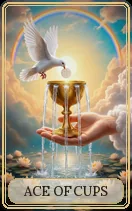 Ace of Cups — The offered cup is a new affection: a love or a joy waiting to be accepted.
 The Hermit — Deep withdrawal; a pause to think, or isolation that is best not prolonged.
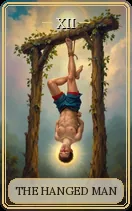 The Hanged Man — Everything at a standstill: a wait that only changes when you change the way you look at things.
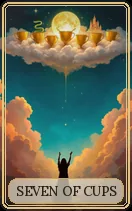 Seven of Cups — Dissatisfaction with reality and escape into dreams; many options and none chosen.
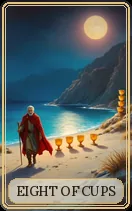 Eight of Cups — Boredom that leads to leaving: putting behind you what no longer nourishes you.
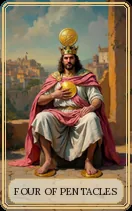 Four of Pentacles — Clinging to security; turning down the new for fear of losing what you have.
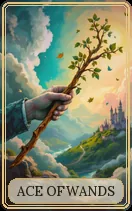 Ace of Wands — A work opportunity or an idea that brings back enthusiasm.
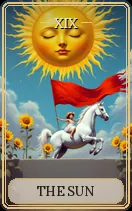 The Sun — The end of low spirits; joy returning.
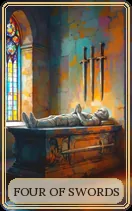 Four of Swords — Necessary rest: a pause that restores your strength.
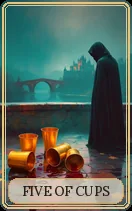 Five of Cups — Disappointment that drags on; sadness that stops you seeing what is left.
Frequently asked questions
What does the Four of Cups mean in love?
Routine and lack of interest: a relationship that has cooled, or someone turning down an advance without considering it. It can also warn that another person’s interest is going unnoticed.
Is the Four of Cups a yes or a no?
It leans towards ‘not yet’, because it speaks of apathy and pause. But if the question is about accepting an offer, it says ‘yes — look at what you are being offered’.
Is the Four of Cups reversed good?
Often it is: it speaks of awakening, of interest returning and of the opportunity finally being accepted. Sometimes, however, it is low spirits dragging on; the neighbouring cards make it clear.
What is the difference between the Four and the Five of Cups?
In the Four nothing has been lost: there is satiety and boredom. In the Five there is a real loss and grief. In both, the person is looking the wrong way and does not see what they still have.
What does the hand coming out of the cloud represent in the Four of Cups?
An offer that comes from outside and unexpectedly — an invitation, some help, an opportunity. It is the key to the card: there is a gift, and it is being ignored.
No sign-up · Reading written on the spot · Free