
Nine of Pentacles: meaning and symbolism of the tarot card
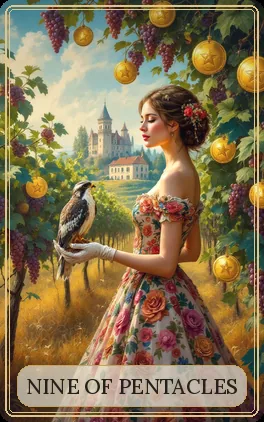
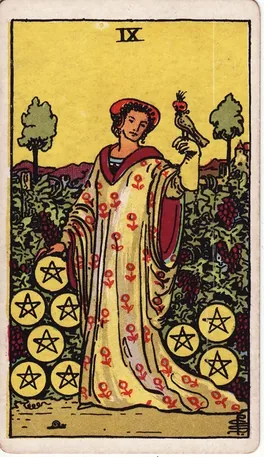
The Nine of Pentacles is the card of someone reaping what they have sown. A woman walks alone through a vineyard heavy with grapes, a hunting bird perched on her gloved hand, and around her gold coins hang from the vines as if they were fruit. In the background, on a hill, a house and a castle. There is nobody with her, and she needs nobody: everything around her was made or won by herself. It is the image of serene independence.
In a spread, the Nine of Pentacles speaks of independence, of deserved comfort and of the pleasure of enjoying what you have built. It is one of the most favourable cards of the suit, but it is not a card of celebration: it is a card of calm satisfaction, of someone who has worked hard and can now stop to look at their garden. Its risk is the other side of the same solitude — the comfort that isolates, or the independence that, in the end, still depends on someone.
The card at a glance
| Card | Nine |
|---|---|
| Suit | Pentacles |
| Element | Earth |
| Astrology | Venus in Virgo (Golden Dawn) |
| Keywords | independence, autonomy, deserved comfort, self-sufficiency, refinement, discipline, quiet pleasure |
| Reversed | dependence, neglected garden, appearances, overspending, isolation, empty comfort |
| Yes or no | Yes — especially when the result depends on you |
The image on the card
In the Sol da Alma Tarot, a young woman, in profile, stands in the middle of a vineyard at the end of summer. Her brown hair is gathered in a bun, with red roses and a small shining pin, and she wears a long, off-the-shoulder ivory dress printed with large pink, orange and blue flowers. On her right hand, protected by a white glove, perches a bird of prey with a pale breast and brown back, unhooded, turned towards her. The woman’s eyes are almost closed and she looks serene. From the vines that frame the scene hang bunches of purple grapes and, among them, gold coins with stars, suspended like fruit. In the background, between the rows of the vineyard and the golden grass, a hill leads up to a manor house with a red roof and, higher still, to a castle with pointed towers, under a blue sky with white clouds.
In the 1909 Rider-Waite-Smith, the scene is similar, and it was from it that the Sol da Alma painting set out: a woman in a long robe printed with red flowers stands in a garden of vines with bunches of grapes, a bird with a red hood perched on her gloved hand. The nine coins are stacked on the ground and among the plants, to her left and right, and a house can be seen in the background. At her feet, on the bottom edge of the card, there is a small snail. The Sol da Alma follows this iconography — the woman alone, the vineyard, the bird on the glove, the house in the distance —, but changes the details: the coins hang from the vines like fruit rather than lying on the ground; the bird has no hood; and in the background, besides the house, a castle appears. The snail is not there.
In the Marseille Tarot, the Neuf de Deniers has no scene: it is nine coins arranged among foliage ornaments. The woman, the vineyard and the bird are a creation of the Rider-Waite-Smith.
The symbolism, detail by detail
The card speaks of a wealth enjoyed calmly, and of a freedom that was hard won. Each detail adds a nuance.
- The woman alone
- Independence. She is not alone because she has been abandoned: she is alone because she needs no company to be well. It is the image of someone who is sufficient unto themselves.
- The bird of prey
- Wild nature tamed by discipline. A falcon is not caught and caged: it is trained, with years of patience. The bird perched on the hand speaks of self-mastery, of impulses that have learnt to obey.
- The white glove
- Refinement and protection. A glove is needed to hold a bird with sharp talons: elegance, here, is also a form of prudence.
- The coins on the vines
- In the Sol da Alma painting, money grows like fruit. It did not fall from the sky: it is a harvest, the result of work that took its time, like the work of a vineyard.
- The ripe grapes
- Abundance and the end of summer. The grape is a fruit that is only picked after a great deal of care, and that then still gives wine — a pleasure that asks for time.
- The flowered dress
- The joy of living, a taste for beautiful things. The woman is not dressed for work, but for enjoyment.
- The half-closed eyes
- Contentment. She is looking for nothing, watching over nothing: she is savouring the moment.
- The house and the castle in the background
- Security that has been built. There is a home to return to, and assets that protect her.
- The roses in her hair
- Affection and the pleasures of the senses. The Nine of Pentacles is not an austere card: it knows how to enjoy what it has.
- The number nine
- The extreme of the suit: Earth taken to its limit, in the form of complete comfort — and also of the risk of shutting oneself up in it.
The history of the Nine of Pentacles
In the first tarots of northern Italy, in the fifteenth century, and in the Marseille decks, which took their settled form between the seventeenth and eighteenth centuries, the Nine of Pentacles was a pip card: nine coins drawn, with no figure. It was used for the game of tarocchi and had no divinatory meaning of its own.
At the end of the nineteenth century, the Hermetic Order of the Golden Dawn gave each numbered card a title and an astrological attribution. The Nine of Pentacles was given Venus in Virgo and the title ‘Lord of Material Gain’ — gain that arrives not through luck, but through a kind of constant care.
In 1909, Arthur Edward Waite and Pamela Colman Smith gave it the scene that is recognised today: a woman with a bird on her wrist, amid a great abundance of vines, in the garden of a manor house. In the book that accompanied the deck, Waite gave as its meanings prudence, safety, success, accomplishment, certitude and discernment. The Sol da Alma Tarot follows this reading and this figure, and heightens the idea of harvest by making the coins grow on the vines.
The Nine of Pentacles upright: the meaning
Upright, the Nine of Pentacles is the card of independence won. It speaks of someone who has reached a point where they can live on what they have built, without having to ask anyone for anything. It is financial independence, but it is also emotional independence: the wellbeing of someone who is at ease with themselves and does not need others in order to feel whole.
It is also the card of deserved comfort and quiet pleasure. It says it is time to enjoy: a house, a garden, a journey, beautiful things, free time. There is no guilt in this pleasure, because it was earned. The card favours everything to do with taste, with quality of life, with looking after yourself.
What sets it apart from mere wealth is discipline. The bird perched on the glove is not there by chance: it was trained. The woman of the Nine of Pentacles got where she is because she knew how to wait, to save, to say no when it was needed. Her freedom is the fruit of long self-mastery.
The Nine of Pentacles reversed
Reversed, the Nine of Pentacles does not lose the garden: it stops tending it. Independence weakens and dependence returns — on a partner, on a family, on a job you cannot manage to leave. It can speak of a security that seems solid but that, in the end, rests on someone else’s resources, or of a freedom that costs more than was thought.
It can also speak of an excess of the same comfort: spending more than you have to keep up appearances, living for luxury, confusing wellbeing with what can be bought. Or of isolation — independence that has turned into loneliness, the beautiful garden nobody enters. The card asks you to go back to tending what is yours, with your own means, and to ask whether comfort is still serving life or has come to take its place.
The Nine of Pentacles in love
In love, the Nine of Pentacles is the card of someone who is happy on their own — and who, for that very reason, can choose freely. For someone who is single, it says there is no hurry: life is full, and whatever love comes will have to add something, not fill a void. It can also herald a meeting with someone independent and elegant, who knows what they want.
In a relationship, it speaks of two partners who respect each other’s independence, and of a comfortable, well-tended life together. Reversed, it can warn against emotional or financial dependence within the couple, against a relationship kept going only for the security it provides, or against an independence so jealously guarded that it no longer lets anyone in.
The Nine of Pentacles in work and money
At work, it is the card of the self-employed, of someone whose business is already bearing fruit, or of someone who has reached a position where they are independent in their decisions. It favours professions connected with taste and quality — fashion, interior design, gastronomy, winemaking, gardening, luxury goods. In a question about a project, it says it will bear fruit, but that it takes time, as with a vineyard.
With money, it is one of the best cards in the deck: financial stability, savings, an income that allows you to live well. Reversed, it warns against spending on appearances, against luxuries beyond your means, or against financial dependence on someone else.
The Nine of Pentacles in health and wellbeing
In questions about wellbeing, the Nine of Pentacles speaks of quality of life: good habits kept up with discipline, time outdoors, looking after yourself with pleasure and without guilt. Reversed, it points to the excesses of comfort and to isolation. The cards are no substitute for any kind of healthcare: the reading speaks of attitude and tendency, not diagnosis.
The Nine of Pentacles in spiritual life
On the inner path, the Nine of Pentacles is the peace of someone who knows themselves. It is the card of gratitude for what you have, of the pleasure of being with yourself in silence, of spirituality lived in everyday life — in the garden, in the kitchen, in the beauty of simple things. The tamed bird is also an image of a spirit that has learnt to settle: a mind that no longer darts from one side to the other and knows how to keep still.
The Nine of Pentacles as advice
As advice, the Nine of Pentacles says: enjoy what you have built. Do not wait for anyone’s approval to feel good, and do not be ashamed of liking good things. And it also says: guard your independence. Tend your garden with your own means — it is that freedom, more than the comfort, that is worth protecting.
The Nine of Pentacles in the positions of a spread
- In the past
- A phase of stability and independence, or an effort that bore fruit and still sustains the present.
- In the present
- A moment of comfort and independence; it is time to enjoy what you have built.
- In the future
- Independence on its way: the harvest of patient work, a freer and more comfortable life.
- As an obstacle
- Dependence that is not admitted, spending on appearances, or an independence that has closed in on itself as loneliness.
- As the outcome
- The matter is resolved with independence and security: a result you can enjoy on your own terms.
Numerology and correspondences
Nine is the extreme of the suit: its quality taken to the limit, for better and for worse. In Pentacles, the suit of Earth, this gives the image of material life in its fullness — the house, the garden, the harvest, enough money to live well. It is the high point of comfort before the Ten, in which wealth stops belonging to one person and comes to belong to a family. And it is also its limit: complete comfort can close in on itself.
In the Golden Dawn tradition, the card corresponds to Venus in Virgo. Venus is the planet of pleasure, beauty and harmony; Virgo, the Earth sign of method, care and detail. Together they describe the woman of the card well: a pleasure cultivated with discipline, a beauty that results from a great deal of care. Hence the title the order gave it, ‘Lord of Material Gain’.
Combinations with other cards
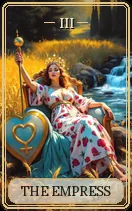 The Empress — Abundance and fertility in every sense; a prosperous, well-kept home.
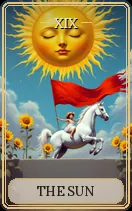 The Sun — A phase of great wellbeing and joy; personal success that is recognised.
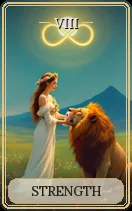 Strength — Self-mastery: the independence born of knowing how to govern your own impulses.
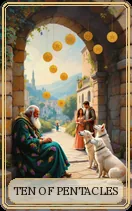 Ten of Pentacles — From personal wealth to family wealth; what has been built comes to be shared.
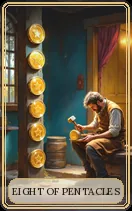 Eight of Pentacles — Patient work that bears fruit; skill that brings independence.
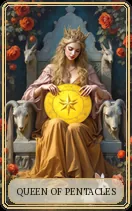 Queen of Pentacles — An independent and generous woman; sound management of home and money.
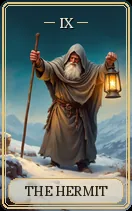 The Hermit — Chosen, serene solitude; independence that turns inwards.
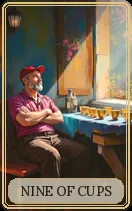 Nine of Cups — Complete satisfaction, a wish fulfilled; material and emotional comfort.
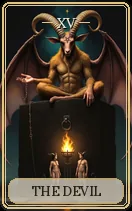 The Devil — Material dependence; comfort that has become a prison.
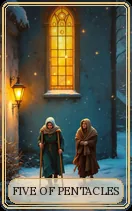 Five of Pentacles — Loss of independence, difficulties that force you to ask for help; or the fear of losing what you have.
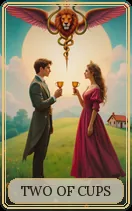 Two of Cups — A relationship between two independent people who choose each other freely.
Frequently asked questions
What does the Nine of Pentacles mean in tarot?
Independence won and comfort deserved: the fruit of your own garden, enjoyed without depending on anyone.
What does the Nine of Pentacles mean in love?
A person who is happy on their own and chooses freely, or a relationship between two independent partners. Reversed, it warns against emotional or financial dependence.
Is the Nine of Pentacles a yes or a no?
It is a clear yes, especially when the result depends on the effort and the means of the person asking.
Is the Nine of Pentacles reversed bad?
No. It is the same garden neglected: dependence returning, spending on appearances or comfort that isolates. It asks you to go back to tending what is yours.
What does the bird mean in the Nine of Pentacles?
The bird of prey perched on the glove is the image of discipline and self-mastery: wild nature that has learnt to obey. That is why the independence of the card is won, not inherited.
No sign-up · Reading written on the spot · Free