
Seven of Pentacles: meaning and symbolism of the tarot card
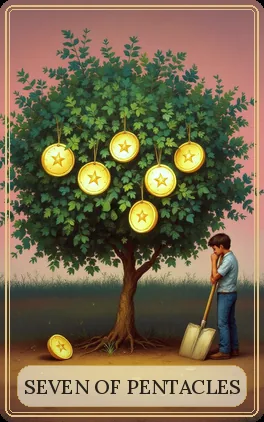
The Seven of Pentacles is the card of the farmer’s pause. A young man leans on his spade, hand on chin, beside a tree from which gold coins hang. He has worked, planted, tended — and now he stops and looks. He does not yet know how much the tree will yield, or when. It is a moment everybody knows: the moment when the effort has already been made and the result cannot yet be seen.
In a spread, the Seven of Pentacles speaks of patience and assessment. It says that things are growing, but at the pace of the earth, which is never hurried. It asks you to take stock of what has been invested — time, money, energy — and to decide calmly whether it is worth carrying on, moving to new ground, or simply waiting.
The card at a glance
| Card | Seven |
|---|---|
| Suit | Pentacles |
| Element | Earth |
| Astrology | Saturn in Taurus (Golden Dawn) |
| Keywords | patience, waiting, assessment, long-term investment, perseverance, slow growth, taking stock |
| Reversed | meagre harvest, effort poorly applied, impatience, frustration, giving up too soon |
| Yes or no | ‘Not yet’: yes, but in time — the fruit is not yet ripe |
The image on the card
In the Sol da Alma Tarot, a tree with a rounded crown and dense green foliage fills almost the whole card. From its branches hang, on threads, six gold coins, each with a golden star at its centre, like fruit. The seventh coin has fallen to the ground, on the left, by the roots, half tilted in the soil. On the right, a young man with brown hair, in a light-blue short-sleeved shirt, jeans and brown shoes, leans on the handle of a spade driven into the ground. His hand is on his chin and his head is tilted, thoughtful, eyes lowered. The sky is a soft pink, the pink of late afternoon; behind the tree there is a line of tall, dark grass, and the ground is brown earth.
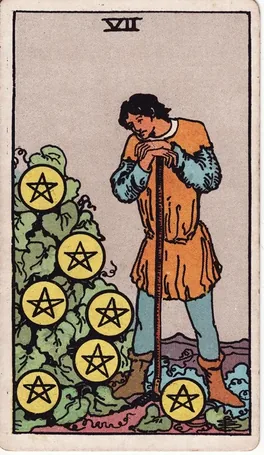
In the 1909 Rider-Waite-Smith, the idea is the same, and it was from it that the Sol da Alma painting set out: a young farmer, leaning on the handle of a hoe, looks at a green bush on which six pentacles hang, while the seventh lies on the ground at his feet. The Sol da Alma changes a few details with purpose: the low bush becomes a tall tree, and the coins hang from the branches like ripe fruit; the grown man of the 1909 deck is here a young man in present-day clothes; the hoe gives way to a spade; and the seventh coin moves from his feet to the roots of the tree. The young man of the Rider-Waite-Smith looks at the coins; the one in the Sol da Alma seems to be looking more into himself than at the tree.
In the Marseille Tarot there is no figure and no tree: the Seven of Pentacles shows seven coins arranged among stylised foliage. The theme of the farmer waiting for the harvest is a reading that the Rider-Waite-Smith made visible.
The symbolism, detail by detail
Everything in this card speaks of the time between planting and harvesting. The tree grows, the coins ripen, and the young man learns to wait.
- The tree
- Work that grows by itself once it has been planted. A tree is never in a hurry: it takes years to bear fruit. It is the image of long-term investment, of what cannot be settled overnight.
- The coins as fruit
- In the Sol da Alma painting, the coins hang from the branches like fruit: the result of the effort is visible, it is there, but it has not yet been picked. It may be ripe, or it may need more time.
- The coin fallen by the roots
- What has already been harvested, or what fell before its time. It may be the first fruit, proof that the work is paying off; it may also be a small loss, a reminder that not everything gets to ripen.
- The spade
- The work done and the work still to do. He does not put it down: he leans on it. The rest of the Seven is a pause, not an abandonment.
- The hand on the chin
- Reflection, taking stock, doubt. The young man wonders whether the effort was worth it, what to do next, whether he should wait or change course.
- The lowered gaze
- Particular to the Sol da Alma painting: he does not stare at the coins, as in the 1909 deck; he seems to be looking at the ground or into himself. The assessment of the Seven is also an assessment of oneself.
- The young man
- In the Sol da Alma, the figure is young: it is work that is still at its beginning, or a lesson in patience learnt early. His present-day clothes say that this waiting belongs to every age.
- The pink sky
- The end of the day, the time to stop and look at what has been done. It is neither night nor morning: it is the interval between work and result.
- The bare earth
- The worked ground, free of weeds, ready. The harvest now depends on things that cannot be controlled — the weather, the season, nature.
The history of the Seven of Pentacles
Tarot was born in northern Italy in the fifteenth century as a card game, and its four suits — cups, swords, batons and coins — are the same as those of the Latin-suited cards still played in Portugal and Spain today. In the earliest decks and in the Marseille decks, which took their settled form in the seventeenth and eighteenth centuries, the numbered cards had no scene: the Seven of Pentacles was an arrangement of seven coins among foliage.
At the end of the nineteenth century, the Hermetic Order of the Golden Dawn assigned each numbered card a planet in a sign and a title. The Seven of Pentacles was given Saturn in Taurus and the title ‘Lord of Success Unfulfilled’. It is a stern title: it speaks of a success that was in sight and does not come about, or is slow in coming. Saturn is the planet of time and limits, and it is Saturn that gives the card its tone of waiting.
It was the Rider-Waite-Smith, drawn by Pamela Colman Smith under the direction of Arthur Edward Waite and published in 1909, that gave a scene to all the Minor cards. Waite describes a young man leaning on his staff and looking intently at seven pentacles attached to a clump of greenery, and remarks that one would say these were his treasures and that his heart was there. The meanings he gives it vary a great deal — money, business and barter, but also, according to other readings, quarrels —, a sign that the card never had a single tradition. It was the image of the thoughtful farmer that fixed the modern reading of the card as patience and assessment, and it is that image the Sol da Alma follows, with its own painting.
The Seven of Pentacles upright: the meaning
Upright, the Seven of Pentacles is the card of patience. The work is done, or nearly; now things have to be given time. It speaks of projects that are growing but have not yet delivered what they promise, of investments that only pay off in the long term, of studies whose fruits will be seen a few years from now. It says: do not pull up the plant to see whether it is growing.
It is also the card of assessment. The young man stops and looks, and that matters: it is the moment to take stock, to see what is working and what is not, to decide where to put your effort from now on. It can indicate a choice — to keep tending this tree or to plant another —, made calmly and on the basis of what can be seen.
There is a quiet satisfaction in the card: the fruit is there, visible. But there is also a touch of unease, because the harvest is not yet guaranteed. The Seven of Pentacles asks for perseverance without anxiety: to keep doing what needs to be done and to trust in the rhythm of things.
The Seven of Pentacles reversed
Reversed, the Seven of Pentacles does not turn into its opposite: it is the same wait, but turned sour. Impatience takes over — you want to harvest before the time is right, you give up when the fruit was almost ripe, you pull up the tree to plant another, and then another, never letting any of them grow. Or else the harvest is meagre: the effort was put in the wrong place, and the result falls short of what was invested.
It can also indicate excess on the other side: waiting too long for something that is no longer going to bear fruit, going on watering a dead tree out of stubbornness or fear of admitting a mistake. Frustration is the typical feeling of the reversed Seven. The advice is to look honestly at the ground and decide: either have more patience, or move to another field.
The Seven of Pentacles in love
In love, the Seven of Pentacles speaks of a relationship that is built slowly and calls for patience. It can describe a couple who have invested a great deal and are now taking stock: are we growing together? Is it worth carrying on? It is a card of reflection on the future as a couple, without haste or drama. For someone who is single, it indicates that love will not arrive overnight — it needs to be cultivated, by meeting people and letting things ripen.
It can also speak of a relationship that has not yet delivered what it promised, or of someone waiting for the other person to make up their mind. Reversed, it warns against impatience that spoils what was just beginning, or against waiting for a person who is not going to change.
The Seven of Pentacles in work and money
At work, the Seven of Pentacles indicates a project in progress that has not yet produced the expected results, but is on the right track. It is the card of mid-course reviews, of progress reports, of decisions about whether to carry on or change strategy. It favours long-term work: farming, building, research, training, businesses that grow slowly.
With money, it is the card of long-term investment: savings that grow little by little, investments that need time, a business that is not yet making a profit but has a future. It calls for patience and regular review. Reversed, it warns against withdrawing money too soon, against investments that do not pay off, or against continuing to put money into a project that has already proved it does not work.
The Seven of Pentacles in health and wellbeing
In questions about wellbeing, the Seven of Pentacles speaks of results that take time: habits that only show their effect after weeks, a gradual recovery, the importance of consistency. It is a reminder that giving up early is the greatest enemy of any change. The cards are no substitute for any kind of healthcare: here, as with any other card, the reading speaks of attitude, not diagnosis.
The Seven of Pentacles in spiritual life
On the inner path, the Seven of Pentacles is the card of patient practice. Spiritual growth, like a tree, cannot be seen from one day to the next, and there is no point in forcing it. It asks us to keep cultivating — meditation, prayer, study — without demanding immediate results, and to stop now and then to look, with gratitude, at what has already grown.
The Seven of Pentacles as advice
As advice, the Seven of Pentacles says: be patient and take stock. Do not give up now, but do not wait blindly either. Look at what you have invested and at what it has already yielded, correct whatever needs correcting and give the rest time. Fruit picked green is no good; fruit left to ripen is worth the wait.
The Seven of Pentacles in the positions of a spread
- In the past
- An effort or an investment made some time ago, whose fruits are only now beginning to appear.
- In the present
- A moment of pause and assessment. The work is done; what remains is to decide what to do next, or simply to wait.
- In the future
- A phase of waiting on its way: the results will come, but more slowly than you would like.
- As an obstacle
- Impatience, discouragement, or effort put in the wrong place.
- As the outcome
- The fruit ripens, if there is patience. The matter is resolved, but in the long term.
Numerology and correspondences
Seven is what is done alone: with no more support or rules, at the risk and on the account of whoever does it. In the suit of Pentacles — the suit of Earth, of the body, of money, of craft and of the slow time of things that are built —, that solitude is the farmer’s, standing before his field. Nobody can hurry the tree for him, and nobody can guarantee him the harvest. After the exchange of the Six, the Seven is the moment to look at what is yours and decide, alone, whether to carry on.
In the Golden Dawn tradition, the Seven of Pentacles corresponds to Saturn in Taurus and bears the title ‘Lord of Success Unfulfilled’. Saturn is the planet of time, patience and limits; Taurus, an Earth sign, is the sign of fertility, comfort and slowness. The meeting of the two gives the card its tone: growth that is real but slow, which calls for discipline and tests the ability to wait.
Combinations with other cards
 The Hermit — A long, reflective pause; assessing the road travelled, alone, before deciding.
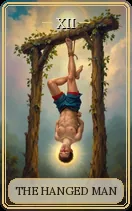 The Hanged Man — A wait that forces you to see things differently; the project on hold.
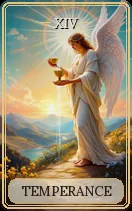 Temperance — Patience and measure: the right pace for the work to bear fruit.
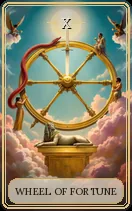 Wheel of Fortune — Harvest time arrives: the waiting ends and the cycle turns in your favour.
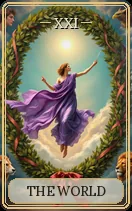 The World — A long piece of work that finally comes to an end, with the result in sight.
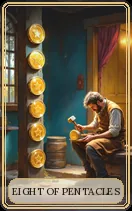 Eight of Pentacles — Carrying on working with dedication while you wait; the craft that matures.
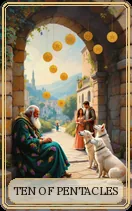 Ten of Pentacles — An investment that becomes lasting wealth; the fruit of years of effort.
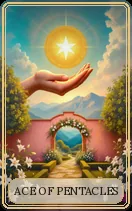 Ace of Pentacles — Planting again: a new seed beside the tree that is still growing.
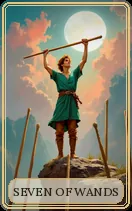 Seven of Wands — Defending what you have planted; persisting in spite of difficulties.
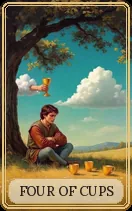 Four of Cups — Discouragement and indifference: no longer seeing the value of what you have built.
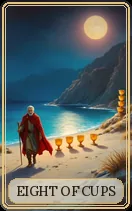 Eight of Cups — Walking away from a project that did not deliver what was hoped, to look for another meaning.
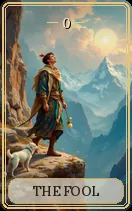 The Fool — The impatience that wants to leave before the harvest; the risk of dropping everything too soon.
Frequently asked questions
What does the Seven of Pentacles mean in tarot?
Patience and assessment: the work is done and you have to wait for it to bear fruit. It is the card of long-term investment and of taking stock halfway along the road.
Is the Seven of Pentacles a yes or a no?
It is a ‘not yet’, or a yes that takes time. The result may come, but it is not yet ripe; the card asks for patience.
What does the Seven of Pentacles mean in love?
A relationship that is built slowly, or a moment of taking stock as a couple. It asks for patience and for reflection on whether what has been invested is bearing fruit.
Is the Seven of Pentacles reversed bad?
It is not a bad card, but it warns against impatience, frustration and effort poorly applied. It asks you to decide honestly whether it is worth waiting longer or moving to new ground.
How much time does the Seven of Pentacles indicate?
It is a card of long stretches of time. It does not speak of days, but of weeks or months — the time a plant takes to grow. It says the result will come, but not just yet.
No sign-up · Reading written on the spot · Free