
Page of Pentacles: meaning and symbolism of the tarot card
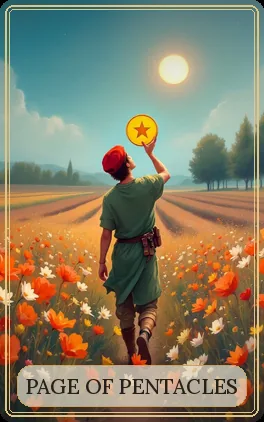
The Page of Pentacles is the figure of the apprentice. A lad in a red beret walks through a sown field, among flowers, and raises a gold coin against the sun, as if he wanted to see it properly in the light. He is in no hurry: he goes slowly, attentive to what he holds in his hand. Everything about him speaks of beginning and of promise — but of a promise that is only kept through work.
In a spread, the Page of Pentacles speaks of study, of learning and of concrete opportunities: a course, a first job, a business proposal, an idea that could make money. It may represent a person — someone young, diligent, reliable — or an attitude the situation calls for. Of the four court cards of the suit, it is the humblest and the most patient: it does not have anything yet, but it knows it holds a seed in its hands.
The card at a glance
| Card | Page |
|---|---|
| Suit | Pentacles |
| Element | Earth |
| Astrology | Varies between schools |
| Keywords | study, application, apprentice, concrete proposal, opportunity, diligence, first steps |
| Reversed | interrupted study, distraction, laziness, procrastination, plans that never leave the drawing board, practical immaturity |
| Yes or no | Yes, with application — the opportunity is real, but it calls for work |
The image on the card
In the Sol da Alma Tarot, the Page is seen from behind. He is a young man with brown hair, wearing a red beret, a long green tunic, brown breeches and leather boots; at his waist, a wide belt with small leather pouches. He walks along a path through a field of flowers — orange and red poppies, white flowers, small yellow flowers — with his right arm raised, holding a gold coin with a red star up high. His head is tilted back, looking at it. Further ahead stretch fields ploughed into long furrows, brown and pinkish, reaching to the horizon; on the right, a group of leafy trees, and on the left a dark wood with a cypress and bluish hills. In the sky, a greenish blue, a large, pale sun shines, and the coin looks almost like another sun, smaller and closer.
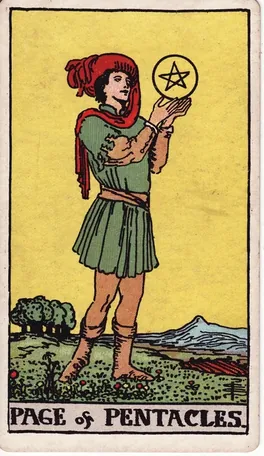
In the 1909 Rider-Waite-Smith, the Page — the Page of Pentacles — faces forward, standing in a flowering meadow, and holds the coin in both hands at eye level, staring at it intently. He wears a red hat with a long band falling over his shoulder, a green tunic and boots. Behind him are trees, a ploughed field and a mountain in the distance, under a yellow sky. The Sol da Alma essentially follows this iconography — the young man alone in the field, the raised coin, the red on his head and the green of the tunic, the ploughed earth —, but changes the point of view: the Page is seen from behind and walking, and holds the coin in one hand only, high, against the sun. Where the Rider-Waite-Smith shows a young man standing still to study what he has, the Sol da Alma shows him moving forward into the field, with the coin ahead of him, like someone following what he has learnt.
In the Marseille Tarot, the Valet de Deniers is a standing, full-length figure with the coin, with no landscape of fields. The scene of the sown field is a contribution of the Rider-Waite-Smith.
The symbolism, detail by detail
The card speaks of a promise taken seriously. Each detail adds a nuance.
- The raised coin
- The opportunity, the idea, the talent that is still only potential. The Page looks at it closely: he knows he holds something of value in his hands, and he wants to understand what it is.
- The gaze fixed on the coin
- Application, the student’s concentration. The Page of Pentacles does not get distracted: all that exists, at that moment, is what he is learning.
- The slow walk
- Patience. The Page of Pentacles does not run, like the Page of Wands; he moves forward step by step, at the pace of the earth.
- Seen from behind
- In the Sol da Alma painting, the Page goes ahead of us, into the landscape. It is the image of someone setting out on a new path — a profession, a course of study, a life — who does not yet quite know where it will lead.
- The ploughed field
- The work that was done before him, and the work still to be done. The earth is prepared; what remains is to sow and to wait.
- The flowers
- Youth, fertility, first promises. The earth of Pentacles is not only work: it also gives beauty.
- The sun
- The light that lets you see clearly. The coin raised against the sun is the wish to understand thoroughly what you hold in your hands.
- The red beret
- Enthusiasm, the energy of someone who is beginning. It is the only touch of fire in a figure of earth.
- The belt with pouches
- Practical sense. The Page is well equipped: he carries with him what he needs for the road.
The history of the Page of Pentacles
The tarots born in northern Italy in the fifteenth century have four court figures in each suit: the page, the knight, the queen and the king. The page — in Italian fante, the servant or foot soldier — was the lowest figure, a young man in the service of the court. In the Marseille decks, which took their settled form between the seventeenth and eighteenth centuries, he is called the Valet de Deniers.
In 1909, Arthur Edward Waite and Pamela Colman Smith made him the Page of Pentacles and gave him the field, the trees and the ploughed earth. In the book that accompanied the deck, Waite described him as a youthful figure looking intently at the pentacle hovering over his raised hands, who moves slowly, unaware of what is around him; and he gave as his meanings application, study, scholarship and reflection. That is where the reading of the Page of Pentacles as the student and the apprentice comes from.
In the Golden Dawn, the court figures changed names and the Page came to be called the Princess; the elemental and astrological attributions of the court cards vary from school to school, and none can be given as certain. What the traditions share is the essential point: the Page is the apprentice and the messenger, the young age of the suit. That is the reading of the Sol da Alma.
The Page of Pentacles upright: the meaning
Upright, the Page of Pentacles is the card of diligent study. It speaks of someone who is learning — at school, at university, on a course, in a new job — and who takes that learning seriously. It is the figure of the good pupil, the dedicated trainee, the beginner who listens, observes and does not give up. It favours exams, training, technical courses, everything that is learnt with method.
It is also the card of concrete opportunities. It can herald a job offer, a business idea, a small investment, news connected with money. But the Page of Pentacles does not bring anything ready-made: it brings a seed. The opportunity is real, and it is good, but it only bears fruit if it is worked on with patience.
What sets it apart from the other Pages is its feet on the ground. The Page of Wands gets excited, the Page of Cups dreams, the Page of Swords keeps watch; the Page of Pentacles studies. He is the slowest of the four, and the most reliable. What he starts, he usually finishes.
The Page of Pentacles reversed
Reversed, the Page of Pentacles does not lose the will to learn: he loses consistency. Study is interrupted, the course is left halfway, the proposal never gets worked on. It can speak of distraction — the attention that should be on the coin gets lost in a thousand things —, of laziness, of putting things off, or of someone who has good ideas and never puts them into practice.
It can also speak of an excess of the same application: the student who only studies and does not live, the person so caught up in detail that they do not move forward, the fear of putting into practice what has been learnt. Or of a practical immaturity — no sense of money, the spending of someone who does not yet know what it costs to earn it. The card asks you to look at the coin again: the opportunity is still there, waiting for someone to see it through.
The Page of Pentacles in love
In love, the Page of Pentacles is a card of slow, serious beginnings. It does not bring sudden passions: it brings a relationship built slowly, with attention and loyalty. It can herald someone reliable, practical, perhaps a little shy, who shows what they feel through concrete gestures more than words. For a couple, it speaks of shared plans and of a relationship that matures step by step.
Reversed, it can warn against a lack of initiative, against someone who keeps putting off commitment, or against a relationship in which one of the two is more focused on work or study than on the other.
The Page of Pentacles in work and money
At work, the Page of Pentacles favours first jobs, internships, training, changes of field in which everything has to be learnt anew. It heralds concrete proposals and opportunities for growth, especially for anyone willing to start at the bottom. In a question about a project, it says the idea is good and worth studying carefully before going ahead.
With money, it speaks of small beginnings: first savings, a first salary, a modest investment, learning to manage money. It is not a card of wealth, but of solid foundations. Reversed, it warns against thoughtless spending, a lack of planning or opportunities wasted through carelessness.
The Page of Pentacles in health and wellbeing
In questions about wellbeing, the Page of Pentacles speaks of starting new habits with patience — a new exercise routine, a more careful diet, learning to listen to the body. Reversed, it points to a lack of consistency in good intentions. The cards are no substitute for any kind of healthcare: the reading speaks of attitude and tendency, not diagnosis.
The Page of Pentacles in spiritual life
On the inner path, the Page of Pentacles is the diligent beginner. It is the card of someone who takes up a practice with humility — a study, a discipline, a tradition — and follows it consistently, without expecting immediate results. It is a reminder that spirituality is also learnt, and that it is learnt slowly, the way one learns to plough a field. And it is a reminder that the sacred can be found in the simplest things: in a coin, in a flower, in the earth.
The Page of Pentacles as a person
When it represents someone, the Page of Pentacles is traditionally a young person — a student, an apprentice, a son or a daughter — or someone of any age who is starting something. It is a diligent, patient, loyal person, practical and down-to-earth. They like to learn by doing, prefer the concrete to the abstract, and keep their promises. Their faults are slowness, shyness or a certain stubbornness about doing everything step by step, even when things need to move faster.
The Page of Pentacles as advice
As advice, the Page of Pentacles says: study. Learn what you need to learn, find out all you can, prepare before moving forward. Take the opportunity seriously. And it also says: start at the bottom, without shame. Every great work began with an apprentice looking at a coin.
The Page of Pentacles in the positions of a spread
- In the past
- A period of study or learning, or an opportunity that was the starting point of the present situation.
- In the present
- It is time to learn, to study, to prepare; or there is a concrete proposal on the table.
- In the future
- An opportunity on its way — a course, a job, news connected with money or work.
- As an obstacle
- Distraction, procrastination, or a lack of preparation.
- As the outcome
- A solid beginning: the matter is not resolved straight away, but the foundations are laid for something that will grow.
The Page and the suit of Pentacles
The Page is the one who learns and the one who announces: the young age of the suit, full of eagerness and still without a craft mastered. In Pentacles — the suit of Earth, of the body, of money and of the slow time of things that are built —, this gives the figure of the apprentice in the most literal sense. The Ace was the coin offered; the Page is the first to pick it up, look at it and wonder what he can do with it.
The court cards have no fixed astrological attribution in tarot: each school gives its own, and they do not agree. The safest reading is that of the hierarchy within the suit. The Page is the apprentice’s rung, before the movement of the Knight, the maturity of the Queen and the rule of the King. And in Pentacles that rung is the foundation of all the others: without the apprentice who studies, there would be no master who governs.
Combinations with other cards
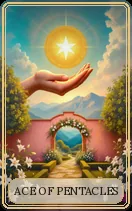 Ace of Pentacles — A concrete and very promising opportunity; a seed worth working on.
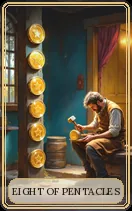 Eight of Pentacles — Learning a craft; study that turns into skill.
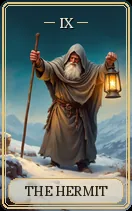 The Hermit — In-depth study, research, an apprentice looking for a master.
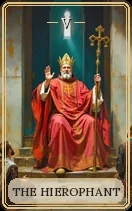 The Hierophant — Formal education, school, university; learning within a tradition.
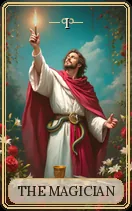 The Magician — Talent beginning to take shape; ability applied to a concrete project.
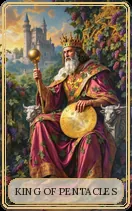 King of Pentacles — An apprentice and a master; advice from someone experienced in money or business.
 Three of Wands — An opportunity from far away; study or work abroad.
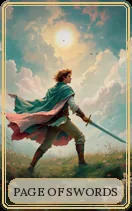 Page of Swords — Study with a critical mind; learning to analyse before acting.
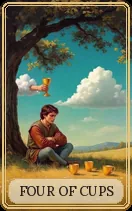 Four of Cups — An opportunity wasted through lack of interest or distraction.
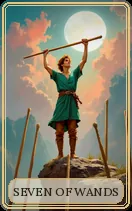 Seven of Wands — Study under pressure, exams, tests to be defended.
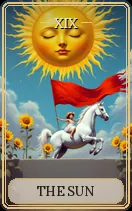 The Sun — Success in studies; learning that goes very well.
Frequently asked questions
What does the Page of Pentacles mean in tarot?
The faithful apprentice: study, application and concrete opportunities that call for work before they bear fruit.
What does the Page of Pentacles mean in love?
A relationship that begins slowly and seriously, or a reliable, practical person who shows what they feel through gestures. Reversed, it warns against a lack of initiative or putting things off.
Is the Page of Pentacles a yes or a no?
It is a yes, but with application: the opportunity is real, and it depends on the work put into it.
Is the Page of Pentacles reversed bad?
No. It is the same study interrupted: distraction, procrastination, projects left halfway. It asks you to take up again, with consistency, what you started.
Does the Page of Pentacles represent a person?
It can: traditionally, someone young, a student or an apprentice, diligent and down-to-earth. But it can also simply be news or an opportunity connected with work and money.
Does the Page of Pentacles speak of studies?
Yes, it is the study card par excellence. It favours exams, courses and training, especially when there is discipline and method.
No sign-up · Reading written on the spot · Free